• Podcast 002 | Week of 30.06.2012
Download entire podcast (320 kbps mp3).

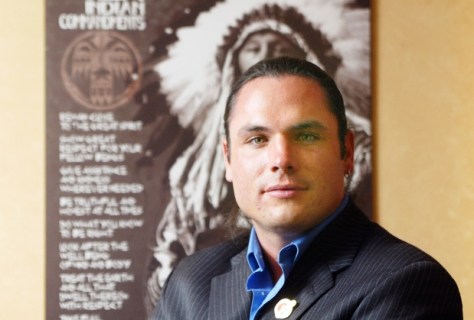
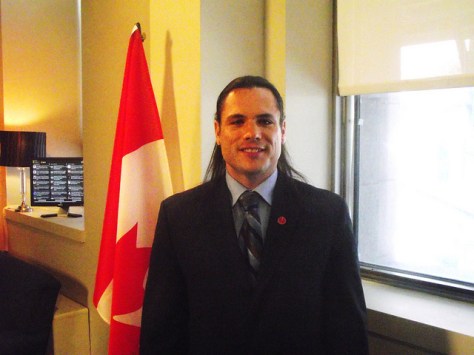
SENATOR PATRICK BRAZEAU was again in the news this week and, as is so often the case, for ignoble reasons. After a report emerged revealing that he holds the title for most-missed days of Senate business, Brazeau took to Twitter and called the reporter who had written the story, Jennifer Ditchburn, a bitch.
His outburst (for which he eventually apologized, while trying to explain that he had personal circumstances that prevented him from being present in the Senate) will likely re-open the never-quite-closed debate over the Senate and its legitimacy as a patronage plum. Brazeau’s career is a good illustration of the Biblical maxim “The race is not to the swift,” and his habitual partisan rowdiness on the Internet does make one wonder if the upper chamber retains any hope of the dignity which is — at least in principle — its chief recommendation.
With little more than a pretty face and a modelling CV, the university drop-out Patrick Brazeau threw himself into aboriginal politics, joining the Congress of Aboriginal Peoples, or “CAP,” just in time to inherit the position of President from the retiring Dwight Dorey. Brazeau well understood the art of political maneuvering. The Assembly of First Nations, under then National Chief Phil Fontaine, had by the mid-2000s cultivated a close working relationship with the federal Liberals. Paul Martin and Phil Fontaine, for example, were on especially good terms.
Brazeau shrewdly manipulated his niche of opportunity — the plentiful non-status, off-reserve aboriginals situated beyond the AFN’s mandate — and aggressively courted the federal Conservative Party of Canada. It was a shrewd move. Stephen Harper needed some aboriginal allies, and Brazeau needed funding and a political ally in Ottawa. Within three years, “National Chief” Brazeau (a title whose adoption turned the rival AFN leadership a lovely hue of purple) had the prospect of collecting a generous CAP salary concurrent with a Senate income.
Having absorbed the disappointing news that it was one or the other, Brazeau dispossessed himself of the weighty charge of national leadership and focused on moving on up to the East Block. Those of us who were around and paying attention will recall him cruising the nation’s capital in his Porsche SUV (purchased used, he pointed out) as local media reported some questionable CAP expenses, allegations of sexual harassment and, later, tardy child-support payments.
Brazeau has long been unpopular in Indian Country, where news of the sort summarized above travels swiftly. A more cautious fellow, having found himself in Brazeau’s blessed situation, would keep his head down, lest he risk his extraordinary good fortune. The Senator, however, never misses an opportunity to stir it up.
When his actions bring disrepute to an entire institution, as in this instance they have, a line is crossed. Patrick Brazeau owes an apology to his colleagues. He might also consider spending less time on Twitter (or, better yet, no time) and more on matters of substance. The Senate ought to be a place for grown-ups, and for debate, deliberation, and broad vision. Leave the antics to others, Mr. Brazeau.
• Podcast 001 | Week of 23.06.2012
Media Round-up / Retrospective of Paul Fussell (1924-2012) / Ethical Oil / Over- and Under-reported media stories / This week’s game: Portmanteau Titles (examples: “Erin Go Brockovich” “To Kill Two Mockingbirds with One Stone”) — submit your entries.
Download entire podcast (320 kbps mp3).
The case of Omar Ahmed Khadr has long divided Canadians into two respective camps, Bring Him Home and Let Him Rot Over There. The federal government of Canada now appears to constitute a third, having for years shilly-shallied and otherwise kept the matter in limbo.
The Let Him Rot camp might do well to review the following facts. Born in Toronto, on 19 September 1986, Khadr was eight years old (give or take a couple years) when he perhaps met the falsely accused Maher Arar. He was ten when he met Osama bin Laden in Jalalabad. After September 11, these childhood encounters constituted a state asset and a potential weapon against al-Qaeda, and as a consequence Khadr was detained, tortured, and likely permanently damaged.
There are — as always in battle — contradictions, ambiguities, and gaps in the record. On July 27, 2002 Sergeant Layne Morris lost an eye and Sergeant Christopher Speer his life in Khost, Afghanistan. The lawsuit filed on behalf of these individuals, by Morris himself and by Speer’s widow, was against the estate of Omar’s father, Ahmed Said Khadr. Some distance was to be traversed to leverage “an act of terrorism,” as the formal charge put it, against a court-enforceable civil liability. To further this case, the plaintiffs argued that Khadr senior was ultimately responsible both for the loss of an eye and the loss of life, and that his estate should pay.
This case, whatever its merits, was in my judgement aiming in the right direction. Khadr senior’s movements, from Peshawar to Logar to Jalalabad, are winks and nods to the knowing. One does not accidentally end up in Bab al-Jihad (Jihad’s Gate), as Logar is known. Nor would Ahmed Khadr be observed by intelligence agencies with Ayman al-Zawahiri, Abu Laith al-Libi, and the bin Ladens as a matter of mere coincidence. In the case of Abu Laith al-Libi, it seems clear the young Khadr was being exploited and perhaps groomed by his elder on account of his ability to speak, among other languages, Pashto. (This detail serves to remind us that international jihadism was imported into Afghanistan by outsiders – in the case of al-Libi, a foreigner of Libyan origin.) Omar Khadr is a bright individual, and even at fifteen he had some experience of the world and would have presented himself as ripe for the taking.
One crisp January morning, on the way to a Parliamentary breakfast with members of the federal Senate, a former CBC journalist wryly told me that 80% of that august body was useless, but that the other 20% made up for it. Among the redeeming contingent is surely Senator Romeo Dallaire, who considers Omar Khadr a former child soldier, and who on this foundation rests his call for the Guantanamo Bay prisoner’s release.
Khadr, the son, may well have gone down the dead-end Jihadist road upon which Abu Laith al-Libi found his martyrdom, but at no time during the events under consideration does he appear to have been an instigator. He was a child who had the all-encompassing misfortune of being born to rotten and hateful parents, and for that proxy offence he has paid enormously — in a decade’s detention and in the currencies of interrogation, abuse and humiliation (both, please note, by American and Canadian officials). The trial which gave rise to his plea agreement was a piece of calculated cynicism designed to rehabilitate the Guantanamo name brand, by applying charges like “murder in violation of the law of war” which could be defined and re-defined as required — as indeed they were. Among those arguing the wrongness of Khadr’s treatment have been the United Nations and the Supreme Court of Canada. Last month, my own publisher McGill-Queen’s University Press released the critical anthology “Omar Khadr, Oh Canada” featuring contributions by Dallaire, Maher Arar, Craig Kielburger, and many others.
The disagreement over Khadr’s place, or lack of place, in Canada will go on, but the moral battle is in my view already lost. The Khadr detention and especially the dirty work of Guantanamo which followed was a disgrace and a crime. Now there appears a new challenge and a new opportunity, to reintegrate and restore a Canadian citizen so badly abused, by so many, and for so long.
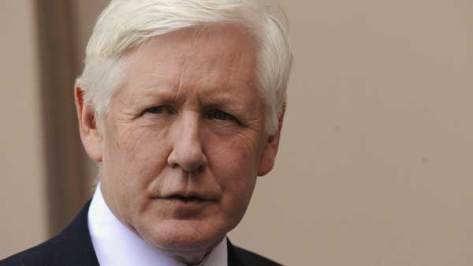
FEDERAL LIBERAL LEADER Bob Rae’s citation of William Shakespeare was an indirect invocation also of a commonplace political euphemism — the putting aside of personal ambition “to spend more time with the family.” Announcing his decision yesterday not to run for permanent leadership, he produced the closing lines of Sonnet 25:

IN RECENT MONTHS, there has been debate over the federal government’s decision to spend a yet-undisclosed sum commemorating the War of 1812. The Americans will doubtless overlook this bit of their history, but I’m unable to imagine any Canadian government ignoring the two-hundred-year anniversary of a conflict that could have converted Upper and Lower Canada into two of the coldest states of the Union.
According to the official government website announcing the initiative, “Canadians gave [the Harper Government] a strong mandate to celebrate important historical events”: in this instance a war which — again, from the Government’s website —
… helped establish Canada’s path toward becoming an independent and free country, united under the Crown, with respect for linguistic and ethnic diversity. Simply put, the War of 1812 helped define who we are today, what side of the border we live on, and which flag we honour. Against great odds, it took the combined efforts of Canadians of all ancestries to repel the American invasion and defend Canada in a time of crisis.
A grand feel-good take on the conflict, and who could disagree? Jeffrey Simpson, for one, who on October 7, 2011 characterized the war as horrible and stupid, and “among the dumbest ever fought.” Whether agreeing with this assessment or agreeing not, one should probably award points for the spot-on retort of Dorchester Review editor, C.P. Champion:
Jeffrey Simpson, a columnist at The Globe & Mail, thinks Canada should not celebrate the upcoming 200th anniversary of the War of 1812 because the conflict was “stupid” and “dumb,” with “bad leadership” and “messy battles.” If that is the standard, we had better forget celebrating much of our history. Get out your calendar and scratch off Remembrance Day, November 11. That date commemorates the allied victory in 1918 that marked the end of the First World War — a conflict that presumably fits Simpson’s definition of a stupid and messy war.
A good point. All wars are indeed irrational and vicious and stupid, even when necessary, their accomplishments invariably measured in the numbers of children turned into corpses and summoning to one’s mind these lines of Hamlet:
… to my shame I see
The imminent death of twenty thousand men
That for a fantasy and trick of fame
Go to their graves like beds, fight for a plot
Whereon the numbers cannot try the cause,
Which is not tomb enough and continent
To hide the slain.
So the question remains, Why commemorate war in general, and the War of 1812 in particular?
Journalist Steven Chase has reported a Department of Canadian Heritage study showing in detail what we should already know, that most Canadians are unfamiliar with the details of the War of 1812 — the countries involved, the causes, the individuals who played prominent roles, the locations of battles, and so on. The figures are as a general rule appalling and culminate in the pronouncement that “only one of the 1,835 respondents correctly identified all six of the historical figures from a list.” Here one should put due emphasis on the cadence from a list, which tells us that the respondents probably didn’t know anything about other historical events either, and therefore were unable to arrive at an answer by means of elimination. This state of collective amnesia is probably as good a reason as any to do some commemorative work, commemorate being a verb meaning “to bring to remembrance.”
An honest and candid assessment of the period 1812-1814 will show that the war was started on false grounds, by American jingoists and super-patriots, as Simpson asserts. However, once started, the people of Upper and Lower Canada had good reason to fight. Also, while the war was lost by the inept and over-confident Americans as much as it was won by the British and the Canadians —and the Canadiens — the character and accomplishments of — for example — Major General Isaac Brock were what they were. The 1814 Treaty of Ghent confirmed the pre-war, and indeed post-Revolution, territories and borders of British North America and the United States, and while the Harper government will tell you that peace followed as a result and ever since, the fact may well be that the Americans would have accomplished at a later date what they could not accomplish in 1812-1814, had they not had vast western and southern frontiers to divert their apparent boundless attention and energy.
In other words, the legacy of the war was neither territorial nor geopolitical, but rather psychological. After 1814 the occupants of territories north of the 49th parallel were possessed of what is today termed “Canadian identity,” which may be summarized in the phrase “not American”. Although there has been peace between Canada and the United States ever since 1814, suspicion and a vague condescension toward the Americans was henceforth a permanent feature of the Canadian psyche. An early example of the Canadian apprehension of Uncle Sam — and of the Canadian habit of arriving at self-understanding by looking south — can be found in Thomas Haliburton’s acerbic 1836 novel The Clockmaker. In this work the satire cuts both ways, reflecting a deeper and uncomfortable awareness that Canada must either side with Britain or else be absorbed by America.
In the preceding paragraph I have stated that “after 1814 the occupants of territories north of the 49th parallel were possessed of what is today termed Canadian identity.” There is of course a large and important exception, the indigenous peoples of this land. One of the principal immediate causes of the war was the growing conflict between a brutal and expansionist settler population and its indigenous resistance, among whose most famous leaders in 1812 was Tecumseh. In the three decades leading up to 1812, the Haudenosaunee (like Tecumseh’s people, and indeed all indigenous groups) had been dispossessed of their land base at an alarming rate. The 1812 war offered an opportunity to extract concessions from Britain and Canada through military alliance, a strategy which had served the League in the past and might do so again. It was a military alliance with Britain, during the American Revolution, which yielded to the Six Nations the Haldimand Tract, in Ontario. Ninety-five percent of this land would eventually revert to Canada through a series of transfers, some of which are held by the Six Nations to have involved deception and outright theft. (The current-day Caledonia dispute is a direct legacy of this period.) Not a promising record, but in 1812 military alliances still counted for something, and then as now there were things for which it was worth fighting.
As it happened, the War of 1812 marked the end of the historical era of British-Indian and French-Indian military alliances. European rivalries having been settled on the continent, the provinces within a couple decades of the war’s conclusion were formulating a new, inward-looking Indian policy at the centre of which was assimilation and absorption of indigenous peoples into the sea-sea-sea body politic. Before the War of 1812, indigenous peoples were viewed by Canadian and American alike either as dangerous enemies or as military allies; after the war, they were increasingly viewed as a problem to be resolved through absorption and legislation. The war probably hastened what would have occurred anyway. Nonetheless, whatever victory Canada may justly claim, it is the case that to the indigenous people who fought alongside the British loyalists, as to the later generations who would do the same on European soil, there fell few of the spoils. An emergent outward-facing nation became after 1814 preponderantly inward-looking, the Indian problem thereafter, and to this day, displacing colonial rivalries of the previous centuries.
 Journalism, Essays, Broadcasting, Books