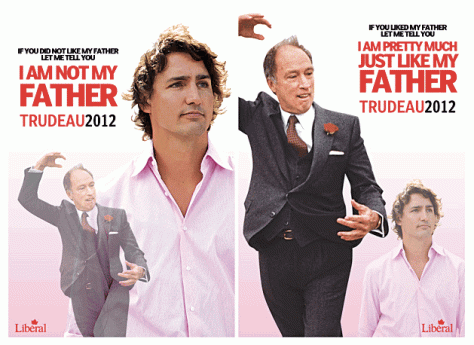
IN THE YEARS since the departure of Prime Minister Jean Chrétien, the Liberal Party of Canada has been trapped in a political Groundhog Day. Three times across a decade, the party has risen at what it expected to be the dawn of its charismatic leader. During the fall of 2003, for example, the word coronation was applied more thickly than the autumn leaves, the media consensus being that Paul Martin was beyond challenge. One after another, up came the saviours — and with equal and opposite force, down they went.
Monthly Archives: September 2012
If it’s 1938 in Iran, what year is it in Ottawa?
AS THIS WEEK’S United Nations General Assembly advanced, faithful to the template, nothing could have been more clear than that the world is suspended discouragingly between the Scylla of Holocaust denial and the Charybdis of Holocaust panic.
Going to the Antique Market
I DON’T KNOW when the antique market first got underway, but I suspect that like everything else the notion of an antique is era-specific. Mass industrial production of commercial consumer goods is an innovation whose origins are of slight remove, both geographically and historically. Before 1900, there were relative few objects to be bought and sold, near all of them hand produced in small number and bartered outside of the production and marketing cycles which now seem as inevitable to us as breathing. This is not to suggest that the idea of mass production had not yet occurred by the twentieth century. In textiles and food and furnishings and housewares, and a few other lucrative industries, industrial-based fortunes were amassed in the eighteenth and nineteenth centuries. But the antique, which by necessity requires time to develop, is a modern idea. And that is our present topic.
Romney’s the victim of campaigns that reduce issues to cartoons and caricatures
RUMOURS OF ROMNEY’S demise, to paraphrase Mark Twain, may be premature: but we know already the substance of the obituary should it soon come to that.
Podcast 12: The “Innocence” Video, Salman Rushdie, Peter Lougheed, TTC, Mitt Romney, and more
Art (Deco) is Everywhere
I‘VE LONG BEEN a pursuer of the decorative style designated in the 1960s by the phrase Art Deco. Perhaps it’s best to begin this little piece of mine with something by way of definition. So: art deco is a visual style created in Paris in the 1920s and characterized by simple, linear and geometrical forms. This aesthetic was popularized at the 1925 International Exhibition of Modern Decorative and Industrial Arts, held in Paris between the months April and October.
Small minds are behind The Innocence of Muslims
IN THE YEARS since the Danish broadsheet Jyllands-Posten, or Jutland Post, incited retribution for its publication of satirical Mohammed cartoons, we’ve had a negative case study of Bertrand’s Russell’s 1940 observation that “in a democracy, it is necessary that people should learn to endure having their sentiments outraged.”
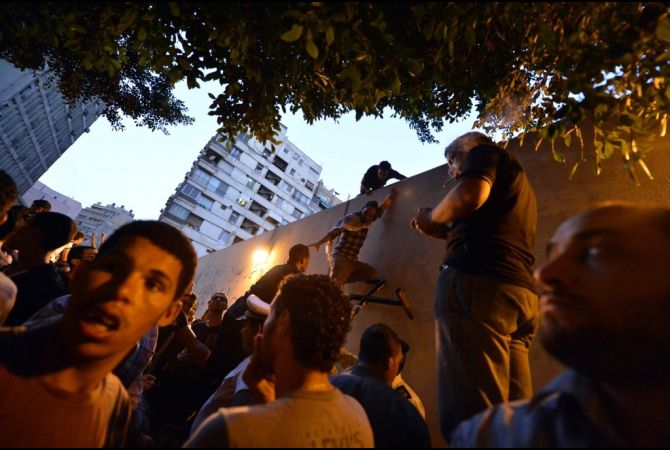
This Russell controversy concerned a New York State school board decision to hire the atheist philosopher, a decision reversed as the result of a pious defamation campaign. The recent killings in Libya of American diplomatic staff (a revisiting of the 2006 cartoon “controversy”) remind us that neither democracy nor the endurance of having one’s sentiments outraged are principles universally accepted, which is why I designate the outrage of some Muslims a negative manifestation of Russell’s principle. Nonetheless it’s into these camps — the democrat and the outraged revenge-murderer — rather than into race or tribal or national categories, which we may in the present instance be most usefully divided.
As did many of you this week I wasted thirteen minutes of my time on the amateurish Innocence of Muslims video, my amusement over its barrel-bottom production values and the shoddy acting of its chubby twenty-first century midwestern American cast (am I alone in seeing the resemblance to a young Michael Gross, from the sit-com Family Ties, in the actor chosen for the lead role?) tempered by the knowledge that revenge had been exacted on dedicated and by all accounts decent public servants.
As I write this, speculation concerning the identity of Sam Bacile, the film’s supposed creator, is abundant. The complete film itself, like Bacile, may not even exist. But does it even matter who made this obvious and clumsy piece of calculated slander, and why? Bertrand Russell’s challenge cuts through the fat and gets to the bone of the current contention: human sentiments will from time to time be outraged, and it is the distinction of civilized persons to endure and to find peaceful means by which to mediate their differences.
We ought to be mindful that the Jutland Post cartoons were the culmination of a debate, at the centre of which were, for example, a September 2005 article “Dyb angst for kritik af islam” (“Deep anxiety over the criticism of Islam,” which registered a cresting Scandinavian fear that candid talk of the world’s youngest monotheism was dangerous and ill-advised), as well as the death of Dutch filmmaker Theo van Gogh and the precarious existence of the Islam critic Ali Hirsi Ali. That debate is as vital and important as ever and, I would add, while it is more active in the West, it will have universal application.
If Innocence of Muslims’ ramshackle depictions of Mohammed invoke Edward Said’s Orientalism (and they do), the intemperate and insecure response of a fringe rabble invokes the indictments, as well as commitments, of Hirsi Ali. Writing of the conflict between religious extremism and “the values of personal freedom,” in her book Infidel, she asserts that “I was a one-issue politician, I decided. I am still. I am also convicted that this is the largest, most important issue that our society and our planet will face in the coming century.” Such is the big picture for these acts of the small minded.

On Getting a Haircut
TODAY I HAD my hair cut at one of the many hip Toronto salons, and I found myself recalling the many haircuts I’ve had. Long ago, when my youthful hair was of unadulterated pepper, a haircut meant a visit to the barber. I don’t know that the word style was of any application to the trade, and in either case what a boy got from the barber of the 1950s to the early ’70s was always the same, at every visit and for every boy. I can’t imagine my mid-century european barbers, who had wielded a scissors and straight-razor through war and possibly also the Depression, submitting to the modish term hair stylist. But then, these were the days before everything, even life itself, became a style.
Podcast 11: Quebec Election, US Election 2012, Strange Fruit, Iran, Said Aburish and more
A Clothing Store, Hitler, Gandhi and Indian Independence
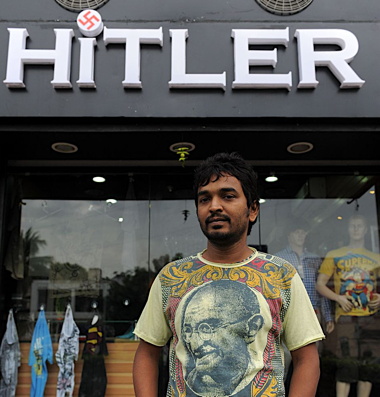
ALMOST PRECISELY seventy years ago, in March of 1942, Winston Churchill dispatched his Marxist-leaning cabinet minister and political rival Stafford Cripps to secure India’s co-operation in the war against Hitler. Partly a result of the well-founded suspicions of Indian nationalists — chief among whom were Jawaharlal Nehru, Rajaji, Subhas Chandra Bose and Mohandas Gandhi — but mostly the result of Churchill’s covert efforts, the negotiations of the Cripps mission failed (as Churchill all along intended). In the subsequent months Gandhi, anticipating a German-Japanese victory, led his colleagues in the Quit India movement, demanding the withdrawal of Britain and immediate Indian independence.
Why Desmond Tutu’s Indictment of Bush and Blair is Weak

IN HIS SEPTEMBER 2 Guardian editorial, “Why I had no choice but to spurn Tony Blair,” Desmond Tutu reproduces the canonical indictments with which opponents of the Iraq war, as well as supporters, are familiar. In doing so he commits familiar errors, and it is to these I shall advert your attention, dear reader, in the hope of furthering a clear-sighted assessment.