Category Archives: Personal Essay

A Faggot On The Alexandra Bridge

I’m not one given to the media fetish of the Ten (or One or Twenty or …) Years Ago Today. We knew, for instance, there would be a gush at the moment Michael Jackson had been dead for precisely three hundred and sixty-five days. It’s an arbitrary and meaningless trope, a cheap hook on which to hang a cheap rag.

However, there are some anniversaries that are with me throughout the year — one of them being the 1989 murder of Alain Brosseau. This then thirty-three year-old man worked in downtown Ottawa and lived in Hull, which necessitated a crossing after each shift of the Alexandra Bridge. On August 21 he was attacked by a group of men, who dropped him head-first from the bridge onto the rocks below, resulting in his death. The piece of information considered essential in this senseless incident is that Mr Brosseau’s attackers killed him because they assumed — wrongly — he was gay.

On the twentieth anniversary of this vile act, civilians and the Ottawa and Gatineau Chiefs of Police met at the middle of the Alexandra bridge at dusk in a symbolic “lighting” of the bridge with flashlights. The idea was to represent a commitment to ensuring “gay-bashing” does not go unreported or unnoticed.

It’s an important commitment, and worth renewing. But of course it won’t and cannot prevent future attacks. Only a three-hundred and sixty-five effort toward discrediting and finally extirpating homophobia will do that. The lesson taken away by many from the murder of Alain Brosseau is that “it can happen to anyone.” I’ve always felt this both hit and missed the target. What if it could only happen to one in ten? Would that make it okay, or less urgent, if your name weren’t on the list of those Not Wanted On The Voyage? In that case you are complicit in the crime — another bystander who allowed it to happen.

I’d prefer to stand in solidarity; and as it happened on my way to work today, crossing the Alexandra Bridge (as I do each day), I was called a faggot by three drunken and menacing-looking men. Apparently it can happen to anyone. But even if it couldn’t happen to “just anyone,” it should never happen. We still have a lot of work to do.

CSIS: Getting It Right, Through Accident

Some days ago, Director of the Canadian Security Intelligence Service, Richard Fadden, said in what he presumed to be a sealed audience that “There are several municipal politicians in British Columbia and in at least two provinces there are ministers of the Crown who we think are under at least the general influence of a foreign government.” For this remark he has been called before a Parliamentary committee established just for this purpose, and has further been widely condemned by media for his supposed crimes of “casting traitorous aspersions” and McCarthyism.

It is doubtless apparent to all that Fadden referred covertly to the influence of China. (The closest he came to saying so was his use of the word “Asia.”) His failed use of code suggests that either he believed an effective veil was unnecessary or that he simply isn’t very good at it. It is also curious that he reposed in the assumption his words would never drift on the open air. What sort of “Spymaster,” as he has been frequently called, fumbles in such a manner? Only the sort of spymaster one finds across the bloated, complacent, self-serving, and incompetent bureaucracies of the “intelligence community” as constituted both here and in the United States.

In case we need the reminder, the mess in which things now are has been further detailed by John C. Major’s Final Report, “Air India Flight 182: A Canadian Tragedy.” Among Major’s findings are the following:

  • CSIS surveillance was ineffective. Surveillants were unable to distinguish one traditionally attired Sikh from another. When a CSIS surveillance team observed experiments involving a test explosion conducted by Sikh extremists in the woods in Duncan B.C. in June 1985 (the Duncan Blast), the loud sound heard was misinterpreted as a gunshot. No photograph was taken of the unknown third person present (Mr. X.) because surveillants had not brought a camera.
  • CSIS failed to include important information, such as the Duncan Blast, in the threat assessments it provided to the RCMP and Transport Canada.
  • The RCMP wasted resources creating a threat assessment structure parallel to CSIS’. The RCMP structure was itself ineffective – it failed to identify, report, and share threat information.
  • CSIS often failed to disclose promptly to the RCMP information relevant to the criminal investigation, particularly information from human sources, or it disclosed information without sufficient detail or in a manner that prevented the RCMP from using the information.
  • CSIS was mesmerized by the mantra that “CSIS doesn’t collect evidence,” and used it to justify the destruction of raw material and information. CSIS erased the tapes that caught coded conversations possibly related to the planning of the bombing, and CSIS investigators destroyed their notes that recorded the information CSIS sources provided in relation to the Air India bombing. Both of these actions compromised the prosecution’s evidentiary position at trial.
  • CSIS delayed disclosure of necessary information for the prosecution of Interjit Singh Reyat by adopting a legalistic and technical approach in responding to requests from prosecutor James Jardine.
  • The RCMP never made a written request that the Parmar tapes be preserved, though it was aware of their existence, and also never made a verbal request specific to the Parmar tapes until months into the investigation, when the early tapes were already erased. CSIS only ceased ongoing erasure in 1986, following a request by the Department of Justice in connection with the civil litigation.
  • The families were not kept informed about the investigation by the Government, and often learned about new developments through the media. The RCMP only began to liaise with the families directly after 1995. CSIS refused to participate.

… and on and on. It’s perhaps far worse in the United States, where the security establishment eats money and defecates requests for more, but no one is quite able to say. Such is the badness. In the meanwhile, the security industry conducts a farcical public relations campaign which has everything to do with managing public perception and little to do with security.

Even before anyone had come around to the word China, the Chinese were protesting a bit too much. The irony here is that all informed persons know China indeed aggressively promotes its interests internationally. What else would you expect of the world’s next global empire? The Confucius Institutes, the espionage, the busloads and busloads of planted Chinese patriots in my neighbourhood — during the recent visit to Ottawa of President Hu Jintao — the all-expenses-paid trips and the endless visits of VIPs: it’s all part of business for the world’s Communist behemoth.

But if you choose to be so naïve as to suppose the world isn’t roughly as Fadden says it is, at least fire the arrows into the proper targets. For this is one of the very few occasions on which a legitimate concern has been brought (even if by accident) to timely attention, by an agency more often having drawn attention for its appalling failures. To the degree that these recent statements are being ridiculed, dismissed, and savaged, the failure to see the worth of these statements is a public failure. You’ve been warned, in other words.

Goya and Me

The foremost recollection is as an eight year-old confronted with “Saturno Devorando a Su Hijo” [Saturn Devouring His Son], from the series commonly known as The Black Paintings, examples of which sat on the bookshelf of my parents’ house. From thence forward my apprehension of Goya has been inseparable from this initial horror, and yet his paintings have lasting positive appeal. What is it that makes Goya so compelling to me?

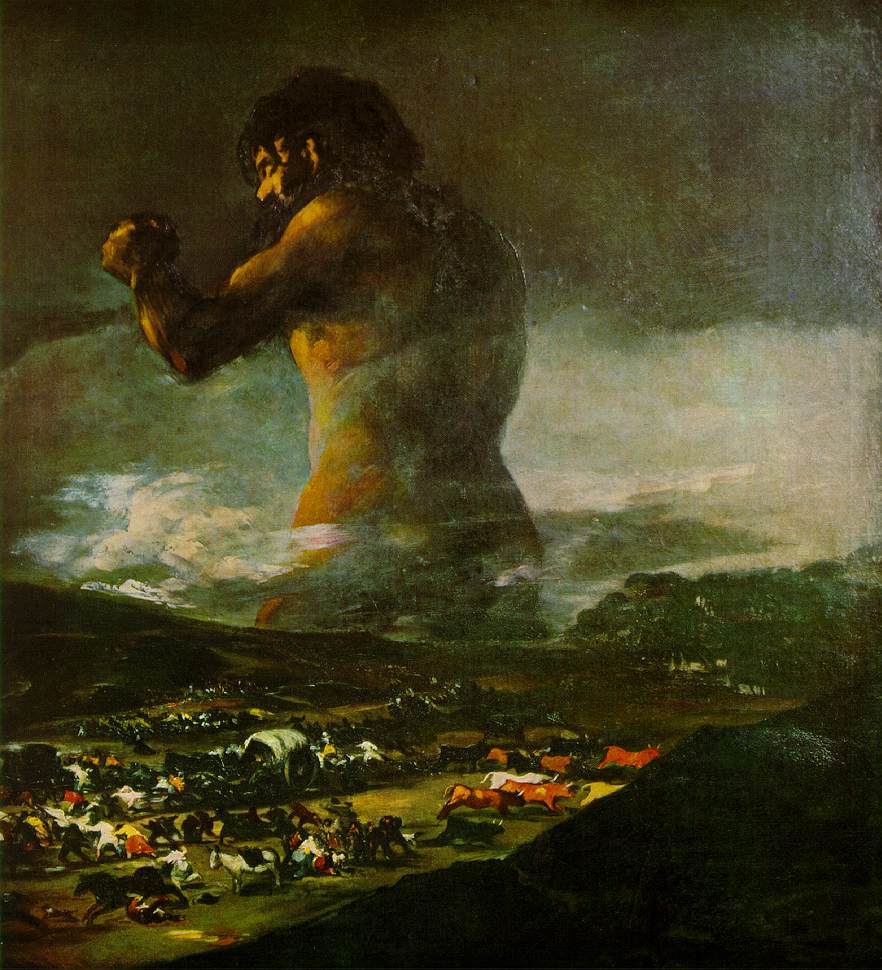
There is something peculiar about the mental character of the child to which Goya especially appeals. He is the painter of monsters, of nightmare, and in particular of The Colossus, a figure I expect every boy will have encountered in sleep.* Indeed, Goya captioned his 1799 series Caprichos with the phrase “the sleep of reason produces monsters.” His monsters were of the adult variety: revolution, murder, hate. Thirty years after first seeing Saturn devour his son, and well familiarized with the really-existing monsters of our world, I drove to Montreal to see his “Caprichos” at the Musée des beaux-arts.

The eighty prints constituting the Caprichos were described by Goya as depicting “ … the innumerable foibles and follies to be found in any civilized society, and from the common prejudices and deceitful practices which custom, ignorance, or self-interest have made usual.” This occupation, one might say preoccupation, rather suggests the satirist. And in his use of caricature, as well as his recourse to the grotesque, Goya does to a good degree fit the designation. Macaulay wrote that “the best portraits are those in which there is a slight mixture of caricature,” but Goya is not an artist of restraint where his subjects are concerned. He has a point to make, and a slight anything simply won’t do.

His work recalls Orwell’s “power of facing unpleasant facts,” specifically the facts of war and self-serving human pretensions, and my response to his representations of human endeavours are nearly characterised in Orwell’s discussion of his response to another satirist, Jonathan Swift, in the essay Politics vs Literature:

Swift falsifies his picture of the world by refusing to see anything in human life except dirt, folly and wickedness, but the part which he abstracts from the whole does exist, and it is something which we all know about while shrinking from mentioning it. Part of our minds — in any normal person it is the dominant part — believes that man is a noble animal and life is worth living: but there is also a sort of inner self which at least intermittently stands aghast at the horror of existence. In the queerest way, pleasure and disgust are linked together. The human body is beautiful: it is also repulsive and ridiculous, a fact which can be verified at any swimming pool. The sexual organs are objects of desire and also of loathing, so much so that in many languages, if not in all languages, their names are used as words of abuse. Meat is delicious, but a butcher’s shop makes one feel sick: and indeed all our food springs ultimately from dung and dead bodies, the two things which of all others seem to us the most horrible. A child, when it is past the infantile stage but still looking at the world with fresh eyes, is moved by horror almost as often as by wonder — horror of snot and spittle, of the dogs’ excrement on the pavement, the dying toad full of maggots, the sweaty smell of grown-ups, the hideousness of old men, with their bald heads and bulbous noses.

I say “nearly summarised” because I do not think that Goya “falsifies his picture of the world.” He exaggerates, and he selects. It seems apparent from the way he painted that he felt deeply. Disgust and outrage were among the emotions. However, Goya manages the essential challenge of satire in a way which differs from that of Swift. This essential challenge is to make one see, and whereas Swift’s choices involve a depiction of human nature in a condition of irredeemable debasement, Goya’s habitual strategy is to focus on human actions and to characterize them by their proper names. It is in the service of human drama to which the caricature is submitted. Although it is the case that Goya typically refuses to depict man as heroic, his nature as such is in any case unsettled and separate from the matter of action and its context in human choices. What people do is the principal concern, and it is according to this nature/culture divide that we may assign Swift to the conservative wing of satire and Goya to the liberal.

Nonetheless there is a morbid streak throughout Goya’s work. He is not an uplifting artist, but rather a disturbing one. The preponderance of war, rape, torture, cannibalism, and debasement as subjects is to be expected from an artist who lived in the time and place in which Goya himself lived, but even the deviations from this universal theme of “Man’s inhumanity toward Man” are telling: a Goya still life invoking the butcher shop as well as butchery, the subtle suggestion of human torment and degredation in the genre paintings (for instance “El pelele”), or the odd use of composition in the Tauromachia series, which displaces human forms from the works’ focal point.

The effect of these and other compositional decisions is to subject human society to profound skepticism. Goya paints a butcher’s table the way he paints a scene of battle, with an awareness of the social meaning of a particular subject. Just as the butcher’s table can not be separated from the universal human fact of eating, so too war is inseparable from the pomp and circumstance of Civilization. The individual act too is social in nature, and the “sleep of reason” is compelling as metaphor because brutality is extravagant but sleep is ordinary. His obsessions are doubtless rooted in an awareness, hence also fear, of this.

Goya seems to paint according to the principle “homo sum: humani nihil a me alienum puto” [I am a man, I consider nothing that is human alien to me.] The sleep of reason is not an academic or theoretical problem, but a condition to which the painter himself is not immune. Goya’s own dichotomy, as a reflective and organising artist who is also an outraged and impotent observer, materializes the larger dichotomy of a society which ostensibly manifests Enlightenment ideals while sponsoring the depravities of the Inquisition. Goya employs his rational intelligence to the purpose of ordering the disorder, expressing with clarity his churning indignation. His world is one of impossibility, of great forward strides into backwardness and barbarism. This explains the depths of Goya’s darkness, for it is in service of the potential but adandoned heights of human achievement that the depths are rendered. John Berger puts the matter this way, in his 1954 essay “The Honesty of Goya”:

The despair of an artist is often misunderstood. It is never total. It excepts his own work. In his own work, however low his opinion of it may be, there is the hope of reprieve. If there were not, he could never summon up the abnormal energy and concentration needed to create it. And an artist’s work constitutes his relationship with his fellow men.

This paragraph nicely captures both the social nature and hopefulness of Goya’s work. Goya is engaged in an act of solidarity, decrying the wicked acts of fellow human beings to his fellow human beings, who he must assume will have the capacity to participate in his disappointment. Berger concludes that “no artist has ever achieved greater honesty than Goya: honesty in the full sense of the word meaning facing the facts and preserving one’s ideals.” I think Berger is correct, and furthermore I think it is this honesty which has made Goya’s work compelling to me for over thirty years.


* Note: there is some controversy concerning whether The Colossus was indeed painted by Goya.

Food Crimes

It was not long ago that bread came from the local bakery, milk could be had from the dairy, and the idea of a grocery store was new. Most meals were prepared in the house, there being few restaurants and the notion of “eating out” in any case having an exotic character. Were those better days? Probably not — but they were different from this day, in ways we may not fully understand.

It occurred to me some years ago that there is enough toxin in a modern grocery store to kill an adult human. The food one ate as a child has been engineered into a tinned simulacrum of the same, a chemistry project of sorts in which generally unknown and unpronounceable substances constitute the smoke-and-mirror foundation of contemporary food industry. Or, better yet, there emerge from the laboratory “foods” with no correspondence in the natural world: pizza pockets, chicken nuggets, pop tarts, Irish Egg Rolls, or a whole rotisserie chicken in a can. Just as it would be impossible to successfully mass-produce and distribute worldwide the five-ingredient spaghetti sauce you ate as a child, so too is it impossible for the ordinary individual to cook the twenty-five ingredient version you will find in a grocery store. What, for instance, would you make of a recipe calling for:

phenethyl alcohol, amyl acetate, heliotropin, cinnamyl isobutyrate, methyl heptine carbonate, phenethyl alcohol, dipropyl ketone, ethyl methylphenylglycidate, hydroxyphenyl-2-butanone, g-undecalactone, maltol, 4-methylacetophenone, anethol, butyric acid, and solvent.

These of course are all substances commonly put into things sold as food. The topics of food engineering and its related concerns have been ably written and spoken upon by many, among them Eric Schlosser and Michael Pollan. There is neither need nor occasion to rehearse their theses and arguments here. I merely wish to reflect upon the many cases of food crime as I encounter them in the day-to-day world. Consider this a personal list prepared in advance of a citizen’s arrest. Here then are the crimes, with cursory gloss as required.

The chief food crime today is the “serving of fries.” Whatever you order, and wherever you order it, there will attend this greasy helping of empty calories and carcinogens. Near effortless and highly profitable, the mound of chips is edible cynicism. It is how a restaurant indicates that they really don’t give a shit about you or your food. Eat and get out, already.

High-fructose corn syrup – also called glucose-fructose — a highly processed form of sugar, added to everything from “soft drinks” to bread, salad dressing, and soups. In this case the crime is the responsibility of a single crooked corporation, Archer Daniels Midland, who used political manoeuvering to make high-fructose corn syrup a staple of the American diet. Soda, a highly profitable sector of the glucose-fructose market, is another ubiquitous empty calorie staple of the modern meal. But in every category, food is being engineered to suit the tastes of those who demand everything be sickly sweet.

Sodium, added in superabundance to everything, for the principal reason that processed food is without flavour. Salt, and indeed all food additives, are perhaps less a crime than an indication of the crime.

Deep frying. It seems everything has to be deep-fried nowadays, even when there are better-tasting food preparation alternatives, such as baking, pan frying, poaching, grilling, or smoking. Looking back over the list thus far, it is depressing how many meals consist of deep-fried something-or-other with a soda and plate of fries.

Complicated food. Here the principle is to substitute for a simple food of a few ingredients a complicated multi-ingredient version. Less raw vegetables and fruits, more cooked food with chemical additives. It is much harder to find a banana than it is a bag of chips.

I am not suggesting that there is no place in this world for french fries or soft drinks. They serve well, for instance, at children’s birthday parties. But please note that they are not food. The propaganda campaigns of Archer Daniels Midland and so on to convince us otherwise are as nefarious as the campaigns to convince millions cigarettes taste good and that Richard Nixon will make a fine President. All around us, every day, crimes of food are being committed. The only beneficiaries are the companies who put dollars before every other concern. Not only do we allow it to happen: we are spending our good money on these cheaply manufactured scams — Pretend Food which is poisoning our children here while elsewhere destroying rivers, forests, and indigenous cultures.

The Adult And The Child

It happens now and then that one hears something praised for its childlikeness, perhaps a book or movie or some other supposedly enchanting object. Childhood is something through which all pass. Subsequent attitudes toward it persist, but with perhaps inadequate critical thought toward their meaning. What is the character of this childlike outlook, and how does it compare with what may be called an adult outlook upon human affairs?

What are generally valued in the constitution of the child are the following: innocence, honesty, wonder, naïveté, simplicity, joy, youthfulness, credibility, vulnerability, and curiosity. The child comes into the world without pre-existing notions, at least so far as the world of ideas are concerned. Of course there are established biological impulses, intuitions, and so forth. But the human child is at the mercy of the world, and must take the surface appearance of things as given, having no previous experiences from which to draw. Most of what is praised or otherwise valued in the child’s disposition comes down to this: ignorance. Considered in its negative aspect, an absence of knowledge for example constitutes a great disadvantage to the individual. But there is a positive aspect as well, for knowledge of the world in almost every instance brings with it unpleasant emotions such as distress, disappointment, and sorrow. The list of child attributes is characterized mostly by absence. Innocence is the absence of experience, honesty is the absence of an ability to dissemble, and credibility is the absence of an acquired mental power of skepticism.

There are however other child qualities which are less readily reducible to the absence of later, adult acquisitions. Among these are joy, youthfulness, wonder, and curiosity. It is easy both to explain and to grasp why these are positive things. Joy is not the mere absence of pain, but may indeed coexist with, and even be informed by, unpleasantness. Youthfulness is not identical with youth, and we have all observed the differing manners in which individual persons age. Note also that an adult may be joyful, and may confront the world with an attitude of both curiosity and wonder. While these states may be inherent in the conventional view of childhood — though not commonly found among actual children, especially outside the so-called rich countries — they may be found in adults as well, even if not widely. It appears to be the qualities determined by absence which characterize the essence of the child outlook, and once they have been filled in by experience, they are quite forever gone.

Thus far the consideration has been rather abstract. But we know that our attitudes toward the child are informed by our relationship to the material world of objects, and in this world one encounters on the one hand toys and on the other jobs, bills, mortgages, and problems with teeth and organs and so on. The life of the child looks to the adult like a life of freedom from responsibility, specifically the responsibility of responding to and altering material conditions. And the reason of course that children are generally in this era of human civilization free from such responsibility is that they are considered to lack as a class of person the required mental, emotional, and physical resources.

It interests me to note that what is praised or valued in the child is despised in the adult. Imagine an adult who believes all that he is told, who takes the appearance of things as the truth of the matter, and who is honest in all of his interactions. In art this is a comic state of affairs, and in life it is contemptible. The exception seems to be in the province of religion, where one encounters in society the general approbation of faith — that is, childlike credulousness. Outside of this, the irresponsible adult who behaves like a child by not “pulling his weight” is regarded with hostility. Nor is it possible to use the term childish as a compliment. The habits and dispositions of the child are not appropriate to the adult, and the reverse is the case also. But what may be said of these qualities in and of themselves?

Consider for example innocence, naïveté, and credibility. They are perhaps charming, but are they good? This question invites a subjective answer. To my tastes the skeptical disposition of mind offers something vastly preferable to innocence and credibility. Indeed, as I reflect upon the list of child qualities I discover that I prefer in almost every instance the adult alternative, even when this alternative is bound up with the unpleasant facts of human affairs.

Some years ago I engaged in an experiment with an evangelist who had come to my door. He was keen to convince me of the merits of salvation, as he understood them, and principally the merit of gaining one’s entry into heaven. I offered him the following challenge: to present me with a compelling description of this state called Paradise. He undertook his task by rehearsing a list of unpleasant facts one would not encounter in the Beyond: sickness, loneliness, misery, death. In other words, absences. Here one may think of the innocence we have considered in relation to the child outlook. On the surface of them, both the Christian Heaven and childhood seem marvellous places. But what I have found in both cases is that more deeply considered they are not so. I am rather fond of doubt, and while innocence may be a pleasant state I feel experience is far more rich and rewarding, as well as painful. I cannot ignore and will not resist the gut feeling that an eternity of pleasantness would be a terrible thing. Indeed, when I consider all that I cherish in this world, I am aware that these things are inextricably connected to others such as loss, pain, conflict, doubt, impermanence, and mortality. In other words, the full range of the adult human condition. There is no getting around it, either by recourse to an afterlife or to the one we have already had.

The consideration of the child and the adult is an indirect way of considering the messy world in which we live and the possibility of its improvement. While I believe in the idea of human progress and am committed to forging a future in which conflict is resolved by peaceful means, I would not wish for instance to abolish conflict, even if that were possible. I do not look with regret upon the lost innocence of childhood. Irony suits me well. I don’t care for pain and disappointment, but they seem to me the cost of going out of doors in pursuit of the good. I am against the certainty of faith and cling to the positive value of skepticism, which I consider essential to the survival of human civilization. Give me the hard lessons of experience, and keep me far from naïveté. Above all, save me from the sweet music of Heaven’s eternal choir, and give me the discordant strain of the human chorus. And if you please a decent single malt and a pen.

‘My Canada includes …’

The bumper sticker I often saw at the time of the 1995 Quebec referendum on sovereignty is still in circulation. It reads, ‘My Canada includes Quebec.’ A generous sentiment, I think, and likely destined to fail. The French and English alike are weary of the status quo, by which I mean protracted rounds of federal-provincial wrangling, followed by solutions that don’t solve anything. They may one day conclude that separation is perhaps after all for the best. Nothing personal: it’s just that the time has come to try something a bit different.

The problem with the bumper sticker is that, decent though its outlook is, it doesn’t really describe the Canada in which most Canadians live. In what manners precisely does Your Canada include Quebec? The bumper sticker does not represent the social experiences of millions of Canadians who cannot name a Quebecois singer (Sorry, Celine Dion does not count), a Francophone author, or a Quebec provincial holiday. Anglophone Canadians complain of having French ‘crammed down their throat’ in school. Then there’s the political Canada, a motley parliament fadged together by means of the federal election. I wrote an article for ASH magazine at the time of the 1997 election in which I wrote the following:

…after reviewing the research data, Lucien Bouchard’s claim that ‘Canada is not a real country’ was beginning to make some sense to me. I’d thought it a ridiculous statement at first, but my discoveries got me wondering. The first surprise was a 1994 Maclean’s/CTV poll suggesting that only about 1/3 of Newfoundlanders think of themselves as ‘Canadian.’ Even the Quebec referendum yielded a higher number: just over 50%. Anecdotal evidence suggests that the West considers itself a nation apart, and if one doesn’t trust anecdotal evidence, there’s the 1997 election to consider. This election carved the political landscape into competing regional chunks, leaving Ottawa to pursue one of the few policies for which there seems to be a national consensus: decentralization. As the next referendum approaches, I try to imagine appropriate regional slogans for the inevitable bumper stickers. Here’s one: My Canada includes Bay Street, Parliament Hill, and parts of Montreal, notwithstanding. Here a brief newspaper quotation, there a statistic: together considered, the data suggest less a nation recreating itself for the next century than a conflict over who should get what, and more important, who shouldn’t. The national mood, perhaps not fully explained by the term ‘regionalism,’ seems to be rooted in an understanding that, in a world of diminishing expectations, looking out for Number One is only a good idea.

I wrote that paragraph less than two years ago, and so it would be premature to conclude it’s withstood the test of time. I’ll say instead it has withstood my suspicion that I was perhaps too pessimistic. Years ago, in preparation for some articles on contemporary Canadian politics that I was writing, I read several dozen books, dozens of articles, and scores of government documents. I read the North American Free Trade Agreement (NAFTA), the Multilateral Agreement on Investment (MAI), and those glossy publications of the World Bank, the International Monetary Fund (IMF), and the Organization for Economic Co-operation and Development (OECD). I read the Prime Minister’s after-dinner speeches, and the reports issued following the blue-ribbon trade missions of which we heard so much. I read Fraser Institute and C.D. Howe books. I read United Nations reports, from UNICEF to a publication called Transnational Corporations. I went through Statistics Canada data. I even consulted Royal Commission documents, Commons debates, Hansard, and on and on and on and on. Now, I’m not boring you with this list to establish my expertise and thus to place what I’m about to say beyond question. I want only to assert that all of these folks, working for the IMF and the World Bank and so on, have a pretty clear idea about what Canada includes. It would perhaps fit on a bumper sticker, too: “My Canada includes underexploited health and education markets.” I was trying to answer a very precise question in my research, What is this thing called Globalization into which we are rushing? After two years of effort I got a well-documented answer, too. Your political and economic leaders regard Canada as an ‘economy’ which needs to be made more ‘efficient.’ Globalization is a new name for laissez-faire capitalism. Theirs is one view of Canada, and the bumper stickers pose another. The problem for the Unity folks is that the bumper-sticker crowd isn’t running the country, the people Up There are. Don’t bother reading books about that; consider your experience and judge for yourself whether or not it’s so.

Here is a description of My Canada from Ontario’s 905 region, infamous as the Heartland of the 1995 Common Sense Revolution. This is where Mike Harris’s Progressive Conservative party won a decisive victory on a platform which pretty much ignored Quebec altogether. It was probably a wise strategy, but in any case I’m not interested here in politics. Remember, I am describing Canada as it really is, not as the My Canada folks wish it to be, or think it to be.

I live on the outskirts of Fort Erie, Ontario where I work as a writer. I’m writing a collection of stories set in a town that doesn’t look too “Canadian,” because we’ve all learned there’s a small market for that sort of thing. Some would regard me as part of the Culture Industry. Let’s talk, then, about culture. In Kingston I used to watch Canadian television and listen to Canadian radio because, unless one paid for cable, Canadian is about all you got. (As a consequence, most of those who can pay for cable do.) In Fort Erie there is only American television, and American radio dominates. Cable is not available in the rural area in which I live. Furthermore, Fort Erie – a city of 27,000 – has no movie theatre and no bookstores. The nearest stores offering these goods are in Buffalo. On the Canadian side I can easily find Canadian papers, full of American content and American spelling, and American books, magazines, rental videos, and music. I once found Canadian movies in the ‘foreign’ section of Jumbo Video, but the foreign section was long ago sacrificed to make room for a sprawling Disney section. I doubt you’re surprised; this is how Canadians are routinely treated by their fellow citizens. In other fields, science and technology for instances, it’s much the same. Canadian taxpayers subsidize education, but the notion of keeping Canadians here with good jobs is quite beyond. America offers the work and reaps the ample rewards of an investment paid for here. Then Canadians buy back the products of that investment at a handsome price. Don’t be surprised; it’s a very old matter which goes by the term Empire. Did you know that two of the original three Hollywood studios were established by expatriate Canadians? Not only does Canada let the Americans manage ‘their’ culture for profit; they supply the managers, at Canada’s expense. Sociologists call this a Brain Drain, which if you pay attention to metaphors makes you think back to NAFTA and all the glorious talk about the free flow of information and goods. Glorious talk aside, most people in the Culture Industry are unable to make a living in Canada, so many look in the States. Or, like me, they find work of another sort. Fort Erie’s prime real estate is American-owned, and the maintenance of these summer ‘cottages’ – far bigger than the houses local Canadians own – involves the labour of several workers. I am one of those workers.

These are the basic facts of Canada as I encounter them daily. It is a US-dominated country in which the Americans own the resources but hire the locals to keep things looking spiffy. When you get home from work you can eat American food, wear American clothes, and watch American entertainment. As for Quebec food, clothes, and entertainment, most people here would ask What the hell are those? 905 Canada doesn’t really include Quebec at all; indeed, it hardly even includes Canada. In 1998 there’s less political and economic substance to Confederation than even a decade ago, and the trend seems to me to be gaining momentum. Conrad Black owns most Canadian newspapers and lives in New York city, the centre of his universe; yesterday I read in his National Post a discussion of Thomas Courchene’s proposal that we establish a North American currency, the US dollar. Well, why not? Courchene, a Queen’s University economist, has on his side the facts that 80% of Canada’s exports go to the US and that Canadian society has undergone a decade-long project of social and economic ‘harmonization‘ with the States. The Canadian nationalists have bumper stickers backed up by Good Vibrations. I am not mocking them. I am merely pointing out that the North American Free Trade Agreement formalized Canada’s status as a milch-cow. The principal function of the federal government today is not ‘unity’; it is to make sure nothing gets between the bucket and the teat. Free Trade is about noble-sounding matters like National Treatment, Most Favoured Nation, and the elimination of non-tariff trade barriers. The goal, largely accomplished, is to get rid of socialist, interventionist government, and replace it with something that makes for a more efficient milking. The IMF now scrutinizes budgets – ’surveillance,’ the IMF people call it – and makes its displeasure felt if the fed gets out of line. So far Finance Minister Paul Martin has been a willing subject, and punishment has therefore been unnecessary. In public, federal leaders belong to the ‘My Canada includes Quebec’ club, and they’ve certainly handed out the goodies, but in private they are more of the school which believes ‘My Canada includes privatization, downsizing, and competition.’ You have to admit, it has a nice practical sound to it. Furthermore, it has practical results.

Confederation, I can’t help but notice, has the word federation in it. A federation gives one a federal government. And what does federal mean? Here is the definition offered by Chamber’s 20th Century Dictionary: “pertaining to or consisting of a treaty or covenant.” It’s an interesting definition, I think. A covenant has a distinct feeling about it; one imagines God and Moses breaking bread, while the lion and lamb frolic together in the distance. Covenants are mutual agreements that place the participants’ needs and interests foremost. Treaties are something altogether else. The word makes me think either of the many broken promises of Canada in their relations with indigenous people, or else it brings to mind those horrendous documents produced by the victors at the conclusion of a war. Germany was humiliated not by its defeat in WWI, but rather by the peace established in the Treaty of Versailles. Indeed, to my mind the word treaty conjures the words ‘lies,’ and ‘deceit’. Someone invariably has, or achieves, a position of dominance where treaties are involved. Someone is usually screwed over. (Just ask Simon Reisman, the embittered Canadian negotiator of NAFTA who admitted Canada got screwed by the American government.) Where there are treaties and covenants, there must be people or agencies to keep them. This is one function of Canada’s federal government, to enforce agreements. I don’t know about you, but I myself have an opinion on whether Canada’s leaders are of the covenant-making or cynical treaty-making variety. The so-called New Economy arrived attended by the unmistakable feeling that Canada had lost a contest, and now must pay. The Federal government has downsized itself out of business and no longer does anything noticeable except hoard taxes and EI surpluses while telling citizens to pay more and learn to live with less. Public health care funding? Education? Social Welfare? Sorry, not anymore. It’s up to the provinces now, who in turn are dumping responsibilities and costs onto the municipalities, without giving them the resources. Perhaps by the time you read this, the municipalities will have entrusted health care ‘market’ to the efficient workings of American Health Maintenance Organizations, or HMOs. Government isn’t so inefficient after all. It’s Getting the Job Done.

My view, if you care to know and haven’t figured it out already, is that Canada is governed not by politicians, but by the lying makers of treaties. They screwed over the Indians, and now they’re busy screwing over Canadians. Behind it all are the financial markets, which in turn are governed by gamblers and robber barons. This form of governance goes on in the open and is sanctioned by the laws. There’s no need to introduce gnosticism, masonry, or a secret world conspiracy into the discussion. Anyone familiar with mercantilism will understand what the global economy is really all about. It’s about rigging the systems of trade and production and reaping the profits. There’s no place for east-west nation-building in a north-south trade regime. No one’s business interests are served by the break-up of Canada, but on the other hand the statist measures required by fiscal federalism (a term which covers federal-provincial cost- and tax-sharing arrangements) are out of fashion. Even if they weren’t, what more has the federal government left to offer Quebec? The answer, of course, is sovereignty. All of these – free trade, decentralization, downsizing, separatism – are centrifugal. They make a flight from the federal centre perhaps inevitable and certainly reasonable. As cynical as this sounds, confederation was a matter of expedience and self-interest. The provinces were in it for the goodies as much as for anything else. Well, Ottawa isn’t in the goodies business anymore. They have the international investor to please, and we know how the international investor loves austerity – not his own of course, but others’. The investors are doing nicely with the help of government, but the rest of us will have to take care of ourselves. The technical term for taking care of oneself, by the way, is independence.

Professor Courchene welcomes the new, decentralized, globally-competitive Canada. You could even say it was his idea. He’s a booster of the unimpeded free market and believes that the nation-state is, alas, obsolete. One man’s opinion, you may say, but Courchene is one of the most influential policy experts in Canada. He has literally written the book, at Ontario’s request, on intergovernmental relations. His approach to separatism is to render it redundant by turning Canada into a loosely-affiliated group of independent economies. The argument is, Make every province actually independent, both economically and politically, and you undercut the separatist cause of independence in law. That is the argument. It overlooks the fact that nationalism is at least as much about the symbols of nationhood as it is about the substance. Jacques Parizeau, I presume, wanted to be the Prime Minister of Quebec. Pomp and circumstance, Oui; Distinct Society, Non. The title ‘Premier of For-All-Intents-and-Purposes-Independent Quebec’ apparently did not interest him. Nonetheless, appeasement has a certain logic, and by a happy coincidence its decentralizing tendencies satisfied the conditions of the North American Free Trade Agreement as well. Under Courchene’s plan, which was adopted by Ottawa, the independent states of Canada would be governed by an agreement on internal trade (AIT). The unimpeded flow of goods, information, and capital would be the primary social and economic goals of Courchene’s, and Ottawa’s, Canada. This plan was published under the title Renewing the Federation.

Having endured a good lot of acronyms and barbarous phrases, are you ready for plain English? All the sound and fury about ‘renewing the federation’ arrives at this: empty the store, and maybe folks will stop trying to rob it. In other words, the only politically safe government in the 1990s – indeed the only good government – is thought to be no government at all. Ottawa will continue to collect incomes and to hand them over to bankers, bondholders, and Bombardier, but not much else will transpire directly between the feds and citizens. Most activists on the left have yet to grasp what this means for their infamous defence of an interventionist federal government. The fed is no longer in the business of social programs, but it is nonetheless busy. Ottawa’s Canada includes acronyms like the Non-Accelerating-Inflation Rate of Unemployment (NAIRU), the World Trade Organization (WTO), and the Multilateral Agreement on Investment (MAI). Or, in plain English, the private economic interests of investors. It makes me wonder are there any good reasons today not to separate?

Needless to say, each Canadian sees the country differently. For some – those who derive the bulk of their income from investments, for instance – a decentralized, American-styled, free-market, individualistic Canada is an exciting, opportunity-filled prospect. I have expressed my suspicions, but I acknowledge also the attractiveness for many of the competing views. I could be wrong about the political system and about the leaders. I could be wrong about globalization. Most of all, I could be wrong about the future of Canada and Quebec. Regarding my assertion that Canada is ‘US-dominated,’ one could hardly think this a novel claim. Much of what I have stated is old and obvious. Some of it, such as the relevance of the IMF to Canadian politics, wants clarification and substance. Do I believe that Canada is under attack from malignant outside forces? No, I believe rather that Canada is open for business. I do not think that Canada is unique in the world, that it is somehow special, set apart from the other nations. The Canadian way of life is not invulnerable, and yet the threats are domestic. If anything brings Canada down, it will be the notions that democracy is a spectator sport, that citizenship is a piece of paper, that ordinary people are powerless, and that in any case ‘Canadianess’ magically shields one from the disasters which descend upon lesser nations. It is possible, even probable, that Quebec will one day leave Canada. It is possible that Canada as you know it will cease to exist. Perhaps it already has. My Canada, you see, includes these possibilities. [-November 1998.]

Of Youth and Age

T.S. Eliot’s 1922 poem, The Waste Land, begins:

April is the cruellest month, breeding
Lilacs out of the dead land, mixing
Memory and desire, stirring
Dull roots with spring rain.

I first read these lines in my early 20s and thought I understood them. But as it is in so many instances of literature, this poem seems commensurate with a certain age, the way Proust is an author for one’s forties and J.D. Salinger for the early teens. The meaning of this strange admixture of memory and desire which indeed comes about suddenly in Spring is not fully appreciated until one reaches an age where the crucial bit, “cruellest,” is actively felt. The opening of The Waste Land finds us somewhere between the youthful outlook of the Pastoral mode and the poetic resignation of Ecclesiastes: “the almond tree shall flourish, and the grasshopper shall be a burden, and desire shall fail.” In that middle space desire persists, but memory indicates the direction in which you’re going, how far you’ve gone, and thus the inevitable matter of the diminishing return.

For me this late middle period, or if you prefer middle age, outlook is best illustrated not by allusion to Spring, but Fall. Here it is, the beginning of September, and it is a beautiful sunny day – Autumn is in the air – as the students return for another year of classes. I admit the whole thing makes me deeply nostalgic. But for what exactly? The facts of much of my years as a student were: tedious lectures, essays, term papers, exams, poverty. I know I do not miss any of these. And yet, when I walk alongside the residences and I get a glimpse inside, a part of me is absorbed into the scene and I want it all again. One month of actual student life, if not one day, would cure me of this, for I’m certain it would be an utterly depressing and irksome experience. But then, I am thirty-four years old and they are twenty. What I really want seems to be this: to be at a point in my life where discovery is a normal mode of experience, where everything is charged by a sort of blind, intense wonder.

A college student is ignorant and entirely at the mercy of hormones, or desire. That is the whole point of being young. But one does not think about that under the spell of nostalgia; one thinks how marvellous it is to have pals gathered about, rather than scattered to the corners of the earth, as they now are. And one ponders how wonderful it was to fall in love for the first time – all while harbouring the conviction that college romance is uninspiring and pedantic, and we’d be better off without it.

Nostalgia is pure sentiment. That is why you can never quite argue yourself out of it. A good lie deeply felt is more useful than an unpleasant fact arrived at through vigorous examination supported by evidence. And the principal lie about college, perhaps even about youth, is that you are freer than you will ever be later on. What you in fact are, for the most part, is confused, naïve, excited, drunk, anxious about the future, tired, and horny. Above all, if you are a young man, horny. All of these remind you that you are at the mercy of mysterious (so it seems at the time) forces, the forces of April. That is what it means to be young. And of course part of the habit of youth is abandoning oneself to these things, because the future, one suspects, consists of stability, boredom, and convention.

Your youth teaches you, if you are paying attention, that it is good to be alive, and it is also messy and inconvenient and painful and absurd. The young accept and even exploit this recognition, and the old perhaps wish desire would relent and leave one well enough alone. Somewhere in between these, life is overtaken by professional and personal aspirations, all of which are organised around making of one’s living a structured, comfortable, and secure affair. And for a time you almost believe it is so – that life has something like predictability about it. A comic idea, when you come to look at it. Nonetheless, a middle aged adult is typically a person who has long ago stopped believing – stopped feeling – that the future is a domain of great promise and newness, whether or not this was ever the case. One gets on with it, and is rewarded for a short time with the illusion that we are more or less on a manageable and rational voyage. The seasons go round, now and then stirring memory and desire, and this too passes. The business of life carries on. [- September 2000]

Kingston, Ontario, in the 1990s

One’s lasting impression is of the old-world feel of the place, ivy growing on limestone and so on. The city, especially its gentrified regions, has a distinct charm. Kingston is Loyalist and wants you to know it: even the garbage cans bear a slogan, pro rege, lege, et grege [for king, for law, and for the people]. Throw a rock and the plaque you’ll hit reads, In this house Sir John A. Macdonald (or perhaps his sister-in-law, or brother) once lived. Walking in Sydenham Ward, among the portes cochère and the gothic churches, the North American feels somehow to have been transported to the Old World, which partly discloses the appeal of the place. For whatever else the Old World may be, it at least is not the same old same old. It is an anachronism which offers both to the conservative and progressive imaginations an escape from the Here and Now. Living in Kingston one learns that architecture is full of metaphor and allusion. The Old World is a mental construct which points us somewhere. That somewhere is by definition an anachronism, and anachronism is itself the dominant Kingston motif. Go to a pub, the Wellington for instance, and you’ll discover Mississaugans drinking Guinness and singing nostalgic Irish songs (Irish songs always mourn that which is lost, for obvious historical reasons). A handful will boast an Irish grandparent, but in any case what you have is a gathering of misplaced souls, and a textbook instance of Freudian cathexis.

Kingston represents nearly everything which is anathema to the contemporary technocrat. This is its chief merit among the artistic. It is not efficient (until about 1 month ago, tall buildings were prohibited), but rather is set out roughly on a human scale and to a good degree with human needs, and not the needs of the automobile, foremost in mind. Business is not its chief legacy, but instead it is dominated by the public sector. Its historical figures are all first and foremost politicians. There are, I think, more parks than shopping malls. Prior to the triumph of the Open For Business agendas of Messrs Harris and Chrètien, the hospitals, schools, and military college were principal employers. Since the triumph, our many prisons have become a growth industry – a warden told me once that the bank granted without further questions his mortgage when told his occupation – but like other public functions the prisons are likely to be privatised, large profits being virtually guaranteed. Only tourism rivals the public sector as a source of economic activity, but it’s questionable whether tourism isn’t in many ways simply an extension of the public sector. I’ve noted, for instance, that the Japanese adore having themselves photographed before our city hall, and not before the Chamber of Commerce. They are fascinated by our squirrels. It is noteworthy that these simple human facts elude our economic experts, who talk as if technology and the modern corporation were the only things that matter. As for private enterprise, it exists, but mostly on the small scale we’re told simply won’t do in the global economy. Kingston business, that is, locally-owned Kingston business, is Mom-and-Pop in scale, which means politicians will praise it as the hope of our future while undermining it at every opportunity.

Everyone who lives in Kingston is a part of a clique. Hugh MacLennan might well have written a book about the place called Many Solitudes. To the north, in what is known as the Heights, you will find many of Kingston’s GWA recipients. The Fruit Belt, still to the north but much closer to downtown, is mostly proletarian ‘townies,’ but elements of the middle class have been moving in. Sydenham Ward is upper-middle, or perhaps lower-upper class, but here also you will find student apartments and some middle class professionals. Going north-west of the downtown you’ll encounter everything from shoebox bungalows, built between the wars, to middle class Tudor houses, neo-colonial mansions, and neighbourhoods where residents sit shirtless on their porches, dining straight from the pot. But these people of course are not mixed up together, and I assume prefer not to be. Class affiliations are too deeply ingrained. The divisions are, appropriately enough, determined by Division Street, which runs roughly north-south, and Princess Street, which runs east-west. The Ghetto, in the south-east, is nastiest of all for sheer aesthetic ugliness – but it’s only student housing, Put-On ugliness, like a Hallowe’en costume. The Ghetto houses are shabby and sordid Victorian monstrosities, at least eight persons to each, and their studied dilapidation is a matter of great pride. I’m unable to say how the name, The Ghetto, has come about, but it is in any case an instance of camp. The idea is to pay homage to the working man, as he’s conceived by the middle classes, until graduation into the Real World. This imitation underscores the essential fact of Kingston life, that the classes barely encounter one another except in the imagination. If you are a student, it means by definition you never socialize with the Fruit Belt proletariat, and vice versa. Perhaps your paths cross. You may both find yourselves at 3 in the morning eating poutine at Bubba’s, but that’s about it. The middle class student will at most learn from Judith Thompson’s play, The Crackwalker, that the lower classes of Kingston enjoy Hockey Night in Canada and hanging-out at Lino’s. The upper classes of Kingston are invisible, as they are everywhere. I have only one personal anecdote concerning them, from my days as a hospital employee, and it involves the annual Hotel Dieu Hospital food drive, a butler, and a can of sardines. As for the so-called lower classes, they will probably never see up-close either Queen’s student life or Old Money society, which they mistakenly conflate. Many BMWs pass within feet of the ‘Hub’ subculture, where Division and Princess intersect, with neither party coming within a million miles of the other.

These of course are largely abstract socio-economic groupings, but there are other sorts of cliques, or perhaps sub-cliques, as well. There are the teenagers who occupy downtown Princess Street doorways, smoking cigarettes and panhandling. There’s nothing distinctively Kingstonian about them, but they are almost a part of the local architecture, like body-pierced gargoyles, one feels. There’s a women’s community which, if you’re part of it, you know intimately. Literally everyone knows everyone else, or has at least heard something specific of her. The culture is organised around Take Back the Night marches, women’s dances, and women-centred agencies like the Sexual Assault Crisis Centre of Kingston and Kingston Interval House. There’s a gay and lesbian community centred on Club 477. If you wish to be seen as a member of long-standing, as they do in the commercials for American Express credit cards, you’ll refer to the club as Robert’s, its former name. There are more narrowly political groups, each with its own history and culture and favoured enemy. (A favoured enemy is essential to group cohesion.) And no list would be complete without Kingston’s itinerant, the many homeless who are well-known by sight. But don’t they form a socio-economic group? No, I suspect they live outside such categories. They aren’t even a clique, being necessarily of a mostly solitary nature. I have heard some of their life stories, which no doubt are embellished if not made-up entire, but the only thing that makes them a distinct group (besides their poverty) is that they all have fallen outside the system. A few of them are clearly mad and you’ll hear it said for that reason ‘they shouldn’t be on the street’ (as if others should), but most are entirely sane. My first year in Kingston, 1990-1991, I read all of Beckett’s novels; his characters’ predilection for bicycles struck me as uncanny, for such people were, and are, a common Kingston sight. Why, I wondered, the bicycle? Why not a yo-yo or a pet? Years later I bought a bicycle myself, and it occurred to me that a bicycle gives one a compelling sense of momentum, which must be a great comfort if you sense your existence is pointless. It’s easier to feel you’re going somewhere on a bicycle. Beckett nowhere makes this explicit, but I doubt the fact escaped him. I’m thinking of one Kingston indigent who I often saw travelling about in a grand arc, like Haley’s comet, taking in not only the city but much of its environs. He collected bits of refuse which he then affixed to his bike, using other bits of refuse. It would have seemed mad if not for the fact that his acquisitiveness simply reminded me of my own. We are all busily engaged in the accumulation of stuff, and whether or not it’s junk is a matter of opinion. This is not however to trivialize deprivation by putting all consumption on a par. The principle characteristic-in-common among the homeless, as I’ve said, is their poverty, for which they are treated as criminals and swept from public view. Their consumption is judged non-economic and hence is subject to treatments alien to the better-off. I dwell on these people (they are always ‘those people’) because they are a highly visible feature of Kingston. No tourist is encouraged to consider them – quite the opposite, in fact – but they exist and speak volumes of the sort of place Kingston is. As a group with an almost exclusively public existence, they constitute a unique category of person. The poor are in a sense always with us, and yet we understand them least of all. On the topic of social groupings I could go on and on (religious affiliations, men’s clubs, Chamber of Commerce, artists’ groups, etc.), but the point is always the same. The members of these cliques rarely if ever interrelate, even in cases where a clear overlapping of interests would lead us to expect them to. This is perhaps typical of any city, but it’s remarkable given Kingston’s geographically-determined physical intimacy. Nowhere are so many solitudes packed into so little real estate.

The solitudes make generalisation about the character of Kingstonians difficult. Nonetheless, at first glance Kingston does at present appear to be a ‘progressive’ community. Progressive here designates a promotion of cultural and political diversity. The positive feature of multiple solitudes, at least in principle, is its advancement of tolerance. You can be anything you wish, and folks will leave you alone. This impression derives from the sheer variety of culture and lifestyle on display, most of it but not all organised for tourist consumption. It’s true that Kingston is more progressive than most Ontario cities, if we’re careful about what this means: many kinds of ‘ethnic’ restaurants, and a diverse set of goods in the stores. This is of course banal, but it does make an impression. A disproportionately large number of writers settle here because it appears to them that Kingston is cosmopolitan and hence ‘civilized’ – that is, it supports Bohemianism. Since many Canadian writers come from small towns and are in flight from orthodoxy and parochialism, this logical error is understandable. In a more narrowly-political sense of diversity, there is plenty of theatre and art which characterises itself as a ‘celebration of alternative lifestyles,’ meaning gay and lesbian. So support for diversity does appear to be part of the local character.

Behind the scenes however one should note Kingston’s managerial monoculture, its solidly Open-for-Business political ideology. To some there’s a contradiction here, but since diversity sells well, the contradiction can be easily resolved. Everything is judged according to the market, including heresy. Window dressing aside, Kingston’s character may be inferred from its current municipal government, elected in 1997. 16 of its 17 members are white males, almost unanimously conservative and middle class, and the lone female was acclaimed. Debate the significance of this if you will, but at least it’s clear that the city is run by the same sort of persons who advise the provincial Harris Tories, and this as the result of a democratic election. [-June 1998]

The Roller Derby

If you are of a certain age you will recall the days of the banked-track Roller Derby, whose history reached back to the 1930s, finally meeting its demise in the 1970s. I remember as a young boy and teenager watching the televised bouts and being captivated by the dizzying combination of spectacle, danger, and athleticism. In the past ten years, the Roller Derby has returned, though in a differing manner. The following essay considers some of the features of this contemporary manifestation.

Creation both of the game and the term Roller Derby is generally attributed to Leo Seltzer, whose Transcontinental Roller Derby first formulated a sports-entertainment event constituted of a roller skating competition undertaken on an oval track. It took some years and modifications to realize the potential of the idea, and by the late 1940s co-ed Roller Derby was a widely-known and regarded feature of American culture. On account of sex prejudice, and the game being generally regarded as a female sport, the Roller Derby was not taken as seriously as sport as it would have been, had it rather been populated by male athletes. This pernicious condescension was a great misfortune and probably had a large role in finishing off the original Roller Derby. But in another sense it was arguably a good thing too, for it prepared the way to a resurgence of, one could argue, an improved and more progressive version of the sport.

Today’s Roller Derby is grounded in what are best described as grassroots, punk, and Do-It-Yourself aesthetics and values. The sport— driven by athleticism and competitive spirit — is organized, directed, and managed by the women who also constitute the teams and leagues. Gone are the co-ed spectacles, the banked track (at least in the case of WFTDA, or the Women’s Flat Track Derby Association), and the choreography. There continues to be a creative tension between sport and spectacle, but in its predominantly-female, do-it-yourself permutation, the Roller Derby has been reconstituted on a wholly new foundation.

There we have the historical overview, and so much for that. Of more interest and value, in my view at least, is a discussion of the features and content of this new Roller Derby. What is it that makes the sport compelling — worthy of attention and support? First, in a world of overpaid professional (and in most cases, male) athletes, the Roller Derby presents a welcome return to the idea of amateur sport and athleticism for its own sake. Second, the Roller Derby is an extraordinary contemporary example of a people’s movement, a self-directed collective grassroots effort toward a common goal. Third, grounded as it is in the experiences and sensibilities of punk, same-sex, transgender, bi-sexual, and indie lives, Roller Derby presents, at least at the present time, a safe and energizing space where alternative communities and mainstream cultures gather. Roller Derby is, among other things, camp in the service of pukka sport.

As such, it is hard to underestimate the potential social and political power of Roller Derby as a sport. It is entertaining, it is interesting, it is complex — and it is also a social force which, in camp fashion, both reflects and in reflecting critiques and challenges the dominant cultures. Roller Derby is beholden to no one. It is not a political party or an economic agenda or a captive interest or a foregone conclusion. It is the free democratic interplay of self-defined and self-organizing communities which have come together to pursue for-keeps competitive sport. Roller Derby reconstituted on this basis may best be understood in relation to other, historical grassroots movements, whether or not the relationship is intended (and in many instances it most likely is not).

It is difficult to say where this new Roller Derby will go. At the very least it will enjoy success as a sport, perhaps even joining a good many other sports at the Olympics. If I am correct in my assumptions, this is only one of its many potential outcomes, and by no means the most remarkable. If I am wrong, it is at least certain Roller Derby is here to kick ass, and that it will do you some good to submit.


[Note: the image above is a reproduction of a program cover for a 1951 bout between the Jersey Jolters and the Washington Jets. My aunt, Jean Porter, was a Jolters skater on that night.]

Ottawa — Random Notes Toward A Portrait

It perhaps goes without needing to be said that persons born and raised here find it to be an exemplary place. The “native Ottawan” boasts of the beauty, quiet, decency, and niceness of the place. And it is true that Ottawa is nice, in the manner that your East Side Mario’s waiter is nice — that is, in a formal and superficial sense. But you understand his niceness is not connected to his being your friend, and you know also that it is part of an effort to extract from you the largest payment possible. In much the same way, Ottawa is a place where form, process, procedure, and placement have become all-encompassing cultural imperatives. Here one finds politics in its largest sense fully domesticated, so that the business of politics itself is the business of the family and of the society, with the attendant result that the attitudes and outlook of the bureaucrat come uppermost in all that takes place.

Ottawa is perhaps the only place in Canada in which you will observe the individual who truly and deeply believes in the concept of “public service” (Ottawa may be they only place in Canada where the public service is a concept, and not the inevitable occasion of a joke or slander), and who labours in earnestness on behalf of that notion. Elsewhere in the country, as anyone knows, one abundantly finds the prejudice that bureaucrats are lazy and over-fed, and are at bottom cynical parasites who do no work and reap enormous material benefits at the expense of everyone else. This is not true, and yet Ottawa is correctly associated with the bureaucratic outlook. Here, it is believed by many employees that Government is engaged in important, meaningful, and even noble work. But note that in Ottawa when one speaks of Government in this fashion, it is the public service, or bureaucracy, which is meant.

Here is a rough and quickly made list of word associations which came off the top of my head, but which I think define Ottawa: bilingualism, French, Government, tourism, the National Capital Commission, museums, politics, national symbols, conservative, Toronto (against), NGOs, protest industry.

The list, which I did not edit and which therefore came out as above, is telling. For instance, so much of Ottawa is determined by two things, government and tourism. It may not be apparent at first, but when one considers the role of the federal government in language and language politics, buildings, uses of property, the cycle of public events, the economy, as well as of the presence of professional lobbyists and “protestors,” there is very little that remains untouched. If it weren’t for the cash-cow tourism, Ottawa would be a whiter Brampton — a land of shopping malls, minivans, and the living dead of the middle and upper middle classes. So little that is done here is done for the people of Ottawa. It is instead the sure payoff, in foreign currencies, which drives every effort at lending to the landscape a touch of grace. Also in the list above you will find Toronto, the official dislike of which is very much an Ottawa character trait, and which doubtless has at its root an inferiority complex. As for the term conservative (meaning cautious, boring, parochial, dull, somnambulant, and unimaginative), Ottawa is universally regarded as such, so that it is difficult to get through the day without hearing someone make note of the fact. Even those who argue on its behalf tend to concede the point in advance.

A cluster of sleepy bedroom communities, that is the feel of the place. It became this in the 1950s-1960s and has settled into it without much thought or resistance. Orleans, Gloucester, Kanata, Nepean, Barrhaven, Aylmer, Hull: this and not the downtown, or city proper, are best understood by the term Ottawa. It is a hodge-podge with a transit system that tries to cope but that is not quite up to the modern city standard. It is not uncommon to see the buses go by utterly cloyed with humanity in the mornings. An Ottawa bus is the closest I’ve ever come to a living resemblance of a Daumier print, specifically the desperate, slightly irritated state of being you see in the faces of the passengers in Daumier’s satires. For years we heard about plans to “modernize” this sorry state of affairs, and a good deal of money was thrown at the idea, but with no results. This too seems typical of the place.

Another thing which is remarkable about Ottawa, but is also perfectly natural and understandable, is the presence of bilingual and bicultural Canadians. Ottawa and Cape Breton are perhaps the only places where the vision of official bilingualism has been realized, excepting of course that it hasn’t been a policy which has been “realized” so much as a mere geographical fact. Nowhere else in Canada will you find people who are unable to say whether English of French is their first language. In the National Capital Region the two, French and English, fully bleed one into another. That is, if one has grown up here. Otherwise, one is always and unavoidably defined in their relation to this tedious division.

You might expect politics to be a highly visible affair in Ottawa, but such is not generally the case. Having moved here I found it astonishing how quickly Parliament becomes simply a part of the background, something one takes for granted. There it is: Canada’s capital building, the epicentre of political life. And yet in a matter of weeks I hardly noticed it any more. It may as well have been a hardware store, or a dental therapy clinic. As a piece of architecture it is interesting, but it has none of the status that I imagine it holds for the tourist.

Likewise, Ottawa is not overly a civic city. Politics is somehow everyone’s profession here; either you are one of them (a politician) or you are trying to influence, or oppose, or placate, or replace one of them. In any event, it is probably your job to have some sort of relation to the political affairs of the city, and even the country. Probably nothing is so harmful to civic life as getting paid to mind politics. It changes everything. For one thing, if you have been politically active elsewhere it makes you think differently about what you did before. Here you are, in Ottawa, surrounded by the symbols of wealth and power and the state. I remember seeing a sign affixed by some optimistic rabble-rouser to a pole on Elgin street, several hundred yards from Parliament Hill. Perhaps in Kingston a clever sign could seem subversive, but here it is only silly. Here everyone is too busy making decisions and busying themselves with their affairs to notice what posters are where. Even the activists are up in the office towers.

As for the ideological character of the place, there are too many people here depending on government for a job to allow reactionary sentiments a foothold. Government is an unalterable fact of this city. You may as well take it as a feature of your environment, the way one takes earthquakes in California or demon possession in the New Testament. People here are neither for nor against in any active way, because neither position would seem to make any difference. Interestingly, this is more true of Federal than of local politics, the latter often evoking great acrimony. Mostly this has been due to the recent perceptions of corruption and a high-profile trial of Mayor Larry O’Brien.

Some other stray observations:

Good service is hard to find in the Ottawa restaurants. It is expensive to live here, and the prices have shot up very sharply in only a few years. Partly this is a result of Ottawa’s success. But the place has gentrified now to such a degree it makes one wonder how anyone can afford to live in the city.

While many efforts have been made to make the waterfront useful, even Kingston offers better access for the person wanting to picnic, or just sit, by the water. There are parks west of the downtown, but you will need a car to get to them. The waterfront in the core is mostly occupied by government buildings. There are no beaches. Waterfront access consists mostly of paved avenues where people rollerblade or cycle. A very nice idea, but of little use if you intend to be immobile. Ottawa is a city for people on the move. Only the commercial spaces allow you to park yourself, and very few of these will be found on water.

The bike paths are very good and the transit system, despite its drawbacks, functions well enough, especially outside of rush hour. For all the talk about community, however, there is really no such thing in Ottawa which I have been able to discern. Ottawa is neither like Kingston, a small town with a small town feel, or Toronto, a large city made up of many distinct neighbourhoods. While you may say that the Glebe is a “neighbourhood community,” or that Westboro is a “neighbourhood community” (and so on), in reality they are simply distinct socio-economic groupings. Ottawa in the past decade has undertaken a sort of ruthless shakedown operation in which entire neighbourhoods have been emptied of the working classes and stores up-scaled to suit the tastes of the affluent. A collection of pigeon holes, not communities, and sooner rather than later your place will be sorted out and you will be duly stuffed where your resources determine. In other words, that warm neighbourly feeling you are supposed to get in the Glebe is the graceful charm, not of neighbourliness, but of money.

All of this occurred to me one day as I was walking to work. I found it odd that, even though I walk to work at roughly the same time each morning, I recognise almost no one. You would suppose everyone else is following a routine also. That would mean you would see the same people each day, week after week and month after month. And yet I cannot recognise a familiar face, excepting some of the panhandlers. It is as if every morning an alien spaceship beamed down a new city-full of strangers, having swept away yesterday’s strangers.

In Bill Gates’s World (1998)

I am not sure exactly how much money Bill Gates is ‘worth’ as I write this sentence. His net worth is, I think, around $50 billion. In any case the number will have dropped or gone up a few hundred million by the end of this essay. And that surely is the basic fact of Bill Gates’s world: astonishing, unimaginable wealth. Everything else about him is a footnote. Just as poverty changes wholly a person’s life, so surely does opulence. What then is the meaning of such extraordinary riches?

An article on my desk tells me that Bill Gates will have to spend $145 every second of every hour of every day to exhaust his riches in 15 years. Elsewhere I read this: “…a new Lamborghini Diablo, which we think of as costing $250,000, would be 63 cents in Bill Gates dollars.” I won’t reproduce the formula behind this calculation, nor will I quote other such trivia, of which there are many. I wish only to note that these are typical of the many current efforts to explain what the world must look like to Bill Gates. I don’t think they succeed. They are quantitative efforts which understandably focus on the scale of his wealth, but what matters is the qualitative view. Yes, Bill Gates can afford to give every man, woman, and child in the world a $20 bill (or whatever); yes, he can buy 3 Boeing 747s as easily as I buy a soft drink; yes, he could purchase an entire small country. What he can do is however less important than what he is likely to do, and this in turn is less important than his reasons for doing it. Here we’ve entered the qualitative world.

Much is said about Bill Gates’s thirst for power, which is thought by some to be nothing short of absolute. The evidence given on behalf of this position is his alleged attempt to control the essential technologies of the information economy. Now, before we proceed, I ask you to imagine yourself a multi-billionaire. Do you seriously claim the thought of how this wealth enhances your power doesn’t occur? I’ve tried the experiment myself, and I’ve found within seconds it’s there: the thought of wealth as an enhancement of power. It’s true that the thoughts are small and far from the theme of world domination, but I’ve got to start somewhere. World domination is an advanced art. A few seconds into my new fortune I’m thinking about less grand things – travel, starting a business, personal freedom. These are all functions of power. My thoughts are of things I would like to do and be but which I cannot do and be under present circumstances. If this concern with power is demonic, and I do not myself believe it is, it’s nonetheless common.

True, most of us don’t set out to form global empires. Bill Gates is unusual, but only in relation to those of us in the non-global-empire-forming category. Put him next to another CEO and you’ll see he’s unexceptional. He’s employing the same logic, the same principles, and often the same tactics, toward the same ends. Only the quantity of his wealth and the industry he occupies distinguish him, and these are external features, accidents of history and timing. Had he chosen to run, say, a chain of barber shops, he would probably be less of a phenomenon. What if he were the 2nd most wealthy man, then what? He’d be Warren Buffet, of whom a relative speck is read by the general public. That Bill Gates chose to produce computer software made all the difference. If he hadn’t, someone else would be Bill Gates today, and we would be talking about him (it probably wouldn’t be a her, given the state of corporate culture). To understand the world of Bill Gates we have to consider not only the man, but the circumstances of the man. The essence of the capitalist, in other words, is capitalism.

Following the principle I’ve just articulated, one may be tempted to say that Bill Gates is the most successful practitioner of capitalism, and in this lies his essence. I’m not sure that this is so. I agree that he has been successful in business, and that for this success he deserves praise or blame, depending upon one’s point of view. He is not merely a creature of luck, though luck has played a part. So too has strategy; what else would we expect? Global empires don’t just happen, and they certainly don’t happen because of luck alone. They are built through a combination of hard work, planning, chicanery, deceit, ruthlessness, foresight, ambition, and cunning. The idea that capitalists succeed because they work hard to give the people what they want at a fair price is self-serving propaganda, like the view that the English Empire existed for the benefit of backward peoples. Indeed, most economic theories invented to flatter the rich are so much hogwash. This isn’t to say people engaged in business don’t believe them. Nonetheless they are hogwash. Even a cursory glance at history reveals the sine qua non of global-corporate profits, or in plain English, that which is necessary for ever-increasing corporate wealth. I’m speaking of course of economic imperialism, or the domination of the weak by the strong. Capitalism, as proponents like to point out, is for the strong.

Here is what I imagine the world looks like to Bill Gates. He is a multi-billionaire, thanks to the computer. He lives in a high-tech house built into the side of a mountain. He wakes each morning beside his wife amidst the splendour made possible by the success of his empire. Is he optimistic about the future? Does he believe technology will better human lives? The context makes all the difference to the analysis. Around him, he sees what a wonderful thing the information economy is. You may talk if you wish about ‘technological downsizing’ and the supposed workerless, automated future. Bill Gates’s only contact with work (for surely someone else buys his groceries, does his laundry, and cooks his dinners) is in the software industry. Here the prospect is splendid. It simply isn’t true that there are no jobs. As for the unsubstantiated claims that Microsoft is out to control the technology of the future, there is again Bill Gates’s house as proof to the contrary. He wants only to make life easier. In order to do this he needs access to certain resources. It is that simple.

Needless to say I haven’t the personal experience of a billionaire, but I’d be surprised if Bill Gates didn’t see matters in the benevolent manner in which I’ve just presented them. The last thing I’d expect of a billionaire is that he should see himself as a rich, greedy, acquisitive monster. Neither however would I expect him to see things as a ‘non-billionaire,’ otherwise known as Everyone Else. We marvel at the wealth of Bill Gates, and it’s a cliché now when discussing him to say, ‘Imagine if you had $50 billion dollars!’ But here’s the intellectual exercise which truly fascinates me: try to imagine Bill Gates imagining what it’s like to live on $39,000 a year. This, by the way, is no arbitrary figure; it’s the 1998 median average gross wage-earnings of an American family as estimated by the Congressional Budget Office. And unlike Bill Gates’s wealth, it is not subject to wild vicissitudes, though it’s been declining (when adjusted for inflation) since 1979. Could Bill Gates really get inside the American life as it’s lived by millions upon millions? Only with an extraordinary effort which he isn’t likely to make. Welcome to Bill Gates’s world.

But again, I said at the outset that what Bill Gates is likely to do is more important than what he’s likely not to do. Furthermore his reasons for doing so are of the greatest importance. And as I’ve suggested his reasons for what he does have everything to do with capitalism, the system which informs his behaviour and which makes it sensible. Here then is the essence of Bill Gates: he is, from the point of view of the average American, the antithesis of Everyman. He is Noman. From the point of view of the capitalist system however he is thoroughly ordinary, thoroughly representative. He hardly merits comment. He will follow the logic of the system and make the best company he can, best meaning biggest, most competitive, most influential, and most profitable. The function of capitalism, as Karl Marx noted, is to reach into every corner of the globe and transform nature into its own image. This means that Bill Gates will genuinely want us all to live in a world created by Microsoft, which, when you think about it, is how Bill Gates himself already lives. How could it be bad if he’s chosen it for himself?

There is no single, sufficient answer to this question. It is again a matter of personal context. This much however is clear: Bill Gates’s choice is not precisely the same as the choice of others. Although the Constitution does not make this explicit, a billionaire’s freedoms differ from those of the average folk, especially when freedom is conceived in market terms. It is furthermore a qualitative difference. Consider: you’ve probably already forgotten the little exercise I introduced near the beginning, the exercise in which you imagine yourself a billionaire. For Bill Gates this is not a game, but rather an unceasing, even banal, reality. His wealth, in short, places him not in a bigger or even much much bigger version of your world, but in another world altogether. What for you is a wild, unsustainable fantasy is for him no more extraordinary than putting on underpants. You are Bill Gates’s wild fantasy. He will forget you soon, if he thinks of you at all, and will continue with his reality, the ongoing creation of a global corporate empire. And he will do so not as an average American, whatever that is, but as an average billionaire capitalist who lives in a house in the side of a mountain. What does this mean for America? That is a question only time will answer. [-July 1998]

Of Roads and Rage

One of the great frustrations of modern life is its sanctions against rage. For instance: how often have you felt compelled to beat back satire, contempt, or disgust for the sake of being polite? Now try to imagine the opposite case. Or have you experienced this: when I was younger I couldn’t complete a job interview without submitting myself to the necessary cliché that ‘I love working with the public.’

In fact there is nothing less loveable than the public. Even to encounter it briefly, as on the subway, is for me intolerable. And yet we are discouraged from admitting this. The public mood, when it involves formal relations, is necessarily fake-friendly. This is not a condemnation of civility, which in any case is to be distinguished from the tedious convention of making everyone out to be a friend. I’ve noticed that waiters, for example, have been instructed by cynical managers to introduce themselves by name to customers. It was only a short step from here to the idle chatter in which cashiers now routinely attempt to engage their customers. No wonder the Europeans find North Americans so tiresome, so unremittingly and artificially nice.

So far I have described mere conventional manners, which may seem irrelevant to a discussion of rage. But the point I wish to establish is that the truth about human affairs is often unpleasant, thus the effort to suppress unpleasantness at any cost is also an effort to suppress the truth. To a degree, the suppression may be wise. I’m certain many of the world’s nice people hate their jobs and the obnoxious people they meet. I am also certain rage is a common emotion, especially concerning the public responses to the acts of politicians. Yet I would scarcely recommend we act on our rage willy-nilly, for instance by indulging in reactionary politics. The case I wish to make on behalf of rage is more complex than this, and perhaps says a good deal about the contemporary public and its discontents.

If you scratch a good number of Canadians today you discover, beneath the conventional niceness, a shirty reactionary. The easy abundance of “send in the army” comments on the CBC website, which accompanies articles on Aboriginal people, is a good example of latent hostilities waiting to be exploited by future politicians. Contemporary public life, meaning electoral politics and media, is characterized by the nourishing, and then manipulation, of base emotions. I have learned, to my great discomfort, that all around there are perfectly nice people who, upon the introduction of certain topics (welfare recipients, capital punishment, the war in Iraq), become quite hostile, as if you’d stabbed a finger into their genitals. They have carried around with them a deep-seated rage, a visceral hostility which is part indignation and part frustration. I have felt these things myself, almost on a daily basis. I have wanted momentarily to murder. I’ve noticed this feeling comes when I read the papers – and again I hasten to add that the media are themselves mostly reactionary, mostly in the business of fomenting and directing discontent. But as the saying goes, it takes two to dance; the public both shapes ‘the system’ and is in turn shaped by it. The whole thing works something like this: media-informed Canadians learn that the country is governed by duplicitous opportunists. Their faces are daily rubbed in the hypocrisy, injustice, violence, and corruption of their ‘betters.’ What do they do? Support the first duplicitous opportunist who has learned how to give voice to their rage. The whole thing is a sham, really, and they know it. But the truth about rage never gets out. All one hears about are the familiar suspects.

Consider ‘road rage.’ Here we have a useful analogy to the current political mood. The growth of the automobile industry is unsustainable. It’s making the cities ugly, crowded, dirty, and uninhabitable. Thanks to the efforts of lobbyists, sane and decent proposals for the organisation of living spaces were long ago defeated. Every year the city planners pave over more green space and further congest the streets with cars and their bad drivers. The arrangement of the world around the automobile now and then strikes the sane person as a species of madness. Everyone knows the problems exist, and yet they are given no practical and immediate forum in which to express usefully their frustration. What expression does exist is arbitrary and meaningless. Nonetheless it is a response to real conditions. The road rage therapist (and there is such a thing) is a sort of pundit who turns the whole matter into a simple failure of manners, clouding the discussion with sociological gas. Road rage, it turns out, is about everything except the road. Wouldn’t it be more healthy though to admit we may hate, for very good reasons, rush hour, crowds, smog, bad driving, traffic jams, concrete jungles, and commuting? At least then our rage would lead us to consider the plain observable facts of our experience, and perhaps to work together toward some decent changes.

This movement from private experience to a public dialogue and collective action would involve a form of human behaviour known as ‘politics.’ In some limited ways, it is true, there is democracy in Canada. Nonetheless I would suggest that the most significant fact of social life at the end of the 20th century is that most people, not only here but elsewhere, are deeply outraged by the public affairs of their country but entirely convinced there is nothing they can do about it. The system is evidently rigged, maybe beyond redemption. So the ordinary folk contain their private, and impotent, rage until a demagogue comes along and opens the bottle.

It is too easy to predict the rise of fascism, or some other such bugaboo. The right wing, currently the source of political momentum in Canada, has tapped into popular discontent; to date however it resembles the fascist right only in some details. Among the social-Darwinist intelligentsia, who promulgate right-wing ideology in the National Post and the Toronto Sun, virulent racism is regarded as déclassé. The acceptable targets of rage are feminists, welfare recipients, unions, and modern liberalism – in short, the advocates of ‘special interests’ generally. One finds among the intellectual right an instinctual deference to traditional authority, and a disgust with anything that suggests collectivist arrangements. This last point perhaps more than any other portends the future direction of Canada, a general withdraw from the public sphere and a return to 19th-century social arrangements. In other words: Leave social problems, and indeed society itself, to voluntary private philanthropy. This is the social background of laissez-faire capitalism, on behalf of which the right-wing has launched its moral crusade. To get there, however, it has been necessary first to turn the public against The Public.

The political left, which abhors individualist talk, underestimates the appeal of the ‘minding one’s own business’ approach. In today’s media-circus culture, the very idea comes as does a breath of fresh air. It is exhilarating. Society, a term which includes political and economic systems, is thought by many to be in a condition every bit as unsustainable as are the roads. Whether or not this perception is warranted is not the present concern; the point is, this notion informs government policy. On the private road of life, one may drive into the sunset, to where there are no feminists, no poor, no welfare sponges, and no teacher unions: in short, no undesirables. The right’s political goal is to rid the individual not only of social obligations, but of society itself – which, as Margaret Thatcher has said, doesn’t exist anyway. The goal has been attracting a good many supporters.

If my intuition, then, is correct, the future may be shaped as much by deep-seated rage as it is by anything else. This may seem to you needlessly dark. That it is perhaps so I concede. And yet there is surely something ‘unnatural’ and disturbing about the average Canadian life – a life under which rage subtends, rarely acknowledged, day after day, until something or someone suddenly brings it to the surface. [-July 1998, revised February 2010]

Keep Turning A While

The chief attraction of a city for me is the endless variety. There are always diversions. And there are so many things you simply can not get in a smaller place, or until recently could not get, such as good Thai food, rare books, and foreign movies. I am finding this is less and less the case, not only due to the Internet but to the spread of goods that has come about as a result of what is termed Globalisation. It was the case as little as ten years ago that hand-produced crafts were available only at the local bazaar, and that to travel was to discover objects unavailable in one’s home market. Whatever the nonsense about globalisation, it is doubtless the case that today everything is available everywhere.

I am tempted to say one can not live a full, interesting life without at the least automobile access to a city. I suspect this is mere snobbery, and yet it matters that one lives in, say, Bobville or Hepton Corner or New York City. It may be Bobville is just the place for you, but in any case the character of your life will be shaped to a large degree by the place you inhabit. Up to this point I have focused upon objects, which are readily available throughout the world, but in the case of, say, Hyderabadi Urdu, you are not likely to encounter this in small town America.

I am imagining the perfect day, the perfect days I had in Kingston when circumstances were propitious. Mostly it involves good weather and a leisurely, extended walk through Sydenham Ward and along the water, after which I find just the right bottle of wine in the liquor store and something tasty in one of the bakeries. (How much the perfect day is a matter of the gut!) I recall the mood effortlessly. These are the simple pleasures that make life agreeable. The hackneyed way of summing this up is ‘joie de vivre.’ But for me it was simply the basic pleasures of friendship and discovery and puttering about on a decent afternoon. Perhaps it was a nice cup of tea at dusk and a good seat from which I could observe the commerce of the day. For in the end I am in some peculiar sense perfectly suited to the world: it fascinates me in every detail. It is what it is, take it or leave it. And so I need a city, to offer up to me as much varied detail as possible for observation. I think those who understand me best know this peculiarity of mine and even share it. Really all I am asking for is a hot cup of tea and that the world keep turning a while. And so I am happy.

In Praise Of Garbage

I was walking along Elgin Street in Ottawa when I saw a woman of about forty leave an empty beer-box on the roadside. She was on a bicycle and had decided for the ease of it to transport her beer in a plastic shopping bag instead. And so she peddled away with her groceries and beer in hand, the handlebar in the other.

In certain areas I have seen a large amount of garbage lying around. In my own neighbourhood there is scads of the stuff, owing to my nearness to a Dépanneur and several neighbourhood restaurants. Broken beer bottles, Slush Puppy cups, McDonald’s packaging, cigarette boxes, half consumed St Hubert meals, and so forth. When the snow melts in Spring, there appears an underworld of it rotting at the stems of hedges and even in the branches of trees. In every crevice, in rivers and puddles, along the embankments of underpasses — garbage. In a word, everywhere.

Littering has always represented to me a category of social contempt, almost misanthropic in character. It involves disdain for the idea of people living together responsibly in a more-or-less constructive, humane manner. At the very least a person demonstrates breathtaking indifference to the idea of the Public by littering.

Even when refuse is “properly” disposed, which means only that one observes the taboo of social contamination, there remains the matter of garbage. What is there to say about garbage and its meaning? The first and I think most basic observation is that our garbage is the most honest and candid witness to our true character that we are able to consult. I have read somewhere that New York City has risen as much as thirty feet since its founding, on account of its sitting upon its garbage. When all else is evaporated of our time on Earth, it is this record alone which will speak to future generations. Note that it is not our poems, novels, heartfelt passions, or dreams by which we will be regarded and understood. It will be our discarded baubles and trinkets, in short our midden, which will be called into this service. And so be it, as human beings tend to lie about themselves when they take deliberately to formal expressions of purpose, whereas archaeologists of the future will have reason to be confident that the daily stream of cheap consumables on which we have spent our disposable income, and which we have consumed behind the veil of privacy, fairly represents us.

Another observation in recommendation of garbage is that it is the thing we most excel in producing. It speaks rather well of a civilization that considerable effort, design, creative thought, and material resources are put into things which following purchase are immediately thrown away. I am speaking of packaging, and in the case of many consumer goods it is the packaging which constitutes the most interesting and attractive part of the product. Plastic wrappers, Styrofoam containers, paper packages, and so forth represent the great advancement of our age, these things having appeared in the world at most one hundred years ago. (Styrofoam for example will have existed seventy years in 2011.) That a certain portion of the economy is dedicated to the deliberate production of mere waste suggests the great wealth and power that today obtains in North America.

This epochal character of garbage was impressed upon me some time ago when I visited Monticello, noting as I did that there were no wastebaskets. And now, everything produced comes in a package which is garbage, as is of course the product proper — a fact made more remarkable by the consideration that consumer goods are both manufactured and bought in full knowledge they will be thrown out, sooner rather than later. Economists know that garbage suggests some rather interesting facts about modern economic arrangements, yet they ignore garbage as a category of study, either by lumping it in with everything else produced or by labeling it an “externality.”

Even in our own time, garbage is a corrective to false notions about current social and economic arrangements. For instance, the idea that we live in a digital, electronic age. Even a cursory investigation of garbage shows beyond question that we are firmly in the age of paper. A good deal of electronic devices are thrown out, and this class of garbage is likely to grow in volume, but it is the paper office waste, the newsprint, the books, and the receipts which make up the bulk of landfill. Despite this, we will go on hearing empty chatter concerning our living in an electronic age, in which digital media such as downloaded music and electronic books will soon render extinct the world of objects.

No — as I have stated, far from being worthless, our garbage will be, perhaps alone, a faithful and enduring witness of our world. We may think we have taken a leap forward. We may claim in public our allegiance to the most noble and lofty of sentiments. But whatever we believe or think we know, there will remain our privately thrown-away Romance novels and Hollywood blockbuster DVDs and sundry guilty pleasures to expose us. This is a good thing.

Homelessness Considered

Although regarded as extraordinary, homeless persons in general I find are in no way unusual. Every city has them, and it is only because no adequate effort has ever been made to ensure all people have a home. I am unable to say what might constitute an “adequate effort,” except by way of noting that the public’s money would be required, something which would be broadly objectionable, and of course might well end in failure. As I write this, the Ottawa-Carleton government seems to have made no co-ordinated effort to get the homeless out of sight.

I remember some years ago (in 1996) there was a sharp rise in the number of people pan-handling in downtown Kingston. This would have been shortly after the government of Ontario decided to ‘get tough’ on the crime of not having a house in which to live. For a period of about one year you could commonly find someone sleeping on the ground whenever you went into a public building at night – as I did to pick up my mail, for instance, or to get money from the ‘automated teller.’ All of a sudden they were gone (the homeless, I mean.) The Kingston solution, as best as I can infer, was to have people rounded up and sent elsewhere, that is, to other cities and towns with precisely the same attitudes and approach to the problem of homelessness. This practice was widespread enough that the phrase Beggar-thy-neighbour was applied to describe it. I expected something similar of Ottawa, but it may be that the scale of the problem has discouraged the effort. Or perhaps they have not yet got around to it.

In any case, homelessness would be a scandal if people cared. The gut feeling that The poor will always be with us induces resignation even in individuals who are of generous disposition. Then there is the human psychological tendency to see an individual misfortune as tragic, whereas apprehended in large quantities misfortune causes one to numb to the matter. There are so many living on the street that you take it for granted, the way you take for granted the certainty of crowded buses and noise and inconvenience. Anyone who dwells on the shame of it all is likely being hypocritical. There is no doubt that it is a terrible thing to be homeless, but the real obstacle to changing conditions has never been a general absence of pity. The greatest enemy to improvement is the idea that the solutions have all been tried, and look what happened.

What ‘successful’ persons rarely consider – for the thought is unbearable – is how precarious their own existence is. Hardly anyone under thirty-five is able to sustain what is today called a middle-class standard of living without assistance of some sort along the way, typically from family. In my own case, well into my adult years an objective description of my economic status, considering in isolation my income, was that I was poor. A ridiculous notion, for I lacked nothing essential. What stood between me and ruin? One might argue education and talent and effort, but the correct view is that the essential facts all concern good fortune. Even my education, talent, and effort all in the end are matters of circumstance beyond my control. For I had the good fortune to be healthy enough to make an effort, and I had the economic status I needed to get an education, and talent was given to me at birth.

Even to look for work requires an amount of economic security. You cannot improve your lot when your energy is going into the mere animal struggle for body survival. It was pure good fortune that I had a supportive family that could and would keep a roof over my head while I looked for work, and it was pure good fortune that I have the intelligence and skills I need to, as they say, compete in the global economy and succeed in what is after all a ruthless world. From this it follows that the lack of these things is a matter of bad fortune. Probably the chief difference then between a homeless person and a person who has a home is this: the former is alone in the world, and the latter is not. And yet the ‘pick yourself up’ speeches never stop and probably never will, even though they are as out-dated and irrelevant as bootstraps.

Concerning ‘panhandlers’ I’ve made a sort of catalogue of the actual people who you will find in Ottawa asking for change. As a point of fact, I should mention very few actually ask for change, preferring instead the convention of placing a hat or some such receptacle on the sidewalk.

· Two men regularly stand on either side of the Kent Street St Patrick Catholic Church entranceway before and after masses. They are not aggressive, but they appear to be exploiting either Catholic guilt or the vulnerability of worshippers about the time of mass. As a matter of scientific curiosity, I’ve wondered how the church folk measure up to a non-church crowd of passers-by. Does this strategy yield a better return?

· There is a man with a reddish beard at the Bank Street bus stop on Albert who I believe is the happiest man in Ottawa. He smiles at each passer-by and says hello. When I took the bus in from Nepean I got out of the bus early, at Bank, just to say hello to him. (It’s probably also relevant that to me he looks like a leprechaun.)

· On O’Connor Street, in front of the Druxy’s delicatessen, a man gives out photocopied newsletters which I presume he himself has made. They are full of odd bits and pieces of information. The last I read was about Schizophrenia. Sometimes he produces muck-raking articles on the government.

· There is a man with two dogs at the corner of Metcalfe and Albert. This is the busiest downtown intersection because all westbound buses stop here at all hours of the day. Many people take the time to talk to this man. He must have some clout to have got this corner.

· A man stands in front of the Ottawa public library with his cap in hand. He has very sad eyes. He reminds me of someone, but I don’t know who. In my imagination I see him dressed for winter. All you can see are his eyes.

I could go on, but you will already have noticed how innocuous, even banal, these descriptions are. These folks seem to have a routine from which they appear hardly to deviate, and most of them are no more aggressive than a lamp post. I’ve no doubt I am in danger only of the aggression of the ‘gainfully employed,’ and since I was nearly run over by one of them recently I can say this without irony.

As far as the style of panhandling goes, there are, as I’ve suggested, certain conventions. Some hold a cup, others put a newspaper on the pavement. Some make eye contact as you pass, others do not. But the principal convention of panhandling is the cap, apparel’s lowest common denominator and the contemporary symbol of Everyman. It is the chief tool of the trade. And panhandling is a trade, something done each day with the same inevitableness of rising for the office job. The principal difference is that the office of a homeless person affords no amenities, even of the most basic character.

As for the idea that a little job training will help … an intelligent person ought to question this idea. Job training for the homeless? Without a proper residence, everything else is near impossible. And while a job seems like the common sense route to a house, you’ve got to have a shower, some decent sleep, and a meal to undertake the considerable task of finding work. Homelessness sweeps away the foundation one needs for a ‘normal’ life to take shape. And in the case of panhandlers often mental problems are involved as well.

I know I am dwelling on this, but it’s only because I sometimes feel the needless, active stupidity of people is rather too much to take. You can hardly get away from the self-congratulation over the ‘new economy’ long enough to suggest some very old things are still with us, and in growing measure. [- December 2000]