
Tag Archives: Good and Hard

Reading Chekhov’s Stories

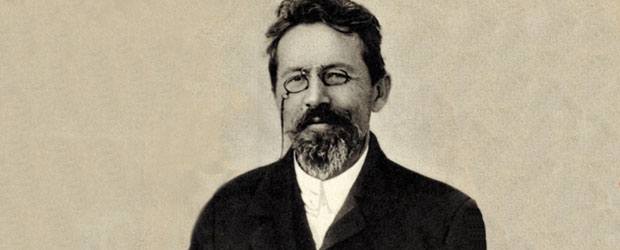
THE RUSSIAN WRITER Anton Chekhov was born in 1860, the son of a poor grocer. He studied medicine, supported himself and his family by writing, and eventually worked his way up to the profession of doctor. He travelled, lived five years on a country estate, and died in Yalta in 1904. He is today regarded as one of the finest writers of the short story. In short, he was a specimen of a Russian rarity, the upwardly-mobile peasant literary genius.

The above sketch is clearly skeletal, but it suggests already the themes with which Chekhov was concerned: rural life, the relation of the classes, and self-improvement through education. Most Chekhov stories involve something like the following. A Russian goes on a rural trip in harsh weather. He is brought by circumstance into the company of a differing social class. Someone brings out the samovar, or tea-urn, and conversation ensues, but the classes do not communicate. There is usually a long passage in which the protagonist dwells upon the absurdity of it all. This one, for example:

Why are there doctors and medical orderlies, he wondered, why are there merchants, clerks and peasants in this world? Why aren’t there just free men? The birds and beasts are free, aren’t they? So is Merik. They fear no one, they need no one. Now, whose idea was it – who says we have to get up in the morning, have a meal at midday and go to bed at night? That a doctor is senior to an orderly? That one must live in a room and love no one but one’s wife? Why shouldn’t things be the other way round – lunch at night and sleep by day? Oh, to leap on a horse, not asking whose it is, and race the wind down fields, woods and dales like some fiend out of hell! Oh, to make love to girls, to laugh at everyone!

There is a good deal to be said about this quotation and the attitudes it suggests. But before we come to the analysis, I should like to explain why I’ve chosen this particular passage. For I could as easily have produced a dozen other on the same theme, all of them making the same point. I chose this one because I have thought exactly these very thoughts. ‘Who decided we must eat breakfast in the morning? sleep at night? work from dawn to dusk for a wage? dedicate our lives to consumption? look forward to the weekend and retirement? etc. etc.’ One can hardly live in an organized society without feeling the subtle and not so subtle external compulsions that determine so much of her behaviour. Are we free? Most of the time we think so, but then come those moments when we know we are living according to a script. It interests me that those moments involve things like breakfast and sleep. After all, war is obviously absurd, but breakfast? Precisely what feels natural, precisely this is being questioned. Beneath the careful crafting of a Chekhov story, one discovers the question, Could the world be otherwise than it is?

The question Could the world be other than it is? tosses us into politics. Here we find what I shall call the skeptical turn of mind – that is, the calling of things into question. A writer whose characters wonder over the meaning of breakfast could hardly be expected to accept human arrangements at face value. Yet what did Chekhov think? He seems to disapprove of the abuses of the Russian class system, but what would he put in its place, if anything? That is the rub. On first reading Chekhov, I find a vague humanism and a pervasive skepticism. Life is absurd. Yes, the peasants are getting shafted, but look at what sort of folk they are! Stubborn, bigoted, suspicious, and above all, stupid. They cannot even perceive their self-interest. Chekhov is commonly portrayed, along with James Joyce, as an exemplary model of the disinterested and apolitical writer. If he is unwilling to accept flattering nonsense about the aristocracy, he is equally unwilling to romanticize, in the common manner of the social reformer, the common folk. The consensus is that he merely describes the world without rendering a judgement.

Is this correct? Consider ‘An Awkward Business,’ which examines an incident between a country doctor, Gregory Ovchinnikov, and a medical orderly, Michael Smirnovsky. Here, as elsewhere, Chekhov establishes a set of contrasts. The doctor is young, educated, and thoughtful. Furthermore, he is a professional with aspirations. Chekhov is careful to note Gregory’s “keen interest in ‘social problems,’” a phrase which seems to me deliberately fuzzy. For Gregory, in contrast to the aged, bumbling, alcoholic Michael, is profoundly at odds with something we would call the system, and yet he’s unable to put his discomfort into practical language. Gregory’s problem is this: he has punched Michael in the face for coming to work drunk. He knows this is unprofessional behaviour, and that he ought to be disciplined, and yet the norms of 19th-century Russian society make only one outcome possible. The ‘old boys’ will rally around Gregory, and as a consequence his behaviour will be pronounced just. Indeed, this is precisely what happens.

Regarding the workings of the system, Gregory comments on ‘the sheer, the crass stupidity of it all.’ Here we have the perspective of the radical, the would-be reformer who is interested in social problems. Gregory seems to me to have Chekhov’s sympathy, but the implicit lesson of the story is that, like it or not, the system works. That, after all, is its function – to keep things moving along. Michael himself understands this and begs the forgiveness of his assailant. It is only when the embarrassed doctor suggests instead a lawsuit against himself that things get complicated. The expedient course of action would be to observe social conventions and let the system do its work. Why drag impractical notions like ‘social problems’ into the matter? No answer is given for this question. The impractical notions are simply there, and as a result Chekhov’s fiction is much more complicated than I’ve made it appear. His characters are plagued by a concern with justice, but they’ve learned to get along in an unjust world. It’s worth noting that the passage quoted above (“Oh, to leap on a horse…”) ends with this: “It would be a good idea to burgle some rich man’s house at night, he reflected.” In other words, once we have decided that the status quo is so much cruel nonsense, which clearly it sometimes is, we may move in any direction. Those directions include murder, robbery, and all manner of violence. Having questioned the prevailing arrangements, Gregory learns what everyone else has known all along, that things flow most smoothly when they follow the established channels. The alternatives are, as the story’s title ironically indicates, awkward.

The Chekhov I’ve proposed thus far conforms to the conventional notion of him as a wry observer of human affairs. But this Chekhov is, I think, too much a quietist, too much a man who merely contemplates things as they are without believing one can make a difference. That Chekhov was no reformer I agree. And yet I’m not satisfied with the view I’ve advanced thus far, that he is a skeptic and nothing more. He makes observable commitments and characteristic choices. There are implicit answers to the question, Could the world be otherwise than it is? In short, there is more to be said about the world of Chekhov’s fiction.

We may note the following. Chekhov is more interested in rural Russia than he is in the cities. Whatever implicit views he has may be inferred from his fondness for the ‘backward regions.’ He is interested in peasants, but he consistently narrates his stories from the perspective of the gentleman, or, where gentlemen are lacking, figures of relative high status. The protagonists are sometimes disdainful of their social inferiors but sometimes are ‘anxious,’ which is to say they encounter the lower orders with a mixed emotion of fear and desire. In the latter case, the upper classes do not wish to be confused with the down-and-out, and yet deep down they believe that the down-and-out lead a fuller, richer, more ‘earthy’ existence than they themselves do. The result is that the lower classes assume a sinister but compelling aspect, as in this passage from ‘Thieves’:

‘Phew, that girl has spirit!’ Yergunov thought, sitting on the chest and observing the dance from there. ‘What fire! Nothing’s too good for her.’

He regretted being a medical orderly instead of an ordinary peasant. Why must he wear a coat and a watch-chain with a gilt key, and not a navy-blue shirt with a cord belt – in which case he, like Merik, could have sung boldly, danced, drunk and thrown both arms round Lyubka?

Yergunov is nearly seduced by Lyubka, and he is robbed by Merik, but the greatest danger these characters pose is the one suggested by the story’s ending, that Yergunov will betray himself and defect his class. And why not? The peasants are having a wonderful time of it, robbing and killing with apparent impunity. Here we get another glimpse, I think, of Chekhov’s ‘position’ on the question, Could things be otherwise in the world? Nowhere does Chekhov allow class defection to occur without at least the suggestion of dire consequence. One has a choice to be a peasant or a gentleman; beyond that there is mere anarchy. Furthermore, class mobility is properly a matter of sustained effort and self-transformation. His is the sensibility of a man who through his own effort has left behind poverty and achieved success, and who believes that the answer is for others to do likewise. In short, he is concerned with personal evolution, not social revolution.

This explains the features of his work, some of which I have already identified. There is no grand social-reform vision in Chekhov’s stories because he is interested in the individual. This interest informs the manner in which he both criticizes and affirms the system. The system dooms the occasional intelligent, gifted individual to be born a peasant; nonetheless, for most peasants, theirs is a proper and even necessary role. As Kuzmichov comments in ‘The Steppe,’ ‘The point is that if everyone becomes a scholar and gentleman there won’t be anyone to trade and sow crops. We all starve.’ It’s not clear to what degree Chekhov endorsed Alexander Arkhipovich’s claim (in ‘An Awkward Business’) that ‘It’s only among professional people and peasants – at the two poles of society, in other words – that one finds honest, sober, reliable workers nowadays,’ but isn’t it interesting that he chooses rural settings, precisely where he may best concentrate upon these two classes. My suspicion is that, like Kuzmichov, Chekhov accepts the practicality of the class system. Social revolution is regarded skeptically, while the system, though evidently flawed, is at least valued as a source of social stability. Those characters who do accomplish a sort of revolution, for instance the protagonist in ‘The Cobbler and the Devil,’ find the results disastrous. The cobbler sells his soul to the devil in exchange for riches, but because he has not risen to his position through his own efforts, but instead by a sort of trickery, he is unable to fill his social position credibly. Despite his riches, he is still at heart a cobbler. When he wakes to find the whole thing was a dream, he joyfully accepts his humble lot. He has learned it’s where he belongs.

The Chekhov I am inferring may today sound reactionary, but we should recall the sort of ideas which were about in the 1890s. Social Darwinism was in ascendance in America, Germany, and Russia – to cite only the most historically significant manifestations. One of Chekhov’s late stories, ‘The Duel,’ repudiates proto-fascist notions about the lower classes, i.e., that they are degenerate and must be sacrificed to the greater good. Chekhov had no kind feeling for this point of view. Here however we may introduce another characteristic of Chekhov’s fiction, that it is almost oblivious to the stirrings of what has come to be called Modernism. A rural setting allowed Chekhov to explore the Russian class system, but the exploration is devoid of what really matters, from a modern point of view. I am referring to the conditions of urban life, the urban proletariat, the aristocracy, and mass society. His fiction looks backward, or tries to ignore the march of history altogether. Considered in its historical context, Chekhov’s decision to write mostly about peasants and gentlemen is remarkable.

I should address the accusation that Chekhov cannot be judged by today’s standard. Modernism did not come along until after his death, so how can he be expected to have written about it? I believe this accusation is misplaced, because clearly Chekhov did see what was happening. He knew that something one of his characters calls the ‘in-betweeners’ was emerging between peasant and gentleman (likely a reference to the rural bourgeoisie, known also as Kulaks or miroyed), and he knew about conditions of life in the cities. The point is, these did not interest him as a writer. He must also have been aware of grievances against the tsar, of the ‘Land and Freedom’ movements, and of the growing state repression of reform efforts. Nonetheless, Russia in 1890, for Chekhov, is farm labour, violent weather, inns, and samovars. ‘Upper classes’ means country priests, doctors, and clerical workers: in other words, gentlemen who have been educated out of the peasant class. As I’ve remarked earlier, these are the only two classes of person you’ll find. Chekhov also gives us murderous criminals, madmen, and exiles, but these are people outside society. They serve as a foil to his chief interests. Nor does class as such seem to be his concern. The peasants complain of their lot, and their suffering is presented sympathetically, but with a suggestion that it is inevitable, given their ignorance. There is no hint of the political struggles that culminated in the 1917 Revolution – struggles, one should note, that had been going on for many decades. One encounters the odd peasant rant against ‘the rich,’ as in the story ‘New Villa’ for instance, but we are never encouraged to take these comments seriously. Class oppression does not seem to be the problem for Chekhov, who himself had shown you could move about in Russian society if you had talent and a bit of gumption.

I am tempted to say that Chekhov’s fiction is informed by something akin to ‘classical liberalism’ or ‘meritocracy,’ but neither term is quite appropriate. I do think nonetheless that the stories imply a rejection of social reform (especially revolution) and that they treat ‘social problems’ as a matter of the individual. The world is recognized as a cruel and harsh place, and the poor are shown to have it badly. But Chekhov suggests that nothing can be done for them which will alter the fact of their poverty; alas, there must forever be peasants. One cannot read ‘New Villa’ without getting this message rather clearly. If the odd, individual peasant has talent and education, he may become a professional. In any case, the system will sort things out and people will end up where they belong, either among the peasants or gentlemen. Note that some, like Chekhov’s cobbler, will belong at the bottom and will only be harmed by artificial arrangements that put them elsewhere. The end result of the system may be harsh – will probably be harsh – and you may not like it, but such is life. That is the apparent moral of many a Chekhov story. Chekhov believed in private philanthropy and the obligations of rank (he helped to organize famine relief), and his story ‘My Wife’ shows he found the gentry’s mere lipservice to these deplorable. But the fact of wealth and poverty does not seem to have bothered him, so long as everyone bore his social rank with dignity and treated others kindly. The people who flout this principle get Chekhov’s harshest treatment. One however should not mistake the harshness as the sentiment of a reformer. If I am correct, Chekhov’s fiction offers us a qualified and careful apology for the class system.

All of this no doubt sounds familiar. Something like the ideology I have been describing is emerging as the official political consensus in all the industrialized countries, including Canada. Already it is the dominant view in America. Put crudely, the beliefs are that social reform has been attempted and found misguided, most of the poor are the authors of their condition and aren’t helped by the state regardless, one’s social position is a matter of merit, the individual alone is responsible for his or her fate, and the best one can do is to alleviate suffering through private philanthropy. Along with the emphasis upon the individual we find renewed attention to education, crime, and the family. When the system is conceived as a mere collection of individuals, issues such as personal crime (as opposed to corporate crime), private education, and personal moral values will come to the surface. The behaviour of the individual will become the substance of reform. Class conflict, structural unemployment, systemic racism, and other such grand reformist catch-phrases will recede to the margins of public discourse. The system will be of little political concern. Reformation of the subject will be the political object. (June 1998)

How I Survived My Education

Writing-lines

WE ARE ALL deeply indebted to our education system, for despite it, and maybe even in rebellion against it, we have become educated persons. Education like birth is something that simply must be done, and however much you may have benefited from it, you’d hardly wish to do it all over again.

I remember peculiar details whose significance today escapes me. I was once forced to stand in the hall for something I’d done, or hadn’t done; I had to go to the bathroom but I feared interrupting the class, so I pressed my legs together and danced until the pressure was more than I could bear, and then I wet my pants. This sort of unpleasant experience is unusual only in particulars. Most of my memories of school involve the themes of crime, authority, fear, and punishment. I suspect any other student could tell comparable tales. Nothing which could be construed as a ‘lesson’ remains afterward. I remember only the punishment, and the rest might as well never have happened.

The grammar school I attended had a long tradition of military-style education. The principal as late as the 1950s was typically a retired sergeant, or some similar figure. ‘Stern, male, and authoritarian’ seemed to be the chief requirements of the job. The yet-surviving Victorian model of the teacher was vanishing, but examples were still plentiful enough. The awkward phrase ‘Victorian model of the teacher’ is my own, and if I had a better phrase I would use it. It designates the educated middle-age woman who, having raised her own children, is thrust upon the children of others only to keep her busy. Behind the practice were some ugly assumptions about women and children which I suspect are familiar. Even today the assumptions inform our education system, which is why tenured university professors tend to be male and grammar-school teachers female. One assumption, which applies to other professions as well, is that work done with children really isn’t important enough to command the respect and wages of work done among adults. Thus the school was a dumping ground of sorts, and though inspired and gifted teachers could be found, they were accidents. Deviation from the norm was an unfortunate condition to be beaten back, and the creative teacher faced, then as now, a host of opponents.

To appreciate the character of the education I’m describing, you’ve got to consider the sort of things one was expected to learn: spelling, penmanship, punctuality, respect for authority, and obedience. All of these involve conformity to standards, whose justification is taken as self-evident. One learned to spell ‘correctly,’ with the help of a British dictionary. The authority of the dictionary was taken for granted, as if there were only One True Dictionary. I was also taught there was a correct way to make a lower-case ‘p’ – with the vertical stroke rising above the curved, much like the Old Norse thorn, þ. Regarding punctuality, never my strong point, I was reminded that I’d never get a job if I couldn’t learn to be on-time. Here the clock was the authority, and there could be no questioning the exigencies of the schedule (correct pronunciation: ‘shed-jewel’). Regarding respect for and obedience to authority, no matter what subject was ostensibly under consideration, these were the lessons. I suspect they were ultimately all that we were meant to learn.

In my case the system failed; I somehow learned not to respect and obey, as a matter of habit, authority. School showed me that our leaders are not self-justified, and that they indeed often behave far from justly. I learned these lessons while reflecting on my experiences. As an adult I could see clearly that the function of the system was to produce moderately intelligent middle-managers and docile proles. That is what the industrial capitalist system of my childhood needed, and that is what it mostly got. The system was designed to produce people who would show up for work on time and do what they’re told, how they’re told, no matter how demeaning, pointless, or even stupid it may be. The system produced these folks the way it produced everything else: in mass quantity, according to specification. In such a world it’s inconvenient to question the structures and dictates of work, just as it’s awkward to ask why ‘fill-um’ is the correct Canadian way to say film. Such questions were discouraged. In both cases one was expected to do as one was told, period. Authority, I discovered, is often a mere matter of expedience. Education standards, for instance, may serve the interests of education bureaucrats more than they do students, and the function of the authorities may be to ensure that the standards always triumph. In my opinion, you’re not educated if you’ve never had this suspicion.

When you start to ask questions, a curious phenomenon occurs. Things begin to unravel. You learn that authority stands on shaky ground. The teacher is not all-knowing and in fact only says fill-um because she was told by someone (another authority) that it is proper to do so. Behind every authority is only another authority: the Oxford dictionary, the CBC, the Queen, and so on. Question any individual authority and there is nothing in principle stopping you from questioning authority itself. How frightening such a state must be for teachers whose insufficient training and meagre resources make them entirely dependent upon the teaching guide. Their authority is all that they have. At least the bureaucracy offers them the conditions they need to do their job. One person’s hell is another’s heaven, and I know today that mindless fill-in-the-blank work is a blessing if you’ve got the right temperament. Bureaucracy, after all, serves a useful and even civilizing function. You need only do and think as you’re told; the system will then propel you along toward your pension.

Although this may sound cynical, it describes the way most of us live. Consider the realm of opinions. Even if we don’t believe most of what we read, we at least have read most of what we believe. We couldn’t possibly have first-hand knowledge of all that goes on in the world. We have to believe something to function. I don’t mean ‘belief’ in the religious sense of ‘faith,’ as in the phrase ‘to believe in God.’ Instead I mean belief in the sense that we concede the world is pretty much what the experts say it is. Though the meanings overlap, they differ in the sense that the expert describes something you could see for yourself, like an atom, if you made the effort. Experts pretend to describe objective facts, in relation to which blind faith is not only unrequired but inappropriate. If you doubt the descriptions, you are free to examine the matter for yourself and to form your own opinion. Most of us however haven’t the time or inclination to do this, and so we acquire our opinions second-hand. This is not an argument against the media, but merely a description of the way in which opinions necessarily operate in the real world. We can only go so far in challenging conventional wisdom, if we challenge at all, because beyond conventional hearsay there is conventional heresy, and beyond that little more than regions of fire and dragons. The conventions, whatever their shortcomings, serve a function.

One of the great and overlooked paradoxes of the education system is that it is blamed for all social ills and called upon to remedy them. The possibility that it is neither the disease nor the cure offers little opportunity to the polemicist and so is rejected. Civilization has its discontents, but this is not entirely the fault of the education system. Even if we restrict the discussion to learning, the education system can be shown to have a doubtful role. Einstein’s genius did not flower as a result of his contact with the University; he was at best a mediocre student. There’s no doubt in my mind that the education system of my childhood tended toward stupefaction, but stupidity was not always the outcome. Yes, school inoculates the young against intellectual curiosity – but this is only merciful, so long as the adulthood to which the young may look forward consists mostly in mindless work, endless sitcoms, and cajoling advertisements. When’s the last time you heard an education reformer observe the obvious, that there’s almost nothing to do with intellectual curiosity except make a pest of oneself. The corporations do not want it, despite their talk of the knowledge economy; the government does not want it; the TV does not afford it; and your boss will retaliate at its first appearance. In short, intellectual curiosity is as useful to social success as bad breath. Nothing is cultivated at such cost, with such pains, only to be met by such perfect indifference. That is why the education system works the way it does. And it does work, by rooting out intellectual curiosity and replacing it with ‘workplace skills,’ lest a peaceful and gainfully-employed existence be forever precluded.

Any system will fail at least some of the time. Intellectual curiosity may survive prolonged therapy. In my case the education system was indispensable to my efforts, like the floor against which an athlete must push in order to leap. I began my life as a critical thinker when I first discerned what the education system is really designed to do – and how far this reality is from what education spokespersons claim it is designed to do. Reformers insist they want to make the education system a place of critical thought. Think about it: a generation of critical thought would pretty much put an end to the advertisement and PR industries, not to mention a good many political careers. The whole culture would have to be remade to suit the thinking and tastes of clever, skeptical people. Critical thought would pose a larger technical challenge than the Year-2000 bug. Our dullness is a national treasure. It is an industrial lubricant; without it the wheels of progress would grind to a halt. No more blockbusters, no more bad newspapers, no more trickle-down economics, and on and on. Do we really want to end civilization as we know it?

I would, but that is only because I am a pest who’s survived the education system. [-June 1998.]

Bertrand Russell on freedom of speech

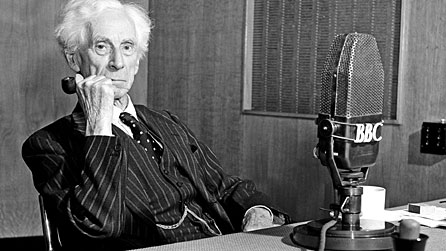
Writing to the New York Times on the 20th of April 1940, Bertrand Russell reminded his audience (chiefly, the editors of the Times) of an unpleasant fact. His no-nonsense, that’s-the-way-it-is manner you will recognize as characteristic. “In a democracy,” he urged, “it is necessary that people should learn to endure having their sentiments outraged.”

The occasion of Russell’s letter was a Times editorial implicitly supporting a decision to ban Russell from teaching at the College of the City of New York. The outraged sentiments in this case belong, I presume, to the ecclesiastical authorities, politicians, citizens, and newspaper editorialists who demanded that the College Board ban Russell, and who to that end launched a bilious project of defamation. The history of that project is long, complicated, and rather ugly; a more thorough review of it can be found in the form of an Appendix to Russell’s Why I Am Not a Christian (London: Unwin Paperbacks, 1988). This account itself is derived from The Bertrand Russell Case, published in 1941 and edited by Horace Kallen and John Dewey. For the present purpose, which is to extrapolate from the above quotation, only a relatively brief sketching of events should suffice.

Russell at first was granted the appointment, by the Board of Higher Education on 26 February 1940, to teach 3 Philosophy courses: logic, foundations of mathematics, relations of pure to applied sciences and the reciprocal influence of metaphysics and scientific theories. Nineteen of the twenty-two Board members were present for the vote, and all nineteen were in support. Only when the decision was made public did trouble begin. A Protestant Episcopal Bishop by the name of Manning wrote to New York’s newspapers, denouncing “a man who is a recognised propagandist against religion and morality, and who specifically defends adultery.” Here I shall interject myself to suggest that these accusations weren’t so errant as they may appear. Russell was a propagandist against religion and, in a sense, against ‘morality’ too, morality here defined as a coercive fear-based system of control grounded in and perpetuated by the Church. Of course, Bishop Manning probably meant to imply that Russell was ‘against moral goodness,’ but that is another matter. The Bishop’s sentiments having been outraged, such quibbles went out the window. As the campaign against Russell aged, other judgements were rendered. The materialist philosopher and self-styled agnostic was called “a professor of paganism,” “a desiccated, divorced and decadent advocate of sexual promiscuity,” “an ape of genius, the devil’s minister of men” and an “anarchist and moral nihilist of Great Britain.” This last quotation openly displays the chauvinism informing these attacks; their general drift is that Russell is not one of Us, he’s one of Them, hence he must be repelled. It’s noteworthy I think that Russell’s response was to defend, not his opinions, but his democratic right to be one of Them. After all, it’s clear that’s what he indeed was.

What happened next is as follows. A member both of the Board and of the Protestant Episcopal Church, Charles H. Tuttle, altered his decision after claiming he’d been ignorant of Russell’s views. Tuttle put the appointment back on the agenda, public vilification intensified, new accusations appeared, and yet the original Board decision was sustained by a vote of 11-7. The campaign however only got nastier, if this was possible. City politicians and administrators urged the cancellation of college funding, the toughening of immigration policy to keep out “dogs” like Russell – the word was Councilman Charles E. Keegan’s – the undertaking of investigations into the education system of New York, tarring and feathering, and so on. During this controversy Russell had his defenders too, among them liberal religious leaders and publishers, academics, and politicians such as City Council Republican Stanley Isaacs, all of whom defended Russell’s appointment at great risk to their careers. Along the way Albert Einstein delivered one of his enduring observations: “Great spirits have always found violent opposition from mediocrities.”

Defeat of the Board was undertaken in a lawsuit issued by a Mrs. Jean Kay of Brooklyn and presented before Justice McGeehan. Kay filed a taxpayer’s suit in the New York Supreme Court, where her lawyer argued that Russell had not taken a competitive examination before receiving his appointment. To this, the lawyer added the charges that Russell was an alien, atheist, and an advocate of sexual immorality, all of which necessarily ought to exclude him from teaching. The Board’s lawyer attempted to restrict the case to the legal question of whether an alien could be appointed to a post in a US city college. Unfortunately for both him and Russell, McGeehan was a crusader on behalf of public morality and ruled two days later that Russell’s appointment was an “insult to the people of the City of New York.” Russell later was represented by independent counsel, but an application for permission to answer Mrs. Kay’s and her lawyer’s charges was dismissed by McGeehan on the astonishing ground that Russell had no “legal interest” in the matter. Successive requests for permission to appeal were also denied. However, McGeehan himself could not stop the Board from hiring Russell. In the end it took the combined efforts of New York Mayor LaGuardia, Bronx Borough President James J. Lyons, and several members of City Council, who banded together to ensure that Bertrand Russell would never teach in New York. Mr. Lyons introduced a resolution at the meeting of the Board of Estimate, which was made part of the terms and conditions of the budget. It read, “No funds herein appropriated shall be used for the employment of Bertrand Russell.” No funds were.

Believe it or not, this is the brief version of the story. The full version contains a good deal more twists and turns, principal players, ugliness, and also courage. The general theme of the story, if I may be allowed to use literary terms, is the Struggle for Intellectual Freedom versus the Defence of Decency. On the one hand we have Freedom of Speech, and on the other, ‘No, not if we don’t like what you’re saying.’

Here we arrive at the entrance of the Times. After a long silence, an editorial appeared on 20 April 1940 in which it was argued (among other things) that the appointment of Russell was impolitic and ought to have been declined by the recipient “as soon as its harmful results became evident.” That is to say, none of this would have happened had Russell just shut up and gone away. The Times editorialist concluded that it was all his fault.

In his response, Russell acknowledged that “it would certainly have been more prudent as far as [his] personal interests are concerned” had he declined at once his teaching position. He refused however, arguing a withdrawal would give tacit assent to the proposition that “substantial groups shall be allowed to drive out of public office individuals whose opinions, race or nationality they find repugnant.” As for the controversy he had occasioned:

I do not believe that controversy is harmful on general grounds. It is not controversy and open differences that endanger democracy. On the contrary, these are its greatest safeguards. It is an essential part of democracy that substantial groups, even majorities, should extend toleration to dissentient groups, however small and however much their sentiments outraged.

And then he added, “In a democracy it is necessary that people should learn to endure having their sentiments outraged.” This seems to have been the fundamental issue for Russell, as well as for the people who came to his defence. Challenging this point of view we find the propositions that some things are better left unsaid, and that ‘the people’ have a right to ensure that they aren’t said. This we may designate the right not to endure having our sentiments outraged.

Russell’s argument is, I think, characteristically harsh. We tend to think of freedom as a bundle of personal rights. Put crudely, democracy in this view consists in my doing what I want without you getting in my way and trying to stop me. We tend less to consider the necessary complement of this formulation – that is to say, rarely do we approach democracy from the point of the view of that fellow who has a strong moral impulse to do the stopping. When we do find ourselves in that position, freedom usually ceases to be the issue. The function of Russell’s letter is to make us see the matter from this complementary perspective. We are reminded that going swimmingly about your happy business without the interference of shits isn’t the sole outcome of democracy; it’s also having to live with the daily outrage of people who insist upon going about their happy business, of which you happen not to approve. Bertrand Russell is a writer who reminds you that your civilized comforts are possible only because somewhere there is someone else suffering on your behalf. The loftiest principles have to be founded somehow, usually in the muck. Since most of us tend to see democracy from the Get Off My Cloud perspective, Russell’s habit of looking up at things from the gutter is disconcerting.

Democracy isn’t a convenient arrangement. When Our side is winning then, obviously, it’s all fair and democratic. But when it’s Their side having a day of it, democracy seems somehow to have failed. We are all susceptible to that sort of hypocrisy, aren’t we? The remarkable thing however is that some of the people who came to Russell’s defence must have been personally offended by his views. At the very least, some of his supporters did not share them. Among his voluminous writings – forty-three books by my count – you will have trouble finding one positive word about religion. Russell, especially skilled at invective, reserved his harshest attacks for the church and its representatives. I have no doubt he felt as strongly about abolishing ‘superstition’ as his opponents felt about abolishing ‘immorality.’ Russell, in his own manner, was a moral crusader. In the world toward which he laboured, there was no place for God and religion. And yet among the people who defended his right to speech as well as to teach were Rabbi Jonah B. Wise, Professor J.S. Bixler of Harvard Divinity School, the Reverend John Haynes Holmes, and the Episcopal Reverend Guy Emery Shipler, the last of this list even disputing Bishop Manning’s right to speak on behalf of the Episcopal Church. Given Russell’s opinions, the public support of these individuals was quite generous.

You may also say this support was self-interested, but that does not diminish the gesture. Democracy itself is founded on, among other things, self-interest. When certain people are no longer willing to have their sentiments outraged, and seek to alter social arrangements on that account, the freedom of all is endangered. Russell, a logician, used words with great precision. Note that he did not write, ‘In a democracy, it helps when people learn to endure having their sentiments outraged.’ His view of freedom was self-interested, but it also considered the public interest. Follow Russell’s argument to its logical conclusion (he would be gratified by this approach) and you find the proposition that in a healthy democracy one finds, not only personal liberty, but people who’ve learned to endure being pissed off. One’s self-interest in liberty is easy to identify, and yet there is an equal self-interest in tolerance of others which tends to feel less compelling when you’re hot under the collar.

I’ve been considering freedom and democracy in abstraction, removed from the messiness of real life. Almost no one would argue against freedom in principle. And yet there are cases every day where freedom seems to many an intolerable burden. What do you make, for instance, of the freedom to publish Nazi tracts, kiddie porn, and hate literature? Here is a question that invites us to draw our personal boundary around freedom, something each of us does. In my case, I almost wrote in the above sentence: “What do you make, for instance, of the ‘freedom’ to publish Nazi tracts, etc.” The quotation marks around ‘freedom’ are a dead give-away; they tell you that, deep-down, I don’t think freedom ought to be extended to the hateful acts of creeps. Thus, when it’s Their speech under question, the issue is not Freedom, but rather Combating Racism, Violence, and Hate. That’s how I feel deep-down. Somewhere presumably higher-up however I suspect that racism and violence don’t go away just because you’ve told them to. Banishing unpleasantness from the public domain was the solution (or ‘solution’) of the Times editorialist, who presumably conceived the ideal public domain as a kind of smooth elevator ride, and ideal public debate as a kind of Muzak. The Times offers us comforting illusions of an easy peace, and although most of us believe peace is what we ought to have, our experience shows us Russell is closer to the truth of things.

By peace I mean the absence of controversy and dissent. We often complain that politics is nasty, that there should be bipartisanship, that people should put aside their differences and get things done, and that the government is too inefficient. To a degree I think the complaints are well-founded. Yet I also find it curious that dissent, controversy, and inefficiency should be regarded in this case as negatives. All of these could be eliminated through the institution of a fascist dictatorship, but few if any of us want this because we cherish the freedom of speech and the right to representation. In practice however these translate roughly into dissent, partisanship, and inefficiency. The trouble-free democracy advocated by the Times editor turned out not to be democracy at all, but instead the right of the raucous to their peace and quiet. In the end they got it, too. [October 1998.]