All posts by Wayne K. Spear

waynekspear.com

Making Love

1. The first thing we need to clarify is the terminology.

Making love is not to be confused with having sex. To make love is, as the phrase suggests, to make. To have sex is, conversely, to have. To have is to possess, and everyone knows that possession and love are nowhere to be found together.

Intercourse, fornication, and copulation are too clinical and pretentious; they lack emotional content and make one feel that you are just showing off your vocabulary. There’s nothing romantic about snobbery.

Sex sounds too Anglo-Saxon, even if it has a Romance etymology. We ought not to confuse the matter by getting obsessed with the facts. The truth is, sex doesn’t sound very nice, no matter how delicately you try to articulate it.

Humping and screwing are demeaning. It grieves us that we have to even mention them. Some people think these terms are cute and funny, but general consensus dictates otherwise. The former term might be appropriate for the sexual activities of dromedaries, but certainly not of homo sapiens, while the latter term is best reserved for specific acts of carpentry.

For brevity’s sake, we will dispense with a thorough technical discussion of: porking, poking, the horizontal bop, bonking, doing the wild thing, makin’ bacon, fooling around, going down and tumbling in the hay. These terms should be avoided. This is not a moral judgement, however – merely a recommendation.

2. When to make love.

The best time to make love is Saturday night between 9:30 and 10:00 p.m. The weekdays are problematic because of busy work schedules. No one has time nor energy. Friday night is worst of all because of the cumulative exhaustion of the work-week. Your best plan is to get as much sleep on Friday night as possible. Therefore: go straight to bed. Do not make love.

Saturday morning would be good, except that there are so many things to do. Think of all the bills that have to be paid, the errands that have to be run, the myriad of chores that have been neglected because you were too busy throughout the week to get around to them. When the alarm clock rings, you had best get right out of bed and get to it. Have your partner help. Tell him to think of dusting as fore-play. This will encourage him to be efficient and enthusiastic.

Note: make sure the bills are paid! Nothing causes coitus interruptus and similar sexual disfunction like the stress of financial debt. One gas bill alone could wreck everything.

If you are efficient and organized, you will have enough energy Saturday night for making love. Here are five questions you can ask yourself and your partner to be sure:

-Am I craving sleep continually?
-Am I listening to my inner child?
-Does my partner respect my needs no matter what, or am I being pressured somehow to do something I do not want to do?
-Do I typically fall asleep during lovemaking?
-Am I getting pleasure out of lovemaking, or am I merely fooling myself?

If you have determined that it is prudent to make love, we recommend the following: First, wait until your favorite television program is finished. If you make love during a half-hour block in which a program you do not like is being broadcasted, your mind will not be divided between love making and television watching. A one-half hour block ensures that you will have time to make love and also to finish any chores (such as dish-washing) that have accumulated throughout the day. Second, ensure that the answering machine is on so that you won’t need to answer calls. Resist the impulse to rush to the phone, even if you are experiencing a lull in the activities. Most calls are not urgent and can be followed up immediately after orgasm, if such an event occurs.

3. Let us proceed to the act itself.

We have established the following norms of lovemaking:

-the missionary position, man on top. Creativity leads to perversity, and besides, you work hard all week. Don’t complicate your life needlessly.

-the bedroom. We are told that the French make love throughout the house, and even prefer the bathroom. This seems unhygienic, and not entirely in good taste. We feel the bedroom was made for making love, and making love for the bedroom.

-since foreplay has more or less been merged with Saturday chores, you might as well get right down to business. It’s a busy world, and besides, you’ve been waiting all day. And no one waits all day for anything anymore.

-congratulate yourself and your partner when appropriate. Nothing is more important in today’s atmosphere of global competitiveness than to reward and to encourage excellence.

Canadian History if Necessary, But Not Necessarily Canadian History

canada-history

THE CHIEF THING that I remember of high school Canadian history is that it was boring. I suspect the same is true in your case. Here is my summary of high school Canadian history, roughly as I recall it: Canada was a pristine land inhabited by some Indians, and discovered by John Cabot in 1497. Jacques Cartier later explored the interior. It’s thought Vikings were in Canada before Europeans, but in any case Samuel de Champlain first colonized the land adjacent to the St. Lawrence (Upper Canada). The French settlers took to fighting the English over control of the resources. A number of alliances with the Indians were made by each side, and trade networks were established. This was the era of the courier de bois, or ‘woods-runner,’ usually a “half-breed” who moved goods from indigenous supplier to white trader. The English gained the upper hand over the French at the Plains of Abraham, in the 1750s or so. The Treaty of Paris ceded North America to Britain. The Yankees then took to fighting the British. In the War of 1812 the Yankees were finally driven back for good. Isaac Brock fought heroically and died beside Chief Tecumseh at Queenston. Troops from Halifax invaded Washington and burnt down buildings, most famously a building which was afterward painted white and called the White House.

Read More

A Faggot On The Alexandra Bridge

I’m not one given to the media fetish of the Ten (or One or Twenty or …) Years Ago Today. We knew, for instance, there would be a gush at the moment Michael Jackson had been dead for precisely three hundred and sixty-five days. It’s an arbitrary and meaningless trope, a cheap hook on which to hang a cheap rag.

However, there are some anniversaries that are with me throughout the year — one of them being the 1989 murder of Alain Brosseau. This then thirty-three year-old man worked in downtown Ottawa and lived in Hull, which necessitated a crossing after each shift of the Alexandra Bridge. On August 21 he was attacked by a group of men, who dropped him head-first from the bridge onto the rocks below, resulting in his death. The piece of information considered essential in this senseless incident is that Mr Brosseau’s attackers killed him because they assumed — wrongly — he was gay.

On the twentieth anniversary of this vile act, civilians and the Ottawa and Gatineau Chiefs of Police met at the middle of the Alexandra bridge at dusk in a symbolic “lighting” of the bridge with flashlights. The idea was to represent a commitment to ensuring “gay-bashing” does not go unreported or unnoticed.

It’s an important commitment, and worth renewing. But of course it won’t and cannot prevent future attacks. Only a three-hundred and sixty-five effort toward discrediting and finally extirpating homophobia will do that. The lesson taken away by many from the murder of Alain Brosseau is that “it can happen to anyone.” I’ve always felt this both hit and missed the target. What if it could only happen to one in ten? Would that make it okay, or less urgent, if your name weren’t on the list of those Not Wanted On The Voyage? In that case you are complicit in the crime — another bystander who allowed it to happen.

I’d prefer to stand in solidarity; and as it happened on my way to work today, crossing the Alexandra Bridge (as I do each day), I was called a faggot by three drunken and menacing-looking men. Apparently it can happen to anyone. But even if it couldn’t happen to “just anyone,” it should never happen. We still have a lot of work to do.

CSIS: Getting It Right, Through Accident

Some days ago, Director of the Canadian Security Intelligence Service, Richard Fadden, said in what he presumed to be a sealed audience that “There are several municipal politicians in British Columbia and in at least two provinces there are ministers of the Crown who we think are under at least the general influence of a foreign government.” For this remark he has been called before a Parliamentary committee established just for this purpose, and has further been widely condemned by media for his supposed crimes of “casting traitorous aspersions” and McCarthyism.

It is doubtless apparent to all that Fadden referred covertly to the influence of China. (The closest he came to saying so was his use of the word “Asia.”) His failed use of code suggests that either he believed an effective veil was unnecessary or that he simply isn’t very good at it. It is also curious that he reposed in the assumption his words would never drift on the open air. What sort of “Spymaster,” as he has been frequently called, fumbles in such a manner? Only the sort of spymaster one finds across the bloated, complacent, self-serving, and incompetent bureaucracies of the “intelligence community” as constituted both here and in the United States.

In case we need the reminder, the mess in which things now are has been further detailed by John C. Major’s Final Report, “Air India Flight 182: A Canadian Tragedy.” Among Major’s findings are the following:

  • CSIS surveillance was ineffective. Surveillants were unable to distinguish one traditionally attired Sikh from another. When a CSIS surveillance team observed experiments involving a test explosion conducted by Sikh extremists in the woods in Duncan B.C. in June 1985 (the Duncan Blast), the loud sound heard was misinterpreted as a gunshot. No photograph was taken of the unknown third person present (Mr. X.) because surveillants had not brought a camera.
  • CSIS failed to include important information, such as the Duncan Blast, in the threat assessments it provided to the RCMP and Transport Canada.
  • The RCMP wasted resources creating a threat assessment structure parallel to CSIS’. The RCMP structure was itself ineffective – it failed to identify, report, and share threat information.
  • CSIS often failed to disclose promptly to the RCMP information relevant to the criminal investigation, particularly information from human sources, or it disclosed information without sufficient detail or in a manner that prevented the RCMP from using the information.
  • CSIS was mesmerized by the mantra that “CSIS doesn’t collect evidence,” and used it to justify the destruction of raw material and information. CSIS erased the tapes that caught coded conversations possibly related to the planning of the bombing, and CSIS investigators destroyed their notes that recorded the information CSIS sources provided in relation to the Air India bombing. Both of these actions compromised the prosecution’s evidentiary position at trial.
  • CSIS delayed disclosure of necessary information for the prosecution of Interjit Singh Reyat by adopting a legalistic and technical approach in responding to requests from prosecutor James Jardine.
  • The RCMP never made a written request that the Parmar tapes be preserved, though it was aware of their existence, and also never made a verbal request specific to the Parmar tapes until months into the investigation, when the early tapes were already erased. CSIS only ceased ongoing erasure in 1986, following a request by the Department of Justice in connection with the civil litigation.
  • The families were not kept informed about the investigation by the Government, and often learned about new developments through the media. The RCMP only began to liaise with the families directly after 1995. CSIS refused to participate.

… and on and on. It’s perhaps far worse in the United States, where the security establishment eats money and defecates requests for more, but no one is quite able to say. Such is the badness. In the meanwhile, the security industry conducts a farcical public relations campaign which has everything to do with managing public perception and little to do with security.

Even before anyone had come around to the word China, the Chinese were protesting a bit too much. The irony here is that all informed persons know China indeed aggressively promotes its interests internationally. What else would you expect of the world’s next global empire? The Confucius Institutes, the espionage, the busloads and busloads of planted Chinese patriots in my neighbourhood — during the recent visit to Ottawa of President Hu Jintao — the all-expenses-paid trips and the endless visits of VIPs: it’s all part of business for the world’s Communist behemoth.

But if you choose to be so naïve as to suppose the world isn’t roughly as Fadden says it is, at least fire the arrows into the proper targets. For this is one of the very few occasions on which a legitimate concern has been brought (even if by accident) to timely attention, by an agency more often having drawn attention for its appalling failures. To the degree that these recent statements are being ridiculed, dismissed, and savaged, the failure to see the worth of these statements is a public failure. You’ve been warned, in other words.

Learning How

You can learn how:

– to lose twenty pounds
– to have more confidence
– to get a man
– to hold on to him
– to be a beauty queen
– to get into shape
– to be more desirable
– to make better love
– to love him more
– to love him less
– to reduce your stress
– to balance home and children and work
– to be the person you’ve always wanted to be.

It’s easy. Here’s how:

1 1 Sit down with a piece of paper and itemize your priorities; or better yet, use a computer–you’ll find that technology is a powerful tool. 2 Read this thoroughly and practice the helpful advice, using your computer to record your progress.

2 1 Learn the proper uses of medication. There are pills that will help you to lose weight, and pills that will reduce your stress and give you confidence. It is up to you to educate yourself regarding their uses–in consultation with an expert, naturally. 2 Watch television carefully. There will be advertisements directing you to the purchase of technologically-advanced equipment. Be comforted by the knowledge that there is a scientifically advanced product for your particular defect. 3  See your doctor. You may be surprised (and relieved) to find that your womb is the source of the problem. Medical specialists have a great deal of experience with such cases. The treatment is usually quite simple and takes little time to perform. 4 Learn the basic concepts. Co-dependency, dysfunction and hysteria are terms that will apply to you, for all have dysfunctions and fall short of the models of authorities. With the correct terminology at your disposal, you will be more able to seek the appropriate product or procedure as dictated by an expert.

3 1 Use your computer to aid you in the organization of your treatment schedule. Begin a file on your software; you may assign it any name up to eight letters in length, such as “HOLINESS,” “PURITY,” or “BODY.” Be organized: submit yourself to a ritual of daily entries, or you will not find yourself improving. 2 When you are cleansed of an offence such as a weight problem or a personal insufficiency of a sexual nature, count off seven days, after which you must visit an expert, taking an appropriate form of offering such as VISA® or MasterCard®. Keep careful track of your transactions by entering the data on your computer file. 3 Continue to purchase self-help guides such as magazines, books and computer software. The field is always changing as new discoveries alter the quest for female perfectibility. As always, seek an expert for guidance when purchasing a product or service.

4 1 Find a private place in which to work. You ought not to disturb others with your problems. Entries should be made in silence, far away from the important business that is being conducted by others.

The G20 and the Bullet Dodged

If you are like me, you spent the past week looking forward to the end of the Toronto G20 summit, hopeful you could ignore it entirely; and if you are very much like me, you further hoped the event would pass without cause for comment.

Just so, most of it did pass without comment. Very little appears to have been written about the discussions themselves, which involved the usual stuff: growth, reductions of deficits and of taxes on capital, increased taxation of consumption, promotion of trade liberalization. The very things forever recommended by the World Bank and the International Monetary Fund, the agencies under whose auspices the G20 briefing documents were drafted. Now the “premier forum for international economic cooperation,” the G20 summit is a technical affair, not nearly as exciting as, say, burning police cars.

There is a patch of Canadian society which boasts the agitprop cliché that Canada is a police state. This idea is an instance of intellectual laziness, leveling the world’s moral terrain to make easier for the discontented their ascent to the heights of indignation. The Left, in Europe and North America, is now populated by “moral equivalentists” – folks who opposed the invasion of Iraq on the grounds that there is no difference between George W. Bush and Saddam Hussein. They have read enough Noam Chomsky to know that Robert McNamara and Henry Kissinger were wicked, and that U.S. foreign policy has been responsible for enormous human suffering around the world. So it has. The unfortunate legacy of Chomsky’s brilliant, original, and useful writings on, for example, East Timor, is a generation of half-educated rabble-rousers who will side with anything that is “against” the United States of America. Well, that simplifies things: The Saddamists are against America, so let’s be for that. The 2001 attacks on the World Trade Center buildings were attacks on Capitalism and American arrogance, so of course let’s sympathise with the attackers.

This kind of reasoning — if that’s even what it is — evidently relishes the destruction and taints a good measure of the political spectrum, from liberal democrat to anarchist. But consider: the time is not far off when the U.S. won’t even be the leading player in global politics, particularly in Africa, Southeast and Central Asia. That dubious honour will go, and is already going, to China. As for the idea that violent jihadism is a response to U.S. foreign policy, I’ll only suggest that this narcissistic idea misses the point. What we are seeing today in Central Asia and the Middle East is the continuation of a civil war in the Islamic world which predates American foreign policy and which has nothing to do with it whatsoever. One is better served on this topic by an understanding of the history and demise of the Ottoman Empire than by, say, a working knowledge of the Marshall Plan. (Better yet would be both.) This may seem a straying from the topic, but it is not. The people who see no difference, or at the least claim to see no difference, between the Taliban and Starbucks, are the same who constitute the flame-and-truncheon photo-ops. So let’s be clear: Canada is not a police state, and intellectual rigour demands of us a higher standard of analysis and more careful use of language.

It is however disheartening and discouraging, don’t you find, to witness the state playing dress-up, flirting momentarily with the trappings of dictatorship? I expect it’s been pointed out to you that the G20 summit was mostly a peaceful event, and indeed that is the case. Yet it could well have been otherwise. A great deal has been said and written of the Black Bloc tactics, with particular attention to the menace of their head-to-toe black clothing. A strategy of deliberate intimidation, it perfectly mirrors the contemporary riot squad, who have adopted precisely the same look. Why on earth are governments, and in this case the Canadian Government, needlessly cultivating such a vulgar dialectic? – and in the heart of Canada’s most densely populated city? What stupidity, and what vain recklessness, to roll the dice on the public’s safety in this manner. Perhaps the next time (and there will be a next time, maybe in your city) the peaceful bits will be the anomaly. If that is the case, the Government won’t even have the benefit of our doubt. They must know, as those familiar with mass human behaviour know, that in a moment things can go terribly wrong. And when they do, the inquiries and assignments of blame will be of no use to the victims.

Nothing asserted to this point has considered the value of these meetings and the conduct of the police. Even if one assumes that the G20 summits are of great utility, and that the police have over the past week behaved in an excellent manner (and these are far from settled assertions), the brick-headed folly informing this past weekend is, I hope, apparent. For it is unnecessary, irresponsible, reckless, and grossly wasteful of Canada to abet these periodic episodes of impromptu mass political theatre. Bullets were dodged this weekend, and fortunately, this time, that is a metaphor.

Seeing The Light

Part One: He was born in poverty and darkness

He made a few mistakes in the beginning, because he was born in poverty and in darkness. I’ve selected, arranged, itemized and interpreted them for you.

-He fooled around a lot, sexually.

-He drank heavily.

-He used foul language.

Don’t look so discouraged. It gets better: you know that.

-He once shot his brother in the foot during an argument about money. Everyone thought it was an accident, but I know that the bastard meant to do it.

He was a bastard, all right. But he reformed. He’s a decent fellow now: I rather like him.

Part Two: He sees the light

Before we go any further, I ought to produce the relevant facts.

1. He was born 4 October 1939.

2. His father was a housepainter and an alcoholic. His mother made crafts. This accounts for our hero’s artistic propensities. He has become quite a clever writer.

3. His mother often read the Bible to him, although he didn’t get much out of it at first–that is, before he saw the light.

4. He had trouble with women. He married in 1962, but after only sixteen months of marriage his wife left him. That was 18 May 1964 at 3:27 p.m.

The car she left in was orange.

5. He liked Dixieland music, and he played his 78 r.p.m.s loud.

6. He shunned vinegar.

He was a bastard, but he saw the light. Let me tell you about it.

On 6 June 1964, 10:27 p.m., he was sitting in Sam’s diner, a white rectangular building on Queen street. If you go there today you’ll see it, although Sam is dead now and the name has changed. It’s the same place though. The very booth he was sitting in is still there.

Anyway, he was eating a clubhouse sandwich with fries. He had put salt on the fries, but not vinegar. Sam’s had the best clubhouse in those days. The bacon made all of the difference: it was crispy, but not dried out and charcoal-tasting.

He had just finished his dinner when he looked up and saw the headlights approach the front window of the diner. The light was blinding. He thought he was going to fall to his knees. He said to himself, God who are you? He eventually got up out of the booth, onto his feet, blinded. When his sight returned to him a minute later, he looked out of the window.

It was him, all right. You don’t forget a face like that, especially when it’s behind the headlights of an orange car.

Well, to make a long story into a short story, he walked up to the front door and waited for the man to come in. They looked one another in the eye, and our hero said, “Step out back.” So out back they go, and our hero gives the man a damn good beating, like no one in that town has ever been beaten before.

When our hero is done, he goes home, puts on a Dixieland 78 r.p.m., and opens up his Bible. He sees the words, eye for eye, tooth for tooth. He thought of those words, there in the restaurant.

Because he saw the light.

Part Three: A New Man

Yes sir, he was a bastard, that man. But you know the story: with age comes wisdom, understanding and contentment. He’s a new man now. I rather like him.

Did I mention he became quite a clever writer?

Shopping Around

This time I am going to shop around.

I met my last lover at a party. I had had too much to drink. We had a brief and tempestuous affair, which ended horribly after three months. I told myself then, I will never make that mistake again.

Linda was my first lover. She was tall and slender. Her hair fell straight along her back, ending where the spine curves inward to form the base of a smooth concave pocket. Her eyes were dark brown, her skin pale. I remember that her teeth were remarkably uniform, as if they were artificial. I did not know real teeth could be so straight.

I’ve had dozens and dozens of lovers. I remember only a few. I’ve probably embellished them beyond all reality. My memories may be fictions.

Tanya had short hair. She dyed it henna. Her hair was bell-shaped and hugged her head like a snug wig. She used a product that made her legs as smooth as those of a store-front mannequin. She said it was excruciatingly painful and expensive to get her legs that way, but that she felt that it was worth it.

Maggie wore clothing from a local Middle-Eastern bazaar: silks and flowing scarves and Jinn pants. She wore pink foundation and red blush. Her preferred products were: Noxema, Clairol, Seabreeze, Neat, Max Factor.

Brenda was slightly overweight, but disguised it well with bulky sweaters and skirts. She worked primarily in odours: L’air du Temps, Channel and Night Musk. Her shoes were always of the highest quality, even those that she wore when taking the garbage to the curb.

Rachel liked to wear hats. She bought most of her clothing through mail order catalogues. Her favorite colours were hunter green, teal, and royal blue. She said she was a Winter. I met her during her black and white phase. She also had a brief leather phase, during which she wore tight black pants and cowhide vests. She liked to wear earrings that dangle to the shoulder.

All of these women were bad for me. I remember their clothing and the way that they smelled, and specific physical details: the curve of a leg, the flatness of a stomach, the darkness of eyes. What I’m not going to tell you about is the grief and the frustration.

I’ve tried for years to block it out of my mind.

Linda was never happy with anything I ever did. She hated the way I cut my steak, and was determined to reform me.

Tanya ate only vegetables and said it is morally wrong to kill cows. I said I only killed them to stop them. I said, Cows are the most vicious and hateful creatures alive because they prey exclusively on helpless vegetables. I told her that I was thinking about going after other vegetable haters too.

She left me.

Maggie was a singer and sexually voracious. She was also insane. She told me that Janice Joplin once came to her house and complimented her on her musical talent.

Brenda tried to make me feel guilty about every bad thing in the world. She told me I never really loved her, which was true, and that I was leaving her only because she wasn’t thin like a supermodel, which wasn’t. She held me personally responsible for the “chauvinism and cruelty of my gender.”

Rachel was unfaithful and ran off with a neighbour of mine. That was during her Spiegel earth-tone phase.

Relationships are so difficult. It’s woeful. But this time I’m going to shop around.

***

What I have learned about shopping

Do your research

Find out where the product comes from. Was it produced by a respectable corporation? Or by one that is exploitative? Check into warranties, and see what kind of experiences other people have had with this product. You may discover things of great importance.

Look under the hood

We’re not talking just about cars here. Whatever it is, see how it’s made and how it works. Have a professional come along and help. Kick the tires.

Ask about trial periods

If possible, take the product home for a few days for a trial run. Be explicit that this in no way implies a commitment. There ought to be no obligation to buy.

Compare and save

Don’t take the first thing that comes along, no matter how shiny and fancy it looks. And don’t enter into a bargain until you know all of the facts! Often a salesperson will only tell you what he or she thinks you want to hear. Don’t trust these people.

Take your time. Get the best deal you can.

Get everything in writing

Remember the expression: a verbal agreement is worth the paper it’s written on.

If you do purchase, keep the receipts and accompanying documents in a safe place

You might want to make an exchange at a later date. Perhaps get a refund. You are not personally responsible for defective goods, but be careful: there are no user serviceable parts. It’s also wise to keep the packaging. Often, with the excitement that accompanies a new item, we fail to consider the possibility that we may grow tired of it later. Or it may not work the way we had thought it would. If you have discarded the packaging, you are stuck with your selection.

Consider the costs

Ask yourself, Do I really need this product? Isn’t the aggravation more than I want? And the responsibility?

In today’s throw-away society, most products break down after only a few years. Then you’re stuck with a useless product and the costs of getting rid of it.

Be honest. Why are you considering this purchase? A lot is at stake. Do you think you could live without it?

You’d be surprised. Many people nowadays are.

Playing With Fire

Everyone thinks they know the whole story. The most recent version I heard came to me in Washington, D.C., and goes like this:

He stole the fire from the gods and gave it to men. The gods weren’t too pleased, because they like having all the power to themselves. He was being insubordinate, radical, rebellious. The head god chained him to Caucasus for eternity. Every day an eagle came down from the skies and ate his blackened liver. Every day the liver grew back. That’s how this version ends, with him chained to a rock forever and with the bird coming every day for fresh liver.

There are other versions. Sometimes the bird is a vulture, sometimes a hawk. I heard someone insert a seagull once. That shows you how careless and irresponsible humans can be. Then there are the disagreements about the organ: “was it a liver? I was sure it was a gall bladder.”

The problem is, none of these humans were there. Of course, even if they had been, it wouldn’t make a difference. Human beings can’t be relied upon to get the facts straight. They mess around with everything, like children. They exaggerate, embellish, distort. They lie when it suits them. It’s a miracle they ever agree on anything. Of course, the usually don’t; they usually end up arguing and fighting.

Still, the basic idea is the same no matter who you talk to. Prometheus is the hero. The gods are tyrants, oppressive and cruel.

This however isn’t the case. When you know all of the facts, you’ll be able to make a more accurate judgement. Of course, you’re probably only human, so it won’t be completely accurate. You’ll need some guidance.

What no one has told you is what happened after he stole the fire.

People were fascinated by the new substance. They lost interest in reading and sat for hours and hours every day staring at fire. Their minds were rotting in their heads. Some of our statisticians tell us that the humans spent on average forty-two hours a week fire-watching. The fires gradually became bigger and more violent. People suffered burns from sitting too close. People paid less attention to one another. Families began to fall apart. Family values were undermined.

Someone discovered that you could ignite dehydrated plant leaves with fire and inhale the by-products of the incinerating material. For some reason completely beyond our comprehension, human beings found this pleasurable. You now call this activity “smoking.” It is both unhealthy and immoral, and it instantly became very popular.

The females experimented with fire in their food preparation. Rather than good, reliable meals such as nuts and berries and raw vegetables, they began to cook and eat the flesh of animals, introducing carcinogens into their diet. We feel it is immoral to eat meat.

Arson became rampant. The usefulness of fire in acts of crime was discovered and exploited, with deadly results.

Fire encouraged romantic behaviour, especially–to our alarm–between unmarried human beings. Not only did men engage in sexual activities with women, but there were also abominations committed between members of the same sex.

It’s no coincidence that we speak of the fires of lust. Fire led to immorality, perversity and unwholesomeness. We knew something had to be done. People were incapable of governing themselves; their thinking and behaviour needed to be directed, legislated. Our decision was intended for their benefit.

We believed that the only way to restore godliness was to make an example of this Prometheus, therefore we drafted a bill outlawing the giving of fire to human beings. The bill was retroactive, enabling us to persecute the criminal responsible for the decline of morality.

You should be able to see that our decision was the right one.

Unfortunately, fire had become so popular that we feared that there was to be no return to the days of decency. We felt that our only recourse was through law, and so we began to punish those who undermined Nature.

Recently, there has been blasphemous talk about the irrelevance of the gods, and some actually believe that we no longer exist. Nothing could be further from the truth. We are still active, although our activities are acknowledged less and less by men. We somehow underestimated the ineptitude of the human race, and the harm that men are able to do to themselves. But we are still acting upon the problem, and we are about to redouble our efforts on behalf of the honourable cause.

Fooling Ourselves

You’re fooling yourself.

The first sure indication that you are fooling yourself is that you begin to hide things. Look under your bed. Right now. I’ll wait for you here.

Well? What did you see? Come on, you can tell me. There’s no way it will ever get out. I don’t know your parents or your priest or your milkman.

You don’t have a milkman? See, that just shows you how little I know you. You’re safe with me. You can trust me.

So what did you see? Fear? Guilt? Loathing? Did you see that horrible lie you told to your mother when you were thirteen years old? We both know you were really having sex in the bushes behind the school. And you said you were helping a friend make oatmeal cookies for the annual senior elementary bake-sale. To raise money for charity.

Don’t ask me how I know all of these things. Let’s just say I’m omniscient.

Not quite like God. Well, a bit like God. I don’t have much of a body, either. God and I like to maintain a respectable distance from materiality, except when it suits us to do otherwise.

You think you know what I look like; you think you are following me along pretty good. But you’re fooling yourself. You’re not fooling God though. He sees every hidden thing, just like I do. And he casts judgement on the things that he sees.

But don’t worry. I won’t do that. I am objective. Sometimes I’ll be ironic, but that isn’t a judgement exactly. It’s more like a fun little game. You know, you try and figure out what I really mean. It’s all in the spirit of play.

Are you following along? Good. That wasn’t an ironic statement, by the way. I really do think it’s good that you are following along. I don’t know where I’d be without you. I don’t have much company. Once in a while someone comes along and drops in, usually just for a few minutes. I make some witty conversation, but people are usually in a hurry or tired, so they don’t pay very careful attention. Their eyelids get heavy and their eyes start to close, and by that point I don’t even want to bother. At first I thought it was me, but after a few times through I began to see and to understand more.

Now I am practically an expert in human nature. If you stay with me long enough, you’ll learn something from me, I promise.

You do trust me, don’t you? How often do people make a promise as wonderful as the one I’ve made? Just think of it: I could help you to understand human nature.

-What makes romance so difficult? –Human nature.

-Why do we hurt one another? –Human nature.

-Where is the secret key to social improvement and a perfect society? –Human nature.

-What is the cause of suffering? –Human nature.

I guess what I am saying is that you can have an easy, pain-free romance in a world where people are honest and happy and free. I didn’t say it was going to be easy, though. You have to read a lot of books to get there, and books are expensive. So you’ll need a lot of money. And free time. And patience. If it doesn’t work out right away like you thought it would, keep trying. You’re probably doing something wrong. You’ll figure it out, eventually. The secret is human nature. Once you’ve understood it, everything else falls into place.

I know what you’re saying. You want a perfect world now. You don’t have time to wait.

You’re in luck. I’ve got a deal for you. Not only am I going to tell you that the key to a perfect world is human nature, but I’m going to tell you what human nature is.

Are you ready? Are you sure?

Okay. Here it is then. Human nature.

Shit. I don’t seem to have it on me. I know I wrote it down. It was on a slip of white paper. In my wallet.

I must have hidden it somewhere.

Goya and Me

The foremost recollection is as an eight year-old confronted with “Saturno Devorando a Su Hijo” [Saturn Devouring His Son], from the series commonly known as The Black Paintings, examples of which sat on the bookshelf of my parents’ house. From thence forward my apprehension of Goya has been inseparable from this initial horror, and yet his paintings have lasting positive appeal. What is it that makes Goya so compelling to me?

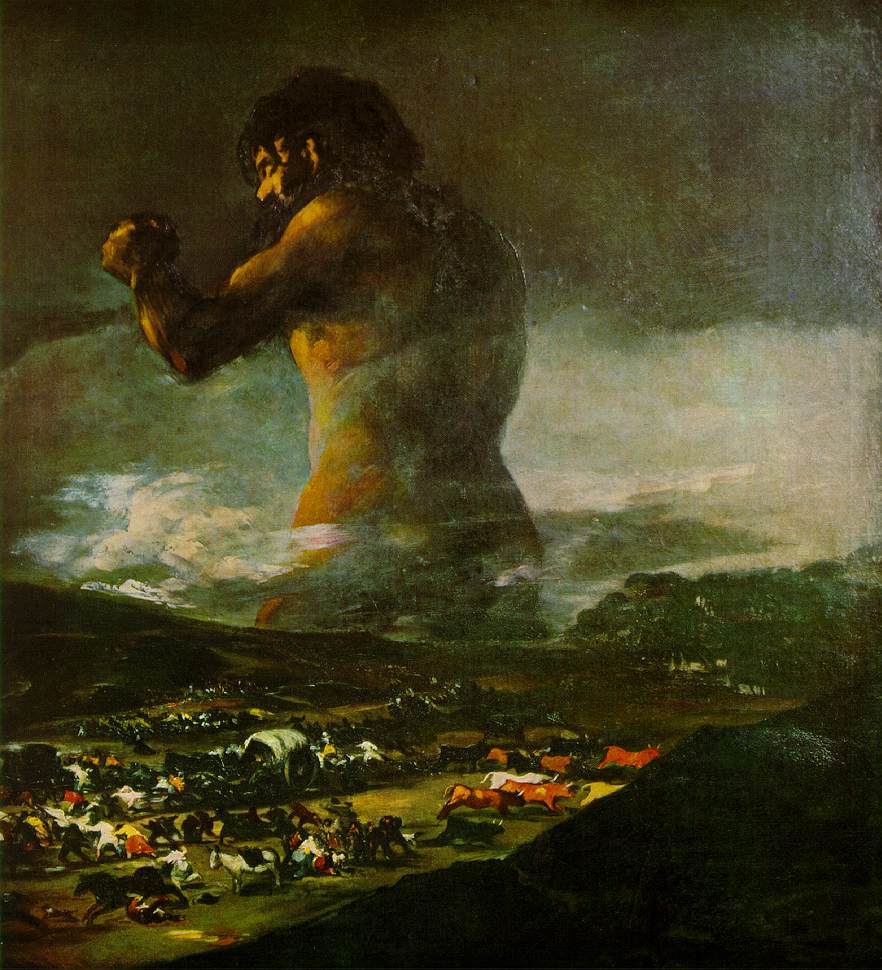
There is something peculiar about the mental character of the child to which Goya especially appeals. He is the painter of monsters, of nightmare, and in particular of The Colossus, a figure I expect every boy will have encountered in sleep.* Indeed, Goya captioned his 1799 series Caprichos with the phrase “the sleep of reason produces monsters.” His monsters were of the adult variety: revolution, murder, hate. Thirty years after first seeing Saturn devour his son, and well familiarized with the really-existing monsters of our world, I drove to Montreal to see his “Caprichos” at the Musée des beaux-arts.

The eighty prints constituting the Caprichos were described by Goya as depicting “ … the innumerable foibles and follies to be found in any civilized society, and from the common prejudices and deceitful practices which custom, ignorance, or self-interest have made usual.” This occupation, one might say preoccupation, rather suggests the satirist. And in his use of caricature, as well as his recourse to the grotesque, Goya does to a good degree fit the designation. Macaulay wrote that “the best portraits are those in which there is a slight mixture of caricature,” but Goya is not an artist of restraint where his subjects are concerned. He has a point to make, and a slight anything simply won’t do.

His work recalls Orwell’s “power of facing unpleasant facts,” specifically the facts of war and self-serving human pretensions, and my response to his representations of human endeavours are nearly characterised in Orwell’s discussion of his response to another satirist, Jonathan Swift, in the essay Politics vs Literature:

Swift falsifies his picture of the world by refusing to see anything in human life except dirt, folly and wickedness, but the part which he abstracts from the whole does exist, and it is something which we all know about while shrinking from mentioning it. Part of our minds — in any normal person it is the dominant part — believes that man is a noble animal and life is worth living: but there is also a sort of inner self which at least intermittently stands aghast at the horror of existence. In the queerest way, pleasure and disgust are linked together. The human body is beautiful: it is also repulsive and ridiculous, a fact which can be verified at any swimming pool. The sexual organs are objects of desire and also of loathing, so much so that in many languages, if not in all languages, their names are used as words of abuse. Meat is delicious, but a butcher’s shop makes one feel sick: and indeed all our food springs ultimately from dung and dead bodies, the two things which of all others seem to us the most horrible. A child, when it is past the infantile stage but still looking at the world with fresh eyes, is moved by horror almost as often as by wonder — horror of snot and spittle, of the dogs’ excrement on the pavement, the dying toad full of maggots, the sweaty smell of grown-ups, the hideousness of old men, with their bald heads and bulbous noses.

I say “nearly summarised” because I do not think that Goya “falsifies his picture of the world.” He exaggerates, and he selects. It seems apparent from the way he painted that he felt deeply. Disgust and outrage were among the emotions. However, Goya manages the essential challenge of satire in a way which differs from that of Swift. This essential challenge is to make one see, and whereas Swift’s choices involve a depiction of human nature in a condition of irredeemable debasement, Goya’s habitual strategy is to focus on human actions and to characterize them by their proper names. It is in the service of human drama to which the caricature is submitted. Although it is the case that Goya typically refuses to depict man as heroic, his nature as such is in any case unsettled and separate from the matter of action and its context in human choices. What people do is the principal concern, and it is according to this nature/culture divide that we may assign Swift to the conservative wing of satire and Goya to the liberal.

Nonetheless there is a morbid streak throughout Goya’s work. He is not an uplifting artist, but rather a disturbing one. The preponderance of war, rape, torture, cannibalism, and debasement as subjects is to be expected from an artist who lived in the time and place in which Goya himself lived, but even the deviations from this universal theme of “Man’s inhumanity toward Man” are telling: a Goya still life invoking the butcher shop as well as butchery, the subtle suggestion of human torment and degredation in the genre paintings (for instance “El pelele”), or the odd use of composition in the Tauromachia series, which displaces human forms from the works’ focal point.

The effect of these and other compositional decisions is to subject human society to profound skepticism. Goya paints a butcher’s table the way he paints a scene of battle, with an awareness of the social meaning of a particular subject. Just as the butcher’s table can not be separated from the universal human fact of eating, so too war is inseparable from the pomp and circumstance of Civilization. The individual act too is social in nature, and the “sleep of reason” is compelling as metaphor because brutality is extravagant but sleep is ordinary. His obsessions are doubtless rooted in an awareness, hence also fear, of this.

Goya seems to paint according to the principle “homo sum: humani nihil a me alienum puto” [I am a man, I consider nothing that is human alien to me.] The sleep of reason is not an academic or theoretical problem, but a condition to which the painter himself is not immune. Goya’s own dichotomy, as a reflective and organising artist who is also an outraged and impotent observer, materializes the larger dichotomy of a society which ostensibly manifests Enlightenment ideals while sponsoring the depravities of the Inquisition. Goya employs his rational intelligence to the purpose of ordering the disorder, expressing with clarity his churning indignation. His world is one of impossibility, of great forward strides into backwardness and barbarism. This explains the depths of Goya’s darkness, for it is in service of the potential but adandoned heights of human achievement that the depths are rendered. John Berger puts the matter this way, in his 1954 essay “The Honesty of Goya”:

The despair of an artist is often misunderstood. It is never total. It excepts his own work. In his own work, however low his opinion of it may be, there is the hope of reprieve. If there were not, he could never summon up the abnormal energy and concentration needed to create it. And an artist’s work constitutes his relationship with his fellow men.

This paragraph nicely captures both the social nature and hopefulness of Goya’s work. Goya is engaged in an act of solidarity, decrying the wicked acts of fellow human beings to his fellow human beings, who he must assume will have the capacity to participate in his disappointment. Berger concludes that “no artist has ever achieved greater honesty than Goya: honesty in the full sense of the word meaning facing the facts and preserving one’s ideals.” I think Berger is correct, and furthermore I think it is this honesty which has made Goya’s work compelling to me for over thirty years.


* Note: there is some controversy concerning whether The Colossus was indeed painted by Goya.

Keeping One Step Ahead

-Sekoh.

-Huh?

-Like this: say go. Try it.

-Say go.

-Well…that’s basically it.

-And that’s how Indians say “hi”?

-Well, that’s how Mohawks say hi. Other nations have different ways.

Cree say Wace. Ojibwa say Bojoo. Whole bunch of ways.

-Bonjour?

-No no no. Bo shoe–sort of.

-I don’t get it. Is there some religious significance?

-Well, no. Bojoo is a greeting. Sometimes Ojibwa say Nana-bojoo. And Nana is Nanabush.

-Nanabush? Is he a god?

-No. Not exactly.

-Nanabush.

-Yeah, only us Mohawks don’t say Nanabush. We say Coyote.

-Coyote?

-Yeah. Coyote, Nanabush, Trickster.

-What’s trickster?

-Well, that’s kind of hard to explain, really. Trickster’s lots of things. I guess you could say he likes to change what he is to keep you guessing. You know, stay one step ahead. He’s sort of tricky that way–tricky like a trickster. Likes to break the rules. Play tricks.

-Like a fool? In Shakespeare?

-Yeah, sort of. Sometimes the tricks backfire, and the joke is on Trickster.

-Is he some sort of religious symbol?

-No. That’s not quite it.

-I’d sure like to see an Indian religious ceremony. Maybe go up north during one of those festivals I heard of. I saw one on television once too. You Indians got anything like Christmas? I’d sure like to see it.

-Yeah, I guess you could say we have.

-What’s it like?

-Well, I’ll tell you a little story about it.

First of all, the sacred Indian ceremony begins about three weeks before sohl-stis, which is December 21 on the European calendar. We call this sacred time of the year tahkayaw. You know when the sacred time has arrived because everyone speaks the sacred greeting, eliwehk tahkayaw. I’d translate it into English, but there’s nothing like it in the Whiteman’s tongue. Anyway, when you hear that greeting, you know the sacred time has come.

The first thing Indians do when the sacred time arrives is go on a mysterious quest called shah-ping. It’s sort of a sacred hunting trip. Everyone does it: men, women, children. Well, the small children don’t. Not until they reach the sacred age. The Indians go in the morning, and return in the evening. We don’t discuss the things we find on our quests. We hide them from everyone else’s sight until the time comes to exchange the sacred objects. It’s so important that no one else know what you’ve found, that the Indians cover their objects in a special paper made just for the occasion. When we’ve covered everything up, we hide it all somewhere. You know, in our tipis.

We spend two, maybe three weeks on the shah-ping quest. We don’t quit until we have found a sacred object for each friend and family member and have brought it back home.

We decorate our tipis with sacred glittering objects made of metals and of wood. We eat special foods and drink special beverages. My favorite is called ehk-nogg. This beverage is served cold and sometimes is sprinkled with a powder called nuht-mek. I think the drink has a religious significance, but I’m not sure what it is. Someone once told me, an elder, but I’ve forgotten. Anyway, you can be sure it means something religious.

Everything Indian does.

So. Once we’ve done that, we go on another special quest. This one is really hard to explain: you might not understand it. But anyway, believe it or not, we go out in groups and look for a kris-mus-dree, which is a sacred object full of spirits that grows in the ground. And when we’ve found the right one, we bring it into our tipis and cover it in sacred objects made especially for the purpose. Some people cut down their own kris-mus-dree–in honour of the Creator. I know it sounds weird, but it’s our way.

There’s a bunch of special songs and chants that we sing throughout the sacred time of eliwehk tahkayaw. Many of the songs have religious significance, although about a hundred years ago–maybe more–people began to sing non-traditional Indian chants about a mythical Õkwehõweh…

-…that Trickster guy?

-…yeah. Yeah: you got it. Trickster.

Well, this time Trickster was really in disguise. You know, he likes to change his shape. Sometimes he’s a person, sometimes an animal. Or something else, even. But this time, Trickster showed up in a big red costume. Like a pow-wow fancy dress, sort of. It was made all of leather, with rabbit fur lining on the hood. And he had on a big black…wampum belt. And big black mukluks, too. Get this: he had a long beard. When’s the last time you saw an Indian with a beard? The really incredible thing is that he was carrying a big bag of those sacred objects I was talking about. The sacred chants tell all about it.

So. Trickster sneaks into the tipis while everyone is sleeping. And he gives each family a few of the sacred objects. Then he goes back up north. To Fort Albany, I think. Or Peawanuk.

And in the morning, all the Indians wake up and exchange the sacred objects. They take off the sacred paper and they sit around the sacred kris-mus-dree and they do many other religious things that I’m not allowed to discuss with White people.

But what about you? What kind of Christian ceremonies do White people perform? I heard once about some White pilgrims who spent Christmas day in prayer. And I saw a movie about Christians, too. Saint Paul, Saint John. Other guys names escape me. Saint someone.

That’s like a Chief, right–Saint?

-Well, a bit’s changed since then, actually.

-You don’t say? Gee, that’s too bad, you know.

-Well, maybe. Maybe not.

-Yeah. I guess I know what you mean.

Raising Cain

At first we all said she was crazy.

“Eve, you remember now what God said about curses and thorns and the sweat of the brow. And what about the increased pains and the ‘he will rule over you’ bit?”

It didn’t matter. She wanted to have a baby. Several babies. Personally, I never cared much for Adam. He borrowed my car once, got drunk, and then smashed it up. He’s rude and he talks too loud. He tells disgusting sexist jokes and thinks he’s so funny. He’s never had a job. He grows drugs in his basement, talks big about some invention of his that’s going to make him rich. The dreamer. He takes Eve’s money and uses it to get drunk, then he becomes violent.

-What happened to your face Eve?

-Um. An apple fell from a tree and hit me.

That’s the second time she’s used that one. The first was just before they moved out of her house. She told me the eviction was all because of an apple. When the authorities came around to the house to ask questions, she told them the apple story too. All Adam had to say was, “The woman did it.” And they bought the whole thing. They even wrote it down in their little black book.

Adam isn’t even divorced from his first wife, Lillith. No one knows about her, he keeps it so secret. He has children with the woman, but he never offers any support, financial or otherwise. He just lies around the house during the day, and goes down to the Paradise Club at night. He spends Eve’s money on beer and strippers.

-Why’d you agree to live with him, Eve? Can’t you see he’s no good for you?

-He really isn’t that bad. You have to get to know him. He just has his own way. Besides, I love him.

I tried to talk sense into Eve, but it was no use.

-Why don’t you go back to school? Get a university degree? You could take up a career. You could be a landscape architectural engineer. You like gardens. We could get you some new clothes, a new image. You really are a beautiful woman, Eve. You ought to care for yourself better.

Adam and Eve are still together. No one says she’s crazy any more; everyone has accepted the fact that Eve is going to stay with this man no matter what. But it still grieves me to see the way she treats herself, and the way she allows herself to be treated. I remember the day she came to my house all excited, saying, “I’m gonna have a baby! I’m gonna have that baby!”

-That baby?

-Yeah. The baby I’ve always wanted to have. I’ve always wanted something of my own, something I could love, that would love me.

-That’s great Eve.

-And I’ve got the name picked out, too.

Remembering Who You Are: The Synecdochic Self in Maria Campbell’s “Half-Breed”

[This is an extract from my 1998 doctoral thesis. You can also read my thesis chapters on Eleanor Brass and James Tyman. The introductory, “Autopoetics,” chapter is here.]

Maria Campbell

Maria Campbell’s Half-Breed constitutes a Metis-centred history of the Metis and conceives history itself as an energising mythos in which both critiques of present social realities and radical hopes for the future subsist

REMEMBERING WHO YOU ARE: The Synecdochic Self in Maria Campbell’s “Half-Breed”, by Maria Campbell (Halifax, Nova Scotia: Goodread Biographies, 1973).

“Surely history consists primarily in speaking and being answered, in crying and being heard. If that is true it means there can be no history in the empire because the cries are never heard and the speaking is never answered. ” -Walter Brueggemann, The Prophetic Imagination.

Maria Campbell’s 1973 autobiography Halfbreed constitutes a rebirth of the Native biographical genre, and hers is a text to which many who have followed refer. This work is striking for its breadth, beginning as it does with a summary narrative of Metis history, a history which frames the narrative of Campbell’s life. The autobiography begins, “In the 1860s, when Saskatchewan was part of what was then called the Northwest Territories and was a land free of towns, barbed-wire fences and farmhouses” (3). Campbell’s story is presented as a chapter, or rather 22 chapters, of Metis history beginning with the first white/native interactions and culminating in the 1869 Red River Rebellion and the 1884 battle at Batoche (following which Louis Riel was hanged, having been found guilty of high treason). Campbell summarises these and other key events, detailing the conditions within which they occurred and presenting the contemporary Metis grievances. Chapter One concludes with the outcomes of the 1884 battle, in the form of a list (6). Campbell establishes a perspective on this period of history (1869-1885) in a list recounting the events and ironically ending with the comment, “The history books say that the Halfbreeds were defeated at Batoche in 1884.” Such however is not the view either of Halfbreed or of Cheechum, a central figure of the narrative who “never surrendered at Batoche” (183). Halfbreed establishes Metis history as the contested ground of subjectivity and derives from its reconstitution of that history a synecdochic conception of the self. Halfbreed thus culminates in an expansive vision of solidarity which in many ways recapitulates the political struggles of Riel.

“Synecdochic self” is a phrase adopted by Arnold Krupat. According to the synecdochic model of selfhood, the individual is a part of the unfolding narrative of a people, and can thus be understood only in relation to the whole; “where narration of personal history is more nearly marked by the individual’s sense of himself in relation to collective social units and groupings, one might speak of a synecdochic sense of self” (Eakin 176). Here the collective social units and groupings under consideration are primarily the Metis people, but Halfbreed takes into consideration also class and gender groupings, and in the end a broad social community of those who seek justice. Indeed, at the heart of the autobiography’s “synecdochic vision” is a developing awareness of the complex inter-relations of gender, class, and race groupings which render solidarity both a logical and practical conclusion of the narrative:

I believe that one day, very soon, people will set aside their differences and come together as one. Maybe not because we love one another, but because we will need each other to survive. Then together we will fight our common enemies. (184)

In order then to understand more fully the workings of Campbell’s Halfbreed I shall attempt to analyse the constituents of this synecdochic vision, giving especial attention to the text’s dynamic representations of gender, class, Metis subjectivity, and history. As in the case in my investigations of Eleanor Brass and James Tyman, I hope to establish the structural-thematic principles according to which the text is organised and to describe the dictions and contradictions which articulate the discourse of the self. In short, I am attempting to elucidate particular instances of autopoetics, or self-making.

Cheechum serves both as the conveyor of the corporate past and the prophet of the future. Campbell’s synecdochic model of selfhood depends upon Cheechum for its substance, for Cheechum’s dual awareness of the crimes of the past and the promise of the future enables her to engage in a radical critique of the present. Maria’s analysis of the Metis condition is framed within Cheechum’s judgement that the state has “taught children to be ashamed” (159) and that governments were not made by the people; “it only looks like that from the outside, my girl” (159). Cheechum well understands the class economic interests which inform social reality, observing for example that war is “white business…between rich and greedy people who wanted power” (22). Cheechum notes further that the Catholic God “took more money from us than the Hudson’s Bay store,” an observation which integrates the religious institution into the project of cultural-economic imperialism (30). Maria’s experiences later confirm Cheechum’s class-based analysis:

I realize now that poor people, both white and Native, who are trapped within a certain kind of life, can never look to the business and political leaders of this country for help. Regardless of what they promise, they’ll never change things, because they are involved in and perpetuate in private the very things that they condemn in public. (137)

Significantly when the colonisation of Maria’s subjectivity reaches its zenith (in other words, when she is reduced to a “cold, rich, and unreal” sexual commodity and drug-addict) she finds herself in the presence of “politics and big business” (136). This convergence is perversely the fulfilment of Maria’s dream of material wealth as well as the disintegration of her “soul” (133) and even to a degree her body. Maria’s status as a commodity imposes upon her the requirement that she “forget about yesterday and tomorrow” (136), for the emptiness of her dream has become intolerable. The commodification of human relations, in which mere economic rationalism determines social reality, is exposed in all its ugliness. Maria performs her role as consort for a “wealthy and influential” unnamed partner. Her function is to “be damned beautiful and happy and entertaining” (137) in exchange for class-based privileges. In fulfilment of Cheechum’s sad prediction (134) Maria gets the “symbols of white ideals of success” she wants, exchanging for these symbols the substance of her “soul.” Cheechum, along with the Metis people, recedes from view as Maria becomes increasingly concerned not with the “tomorrow” of which Cheechum has spoken, but rather with the tomorrow of economic worries and the “next fix” (138).

The colonisation of Maria’s subjectivity is facilitated, if not driven, by the imposition of economic necessity. There is “no worse sin in this country than to be poor” (61), according to Maria. It is this sin of poverty that drives her to seek expiation in marriage, exile, and prostitution. The economic system of behaviour management complements and reinforces gender and class roles, interpolating Maria’s subjectivity into the contradictions of ideology. She subsists in the low- or non-paying gendered labour of the housewife and finds herself unable escape poverty. The contradictions of ideology inform her labour experiences as well as her subjectivity, for economic survival depends upon Maria’s ability to be the kind of women men like (97): “It made me feel that I might as well give up right then as there was no way I could ever be the combination of saint, angel, devil and lady that was required” (97). Maria’s work experiences consistently reproduce the contradictions of gender ideology. Gender ideology invariably domesticates her social and economic roles while introducing the notion of a threat to domestic stability. Thus, Maria’s employers rely upon her domestic skills while anticipating sexual indiscretions. Maria is a potential whore in the household whose presence necessarily elicits surveillance. Race ideology reinforces the notion of a whore-housewife, as demonstrated by an employer’s claim that Indians are “only good for two things – working and fucking.”(108). In short, the gender ideology which requires Maria to be a domestic labourer also renders her labour of dubious utility. As in other contexts, the accusation of “whore” is never far away.

First let us consider the matter of the writing of history. To write a Metis history is to practice radicalism (radix), for the Metis of the popular imagination is a creature whose essential characteristic is that he dwells outside history, history here understood as a people’s evolving self-realisation through purposeful agency. To write a Metis-centred history is thus to contradict officialdom’s most cherished rationalisation, that the Metis are not a people. The term “Metis” however properly refers to a distinct group, those whose origin can be traced back to the Red River in the early 1800s. These are the people, now located mainly in the prairie provinces and in the north, who joined together to fight the Hudson’s Bay Company and who in 1869 formed a government to negotiate their entry into the Canadian federation. Theirs is a unique culture with unique languages, among them patois and Michif (Purich 10-11). Campbell distinguishes “three main clans” of Metis in three settlements, and then contrasts the Metis to Indians, not only on cultural and linguistic grounds, but also on the grounds of character traits:

There was never much love lost between Indians and Halfbreeds. They were completely different from us – quiet when we were noisy, dignified even at dances and get-togethers. Indians were very passive – they would get angry at things done to them but would never fight back, whereas Halfbreeds were quick-tempered – quick to fight, but quick to forgive and forget (25).

The narrative is informed throughout by its implicit reference to the history leading up to and following from the Rebellion, a history which, as I have already suggested, serves as the mythic centre of Halfbreed.

Like the writing of history, the writing of an autobiography conveys phenomenal ownership of the productive means of one’s life-narrative, in contrast to the historical determinism which is an implicit (and at times explicit) theme of Halfbreed. In other words, autobiographical production appears to confirm the notion of the “self-authorising I” but does not and can not obliviate the material conditions of native lives, which are typically far from “self-authorised.” In this lies one of the many contradictions of “Indian autobiography” and hence Indian subjectivity. A subject-producing institution, autobiography is rooted both in liberal ideology’s notions of rational self-mastery as well as in the ideologies of class, gender, and race from which institutionally-mediated formulations of identity must borrow. This contradiction, of a self-mastered subjectivity and subjection, is furthermore subsumed in the dynamics of state-capitalism itself, which call forth active, autonomous, individualist “economic man” while constituting a complex class-based social order. One is constituted by ideology both as a subject and an agent, both as passive and active. Autobiography, as a culturally-mediated object, discloses the many ideological contradictions of liberal state-capitalism. A negotiation of the contradictions of state-capitalist ideology, whether consciously pursued or not, is thus necessary for the author of autobiographical narrative.

Each of the texts under discussion discloses (with varying degrees of self-consciousness) a negotiation of ideological contradictions. The challenge for analysis is to articulate coherently the particular features of the negotiation. I have claimed earlier that the contradictions of autobiographical narrative are rooted in the economic and political institutions designed to “solve the Indian problem” (see Introduction). These institutions are themselves historically rooted in the dynamics of state control, which constitute the material foundation both of social relations and of ideological constructs. The analysis of autobiography here undertaken involves a search for the textualised configurations of subjectivity according to the historical, cultural, economic and ideological substance of state subjects. Recall that particular incidences of autobiography and biography are ritualised recreations of the cultural myth of subjectivity, and that it is therefore with the performance of this “ritualised recreation” that we are concerned – with how the text operates rather than what it “means.” Under these conditions we may turn to Campbell’s text and to the contradictions inherent within its performance.

Campbell’s Halfbreed roots the autobiographical “I” in a corporate identity: the Metis people, but also as the narrative develops the collective social groupings of women and the poor. Historical narrative facilitates a mode of autopoetics which is at once critical and energising, a mode which situates the cultural and ideological contradictions of the self within a broader project of collective agency. Maria’s personal story is relational, posited among and extrapolated from the struggles, frustrations, and dreams of the oppressed. The reader is presented with two chapters of cultural history and genealogy before arriving at the phrase “I was born” (16). Structurally the autobiography implies that the “beginning” of the autobiography’s “I” precedes its explicit narrative introduction. The story of the “I” begins before the “I” is born (a point exploited to humorous effect in the autobiography parody Tristam Shandy.) By the time of Maria’s birth we have encountered not only the Riel Rebellion, but also the failed attempts of the Halfbreeds at farming, the conditions endured by the “Road Allowance People” (8), and descriptions of Saskatchewan life in the 1920s. At the centre of this corporate history is the role of the land in the unfolding story of Campbell’s ancestors, for the social, legal, political and cultural dynamics represented in her people’s history are literally grounded, rooted in the struggle to occupy and to live from the land. Campbell alludes to the land in an introduction, and notes that “like me the land had changed, my people were gone, and if I was to know peace I would have to search within myself. That is when I decided to write about my life” (2).

The notion of looking inside the self is illustrated on page 171, where Maria is given a painting “of a burnt-out forest, all black, bleak and dismal” with “little green shoots” representing hope. Land thematically integrates the political struggle over physical resources with the narrative struggle for the factors of self-production, an integration which literalises the apparent pathetic fallacy of the autobiography’s introduction. Land and history are the principal sites of struggle between state and Metis for the control of critical resources. This struggle informs Half-breed’s conceptions of Metis identity and discloses the ideological contradictions of the colonised self.

The text’s contradictions involve the ideological substance of the concept “Indian.” As the Welfare Office bureaucrat remarks on page 155, “I can’t see the difference – part Indian, all Indian. You’re all the same.” For him, Halfbreed, Metis, Indian, and presumably a score of other terms circulate interchangeably within a verbal economy of the Indian. While Campbell certainly knows the difference between Indians and Metis (differences which are legal, linguistic, cultural, and historical), this verbal economy informs her articulations of the self. The signified “Indian” is never far from the text’s multiple signifiers of Native identity, even in the case of illocutionary efforts to speak beyond or against the verbal economy of the Indian. The Metis is always-already an Indian, entailing the concept’s pejorative declinations. While the term “white” appears to be taken for granted as a proper and plainly descriptive signifier in Native autobiography, the terms Indian, Metis, and Native (to cite only three of many) are rife with ambiguities and negative connotations. The Native writer’s relation to the signifiers which speak her is an uncomfortable one, bound as the signifiers are by the ideological horizon of the signified.

Campbell construes her discomforting engagement with the signified as a love-hate relationship (103, 117). In these terms the autobiography thematises the bounding of its verbal economy. The power of the signified is acknowledged by Sophie, who according to Campbell comments that “she had let herself believe she was merely a ‘no good Halfbreed’” (103). Alex Vandal, the village joker, decides in what could be variously interpreted as an act of resistance or a capitulation to racial prejudice (or both) “to act retarded because the whites thought we were anyway.” Maria too, in a passage reminiscent of Edward Ahenakew’s Old Keyam (“I Do Not Care”) comments, “What’s the use? – people believed I was bad anyway, so I might as well give them real things to talk about” (129). The signified has precisely this force, as Cheechum’s comment, “They make you hate what you are,” suggests (103). The “proper” subject-positions of the Indian/Halfbreed are only too well-known, and being known they are at times self-consciously enacted by Native and Halfbreed agents. (James Tyman’s autobiography is a good example of just such self-conscious enactments, as I shall attempt to show.) Racism thus becomes literally a self-fulfilling prophecy.

Considerations of racism and identity are introduced into the narrative alongside the themes of imperialism and colonisation. Recalling a love of books from her childhood, Campbell writes of her fascination with the stories of Cleopatra which she had then known. Her imagination having been “stirred,” the juvenile Campbell enacts, with the help of her cousins, “plays” derived from the familiar stories:

In good weather my brothers and sisters and I gathered our cousins behind the house and organized plays. The house was our Roman Empire, the two pine trees were the gates of Rome. I was Julius Caesar and would be wrapped in a long sheet with a willow branch on my head. My brother Jamie was Mark Anthony, and shouts of “Hail Caesar!” would ring throughout out settlement. (14 sic)

One of the ironies of this Metis reconstitution of imperial Rome consists in the careful attention to racial representation in an otherwise naïve performance of roles. Young Maria wants to play Cleopatra but is instead cast as Julius Caesar, for she is “too black” and her hair is “like a nigger’s” (14). A “white-skinned, red-haired cousin” is instead pressed into the role, assuming her place aboard a raft, her slaves at her side. Cleopatra’s status (she clearly occupies the central place in this play) calls unequivocally for an Aryan representation. Race, class, and gender are each assigned their proper roles and places in this miniature rehearsal of historical imperialism’s social determinations. The Empire, in other words, arrogates to itself the exclusive right to constitute subjects according to its dominant interests. The word “nigger” suggests the virulent racism which subsists below the conscious awareness of the actors, and though the white neighbours perceive the irony of “Caesar, Rome and Cleopatra among Halfbreeds in the backwoods of northern Saskatchewan” (14) a greater irony may perhaps be the thematic appropriateness of this scene. The irony lies in the fact that matters of imperialism, colonisation, and racism may be abundantly clear in a representation of ancient Roman history while being indiscernible to the witnesses of the affairs of the modern and contemporary state. Imperialism nonetheless both produces and reproduces its conquests in the constitution of Indian subjects, an idea enacted not only within this scene but within the autobiography as a whole. Metis history and subjectivity are obliterated and in their place are put the White Man’s Indian.

The Cleopatra motif reappears in Chapter 22, perhaps the bleakest section of the narrative. Maria, institutionalised subsequent to her breakdown, revisits the world of make-believe:

They would be all right until a nurse or doctor came along, and then they would feign insanity. Sometimes they were moved to another ward, and eventually some received shock treatments. One attractive lady in her late forties had been there for over seven years. She believed she was Cleopatra, and spent hours sitting on a chesterfield. Sometimes one of us would feed her and pretend to be her slave.

Here play takes on a sinister aspect not at all like the play in which Maria has previously engaged. This Cleopatra is ironically described as an “attractive lady” (ironic because in the brutality and bleakness of her environment an attractive lady is incongruous), and the slaves at her side vividly depict the theme of power and powerlessness which is only suggested in the Cleopatra scene on page 14. The Alberta Hospital Cleopatra undercuts Maria’s earlier glamorous conception (“Oh, how I wanted to be Cleopatra”) and raises disturbing considerations of gender, class, and institutionalisation. An attractive lady would not likely find herself in such circumstances, though a woman of modest means like Maria may. In the female environment of the hospital powerlessness is graphically presented, the only “exception” being the mock pregnancies of a “fairly stout woman, with the most enormous belly” (163). I designate this an “exception” because there is an apparent and ironic appropriation of the female power of reproduction, an equivocal power, rooted as it is in patriarchal social and economic relations.

Awareness of patriarchal values shapes a number of Campbell’s reflections upon gender. Her father, we are told, is “disappointed” by the arrival of a daughter (16) and remarks disparagingly to his sons, “Dammit you boys! Maria can do it and she’s a girl!” (34). His conception of women is determined by a decent girl/whore dichotomy (111-112) which Campbell construes in the following terms:

On our way home Dad and I talked about babies, men, women and love. I asked him what kind of women men liked – I have to laugh now at his description. It made me feel that I might as well give up right then and there as there was no way I could ever be the combination of saint, angel, devil and lady that was required (97).

Campbell identifies the sexism of Native political organisations which “women were not encouraged to attend unless a secretary was needed” (182). She discerns in this attitude both general systemic determinants – what she calls “the system” – and the particular influence of missionaries who “had impressed upon us the feeling that women were a source of evil. This belief, combined with the ancient Indian recognition of the power of women, is still holding back the progress of our people today” (168). This account proposes an interesting case of ideological syncretism as well as a surprising manner in which ideologies can intersect and reinforce one another.

Representations of gender in Halfbreed comment variously upon gender roles and norms. Female beauty is a recurring motif of the narrative, whether the beauty of the Alberta Hospital Cleopatra or the beauty imposed upon the corpse of Maria’s mother and washed away by the horrified witnesses (78). Campbell notes the beauty which attends Lil’s prostitutes (137) as well as Darrel’s materialist sister, appropriately named “Bonny.” The description of her as “beautiful…and also very cold” (125) is a formula we meet in both instances, as well as in the description of the immigrants (27) and the transformed Maria, who we are told is “cold and unreal, rich and expensive” – and I presume beautiful in the manner expected of a prostitute (134). One insight to be drawn from this last episode is the relation of these depictions of beauty to agency and the self. The beauty of a prostitute, for example, is an instrumental value which serves economic necessity. Hence the intersection of beauty, money, and coldness, “cold” suggesting an absence of humanity. Indeed, in a world dominated by money relations all human interaction risks becoming predominantly instrumental in character:

I thought to myself, “Love! They all love you if they are on the gravy train. He can afford to love me. I made him good money.” I neither hated nor loved him. He was a means to an end, and I didn’t feel I owed him anything. (141)

We have already encountered Eleanor Brass’s comment upon the importance of money in the white man’s world (Brass 47). Maria’s conception of wealth and beauty involves at least in part a failure of logic, for these things begin as symbols of the good life but eventually become substitutes. In other words, the instrumental value becomes itself an end value, with disastrous results. Maria’s dream of wealth and beauty, innocent in itself, is co-opted by social relations which define the female subject as a commodity.

There are of course alternative models both of the self and of social relations. The commodified self rooted in instrumental social relations however is a subject position assumed by Maria in her dream to live in “a beautiful world full of beautiful people with no feelings of guilt or shame” (137). The dream of her materially-impoverished youth in this case is fulfilled only at the expense of agency and the self:

Dreams are so important in one’s life, yet when followed blindly they can lead to the disintegration of one’s soul. Take for example the driving ambition and dream of a little girl telling her Cheechum, “Someday my brothers and sisters will each have a toothbrush and they’ll brush their teeth every day and we’ll have a bowl of fruit on the table all the time…. Cheechum would look at her and see the toothbrushes, fruit and all those other symbols of white ideals of success and say sadly, “You’ll have them, my girl, you’ll have them.” (134)

These ideals of success, which are class-specific (Maria having associated them with wealth) as much as they are “white,” manifest themselves to Maria as a relation of the self to objective signifiers of status, as in the case of the business suit (67-68). “To own a suit and hat was a real status symbol,” Campbell writes, reflecting that in later years her awe is transformed into sorrow by the absurd pictures of men in ill-fitting clothes (68). Ironically the “holy” suits only underscore Metis poverty, for the pathetic attempt to look the part invariably fails. Toothbrushes and fruit further substantiate the theme of self-objectification, that is, of rendering the self an agent-less object of social relations. Cheechum “sadly” tells Maria she will have the “symbols of white ideals of success,” a prediction whose fulfilment clarifies Maria’s quest for her identity. Cheechum’s critique of the “white ideals” is implicit on page 98, where she says “Go out there and find what you want and take it, but always remember who you are and why you want it.” Cheechum here makes the distinction between material wealth as an instrumental value and an end value, and the word “remember” further suggests the critical function of memory in the constitution of the self. Maria’s failure is to render who you are equal to what you have, an understanding which abstracts the self from memory and history and posits it among object relations.

Prostitution fulfils the logic of the self-as-object, as commodity. Maria is taken to a “fashionable” dress shop and afterward to a beauty parlour. Having become the glamorous woman of her dreams, she is given an opportunity to contemplate the transformation:

When I was finally pushed in front of a mirror, I hardly recognized the woman staring back at me. She looked cold and unreal, rich and expensive. “Dear God,” I thought, “this is how I’ve always wanted to look, but do the women who look like this ever feel like I do inside?” (134)

The mirror image graphically imposes upon Maria the contradictions of her subject-position. She confronts herself as object – as simply another symbol, like a toothbrush or a bowl of fruit. The contradiction forces her to evaluate the conventional image of success which she has cultivated, for clearly inner does not correspond with outer. The contradiction of inner and outer initiates a critique of the material signifiers of success, a critique which will be evident in later sections of the text. At this point in the narrative, however, there is merely a recognition on Campbell’s part that the dream of success pursued thus far is empty. Campbell writes, “I lost something that afternoon. Something inside of me died” (134).

The death of one dream does not immediately bring about the birth of another. Structurally, chapter seventeen constitutes a negative space between the commodified subjectivity which has been the dominant (but not exclusive) concern of the early chapters and the synecdochic subject which shall dominate later. The term “negative” is employed because the subject-position adopted in chapter seventeen is “no self”; Maria recognises the perversity of a “self-as-object” model but finds the demands of agency insupportable:

Most of the girls at Lil’s used pills, and once I discovered them the world became a great deal more bearable. I took them like they were going out of style. They helped me to sleep, they kept me happy, and most of all, I could forget about yesterday and tomorrow. (136)

Forgetting is the means by which the self rooted in a historical narrative is negated. History, to borrow from James Joyce, is a nightmare from which Maria wishes to escape. Profoundly informed by history, Halfbreed conveys the horror of a history-less existence. Severed from an energising past and future (which the narrative derives from the story of Riel and the Metis people), the present is static and deathly. Campbell describes herself then as “numb,” (136) which is another way of saying, as she has earlier stated, that something inside of her died (134). What has “died” at this point is human agency. This death manifests itself not only in an absence of memories of the past and imaginings of the future but also in the absence of a critique of the present. The death of the Chinese girl, for instance, is met with a resolute attempt on Maria’s part to pull herself together lest she “fall apart and be finished” (135). Maria herself attempts suicide and ends up in a hospital among women whose “greatest fear was being released,” that is, of becoming agents actively involved in the mess of existence (163). Smoky speaks for them also when he expresses his efforts “to forget we exist” (174). Cheechum’s admonition, “always remember who you are,” is here appropriate, for the hospital scene suggests a link between the institutionally-coopted subject and forgetting. Cheechum herself suggests such a link when she claims that the state offers blankets but steals souls (159). The subject subjected to the state in this way is emptied of agency and ceases to be fully human.

Campbell first relates Cheechum’s story of the blanket during the restaurant scene. Two Indian boys are mocked by a group of “drunk and noisy” white men, who yell, “Watch it! The bow and arrows are coming” (158). Narrative details lead the reader to associate this scene with an earlier incident from Maria’s life. The older child stops, puts his arm around his younger brother and, “with his head up,” continues walking (159). The resemblance of this scene to the town scene of page 37 is clear. In both scenes, the Indians are objects of a white gaze, which imparts to them the shame Cheechum traces back to state apparatuses, church and school in particular. The very concept “Indian” issues implicitly from this white gaze, a gaze which the church, the school, the welfare system and the paternalistic state as a whole constitute in an institutionalised form. We have seen this for instance in Maria’s encounter with the welfare office, where she is stripped of dignity and pride and is called by the state to recognise herself as an “Indian” subject. As a reward for her subjection, she receives a small amount of money: a “blanket,” to use Cheechum’s term.

Cheechum’s insight discloses what might be termed the politics of identity. Halfbreed examines power in its manifestations as instruments which name, for as Cheechum understands, the dominant culture sustains its privileges by fashioning the world in its image. Against Halfbreed’s energising Riel mythos, the dominant ideology pits a cinematic farce (111), thereby discrediting the call for justice at the heart of Metis history. The cinema screen functions as a state apparatus, for it calls its Metis audience to a recognition of itself in the image. In this context, the political function of Halfbreed is clear. As Leigh Gilmore argues, in the “transformative process of naming” lies the allure of autobiography. An autobiography empowers the writing subject to speak, as opposed to being spoken for. Having been “spoken” by the ideology of the coloniser, Maria sees her destiny as determined by a choice between failure and assimilation. This choice rests on the assumption that to be Metis is to be poor and dirty, whereas success (in the form of toothbrushes and bowls of fruit) comes to those who become white. The only other “respectable” identity left to the Metis in the present order is a parodic one: the Calgary Stampede Indian, for example. The Indian is an anachronism; white history dictates that the present belongs entirely to the whites. Autobiography offers Campbell a recourse to the discursive production of an alternative reality, and enables her to reconstitute both Metis history and a synecdochic model of selfhood. Thus Halfbreed ends both with an affirmation of solidarity and the words “I no longer need my blanket to survive.”

Solidarity subsists in the common historical grounding of various subject-positions presented in Halfbreed. Metis and non-Metis poor, for example, share comparable experiences, while Metis women in their experiences of work have more in common with other women than with Metis men. The subject-positions of Metis, women, and the poor are represented in a narrative which grounds oppression and poverty in the history which has yielded Canada:

So began a miserable life of poverty which held no hope for the future. That generation of my people was completely beaten. Their fathers had failed during the Rebellion to make a dream come true; they failed as farmers; now there was nothing left. Their way of life was a part of Canada’s past and they saw no place in the world around them, for they believed they had nothing to offer. (8)

The Rebellion was, as the “official” account on page 6 suggests, the final impediment to the dream of a nation stretching “from sea to shining sea.” Those defeated at Batoche disappear as agents from this history. Poverty, which discloses their (non)relation to the prevailing modes of production, forecloses the future and hence renders dreaming futile. The marginalised share in common a present in which they see for themselves “no place in the world around them” as well as a past which is irrelevant and a future which is impossible. Human agency in such conditions becomes an intollerable burden, and a people forced to endure the burden end up “merely existing,” a phrase employed by Campbell in the Introduction. Mere existence is the antipode of historical existence, and Halfbreed implicitly attempts to reconstitute the latter within a narrative informed both by remembering and hope.

Memory and hope merge in the failed effort of the Rebellion, which Campbell recapitulates ironically. Following a disappointing encounter with the CCF, Campbell’s father becomes involved in Native politics, becoming a strong supporter of Jim Brady. This chapter is an ironic repetition, in miniature, of the disappointments following the defeat of Riel. The arrival of Jim Brady is attended by hope and excitement, both of which find their expression through Campbell’s father. Although Jim Brady is clearly the driving force of the political agenda, the narrative construes politics as domestic drama, casting the father in the role of hero. The Campbell family becomes a part of the Riel struggle, just as the meaning of Campbell’s individual life is itself synechdochically related to the corporate history of the opening chapters. The Riel mythos provides both a set of compelling symbols and an explanatory framework for the past, present, and future. In Riel, the terms of the struggle are articulated and the people find an energising narrative of origin and destiny. The domestic drama is therefore cast in the symbolic terms of the Riel mythos:

Daddy went to meetings all that year. He didn’t go trapping and so we were very poor. He was gone nearly all the time, and when he was home he would be very moody, either so happy that he was singing, or else very quiet. We all suffered these times with him. It seemed the Mounties and wardens were always at our house now. We were treated badly at school, even our teacher would make jokes about Dad, like, “Saskatchewan has a new Riel. Campbells have quit poaching to take up the new rebellion.” (74)

The irony of the invocation of Riel is clear enough. It is intended by the whites as a form of derision. Furthermore, it is true that neither the victories nor the defeats of Campbell’s father can claim the historical significance that the life of Riel can claim. Structurally, however, the invocation is a serious one, for in this chapter ( Chapter Eight) Campbell first becomes politically-conscious, and the perennial struggles of the Metis are first given expression:

Jim [Brady] said almost word for word what I have heard our leaders discuss today: the poverty, the death of trapping as our livelihood, the education of our children, the loss of land, and the attitude of both governments towards out plight. He talked about a strong united voice that would demand justice for our people – an organization that government couldn’t ignore. He said many people were poor, not just us, and maybe someday we could put all our differences aside and walk together and build a better country for all our children. (73)

The narrative is simultaneously mindful of past, present and future. The conditions of the past are linked to those of the present, and the subjunctive mood (“maybe someday we could”) projects the narrative into the future. Here the point being advanced is not merely that history is presented as repeating itself, which is apparent enough. Rather, a particular relation of structure and meaning is proposed. Through repetition, events take on their full significance. This relation takes us to a central implicit concern of the book, historical determinism. The repetitions that make the narrative meaningful also constitute a central problem for Maria: are her people doomed to repeat history? Again, we may think in this context of James Joyce’s Stephen Dedalus, for whom history is a nightmare to be escaped. Dedalus’s decision to “forge in the smithy of his soul the uncreated conscience of his race” proposes the transformation of personal and collective history in an act of literary re-creation. Campbell’s task is comparable: “Like me the land had changed, my people were gone, and if I was to know peace I would have to search within myself. That is when I decided to write about my life”(2).

Further observations could be made in relation to Joyce’s A Portrait of the Artist as a Young Man, particularly regarding the significance of imperialism both to Irish history and to Stephen Dedalus’s project of self-creation. Dedalus speaks of his alienation from the English language (182) and from the Christian religion (241), both of which he correctly views as imperial impositions, and rejects the offers of state institutions (principally the church) to affiliate himself with the empire through allegiance to its symbols and narratives. Dedalus’s assertion of non serviam [“I will not serve”] manifests itself in the “silence, exile and cunning” (238) whose mythic representation is Odysseus. It is especially fitting in this context that among Odysseus’s epithets are the terms metis (“cunning”) and polymetis (resourceful); clearly also exile is a central element not only of Campbell’s autobiography, but of the life of Riel himself (4). The suggestion here being made is not that Campbell is by virtue of a fortuitous pun an “Odyssean” author, whatever such an assertion may mean; rather, this brief interpolation of Joyce’s work is intended to suggest ways in which both autobiographical narratives (or in the case of the Künstlerroman, pseudo-autobiographical narrative) provoke a consideration of the constitution of subjects and subjectivities. Cunning is a practical necessity if the state production of subject-positions is to be challenged (For a discussion of Joyce and imperialism, see Vincent J. Cheng, Joyce, race, and empire. Cambridge, Cambridge University Press, 1997.) Halfbreed presents the multifarious state apparatuses involved in the production and reproduction of Indian subjects while constituting the terms of its self-determination of subject-positions, that is, historical agency.

One apparatus considered is the motion picture. The representation of history in a movie recalled by Campbell effects a successful appelation of subjects. The Metis apparently consent to the appropriation of their history and, in so doing, forego the opportunity to remember who they are, the task of historical agents:

One show I remember was about the Northwest Rebellion. People came from miles around and the theatre was packed. They were sitting in the aisles and on the floor. Riel and Dumont were our heroes. The movie was a comedy and it was awful: the Halfbreeds were made to look like such fools that it left you wondering how they ever organized a rebellion.

Here the very notion of a rebellion (which may raise the troubling question Why did people rebel?) is obliviated and replaced by a depoliticised comic vision of the Metis, complete with a “filthy and gross” Dumont and a Riel who is a “real lunatic who believed he was god” (111). History, with its troubling themes of imperialism and injustice, is displaced by triumphalism and the gratifying resolutions of comedy. The followers of Riel are appropriated to the prevailing cultural symbols of the day, emerging from this version of the Rebellion as “‘three stooges’ types” devoid of serious interest. Not surprisingly, the representatives of the state, in particular the NWMP, are recreated as heroic. Campbell notes the “hysterical laughter” of the Halfbreeds, who apparently are unaware that an ideological assault is underway. Cheechum however walks out in disgust.

The ideological assault on the Metis, and its concomitant production of subject-positions, manifests itself in a number of conventional assumptions. On page 8 we find the ethnocentric and essentialist notion advanced also by Eleanor Brass that Metis “just did not have the kind of thing inside them that makes farmers,” an assertion contradicted by the example of her father. This ontological assertion is particularly striking coming as it does after a lengthy materialist accounting of the barriers faced by the would-be Native and Metis farmer:

Due to the depression and shortage of fur there was no money to buy the implements to break the land. A few families could have scraped up the money to hire outside help but no one would risk expensive equipment on a land so covered with rocks and muskeg. Some tried with horse and plough but were defeated in the end. Fearless men who could brave sub-zero weather and all the dangers associated with living in the bush gave up, frustrated and discouraged (8).

I considered earlier the self-interest invested by whites in the notion that Indians were incapable of cultivating the land, a notion that Sarah Carter has argued to be false. Donald Purich furthermore has analysed the diverse legal and economic arrangements which rigged the system of property distribution in favour of white settlers and speculators, virtually guaranteeing that Indian and Metis farmers would be unable to take possession of the land. The result of government policies was that most of the land given to the Metis ended up in the possession of eastern speculators, whose predation was tolerated by the state, if not actively assisted. Campbell acknowledges the consistency of government efforts to undermine Metis organisation, but underestimates the role of the government policy in the expropriation of Metis land, relying instead on a ready cultural explanation.

The “failure” of the Metis is construed as a historical failure, part of the inevitable if poignant displacement of barbarism by civilisation. The Metis, in other words, failed to meet the challenge of history. Thus the Metis way of life is conceived to be “a part of Canada’s past,” an inference whose complement is (as I have suggested) the triumphalism of the empire. Campbell notes “there are some who even after a hundred years continue to struggle for equality and justice for their people,” a statement which recasts history in differing terms. History thus conceived is the product of human effort and inescapably subject to a moral accounting. The “white” version of history apportions only dehistoricised and static subject-positions to the Metis; only as commodity does the Indian serve a legitimate function. Business is “good in Calgary for Indians,” Marion notes (155), for the commodified Indian reproduces an ideological discourse which regards the Indian as a historical (that is dead) artefact. The Indian-as-antique manifests itself in the “gaudy feather and costumes” which Campbell equates with the “welfare coat” put on to get government money. In both cases it is a white man’s Indian devoid of humanity and historical agency, the same Indian who appears on the movie screen at page 111. Campbell deduces the source of her personal shame from these representations and from the subject-positions imposed upon her by political, economic, and cultural institutions.

Guilt and shame are emotions that Metis and Indians alike have acquired as a result of colonisation. These are a feature of the Indian subject. “Indianness” has been defined by the dominant (white) culture at the same time that Native and Metis traditions have been weakened or even supplanted; the result is that as the material conditions of Native people have been destroyed, the destroyers have rationalised the matter by redefining the Indian subject, paradoxically, as the agent of his own undoing. Such is the case in the official judgements regarding the Indian as a farmer, which tended to render as just the usurpation of land by whites. Campbell depicts the power inherent in this relationship, of coloniser and colonised, in a representation of what may be termed the anthropological gaze:

[The Metis] were happy and proud until we drove into town, then everyone became quiet and looked different. The men walked in front, looking straight ahead, their wives behind, and, I can never forget this, they had their heads down and never looked up. We kids trailed behind with our grannies in much the same manner. (37)

The transition from “happy and proud” to shameful suggests the implicit function of the “white gaze” (recall that Brass uses the term gaze in her depiction of the trip into town). The gaze interpolates the Indian subject, and in this instance even the children respond with the “proper” subject-position. The encounter of the white townspeople and the Metis discloses the intersubjectivity at the base of this shame-filled Indian subject; even Maria’s dream of escaping the shame of poverty is a mere reciprocation of the gaze. She respects (respectare) the “symbols of white ideals of success” (134) and in so doing recognizes herself as the Metis subject of the gaze. The response depicted on page 37 is elicited by the encounter of Maria and the Welfare agent, for whom Campbell acts “timid and ignorant” as she’s been instructed to do by Marion (157). This suggests that the welfare department, and presumably other state apparatuses, institutionalise the gaze, that is, the power of interpolating subjects. Notably an Indian child frustrates what may be construed as an interpolation on page 158 (“Watch it! The bow and arrows are coming”), walking “with his head up.” Cheechum already has exhorted Maria always to do the same (37), an exhortation which challenges directly interpolative strategies and the power inherent within them.

Poverty and the institutional arrangements deployed in its management are mediated by subjects, which is another manner of articulating the point that the ideologies of the welfare state constitute subjects for welfare state apparatuses. The Poor as such is an abstraction, rationalised in the fictive subject-positions where the state renders poverty subject to its own institutional and instrumental logics. This mediation-function of the subject is indeed what we encounter on pages 36-37:

I went to the [Welfare] office in a ten-year-old threadbare red coat, with old boots and a scarf. I looked like a Whitefish Lake squaw, and that’s exactly what the social worker thought. He insisted that I go to the Department of Indian Affairs, and when I said I was not a Treaty Indian but a Halfbreed, he said if that was the case I was eligible, but added, “I can’t see the difference – part Indian, all Indian. You’re all the same.” (155)

Maria has been instructed by a friend to perform for the Welfare agency: “Act ignorant, timid and grateful” (155). Here performance designates the simulation of a specific subject-position appropriate to the ideological assumptions of the welfare office worker, assumptions clearly articulated in this passage. Indians and Metis are “all the same” insofar as they together are interpolated by welfare-state apparatuses. The simulation of poverty involves a concomitant simulation of ignorance and timidity, what one may term following Cheechum the “blanketed subject” for which the state stands ready, arms filled with more blankets. Maria’s request for assistance is co-opted by the state and thus becomes an institutional encounter where agency is undermined and a passive subject constituted. Identity is objectified and reified in order to satisfy bureaucratic ends. The bureaucratic demands of the state furthermore resemble the economic demands of capitalism. As Maria notes, “To me [dancing in the Calgary Stampede] was the same as putting on a welfare coat to get government money” (156). In either case, she become merely “a white man’s Indian,” a subject amenable to institutional expedience.

The pervasiveness of institutions is a striking feature of Native autobiographies, especially those autobiographies written since World War II. In text after text, the protagonists are taken captive by one institution after another; relief agencies, welfare offices, prisons, the Department of Indian and Northern Affairs, psychiatric hospitals, and countless other entities make regular appearances. An Indian autobiography is, whatever else it may be, a reflection upon the multiple and contradictory modes of production of subjects in the paternalistic state of modern and contemporary times. Cheechum, as we have seen, puts the matter this way:

…when the government gives you something, they take all that you have in return – your pride, your dignity, all the things that make you a living soul. When they are sure they have everything, they give you a blanket to cover your shame. (159)

Cheechum includes in the category “government” the churches and schools, recognising their subject-producing function as state apparatuses. Significantly Cheechum emphasises the negative character of their operations; what they may impart (Christian religion, literacy, etc.) is apparently less important to Cheechum than what they negate – “all the things that make you a living soul.” The two, giving and taking, are regardless complementary, for the exchange constitutes an agent-less, soul-less subject. This is one of the lessons of Maria’s experience. Cheechum here describes not only the schools and the churches, but the tactics of treaty negotiations by means of which the Canadian government asserted its control. The treaty negotiations proposed an institutionalised rationalisation of imperialism, offering to Native peoples the opportunity to become subjects, on the Empire’s terms. Doubtless the offers of blankets were seen for what they were and met appropriate responses. In any case Cheechum’s characterisation of giving and taking succinctly captures the subtle (and at times not so subtle) operations of institutionalised encounters, where the state bids for subjects and the agent risks her soul.

The narrative’s contradictions, between individual and institution and self and other, are manifested both in the mirror scene (134) and the welfare-office exchange. In the former scene Maria regards the subject she has wanted to become and in the latter she becomes the subject she has wanted to avoid. Both subject-positions alienate Maria from “the things that make her a living soul,” principal among them being history and a synecdochic relation to others. The autobiography, in keeping with the narrative convention of closure, ends with a synechdochic vision (“I believe that one day, very soon, people will set aside their differences and come together as one” [184]); Cambell’s personal story is a part for the whole, and both together are an effort of “brothers and sisters all over the country” who seek together to throw away their blankets, and in so doing to ensure that “the whole world would change” (159). This is not a claim that the text resolves all conflicts and contradictions. Campbell, having derived from history a synechdochic understanding of her personal struggle, projects the struggle into an unspecified future: “one day, very soon, people will set aside their differences and come together as one.” Maria’s searching, loneliness, and pain are over because she has been restored to her brothers and sisters, but for Native people change will come only when together they fight their common enemies. This hopeful denouement is rooted in Metis history, particularly in the history of resistance and rebellion and in the refusal to surrender associated with Cheechum (183). Maria emerges from her “numbness” to find solidarity among “people like herself” (167), a reminder that it is not only Halfbreeds who have reasons to do so but, as in the days of Riel, “white settlers and Indians as well” (4). In short, while the synecodochic vision of Halfbreed’s closing pages extends to all peoples, it is nonetheless a vision which is profoundly Metis, derived from the promise of the Riel-centred Metis mythos by which Halfbreed is informed.

Campbell prefaces the introduction of her people with the words, “The history books say that the Halfbreeds were defeated at Batoche in 1884” (6). Following this is a list of events which constitutes the orthodox, white version of Metis history. This is the history which the white history books have spoken into existence: it is a history ending in defeat and death. Maria, however, says that “My Cheechum never surrendered at Batoche: she only accepted what she considered an honourable truce” (184). These two statements occupy the beginning and end of the narrative, and stand in opposition to one another. History as it is presented in the opening pages is “objective” and cast in the tragic mode. It looks dispassionately at the facts of the matter, which are beyond dispute, and finds poignant the inevitable deaths, which were in any case necessary to produce the present order. Halfbreed, on the other hand, articulates an alternative understanding of Batoche and its aftermath. It is an instance of constitutive rhetoric which, by its very existence, refutes the textbook proposition that the Metis were defeated in 1884, and thereafter disappeared as historical agents. Halfbreed constitutes a Metis-centred history of the Metis and conceives “history” itself as an energising mythos in which both critiques of present social realities and radical hopes for the future subsist.
RES-SCHOOL-DJ-lr-(2)

My Fall 2014 book “Residential Schools, With the Words and Images of Survivors, A National History,” is available from Goodminds. Order by phone, toll-free 1-877-862-8483.

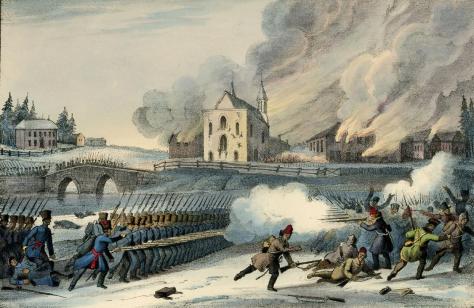
Follow me on Twitter

June Fourth Thoughts

I confess that on this particular June 4th I’m pleased to see Tony Hayward having quite an unpleasant time of it. If only somehow we could spread the malaise more broadly, across the globe’s Unaccountables. We know too well however, from historical memory, that he’ll one day “have his life back.” Like the clichéd African dictator who retires afterward to the French countryside – with only the Swiss bank accounts to remind him of home – Mr. Hayward will do fine, whilst the masses will be left to the business of living in the dirty wake of the mess that enriched him. That’s how it is in our age of Winner Take All.

Africa comes to mind for two reasons. One: it is this continent, and not the North American, which may lay claim to the world’s worst disasters of the crude variety. As Anene Ejikeme points out in today’s New York Times, “Experts estimate that some 13 million barrels of oil have been spilt in the Niger Delta since oil exploration began in 1958. This is the equivalent of one Exxon Valdez every year for 50 years.” Two: Africa is quietly being re-colonized and “re-Apartheided” (if I may coin an awkward term) by a dictatorship which on June 4 is recollected around the world for its Tiananmen massacre.

Neither examples one or two has received the attention in the West that British Petroleum now receives, but they are more useful indications than the Macondo spill of perils our species will face in the future. China has shown beyond any doubt that it has no regard for human life, that it cares nothing for the environment, and that it intends to flood territories it finds useful, from Tibet to Zimbabwe, with Han Chinese. As its appetite and boldness for acquiring both greater Lebensraum and resources increases, China (the world’s leading exporter of goods, the possessor of the largest foreign currency reserves, and the country with the most severe wealth polarization) will export ever more weapons, and it will back more and worse dictators throughout the world. In short it will export its totalitarian version of market socialism, its racism, and its contempt generally for human life.

In any war zone or dictatorship into which one may have looked in recent years, whether Sudan, Ethiopia, Eritrea, Zimbabwe, or Nigeria, the participation of China can be discerned. In Darfur, the Janjaweed militia kill with China-supplied AK-47 rifles and grenade launchers. In Equatorial Guinea, the Chinese government lavished a new capital upon long-standing dictator Teodoro Obiang Nguema Mbasogo, whose regime competes with Robert Mugabe’s for the title of Africa’s most corrupt. In Zimbabwe, it is Chi­na’s weapons and military equipment which have enabled Mugabe to crush his opponents.

True, you may say. But what about the Russian and British and American weapons? Well, we rightly denounce these and look with indignation upon the history of colonialism. How depressing it is, then, to contemplate the very likely prospect of a vigorous expansion of this project in the present century. The country best poised to dominate our planet for the foreseeable future is backward and wicked in every respect. Reactionary, barbaric, and obstinate on every issue of present concern, China is the land of vetoes, denials, obfuscations, and crackdowns, and so its approaching global rule promises disaster for the causes of human rights and social progress — as indeed it does for the very notion of progress itself.