CSIS: Getting It Right, Through Accident

Some days ago, Director of the Canadian Security Intelligence Service, Richard Fadden, said in what he presumed to be a sealed audience that “There are several municipal politicians in British Columbia and in at least two provinces there are ministers of the Crown who we think are under at least the general influence of a foreign government.” For this remark he has been called before a Parliamentary committee established just for this purpose, and has further been widely condemned by media for his supposed crimes of “casting traitorous aspersions” and McCarthyism.

It is doubtless apparent to all that Fadden referred covertly to the influence of China. (The closest he came to saying so was his use of the word “Asia.”) His failed use of code suggests that either he believed an effective veil was unnecessary or that he simply isn’t very good at it. It is also curious that he reposed in the assumption his words would never drift on the open air. What sort of “Spymaster,” as he has been frequently called, fumbles in such a manner? Only the sort of spymaster one finds across the bloated, complacent, self-serving, and incompetent bureaucracies of the “intelligence community” as constituted both here and in the United States.

In case we need the reminder, the mess in which things now are has been further detailed by John C. Major’s Final Report, “Air India Flight 182: A Canadian Tragedy.” Among Major’s findings are the following:

  • CSIS surveillance was ineffective. Surveillants were unable to distinguish one traditionally attired Sikh from another. When a CSIS surveillance team observed experiments involving a test explosion conducted by Sikh extremists in the woods in Duncan B.C. in June 1985 (the Duncan Blast), the loud sound heard was misinterpreted as a gunshot. No photograph was taken of the unknown third person present (Mr. X.) because surveillants had not brought a camera.
  • CSIS failed to include important information, such as the Duncan Blast, in the threat assessments it provided to the RCMP and Transport Canada.
  • The RCMP wasted resources creating a threat assessment structure parallel to CSIS’. The RCMP structure was itself ineffective – it failed to identify, report, and share threat information.
  • CSIS often failed to disclose promptly to the RCMP information relevant to the criminal investigation, particularly information from human sources, or it disclosed information without sufficient detail or in a manner that prevented the RCMP from using the information.
  • CSIS was mesmerized by the mantra that “CSIS doesn’t collect evidence,” and used it to justify the destruction of raw material and information. CSIS erased the tapes that caught coded conversations possibly related to the planning of the bombing, and CSIS investigators destroyed their notes that recorded the information CSIS sources provided in relation to the Air India bombing. Both of these actions compromised the prosecution’s evidentiary position at trial.
  • CSIS delayed disclosure of necessary information for the prosecution of Interjit Singh Reyat by adopting a legalistic and technical approach in responding to requests from prosecutor James Jardine.
  • The RCMP never made a written request that the Parmar tapes be preserved, though it was aware of their existence, and also never made a verbal request specific to the Parmar tapes until months into the investigation, when the early tapes were already erased. CSIS only ceased ongoing erasure in 1986, following a request by the Department of Justice in connection with the civil litigation.
  • The families were not kept informed about the investigation by the Government, and often learned about new developments through the media. The RCMP only began to liaise with the families directly after 1995. CSIS refused to participate.

… and on and on. It’s perhaps far worse in the United States, where the security establishment eats money and defecates requests for more, but no one is quite able to say. Such is the badness. In the meanwhile, the security industry conducts a farcical public relations campaign which has everything to do with managing public perception and little to do with security.

Even before anyone had come around to the word China, the Chinese were protesting a bit too much. The irony here is that all informed persons know China indeed aggressively promotes its interests internationally. What else would you expect of the world’s next global empire? The Confucius Institutes, the espionage, the busloads and busloads of planted Chinese patriots in my neighbourhood — during the recent visit to Ottawa of President Hu Jintao — the all-expenses-paid trips and the endless visits of VIPs: it’s all part of business for the world’s Communist behemoth.

But if you choose to be so naïve as to suppose the world isn’t roughly as Fadden says it is, at least fire the arrows into the proper targets. For this is one of the very few occasions on which a legitimate concern has been brought (even if by accident) to timely attention, by an agency more often having drawn attention for its appalling failures. To the degree that these recent statements are being ridiculed, dismissed, and savaged, the failure to see the worth of these statements is a public failure. You’ve been warned, in other words.

Learning How

You can learn how:

– to lose twenty pounds
– to have more confidence
– to get a man
– to hold on to him
– to be a beauty queen
– to get into shape
– to be more desirable
– to make better love
– to love him more
– to love him less
– to reduce your stress
– to balance home and children and work
– to be the person you’ve always wanted to be.

It’s easy. Here’s how:

1 1 Sit down with a piece of paper and itemize your priorities; or better yet, use a computer–you’ll find that technology is a powerful tool. 2 Read this thoroughly and practice the helpful advice, using your computer to record your progress.

2 1 Learn the proper uses of medication. There are pills that will help you to lose weight, and pills that will reduce your stress and give you confidence. It is up to you to educate yourself regarding their uses–in consultation with an expert, naturally. 2 Watch television carefully. There will be advertisements directing you to the purchase of technologically-advanced equipment. Be comforted by the knowledge that there is a scientifically advanced product for your particular defect. 3  See your doctor. You may be surprised (and relieved) to find that your womb is the source of the problem. Medical specialists have a great deal of experience with such cases. The treatment is usually quite simple and takes little time to perform. 4 Learn the basic concepts. Co-dependency, dysfunction and hysteria are terms that will apply to you, for all have dysfunctions and fall short of the models of authorities. With the correct terminology at your disposal, you will be more able to seek the appropriate product or procedure as dictated by an expert.

3 1 Use your computer to aid you in the organization of your treatment schedule. Begin a file on your software; you may assign it any name up to eight letters in length, such as “HOLINESS,” “PURITY,” or “BODY.” Be organized: submit yourself to a ritual of daily entries, or you will not find yourself improving. 2 When you are cleansed of an offence such as a weight problem or a personal insufficiency of a sexual nature, count off seven days, after which you must visit an expert, taking an appropriate form of offering such as VISA® or MasterCard®. Keep careful track of your transactions by entering the data on your computer file. 3 Continue to purchase self-help guides such as magazines, books and computer software. The field is always changing as new discoveries alter the quest for female perfectibility. As always, seek an expert for guidance when purchasing a product or service.

4 1 Find a private place in which to work. You ought not to disturb others with your problems. Entries should be made in silence, far away from the important business that is being conducted by others.

The G20 and the Bullet Dodged

If you are like me, you spent the past week looking forward to the end of the Toronto G20 summit, hopeful you could ignore it entirely; and if you are very much like me, you further hoped the event would pass without cause for comment.

Just so, most of it did pass without comment. Very little appears to have been written about the discussions themselves, which involved the usual stuff: growth, reductions of deficits and of taxes on capital, increased taxation of consumption, promotion of trade liberalization. The very things forever recommended by the World Bank and the International Monetary Fund, the agencies under whose auspices the G20 briefing documents were drafted. Now the “premier forum for international economic cooperation,” the G20 summit is a technical affair, not nearly as exciting as, say, burning police cars.

There is a patch of Canadian society which boasts the agitprop cliché that Canada is a police state. This idea is an instance of intellectual laziness, leveling the world’s moral terrain to make easier for the discontented their ascent to the heights of indignation. The Left, in Europe and North America, is now populated by “moral equivalentists” – folks who opposed the invasion of Iraq on the grounds that there is no difference between George W. Bush and Saddam Hussein. They have read enough Noam Chomsky to know that Robert McNamara and Henry Kissinger were wicked, and that U.S. foreign policy has been responsible for enormous human suffering around the world. So it has. The unfortunate legacy of Chomsky’s brilliant, original, and useful writings on, for example, East Timor, is a generation of half-educated rabble-rousers who will side with anything that is “against” the United States of America. Well, that simplifies things: The Saddamists are against America, so let’s be for that. The 2001 attacks on the World Trade Center buildings were attacks on Capitalism and American arrogance, so of course let’s sympathise with the attackers.

This kind of reasoning — if that’s even what it is — evidently relishes the destruction and taints a good measure of the political spectrum, from liberal democrat to anarchist. But consider: the time is not far off when the U.S. won’t even be the leading player in global politics, particularly in Africa, Southeast and Central Asia. That dubious honour will go, and is already going, to China. As for the idea that violent jihadism is a response to U.S. foreign policy, I’ll only suggest that this narcissistic idea misses the point. What we are seeing today in Central Asia and the Middle East is the continuation of a civil war in the Islamic world which predates American foreign policy and which has nothing to do with it whatsoever. One is better served on this topic by an understanding of the history and demise of the Ottoman Empire than by, say, a working knowledge of the Marshall Plan. (Better yet would be both.) This may seem a straying from the topic, but it is not. The people who see no difference, or at the least claim to see no difference, between the Taliban and Starbucks, are the same who constitute the flame-and-truncheon photo-ops. So let’s be clear: Canada is not a police state, and intellectual rigour demands of us a higher standard of analysis and more careful use of language.

It is however disheartening and discouraging, don’t you find, to witness the state playing dress-up, flirting momentarily with the trappings of dictatorship? I expect it’s been pointed out to you that the G20 summit was mostly a peaceful event, and indeed that is the case. Yet it could well have been otherwise. A great deal has been said and written of the Black Bloc tactics, with particular attention to the menace of their head-to-toe black clothing. A strategy of deliberate intimidation, it perfectly mirrors the contemporary riot squad, who have adopted precisely the same look. Why on earth are governments, and in this case the Canadian Government, needlessly cultivating such a vulgar dialectic? – and in the heart of Canada’s most densely populated city? What stupidity, and what vain recklessness, to roll the dice on the public’s safety in this manner. Perhaps the next time (and there will be a next time, maybe in your city) the peaceful bits will be the anomaly. If that is the case, the Government won’t even have the benefit of our doubt. They must know, as those familiar with mass human behaviour know, that in a moment things can go terribly wrong. And when they do, the inquiries and assignments of blame will be of no use to the victims.

Nothing asserted to this point has considered the value of these meetings and the conduct of the police. Even if one assumes that the G20 summits are of great utility, and that the police have over the past week behaved in an excellent manner (and these are far from settled assertions), the brick-headed folly informing this past weekend is, I hope, apparent. For it is unnecessary, irresponsible, reckless, and grossly wasteful of Canada to abet these periodic episodes of impromptu mass political theatre. Bullets were dodged this weekend, and fortunately, this time, that is a metaphor.

Seeing The Light

Part One: He was born in poverty and darkness

He made a few mistakes in the beginning, because he was born in poverty and in darkness. I’ve selected, arranged, itemized and interpreted them for you.

-He fooled around a lot, sexually.

-He drank heavily.

-He used foul language.

Don’t look so discouraged. It gets better: you know that.

-He once shot his brother in the foot during an argument about money. Everyone thought it was an accident, but I know that the bastard meant to do it.

He was a bastard, all right. But he reformed. He’s a decent fellow now: I rather like him.

Part Two: He sees the light

Before we go any further, I ought to produce the relevant facts.

1. He was born 4 October 1939.

2. His father was a housepainter and an alcoholic. His mother made crafts. This accounts for our hero’s artistic propensities. He has become quite a clever writer.

3. His mother often read the Bible to him, although he didn’t get much out of it at first–that is, before he saw the light.

4. He had trouble with women. He married in 1962, but after only sixteen months of marriage his wife left him. That was 18 May 1964 at 3:27 p.m.

The car she left in was orange.

5. He liked Dixieland music, and he played his 78 r.p.m.s loud.

6. He shunned vinegar.

He was a bastard, but he saw the light. Let me tell you about it.

On 6 June 1964, 10:27 p.m., he was sitting in Sam’s diner, a white rectangular building on Queen street. If you go there today you’ll see it, although Sam is dead now and the name has changed. It’s the same place though. The very booth he was sitting in is still there.

Anyway, he was eating a clubhouse sandwich with fries. He had put salt on the fries, but not vinegar. Sam’s had the best clubhouse in those days. The bacon made all of the difference: it was crispy, but not dried out and charcoal-tasting.

He had just finished his dinner when he looked up and saw the headlights approach the front window of the diner. The light was blinding. He thought he was going to fall to his knees. He said to himself, God who are you? He eventually got up out of the booth, onto his feet, blinded. When his sight returned to him a minute later, he looked out of the window.

It was him, all right. You don’t forget a face like that, especially when it’s behind the headlights of an orange car.

Well, to make a long story into a short story, he walked up to the front door and waited for the man to come in. They looked one another in the eye, and our hero said, “Step out back.” So out back they go, and our hero gives the man a damn good beating, like no one in that town has ever been beaten before.

When our hero is done, he goes home, puts on a Dixieland 78 r.p.m., and opens up his Bible. He sees the words, eye for eye, tooth for tooth. He thought of those words, there in the restaurant.

Because he saw the light.

Part Three: A New Man

Yes sir, he was a bastard, that man. But you know the story: with age comes wisdom, understanding and contentment. He’s a new man now. I rather like him.

Did I mention he became quite a clever writer?

Shopping Around

This time I am going to shop around.

I met my last lover at a party. I had had too much to drink. We had a brief and tempestuous affair, which ended horribly after three months. I told myself then, I will never make that mistake again.

Linda was my first lover. She was tall and slender. Her hair fell straight along her back, ending where the spine curves inward to form the base of a smooth concave pocket. Her eyes were dark brown, her skin pale. I remember that her teeth were remarkably uniform, as if they were artificial. I did not know real teeth could be so straight.

I’ve had dozens and dozens of lovers. I remember only a few. I’ve probably embellished them beyond all reality. My memories may be fictions.

Tanya had short hair. She dyed it henna. Her hair was bell-shaped and hugged her head like a snug wig. She used a product that made her legs as smooth as those of a store-front mannequin. She said it was excruciatingly painful and expensive to get her legs that way, but that she felt that it was worth it.

Maggie wore clothing from a local Middle-Eastern bazaar: silks and flowing scarves and Jinn pants. She wore pink foundation and red blush. Her preferred products were: Noxema, Clairol, Seabreeze, Neat, Max Factor.

Brenda was slightly overweight, but disguised it well with bulky sweaters and skirts. She worked primarily in odours: L’air du Temps, Channel and Night Musk. Her shoes were always of the highest quality, even those that she wore when taking the garbage to the curb.

Rachel liked to wear hats. She bought most of her clothing through mail order catalogues. Her favorite colours were hunter green, teal, and royal blue. She said she was a Winter. I met her during her black and white phase. She also had a brief leather phase, during which she wore tight black pants and cowhide vests. She liked to wear earrings that dangle to the shoulder.

All of these women were bad for me. I remember their clothing and the way that they smelled, and specific physical details: the curve of a leg, the flatness of a stomach, the darkness of eyes. What I’m not going to tell you about is the grief and the frustration.

I’ve tried for years to block it out of my mind.

Linda was never happy with anything I ever did. She hated the way I cut my steak, and was determined to reform me.

Tanya ate only vegetables and said it is morally wrong to kill cows. I said I only killed them to stop them. I said, Cows are the most vicious and hateful creatures alive because they prey exclusively on helpless vegetables. I told her that I was thinking about going after other vegetable haters too.

She left me.

Maggie was a singer and sexually voracious. She was also insane. She told me that Janice Joplin once came to her house and complimented her on her musical talent.

Brenda tried to make me feel guilty about every bad thing in the world. She told me I never really loved her, which was true, and that I was leaving her only because she wasn’t thin like a supermodel, which wasn’t. She held me personally responsible for the “chauvinism and cruelty of my gender.”

Rachel was unfaithful and ran off with a neighbour of mine. That was during her Spiegel earth-tone phase.

Relationships are so difficult. It’s woeful. But this time I’m going to shop around.

***

What I have learned about shopping

Do your research

Find out where the product comes from. Was it produced by a respectable corporation? Or by one that is exploitative? Check into warranties, and see what kind of experiences other people have had with this product. You may discover things of great importance.

Look under the hood

We’re not talking just about cars here. Whatever it is, see how it’s made and how it works. Have a professional come along and help. Kick the tires.

Ask about trial periods

If possible, take the product home for a few days for a trial run. Be explicit that this in no way implies a commitment. There ought to be no obligation to buy.

Compare and save

Don’t take the first thing that comes along, no matter how shiny and fancy it looks. And don’t enter into a bargain until you know all of the facts! Often a salesperson will only tell you what he or she thinks you want to hear. Don’t trust these people.

Take your time. Get the best deal you can.

Get everything in writing

Remember the expression: a verbal agreement is worth the paper it’s written on.

If you do purchase, keep the receipts and accompanying documents in a safe place

You might want to make an exchange at a later date. Perhaps get a refund. You are not personally responsible for defective goods, but be careful: there are no user serviceable parts. It’s also wise to keep the packaging. Often, with the excitement that accompanies a new item, we fail to consider the possibility that we may grow tired of it later. Or it may not work the way we had thought it would. If you have discarded the packaging, you are stuck with your selection.

Consider the costs

Ask yourself, Do I really need this product? Isn’t the aggravation more than I want? And the responsibility?

In today’s throw-away society, most products break down after only a few years. Then you’re stuck with a useless product and the costs of getting rid of it.

Be honest. Why are you considering this purchase? A lot is at stake. Do you think you could live without it?

You’d be surprised. Many people nowadays are.

Playing With Fire

Everyone thinks they know the whole story. The most recent version I heard came to me in Washington, D.C., and goes like this:

He stole the fire from the gods and gave it to men. The gods weren’t too pleased, because they like having all the power to themselves. He was being insubordinate, radical, rebellious. The head god chained him to Caucasus for eternity. Every day an eagle came down from the skies and ate his blackened liver. Every day the liver grew back. That’s how this version ends, with him chained to a rock forever and with the bird coming every day for fresh liver.

There are other versions. Sometimes the bird is a vulture, sometimes a hawk. I heard someone insert a seagull once. That shows you how careless and irresponsible humans can be. Then there are the disagreements about the organ: “was it a liver? I was sure it was a gall bladder.”

The problem is, none of these humans were there. Of course, even if they had been, it wouldn’t make a difference. Human beings can’t be relied upon to get the facts straight. They mess around with everything, like children. They exaggerate, embellish, distort. They lie when it suits them. It’s a miracle they ever agree on anything. Of course, the usually don’t; they usually end up arguing and fighting.

Still, the basic idea is the same no matter who you talk to. Prometheus is the hero. The gods are tyrants, oppressive and cruel.

This however isn’t the case. When you know all of the facts, you’ll be able to make a more accurate judgement. Of course, you’re probably only human, so it won’t be completely accurate. You’ll need some guidance.

What no one has told you is what happened after he stole the fire.

People were fascinated by the new substance. They lost interest in reading and sat for hours and hours every day staring at fire. Their minds were rotting in their heads. Some of our statisticians tell us that the humans spent on average forty-two hours a week fire-watching. The fires gradually became bigger and more violent. People suffered burns from sitting too close. People paid less attention to one another. Families began to fall apart. Family values were undermined.

Someone discovered that you could ignite dehydrated plant leaves with fire and inhale the by-products of the incinerating material. For some reason completely beyond our comprehension, human beings found this pleasurable. You now call this activity “smoking.” It is both unhealthy and immoral, and it instantly became very popular.

The females experimented with fire in their food preparation. Rather than good, reliable meals such as nuts and berries and raw vegetables, they began to cook and eat the flesh of animals, introducing carcinogens into their diet. We feel it is immoral to eat meat.

Arson became rampant. The usefulness of fire in acts of crime was discovered and exploited, with deadly results.

Fire encouraged romantic behaviour, especially–to our alarm–between unmarried human beings. Not only did men engage in sexual activities with women, but there were also abominations committed between members of the same sex.

It’s no coincidence that we speak of the fires of lust. Fire led to immorality, perversity and unwholesomeness. We knew something had to be done. People were incapable of governing themselves; their thinking and behaviour needed to be directed, legislated. Our decision was intended for their benefit.

We believed that the only way to restore godliness was to make an example of this Prometheus, therefore we drafted a bill outlawing the giving of fire to human beings. The bill was retroactive, enabling us to persecute the criminal responsible for the decline of morality.

You should be able to see that our decision was the right one.

Unfortunately, fire had become so popular that we feared that there was to be no return to the days of decency. We felt that our only recourse was through law, and so we began to punish those who undermined Nature.

Recently, there has been blasphemous talk about the irrelevance of the gods, and some actually believe that we no longer exist. Nothing could be further from the truth. We are still active, although our activities are acknowledged less and less by men. We somehow underestimated the ineptitude of the human race, and the harm that men are able to do to themselves. But we are still acting upon the problem, and we are about to redouble our efforts on behalf of the honourable cause.

Fooling Ourselves

You’re fooling yourself.

The first sure indication that you are fooling yourself is that you begin to hide things. Look under your bed. Right now. I’ll wait for you here.

Well? What did you see? Come on, you can tell me. There’s no way it will ever get out. I don’t know your parents or your priest or your milkman.

You don’t have a milkman? See, that just shows you how little I know you. You’re safe with me. You can trust me.

So what did you see? Fear? Guilt? Loathing? Did you see that horrible lie you told to your mother when you were thirteen years old? We both know you were really having sex in the bushes behind the school. And you said you were helping a friend make oatmeal cookies for the annual senior elementary bake-sale. To raise money for charity.

Don’t ask me how I know all of these things. Let’s just say I’m omniscient.

Not quite like God. Well, a bit like God. I don’t have much of a body, either. God and I like to maintain a respectable distance from materiality, except when it suits us to do otherwise.

You think you know what I look like; you think you are following me along pretty good. But you’re fooling yourself. You’re not fooling God though. He sees every hidden thing, just like I do. And he casts judgement on the things that he sees.

But don’t worry. I won’t do that. I am objective. Sometimes I’ll be ironic, but that isn’t a judgement exactly. It’s more like a fun little game. You know, you try and figure out what I really mean. It’s all in the spirit of play.

Are you following along? Good. That wasn’t an ironic statement, by the way. I really do think it’s good that you are following along. I don’t know where I’d be without you. I don’t have much company. Once in a while someone comes along and drops in, usually just for a few minutes. I make some witty conversation, but people are usually in a hurry or tired, so they don’t pay very careful attention. Their eyelids get heavy and their eyes start to close, and by that point I don’t even want to bother. At first I thought it was me, but after a few times through I began to see and to understand more.

Now I am practically an expert in human nature. If you stay with me long enough, you’ll learn something from me, I promise.

You do trust me, don’t you? How often do people make a promise as wonderful as the one I’ve made? Just think of it: I could help you to understand human nature.

-What makes romance so difficult? –Human nature.

-Why do we hurt one another? –Human nature.

-Where is the secret key to social improvement and a perfect society? –Human nature.

-What is the cause of suffering? –Human nature.

I guess what I am saying is that you can have an easy, pain-free romance in a world where people are honest and happy and free. I didn’t say it was going to be easy, though. You have to read a lot of books to get there, and books are expensive. So you’ll need a lot of money. And free time. And patience. If it doesn’t work out right away like you thought it would, keep trying. You’re probably doing something wrong. You’ll figure it out, eventually. The secret is human nature. Once you’ve understood it, everything else falls into place.

I know what you’re saying. You want a perfect world now. You don’t have time to wait.

You’re in luck. I’ve got a deal for you. Not only am I going to tell you that the key to a perfect world is human nature, but I’m going to tell you what human nature is.

Are you ready? Are you sure?

Okay. Here it is then. Human nature.

Shit. I don’t seem to have it on me. I know I wrote it down. It was on a slip of white paper. In my wallet.

I must have hidden it somewhere.

Goya and Me

The foremost recollection is as an eight year-old confronted with “Saturno Devorando a Su Hijo” [Saturn Devouring His Son], from the series commonly known as The Black Paintings, examples of which sat on the bookshelf of my parents’ house. From thence forward my apprehension of Goya has been inseparable from this initial horror, and yet his paintings have lasting positive appeal. What is it that makes Goya so compelling to me?

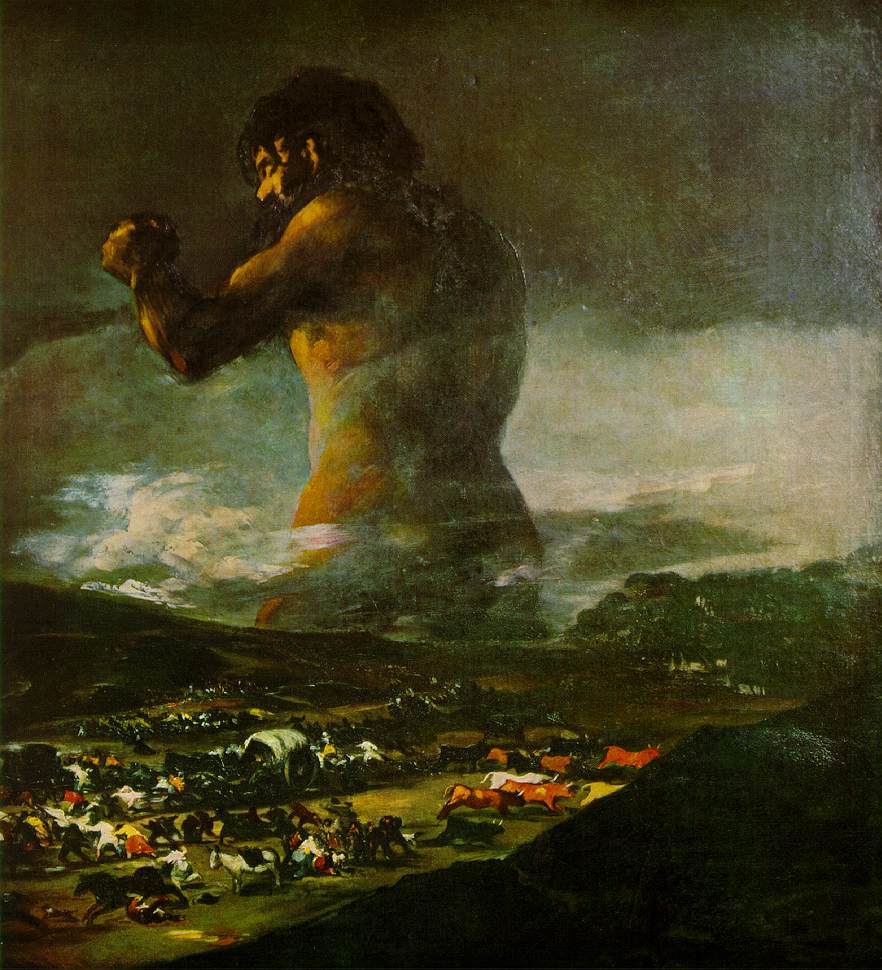
There is something peculiar about the mental character of the child to which Goya especially appeals. He is the painter of monsters, of nightmare, and in particular of The Colossus, a figure I expect every boy will have encountered in sleep.* Indeed, Goya captioned his 1799 series Caprichos with the phrase “the sleep of reason produces monsters.” His monsters were of the adult variety: revolution, murder, hate. Thirty years after first seeing Saturn devour his son, and well familiarized with the really-existing monsters of our world, I drove to Montreal to see his “Caprichos” at the Musée des beaux-arts.

The eighty prints constituting the Caprichos were described by Goya as depicting “ … the innumerable foibles and follies to be found in any civilized society, and from the common prejudices and deceitful practices which custom, ignorance, or self-interest have made usual.” This occupation, one might say preoccupation, rather suggests the satirist. And in his use of caricature, as well as his recourse to the grotesque, Goya does to a good degree fit the designation. Macaulay wrote that “the best portraits are those in which there is a slight mixture of caricature,” but Goya is not an artist of restraint where his subjects are concerned. He has a point to make, and a slight anything simply won’t do.

His work recalls Orwell’s “power of facing unpleasant facts,” specifically the facts of war and self-serving human pretensions, and my response to his representations of human endeavours are nearly characterised in Orwell’s discussion of his response to another satirist, Jonathan Swift, in the essay Politics vs Literature:

Swift falsifies his picture of the world by refusing to see anything in human life except dirt, folly and wickedness, but the part which he abstracts from the whole does exist, and it is something which we all know about while shrinking from mentioning it. Part of our minds — in any normal person it is the dominant part — believes that man is a noble animal and life is worth living: but there is also a sort of inner self which at least intermittently stands aghast at the horror of existence. In the queerest way, pleasure and disgust are linked together. The human body is beautiful: it is also repulsive and ridiculous, a fact which can be verified at any swimming pool. The sexual organs are objects of desire and also of loathing, so much so that in many languages, if not in all languages, their names are used as words of abuse. Meat is delicious, but a butcher’s shop makes one feel sick: and indeed all our food springs ultimately from dung and dead bodies, the two things which of all others seem to us the most horrible. A child, when it is past the infantile stage but still looking at the world with fresh eyes, is moved by horror almost as often as by wonder — horror of snot and spittle, of the dogs’ excrement on the pavement, the dying toad full of maggots, the sweaty smell of grown-ups, the hideousness of old men, with their bald heads and bulbous noses.

I say “nearly summarised” because I do not think that Goya “falsifies his picture of the world.” He exaggerates, and he selects. It seems apparent from the way he painted that he felt deeply. Disgust and outrage were among the emotions. However, Goya manages the essential challenge of satire in a way which differs from that of Swift. This essential challenge is to make one see, and whereas Swift’s choices involve a depiction of human nature in a condition of irredeemable debasement, Goya’s habitual strategy is to focus on human actions and to characterize them by their proper names. It is in the service of human drama to which the caricature is submitted. Although it is the case that Goya typically refuses to depict man as heroic, his nature as such is in any case unsettled and separate from the matter of action and its context in human choices. What people do is the principal concern, and it is according to this nature/culture divide that we may assign Swift to the conservative wing of satire and Goya to the liberal.

Nonetheless there is a morbid streak throughout Goya’s work. He is not an uplifting artist, but rather a disturbing one. The preponderance of war, rape, torture, cannibalism, and debasement as subjects is to be expected from an artist who lived in the time and place in which Goya himself lived, but even the deviations from this universal theme of “Man’s inhumanity toward Man” are telling: a Goya still life invoking the butcher shop as well as butchery, the subtle suggestion of human torment and degredation in the genre paintings (for instance “El pelele”), or the odd use of composition in the Tauromachia series, which displaces human forms from the works’ focal point.

The effect of these and other compositional decisions is to subject human society to profound skepticism. Goya paints a butcher’s table the way he paints a scene of battle, with an awareness of the social meaning of a particular subject. Just as the butcher’s table can not be separated from the universal human fact of eating, so too war is inseparable from the pomp and circumstance of Civilization. The individual act too is social in nature, and the “sleep of reason” is compelling as metaphor because brutality is extravagant but sleep is ordinary. His obsessions are doubtless rooted in an awareness, hence also fear, of this.

Goya seems to paint according to the principle “homo sum: humani nihil a me alienum puto” [I am a man, I consider nothing that is human alien to me.] The sleep of reason is not an academic or theoretical problem, but a condition to which the painter himself is not immune. Goya’s own dichotomy, as a reflective and organising artist who is also an outraged and impotent observer, materializes the larger dichotomy of a society which ostensibly manifests Enlightenment ideals while sponsoring the depravities of the Inquisition. Goya employs his rational intelligence to the purpose of ordering the disorder, expressing with clarity his churning indignation. His world is one of impossibility, of great forward strides into backwardness and barbarism. This explains the depths of Goya’s darkness, for it is in service of the potential but adandoned heights of human achievement that the depths are rendered. John Berger puts the matter this way, in his 1954 essay “The Honesty of Goya”:

The despair of an artist is often misunderstood. It is never total. It excepts his own work. In his own work, however low his opinion of it may be, there is the hope of reprieve. If there were not, he could never summon up the abnormal energy and concentration needed to create it. And an artist’s work constitutes his relationship with his fellow men.

This paragraph nicely captures both the social nature and hopefulness of Goya’s work. Goya is engaged in an act of solidarity, decrying the wicked acts of fellow human beings to his fellow human beings, who he must assume will have the capacity to participate in his disappointment. Berger concludes that “no artist has ever achieved greater honesty than Goya: honesty in the full sense of the word meaning facing the facts and preserving one’s ideals.” I think Berger is correct, and furthermore I think it is this honesty which has made Goya’s work compelling to me for over thirty years.


* Note: there is some controversy concerning whether The Colossus was indeed painted by Goya.

Keeping One Step Ahead

-Sekoh.

-Huh?

-Like this: say go. Try it.

-Say go.

-Well…that’s basically it.

-And that’s how Indians say “hi”?

-Well, that’s how Mohawks say hi. Other nations have different ways.

Cree say Wace. Ojibwa say Bojoo. Whole bunch of ways.

-Bonjour?

-No no no. Bo shoe–sort of.

-I don’t get it. Is there some religious significance?

-Well, no. Bojoo is a greeting. Sometimes Ojibwa say Nana-bojoo. And Nana is Nanabush.

-Nanabush? Is he a god?

-No. Not exactly.

-Nanabush.

-Yeah, only us Mohawks don’t say Nanabush. We say Coyote.

-Coyote?

-Yeah. Coyote, Nanabush, Trickster.

-What’s trickster?

-Well, that’s kind of hard to explain, really. Trickster’s lots of things. I guess you could say he likes to change what he is to keep you guessing. You know, stay one step ahead. He’s sort of tricky that way–tricky like a trickster. Likes to break the rules. Play tricks.

-Like a fool? In Shakespeare?

-Yeah, sort of. Sometimes the tricks backfire, and the joke is on Trickster.

-Is he some sort of religious symbol?

-No. That’s not quite it.

-I’d sure like to see an Indian religious ceremony. Maybe go up north during one of those festivals I heard of. I saw one on television once too. You Indians got anything like Christmas? I’d sure like to see it.

-Yeah, I guess you could say we have.

-What’s it like?

-Well, I’ll tell you a little story about it.

First of all, the sacred Indian ceremony begins about three weeks before sohl-stis, which is December 21 on the European calendar. We call this sacred time of the year tahkayaw. You know when the sacred time has arrived because everyone speaks the sacred greeting, eliwehk tahkayaw. I’d translate it into English, but there’s nothing like it in the Whiteman’s tongue. Anyway, when you hear that greeting, you know the sacred time has come.

The first thing Indians do when the sacred time arrives is go on a mysterious quest called shah-ping. It’s sort of a sacred hunting trip. Everyone does it: men, women, children. Well, the small children don’t. Not until they reach the sacred age. The Indians go in the morning, and return in the evening. We don’t discuss the things we find on our quests. We hide them from everyone else’s sight until the time comes to exchange the sacred objects. It’s so important that no one else know what you’ve found, that the Indians cover their objects in a special paper made just for the occasion. When we’ve covered everything up, we hide it all somewhere. You know, in our tipis.

We spend two, maybe three weeks on the shah-ping quest. We don’t quit until we have found a sacred object for each friend and family member and have brought it back home.

We decorate our tipis with sacred glittering objects made of metals and of wood. We eat special foods and drink special beverages. My favorite is called ehk-nogg. This beverage is served cold and sometimes is sprinkled with a powder called nuht-mek. I think the drink has a religious significance, but I’m not sure what it is. Someone once told me, an elder, but I’ve forgotten. Anyway, you can be sure it means something religious.

Everything Indian does.

So. Once we’ve done that, we go on another special quest. This one is really hard to explain: you might not understand it. But anyway, believe it or not, we go out in groups and look for a kris-mus-dree, which is a sacred object full of spirits that grows in the ground. And when we’ve found the right one, we bring it into our tipis and cover it in sacred objects made especially for the purpose. Some people cut down their own kris-mus-dree–in honour of the Creator. I know it sounds weird, but it’s our way.

There’s a bunch of special songs and chants that we sing throughout the sacred time of eliwehk tahkayaw. Many of the songs have religious significance, although about a hundred years ago–maybe more–people began to sing non-traditional Indian chants about a mythical Õkwehõweh…

-…that Trickster guy?

-…yeah. Yeah: you got it. Trickster.

Well, this time Trickster was really in disguise. You know, he likes to change his shape. Sometimes he’s a person, sometimes an animal. Or something else, even. But this time, Trickster showed up in a big red costume. Like a pow-wow fancy dress, sort of. It was made all of leather, with rabbit fur lining on the hood. And he had on a big black…wampum belt. And big black mukluks, too. Get this: he had a long beard. When’s the last time you saw an Indian with a beard? The really incredible thing is that he was carrying a big bag of those sacred objects I was talking about. The sacred chants tell all about it.

So. Trickster sneaks into the tipis while everyone is sleeping. And he gives each family a few of the sacred objects. Then he goes back up north. To Fort Albany, I think. Or Peawanuk.

And in the morning, all the Indians wake up and exchange the sacred objects. They take off the sacred paper and they sit around the sacred kris-mus-dree and they do many other religious things that I’m not allowed to discuss with White people.

But what about you? What kind of Christian ceremonies do White people perform? I heard once about some White pilgrims who spent Christmas day in prayer. And I saw a movie about Christians, too. Saint Paul, Saint John. Other guys names escape me. Saint someone.

That’s like a Chief, right–Saint?

-Well, a bit’s changed since then, actually.

-You don’t say? Gee, that’s too bad, you know.

-Well, maybe. Maybe not.

-Yeah. I guess I know what you mean.

Raising Cain

At first we all said she was crazy.

“Eve, you remember now what God said about curses and thorns and the sweat of the brow. And what about the increased pains and the ‘he will rule over you’ bit?”

It didn’t matter. She wanted to have a baby. Several babies. Personally, I never cared much for Adam. He borrowed my car once, got drunk, and then smashed it up. He’s rude and he talks too loud. He tells disgusting sexist jokes and thinks he’s so funny. He’s never had a job. He grows drugs in his basement, talks big about some invention of his that’s going to make him rich. The dreamer. He takes Eve’s money and uses it to get drunk, then he becomes violent.

-What happened to your face Eve?

-Um. An apple fell from a tree and hit me.

That’s the second time she’s used that one. The first was just before they moved out of her house. She told me the eviction was all because of an apple. When the authorities came around to the house to ask questions, she told them the apple story too. All Adam had to say was, “The woman did it.” And they bought the whole thing. They even wrote it down in their little black book.

Adam isn’t even divorced from his first wife, Lillith. No one knows about her, he keeps it so secret. He has children with the woman, but he never offers any support, financial or otherwise. He just lies around the house during the day, and goes down to the Paradise Club at night. He spends Eve’s money on beer and strippers.

-Why’d you agree to live with him, Eve? Can’t you see he’s no good for you?

-He really isn’t that bad. You have to get to know him. He just has his own way. Besides, I love him.

I tried to talk sense into Eve, but it was no use.

-Why don’t you go back to school? Get a university degree? You could take up a career. You could be a landscape architectural engineer. You like gardens. We could get you some new clothes, a new image. You really are a beautiful woman, Eve. You ought to care for yourself better.

Adam and Eve are still together. No one says she’s crazy any more; everyone has accepted the fact that Eve is going to stay with this man no matter what. But it still grieves me to see the way she treats herself, and the way she allows herself to be treated. I remember the day she came to my house all excited, saying, “I’m gonna have a baby! I’m gonna have that baby!”

-That baby?

-Yeah. The baby I’ve always wanted to have. I’ve always wanted something of my own, something I could love, that would love me.

-That’s great Eve.

-And I’ve got the name picked out, too.

Remembering Who You Are: The Synecdochic Self in Maria Campbell’s “Half-Breed”

[This is an extract from my 1998 doctoral thesis. You can also read my thesis chapters on Eleanor Brass and James Tyman. The introductory, “Autopoetics,” chapter is here.]

Maria Campbell

Maria Campbell’s Half-Breed constitutes a Metis-centred history of the Metis and conceives history itself as an energising mythos in which both critiques of present social realities and radical hopes for the future subsist

REMEMBERING WHO YOU ARE: The Synecdochic Self in Maria Campbell’s “Half-Breed”, by Maria Campbell (Halifax, Nova Scotia: Goodread Biographies, 1973).

“Surely history consists primarily in speaking and being answered, in crying and being heard. If that is true it means there can be no history in the empire because the cries are never heard and the speaking is never answered. ” -Walter Brueggemann, The Prophetic Imagination.

Maria Campbell’s 1973 autobiography Halfbreed constitutes a rebirth of the Native biographical genre, and hers is a text to which many who have followed refer. This work is striking for its breadth, beginning as it does with a summary narrative of Metis history, a history which frames the narrative of Campbell’s life. The autobiography begins, “In the 1860s, when Saskatchewan was part of what was then called the Northwest Territories and was a land free of towns, barbed-wire fences and farmhouses” (3). Campbell’s story is presented as a chapter, or rather 22 chapters, of Metis history beginning with the first white/native interactions and culminating in the 1869 Red River Rebellion and the 1884 battle at Batoche (following which Louis Riel was hanged, having been found guilty of high treason). Campbell summarises these and other key events, detailing the conditions within which they occurred and presenting the contemporary Metis grievances. Chapter One concludes with the outcomes of the 1884 battle, in the form of a list (6). Campbell establishes a perspective on this period of history (1869-1885) in a list recounting the events and ironically ending with the comment, “The history books say that the Halfbreeds were defeated at Batoche in 1884.” Such however is not the view either of Halfbreed or of Cheechum, a central figure of the narrative who “never surrendered at Batoche” (183). Halfbreed establishes Metis history as the contested ground of subjectivity and derives from its reconstitution of that history a synecdochic conception of the self. Halfbreed thus culminates in an expansive vision of solidarity which in many ways recapitulates the political struggles of Riel.

“Synecdochic self” is a phrase adopted by Arnold Krupat. According to the synecdochic model of selfhood, the individual is a part of the unfolding narrative of a people, and can thus be understood only in relation to the whole; “where narration of personal history is more nearly marked by the individual’s sense of himself in relation to collective social units and groupings, one might speak of a synecdochic sense of self” (Eakin 176). Here the collective social units and groupings under consideration are primarily the Metis people, but Halfbreed takes into consideration also class and gender groupings, and in the end a broad social community of those who seek justice. Indeed, at the heart of the autobiography’s “synecdochic vision” is a developing awareness of the complex inter-relations of gender, class, and race groupings which render solidarity both a logical and practical conclusion of the narrative:

I believe that one day, very soon, people will set aside their differences and come together as one. Maybe not because we love one another, but because we will need each other to survive. Then together we will fight our common enemies. (184)

In order then to understand more fully the workings of Campbell’s Halfbreed I shall attempt to analyse the constituents of this synecdochic vision, giving especial attention to the text’s dynamic representations of gender, class, Metis subjectivity, and history. As in the case in my investigations of Eleanor Brass and James Tyman, I hope to establish the structural-thematic principles according to which the text is organised and to describe the dictions and contradictions which articulate the discourse of the self. In short, I am attempting to elucidate particular instances of autopoetics, or self-making.

Cheechum serves both as the conveyor of the corporate past and the prophet of the future. Campbell’s synecdochic model of selfhood depends upon Cheechum for its substance, for Cheechum’s dual awareness of the crimes of the past and the promise of the future enables her to engage in a radical critique of the present. Maria’s analysis of the Metis condition is framed within Cheechum’s judgement that the state has “taught children to be ashamed” (159) and that governments were not made by the people; “it only looks like that from the outside, my girl” (159). Cheechum well understands the class economic interests which inform social reality, observing for example that war is “white business…between rich and greedy people who wanted power” (22). Cheechum notes further that the Catholic God “took more money from us than the Hudson’s Bay store,” an observation which integrates the religious institution into the project of cultural-economic imperialism (30). Maria’s experiences later confirm Cheechum’s class-based analysis:

I realize now that poor people, both white and Native, who are trapped within a certain kind of life, can never look to the business and political leaders of this country for help. Regardless of what they promise, they’ll never change things, because they are involved in and perpetuate in private the very things that they condemn in public. (137)

Significantly when the colonisation of Maria’s subjectivity reaches its zenith (in other words, when she is reduced to a “cold, rich, and unreal” sexual commodity and drug-addict) she finds herself in the presence of “politics and big business” (136). This convergence is perversely the fulfilment of Maria’s dream of material wealth as well as the disintegration of her “soul” (133) and even to a degree her body. Maria’s status as a commodity imposes upon her the requirement that she “forget about yesterday and tomorrow” (136), for the emptiness of her dream has become intolerable. The commodification of human relations, in which mere economic rationalism determines social reality, is exposed in all its ugliness. Maria performs her role as consort for a “wealthy and influential” unnamed partner. Her function is to “be damned beautiful and happy and entertaining” (137) in exchange for class-based privileges. In fulfilment of Cheechum’s sad prediction (134) Maria gets the “symbols of white ideals of success” she wants, exchanging for these symbols the substance of her “soul.” Cheechum, along with the Metis people, recedes from view as Maria becomes increasingly concerned not with the “tomorrow” of which Cheechum has spoken, but rather with the tomorrow of economic worries and the “next fix” (138).

The colonisation of Maria’s subjectivity is facilitated, if not driven, by the imposition of economic necessity. There is “no worse sin in this country than to be poor” (61), according to Maria. It is this sin of poverty that drives her to seek expiation in marriage, exile, and prostitution. The economic system of behaviour management complements and reinforces gender and class roles, interpolating Maria’s subjectivity into the contradictions of ideology. She subsists in the low- or non-paying gendered labour of the housewife and finds herself unable escape poverty. The contradictions of ideology inform her labour experiences as well as her subjectivity, for economic survival depends upon Maria’s ability to be the kind of women men like (97): “It made me feel that I might as well give up right then as there was no way I could ever be the combination of saint, angel, devil and lady that was required” (97). Maria’s work experiences consistently reproduce the contradictions of gender ideology. Gender ideology invariably domesticates her social and economic roles while introducing the notion of a threat to domestic stability. Thus, Maria’s employers rely upon her domestic skills while anticipating sexual indiscretions. Maria is a potential whore in the household whose presence necessarily elicits surveillance. Race ideology reinforces the notion of a whore-housewife, as demonstrated by an employer’s claim that Indians are “only good for two things – working and fucking.”(108). In short, the gender ideology which requires Maria to be a domestic labourer also renders her labour of dubious utility. As in other contexts, the accusation of “whore” is never far away.

First let us consider the matter of the writing of history. To write a Metis history is to practice radicalism (radix), for the Metis of the popular imagination is a creature whose essential characteristic is that he dwells outside history, history here understood as a people’s evolving self-realisation through purposeful agency. To write a Metis-centred history is thus to contradict officialdom’s most cherished rationalisation, that the Metis are not a people. The term “Metis” however properly refers to a distinct group, those whose origin can be traced back to the Red River in the early 1800s. These are the people, now located mainly in the prairie provinces and in the north, who joined together to fight the Hudson’s Bay Company and who in 1869 formed a government to negotiate their entry into the Canadian federation. Theirs is a unique culture with unique languages, among them patois and Michif (Purich 10-11). Campbell distinguishes “three main clans” of Metis in three settlements, and then contrasts the Metis to Indians, not only on cultural and linguistic grounds, but also on the grounds of character traits:

There was never much love lost between Indians and Halfbreeds. They were completely different from us – quiet when we were noisy, dignified even at dances and get-togethers. Indians were very passive – they would get angry at things done to them but would never fight back, whereas Halfbreeds were quick-tempered – quick to fight, but quick to forgive and forget (25).

The narrative is informed throughout by its implicit reference to the history leading up to and following from the Rebellion, a history which, as I have already suggested, serves as the mythic centre of Halfbreed.

Like the writing of history, the writing of an autobiography conveys phenomenal ownership of the productive means of one’s life-narrative, in contrast to the historical determinism which is an implicit (and at times explicit) theme of Halfbreed. In other words, autobiographical production appears to confirm the notion of the “self-authorising I” but does not and can not obliviate the material conditions of native lives, which are typically far from “self-authorised.” In this lies one of the many contradictions of “Indian autobiography” and hence Indian subjectivity. A subject-producing institution, autobiography is rooted both in liberal ideology’s notions of rational self-mastery as well as in the ideologies of class, gender, and race from which institutionally-mediated formulations of identity must borrow. This contradiction, of a self-mastered subjectivity and subjection, is furthermore subsumed in the dynamics of state-capitalism itself, which call forth active, autonomous, individualist “economic man” while constituting a complex class-based social order. One is constituted by ideology both as a subject and an agent, both as passive and active. Autobiography, as a culturally-mediated object, discloses the many ideological contradictions of liberal state-capitalism. A negotiation of the contradictions of state-capitalist ideology, whether consciously pursued or not, is thus necessary for the author of autobiographical narrative.

Each of the texts under discussion discloses (with varying degrees of self-consciousness) a negotiation of ideological contradictions. The challenge for analysis is to articulate coherently the particular features of the negotiation. I have claimed earlier that the contradictions of autobiographical narrative are rooted in the economic and political institutions designed to “solve the Indian problem” (see Introduction). These institutions are themselves historically rooted in the dynamics of state control, which constitute the material foundation both of social relations and of ideological constructs. The analysis of autobiography here undertaken involves a search for the textualised configurations of subjectivity according to the historical, cultural, economic and ideological substance of state subjects. Recall that particular incidences of autobiography and biography are ritualised recreations of the cultural myth of subjectivity, and that it is therefore with the performance of this “ritualised recreation” that we are concerned – with how the text operates rather than what it “means.” Under these conditions we may turn to Campbell’s text and to the contradictions inherent within its performance.

Campbell’s Halfbreed roots the autobiographical “I” in a corporate identity: the Metis people, but also as the narrative develops the collective social groupings of women and the poor. Historical narrative facilitates a mode of autopoetics which is at once critical and energising, a mode which situates the cultural and ideological contradictions of the self within a broader project of collective agency. Maria’s personal story is relational, posited among and extrapolated from the struggles, frustrations, and dreams of the oppressed. The reader is presented with two chapters of cultural history and genealogy before arriving at the phrase “I was born” (16). Structurally the autobiography implies that the “beginning” of the autobiography’s “I” precedes its explicit narrative introduction. The story of the “I” begins before the “I” is born (a point exploited to humorous effect in the autobiography parody Tristam Shandy.) By the time of Maria’s birth we have encountered not only the Riel Rebellion, but also the failed attempts of the Halfbreeds at farming, the conditions endured by the “Road Allowance People” (8), and descriptions of Saskatchewan life in the 1920s. At the centre of this corporate history is the role of the land in the unfolding story of Campbell’s ancestors, for the social, legal, political and cultural dynamics represented in her people’s history are literally grounded, rooted in the struggle to occupy and to live from the land. Campbell alludes to the land in an introduction, and notes that “like me the land had changed, my people were gone, and if I was to know peace I would have to search within myself. That is when I decided to write about my life” (2).

The notion of looking inside the self is illustrated on page 171, where Maria is given a painting “of a burnt-out forest, all black, bleak and dismal” with “little green shoots” representing hope. Land thematically integrates the political struggle over physical resources with the narrative struggle for the factors of self-production, an integration which literalises the apparent pathetic fallacy of the autobiography’s introduction. Land and history are the principal sites of struggle between state and Metis for the control of critical resources. This struggle informs Half-breed’s conceptions of Metis identity and discloses the ideological contradictions of the colonised self.

The text’s contradictions involve the ideological substance of the concept “Indian.” As the Welfare Office bureaucrat remarks on page 155, “I can’t see the difference – part Indian, all Indian. You’re all the same.” For him, Halfbreed, Metis, Indian, and presumably a score of other terms circulate interchangeably within a verbal economy of the Indian. While Campbell certainly knows the difference between Indians and Metis (differences which are legal, linguistic, cultural, and historical), this verbal economy informs her articulations of the self. The signified “Indian” is never far from the text’s multiple signifiers of Native identity, even in the case of illocutionary efforts to speak beyond or against the verbal economy of the Indian. The Metis is always-already an Indian, entailing the concept’s pejorative declinations. While the term “white” appears to be taken for granted as a proper and plainly descriptive signifier in Native autobiography, the terms Indian, Metis, and Native (to cite only three of many) are rife with ambiguities and negative connotations. The Native writer’s relation to the signifiers which speak her is an uncomfortable one, bound as the signifiers are by the ideological horizon of the signified.

Campbell construes her discomforting engagement with the signified as a love-hate relationship (103, 117). In these terms the autobiography thematises the bounding of its verbal economy. The power of the signified is acknowledged by Sophie, who according to Campbell comments that “she had let herself believe she was merely a ‘no good Halfbreed’” (103). Alex Vandal, the village joker, decides in what could be variously interpreted as an act of resistance or a capitulation to racial prejudice (or both) “to act retarded because the whites thought we were anyway.” Maria too, in a passage reminiscent of Edward Ahenakew’s Old Keyam (“I Do Not Care”) comments, “What’s the use? – people believed I was bad anyway, so I might as well give them real things to talk about” (129). The signified has precisely this force, as Cheechum’s comment, “They make you hate what you are,” suggests (103). The “proper” subject-positions of the Indian/Halfbreed are only too well-known, and being known they are at times self-consciously enacted by Native and Halfbreed agents. (James Tyman’s autobiography is a good example of just such self-conscious enactments, as I shall attempt to show.) Racism thus becomes literally a self-fulfilling prophecy.

Considerations of racism and identity are introduced into the narrative alongside the themes of imperialism and colonisation. Recalling a love of books from her childhood, Campbell writes of her fascination with the stories of Cleopatra which she had then known. Her imagination having been “stirred,” the juvenile Campbell enacts, with the help of her cousins, “plays” derived from the familiar stories:

In good weather my brothers and sisters and I gathered our cousins behind the house and organized plays. The house was our Roman Empire, the two pine trees were the gates of Rome. I was Julius Caesar and would be wrapped in a long sheet with a willow branch on my head. My brother Jamie was Mark Anthony, and shouts of “Hail Caesar!” would ring throughout out settlement. (14 sic)

One of the ironies of this Metis reconstitution of imperial Rome consists in the careful attention to racial representation in an otherwise naïve performance of roles. Young Maria wants to play Cleopatra but is instead cast as Julius Caesar, for she is “too black” and her hair is “like a nigger’s” (14). A “white-skinned, red-haired cousin” is instead pressed into the role, assuming her place aboard a raft, her slaves at her side. Cleopatra’s status (she clearly occupies the central place in this play) calls unequivocally for an Aryan representation. Race, class, and gender are each assigned their proper roles and places in this miniature rehearsal of historical imperialism’s social determinations. The Empire, in other words, arrogates to itself the exclusive right to constitute subjects according to its dominant interests. The word “nigger” suggests the virulent racism which subsists below the conscious awareness of the actors, and though the white neighbours perceive the irony of “Caesar, Rome and Cleopatra among Halfbreeds in the backwoods of northern Saskatchewan” (14) a greater irony may perhaps be the thematic appropriateness of this scene. The irony lies in the fact that matters of imperialism, colonisation, and racism may be abundantly clear in a representation of ancient Roman history while being indiscernible to the witnesses of the affairs of the modern and contemporary state. Imperialism nonetheless both produces and reproduces its conquests in the constitution of Indian subjects, an idea enacted not only within this scene but within the autobiography as a whole. Metis history and subjectivity are obliterated and in their place are put the White Man’s Indian.

The Cleopatra motif reappears in Chapter 22, perhaps the bleakest section of the narrative. Maria, institutionalised subsequent to her breakdown, revisits the world of make-believe:

They would be all right until a nurse or doctor came along, and then they would feign insanity. Sometimes they were moved to another ward, and eventually some received shock treatments. One attractive lady in her late forties had been there for over seven years. She believed she was Cleopatra, and spent hours sitting on a chesterfield. Sometimes one of us would feed her and pretend to be her slave.

Here play takes on a sinister aspect not at all like the play in which Maria has previously engaged. This Cleopatra is ironically described as an “attractive lady” (ironic because in the brutality and bleakness of her environment an attractive lady is incongruous), and the slaves at her side vividly depict the theme of power and powerlessness which is only suggested in the Cleopatra scene on page 14. The Alberta Hospital Cleopatra undercuts Maria’s earlier glamorous conception (“Oh, how I wanted to be Cleopatra”) and raises disturbing considerations of gender, class, and institutionalisation. An attractive lady would not likely find herself in such circumstances, though a woman of modest means like Maria may. In the female environment of the hospital powerlessness is graphically presented, the only “exception” being the mock pregnancies of a “fairly stout woman, with the most enormous belly” (163). I designate this an “exception” because there is an apparent and ironic appropriation of the female power of reproduction, an equivocal power, rooted as it is in patriarchal social and economic relations.

Awareness of patriarchal values shapes a number of Campbell’s reflections upon gender. Her father, we are told, is “disappointed” by the arrival of a daughter (16) and remarks disparagingly to his sons, “Dammit you boys! Maria can do it and she’s a girl!” (34). His conception of women is determined by a decent girl/whore dichotomy (111-112) which Campbell construes in the following terms:

On our way home Dad and I talked about babies, men, women and love. I asked him what kind of women men liked – I have to laugh now at his description. It made me feel that I might as well give up right then and there as there was no way I could ever be the combination of saint, angel, devil and lady that was required (97).

Campbell identifies the sexism of Native political organisations which “women were not encouraged to attend unless a secretary was needed” (182). She discerns in this attitude both general systemic determinants – what she calls “the system” – and the particular influence of missionaries who “had impressed upon us the feeling that women were a source of evil. This belief, combined with the ancient Indian recognition of the power of women, is still holding back the progress of our people today” (168). This account proposes an interesting case of ideological syncretism as well as a surprising manner in which ideologies can intersect and reinforce one another.

Representations of gender in Halfbreed comment variously upon gender roles and norms. Female beauty is a recurring motif of the narrative, whether the beauty of the Alberta Hospital Cleopatra or the beauty imposed upon the corpse of Maria’s mother and washed away by the horrified witnesses (78). Campbell notes the beauty which attends Lil’s prostitutes (137) as well as Darrel’s materialist sister, appropriately named “Bonny.” The description of her as “beautiful…and also very cold” (125) is a formula we meet in both instances, as well as in the description of the immigrants (27) and the transformed Maria, who we are told is “cold and unreal, rich and expensive” – and I presume beautiful in the manner expected of a prostitute (134). One insight to be drawn from this last episode is the relation of these depictions of beauty to agency and the self. The beauty of a prostitute, for example, is an instrumental value which serves economic necessity. Hence the intersection of beauty, money, and coldness, “cold” suggesting an absence of humanity. Indeed, in a world dominated by money relations all human interaction risks becoming predominantly instrumental in character:

I thought to myself, “Love! They all love you if they are on the gravy train. He can afford to love me. I made him good money.” I neither hated nor loved him. He was a means to an end, and I didn’t feel I owed him anything. (141)

We have already encountered Eleanor Brass’s comment upon the importance of money in the white man’s world (Brass 47). Maria’s conception of wealth and beauty involves at least in part a failure of logic, for these things begin as symbols of the good life but eventually become substitutes. In other words, the instrumental value becomes itself an end value, with disastrous results. Maria’s dream of wealth and beauty, innocent in itself, is co-opted by social relations which define the female subject as a commodity.

There are of course alternative models both of the self and of social relations. The commodified self rooted in instrumental social relations however is a subject position assumed by Maria in her dream to live in “a beautiful world full of beautiful people with no feelings of guilt or shame” (137). The dream of her materially-impoverished youth in this case is fulfilled only at the expense of agency and the self:

Dreams are so important in one’s life, yet when followed blindly they can lead to the disintegration of one’s soul. Take for example the driving ambition and dream of a little girl telling her Cheechum, “Someday my brothers and sisters will each have a toothbrush and they’ll brush their teeth every day and we’ll have a bowl of fruit on the table all the time…. Cheechum would look at her and see the toothbrushes, fruit and all those other symbols of white ideals of success and say sadly, “You’ll have them, my girl, you’ll have them.” (134)

These ideals of success, which are class-specific (Maria having associated them with wealth) as much as they are “white,” manifest themselves to Maria as a relation of the self to objective signifiers of status, as in the case of the business suit (67-68). “To own a suit and hat was a real status symbol,” Campbell writes, reflecting that in later years her awe is transformed into sorrow by the absurd pictures of men in ill-fitting clothes (68). Ironically the “holy” suits only underscore Metis poverty, for the pathetic attempt to look the part invariably fails. Toothbrushes and fruit further substantiate the theme of self-objectification, that is, of rendering the self an agent-less object of social relations. Cheechum “sadly” tells Maria she will have the “symbols of white ideals of success,” a prediction whose fulfilment clarifies Maria’s quest for her identity. Cheechum’s critique of the “white ideals” is implicit on page 98, where she says “Go out there and find what you want and take it, but always remember who you are and why you want it.” Cheechum here makes the distinction between material wealth as an instrumental value and an end value, and the word “remember” further suggests the critical function of memory in the constitution of the self. Maria’s failure is to render who you are equal to what you have, an understanding which abstracts the self from memory and history and posits it among object relations.

Prostitution fulfils the logic of the self-as-object, as commodity. Maria is taken to a “fashionable” dress shop and afterward to a beauty parlour. Having become the glamorous woman of her dreams, she is given an opportunity to contemplate the transformation:

When I was finally pushed in front of a mirror, I hardly recognized the woman staring back at me. She looked cold and unreal, rich and expensive. “Dear God,” I thought, “this is how I’ve always wanted to look, but do the women who look like this ever feel like I do inside?” (134)

The mirror image graphically imposes upon Maria the contradictions of her subject-position. She confronts herself as object – as simply another symbol, like a toothbrush or a bowl of fruit. The contradiction forces her to evaluate the conventional image of success which she has cultivated, for clearly inner does not correspond with outer. The contradiction of inner and outer initiates a critique of the material signifiers of success, a critique which will be evident in later sections of the text. At this point in the narrative, however, there is merely a recognition on Campbell’s part that the dream of success pursued thus far is empty. Campbell writes, “I lost something that afternoon. Something inside of me died” (134).

The death of one dream does not immediately bring about the birth of another. Structurally, chapter seventeen constitutes a negative space between the commodified subjectivity which has been the dominant (but not exclusive) concern of the early chapters and the synecdochic subject which shall dominate later. The term “negative” is employed because the subject-position adopted in chapter seventeen is “no self”; Maria recognises the perversity of a “self-as-object” model but finds the demands of agency insupportable:

Most of the girls at Lil’s used pills, and once I discovered them the world became a great deal more bearable. I took them like they were going out of style. They helped me to sleep, they kept me happy, and most of all, I could forget about yesterday and tomorrow. (136)

Forgetting is the means by which the self rooted in a historical narrative is negated. History, to borrow from James Joyce, is a nightmare from which Maria wishes to escape. Profoundly informed by history, Halfbreed conveys the horror of a history-less existence. Severed from an energising past and future (which the narrative derives from the story of Riel and the Metis people), the present is static and deathly. Campbell describes herself then as “numb,” (136) which is another way of saying, as she has earlier stated, that something inside of her died (134). What has “died” at this point is human agency. This death manifests itself not only in an absence of memories of the past and imaginings of the future but also in the absence of a critique of the present. The death of the Chinese girl, for instance, is met with a resolute attempt on Maria’s part to pull herself together lest she “fall apart and be finished” (135). Maria herself attempts suicide and ends up in a hospital among women whose “greatest fear was being released,” that is, of becoming agents actively involved in the mess of existence (163). Smoky speaks for them also when he expresses his efforts “to forget we exist” (174). Cheechum’s admonition, “always remember who you are,” is here appropriate, for the hospital scene suggests a link between the institutionally-coopted subject and forgetting. Cheechum herself suggests such a link when she claims that the state offers blankets but steals souls (159). The subject subjected to the state in this way is emptied of agency and ceases to be fully human.

Campbell first relates Cheechum’s story of the blanket during the restaurant scene. Two Indian boys are mocked by a group of “drunk and noisy” white men, who yell, “Watch it! The bow and arrows are coming” (158). Narrative details lead the reader to associate this scene with an earlier incident from Maria’s life. The older child stops, puts his arm around his younger brother and, “with his head up,” continues walking (159). The resemblance of this scene to the town scene of page 37 is clear. In both scenes, the Indians are objects of a white gaze, which imparts to them the shame Cheechum traces back to state apparatuses, church and school in particular. The very concept “Indian” issues implicitly from this white gaze, a gaze which the church, the school, the welfare system and the paternalistic state as a whole constitute in an institutionalised form. We have seen this for instance in Maria’s encounter with the welfare office, where she is stripped of dignity and pride and is called by the state to recognise herself as an “Indian” subject. As a reward for her subjection, she receives a small amount of money: a “blanket,” to use Cheechum’s term.

Cheechum’s insight discloses what might be termed the politics of identity. Halfbreed examines power in its manifestations as instruments which name, for as Cheechum understands, the dominant culture sustains its privileges by fashioning the world in its image. Against Halfbreed’s energising Riel mythos, the dominant ideology pits a cinematic farce (111), thereby discrediting the call for justice at the heart of Metis history. The cinema screen functions as a state apparatus, for it calls its Metis audience to a recognition of itself in the image. In this context, the political function of Halfbreed is clear. As Leigh Gilmore argues, in the “transformative process of naming” lies the allure of autobiography. An autobiography empowers the writing subject to speak, as opposed to being spoken for. Having been “spoken” by the ideology of the coloniser, Maria sees her destiny as determined by a choice between failure and assimilation. This choice rests on the assumption that to be Metis is to be poor and dirty, whereas success (in the form of toothbrushes and bowls of fruit) comes to those who become white. The only other “respectable” identity left to the Metis in the present order is a parodic one: the Calgary Stampede Indian, for example. The Indian is an anachronism; white history dictates that the present belongs entirely to the whites. Autobiography offers Campbell a recourse to the discursive production of an alternative reality, and enables her to reconstitute both Metis history and a synecdochic model of selfhood. Thus Halfbreed ends both with an affirmation of solidarity and the words “I no longer need my blanket to survive.”

Solidarity subsists in the common historical grounding of various subject-positions presented in Halfbreed. Metis and non-Metis poor, for example, share comparable experiences, while Metis women in their experiences of work have more in common with other women than with Metis men. The subject-positions of Metis, women, and the poor are represented in a narrative which grounds oppression and poverty in the history which has yielded Canada:

So began a miserable life of poverty which held no hope for the future. That generation of my people was completely beaten. Their fathers had failed during the Rebellion to make a dream come true; they failed as farmers; now there was nothing left. Their way of life was a part of Canada’s past and they saw no place in the world around them, for they believed they had nothing to offer. (8)

The Rebellion was, as the “official” account on page 6 suggests, the final impediment to the dream of a nation stretching “from sea to shining sea.” Those defeated at Batoche disappear as agents from this history. Poverty, which discloses their (non)relation to the prevailing modes of production, forecloses the future and hence renders dreaming futile. The marginalised share in common a present in which they see for themselves “no place in the world around them” as well as a past which is irrelevant and a future which is impossible. Human agency in such conditions becomes an intollerable burden, and a people forced to endure the burden end up “merely existing,” a phrase employed by Campbell in the Introduction. Mere existence is the antipode of historical existence, and Halfbreed implicitly attempts to reconstitute the latter within a narrative informed both by remembering and hope.

Memory and hope merge in the failed effort of the Rebellion, which Campbell recapitulates ironically. Following a disappointing encounter with the CCF, Campbell’s father becomes involved in Native politics, becoming a strong supporter of Jim Brady. This chapter is an ironic repetition, in miniature, of the disappointments following the defeat of Riel. The arrival of Jim Brady is attended by hope and excitement, both of which find their expression through Campbell’s father. Although Jim Brady is clearly the driving force of the political agenda, the narrative construes politics as domestic drama, casting the father in the role of hero. The Campbell family becomes a part of the Riel struggle, just as the meaning of Campbell’s individual life is itself synechdochically related to the corporate history of the opening chapters. The Riel mythos provides both a set of compelling symbols and an explanatory framework for the past, present, and future. In Riel, the terms of the struggle are articulated and the people find an energising narrative of origin and destiny. The domestic drama is therefore cast in the symbolic terms of the Riel mythos:

Daddy went to meetings all that year. He didn’t go trapping and so we were very poor. He was gone nearly all the time, and when he was home he would be very moody, either so happy that he was singing, or else very quiet. We all suffered these times with him. It seemed the Mounties and wardens were always at our house now. We were treated badly at school, even our teacher would make jokes about Dad, like, “Saskatchewan has a new Riel. Campbells have quit poaching to take up the new rebellion.” (74)

The irony of the invocation of Riel is clear enough. It is intended by the whites as a form of derision. Furthermore, it is true that neither the victories nor the defeats of Campbell’s father can claim the historical significance that the life of Riel can claim. Structurally, however, the invocation is a serious one, for in this chapter ( Chapter Eight) Campbell first becomes politically-conscious, and the perennial struggles of the Metis are first given expression:

Jim [Brady] said almost word for word what I have heard our leaders discuss today: the poverty, the death of trapping as our livelihood, the education of our children, the loss of land, and the attitude of both governments towards out plight. He talked about a strong united voice that would demand justice for our people – an organization that government couldn’t ignore. He said many people were poor, not just us, and maybe someday we could put all our differences aside and walk together and build a better country for all our children. (73)

The narrative is simultaneously mindful of past, present and future. The conditions of the past are linked to those of the present, and the subjunctive mood (“maybe someday we could”) projects the narrative into the future. Here the point being advanced is not merely that history is presented as repeating itself, which is apparent enough. Rather, a particular relation of structure and meaning is proposed. Through repetition, events take on their full significance. This relation takes us to a central implicit concern of the book, historical determinism. The repetitions that make the narrative meaningful also constitute a central problem for Maria: are her people doomed to repeat history? Again, we may think in this context of James Joyce’s Stephen Dedalus, for whom history is a nightmare to be escaped. Dedalus’s decision to “forge in the smithy of his soul the uncreated conscience of his race” proposes the transformation of personal and collective history in an act of literary re-creation. Campbell’s task is comparable: “Like me the land had changed, my people were gone, and if I was to know peace I would have to search within myself. That is when I decided to write about my life”(2).

Further observations could be made in relation to Joyce’s A Portrait of the Artist as a Young Man, particularly regarding the significance of imperialism both to Irish history and to Stephen Dedalus’s project of self-creation. Dedalus speaks of his alienation from the English language (182) and from the Christian religion (241), both of which he correctly views as imperial impositions, and rejects the offers of state institutions (principally the church) to affiliate himself with the empire through allegiance to its symbols and narratives. Dedalus’s assertion of non serviam [“I will not serve”] manifests itself in the “silence, exile and cunning” (238) whose mythic representation is Odysseus. It is especially fitting in this context that among Odysseus’s epithets are the terms metis (“cunning”) and polymetis (resourceful); clearly also exile is a central element not only of Campbell’s autobiography, but of the life of Riel himself (4). The suggestion here being made is not that Campbell is by virtue of a fortuitous pun an “Odyssean” author, whatever such an assertion may mean; rather, this brief interpolation of Joyce’s work is intended to suggest ways in which both autobiographical narratives (or in the case of the Künstlerroman, pseudo-autobiographical narrative) provoke a consideration of the constitution of subjects and subjectivities. Cunning is a practical necessity if the state production of subject-positions is to be challenged (For a discussion of Joyce and imperialism, see Vincent J. Cheng, Joyce, race, and empire. Cambridge, Cambridge University Press, 1997.) Halfbreed presents the multifarious state apparatuses involved in the production and reproduction of Indian subjects while constituting the terms of its self-determination of subject-positions, that is, historical agency.

One apparatus considered is the motion picture. The representation of history in a movie recalled by Campbell effects a successful appelation of subjects. The Metis apparently consent to the appropriation of their history and, in so doing, forego the opportunity to remember who they are, the task of historical agents:

One show I remember was about the Northwest Rebellion. People came from miles around and the theatre was packed. They were sitting in the aisles and on the floor. Riel and Dumont were our heroes. The movie was a comedy and it was awful: the Halfbreeds were made to look like such fools that it left you wondering how they ever organized a rebellion.

Here the very notion of a rebellion (which may raise the troubling question Why did people rebel?) is obliviated and replaced by a depoliticised comic vision of the Metis, complete with a “filthy and gross” Dumont and a Riel who is a “real lunatic who believed he was god” (111). History, with its troubling themes of imperialism and injustice, is displaced by triumphalism and the gratifying resolutions of comedy. The followers of Riel are appropriated to the prevailing cultural symbols of the day, emerging from this version of the Rebellion as “‘three stooges’ types” devoid of serious interest. Not surprisingly, the representatives of the state, in particular the NWMP, are recreated as heroic. Campbell notes the “hysterical laughter” of the Halfbreeds, who apparently are unaware that an ideological assault is underway. Cheechum however walks out in disgust.

The ideological assault on the Metis, and its concomitant production of subject-positions, manifests itself in a number of conventional assumptions. On page 8 we find the ethnocentric and essentialist notion advanced also by Eleanor Brass that Metis “just did not have the kind of thing inside them that makes farmers,” an assertion contradicted by the example of her father. This ontological assertion is particularly striking coming as it does after a lengthy materialist accounting of the barriers faced by the would-be Native and Metis farmer:

Due to the depression and shortage of fur there was no money to buy the implements to break the land. A few families could have scraped up the money to hire outside help but no one would risk expensive equipment on a land so covered with rocks and muskeg. Some tried with horse and plough but were defeated in the end. Fearless men who could brave sub-zero weather and all the dangers associated with living in the bush gave up, frustrated and discouraged (8).

I considered earlier the self-interest invested by whites in the notion that Indians were incapable of cultivating the land, a notion that Sarah Carter has argued to be false. Donald Purich furthermore has analysed the diverse legal and economic arrangements which rigged the system of property distribution in favour of white settlers and speculators, virtually guaranteeing that Indian and Metis farmers would be unable to take possession of the land. The result of government policies was that most of the land given to the Metis ended up in the possession of eastern speculators, whose predation was tolerated by the state, if not actively assisted. Campbell acknowledges the consistency of government efforts to undermine Metis organisation, but underestimates the role of the government policy in the expropriation of Metis land, relying instead on a ready cultural explanation.

The “failure” of the Metis is construed as a historical failure, part of the inevitable if poignant displacement of barbarism by civilisation. The Metis, in other words, failed to meet the challenge of history. Thus the Metis way of life is conceived to be “a part of Canada’s past,” an inference whose complement is (as I have suggested) the triumphalism of the empire. Campbell notes “there are some who even after a hundred years continue to struggle for equality and justice for their people,” a statement which recasts history in differing terms. History thus conceived is the product of human effort and inescapably subject to a moral accounting. The “white” version of history apportions only dehistoricised and static subject-positions to the Metis; only as commodity does the Indian serve a legitimate function. Business is “good in Calgary for Indians,” Marion notes (155), for the commodified Indian reproduces an ideological discourse which regards the Indian as a historical (that is dead) artefact. The Indian-as-antique manifests itself in the “gaudy feather and costumes” which Campbell equates with the “welfare coat” put on to get government money. In both cases it is a white man’s Indian devoid of humanity and historical agency, the same Indian who appears on the movie screen at page 111. Campbell deduces the source of her personal shame from these representations and from the subject-positions imposed upon her by political, economic, and cultural institutions.

Guilt and shame are emotions that Metis and Indians alike have acquired as a result of colonisation. These are a feature of the Indian subject. “Indianness” has been defined by the dominant (white) culture at the same time that Native and Metis traditions have been weakened or even supplanted; the result is that as the material conditions of Native people have been destroyed, the destroyers have rationalised the matter by redefining the Indian subject, paradoxically, as the agent of his own undoing. Such is the case in the official judgements regarding the Indian as a farmer, which tended to render as just the usurpation of land by whites. Campbell depicts the power inherent in this relationship, of coloniser and colonised, in a representation of what may be termed the anthropological gaze:

[The Metis] were happy and proud until we drove into town, then everyone became quiet and looked different. The men walked in front, looking straight ahead, their wives behind, and, I can never forget this, they had their heads down and never looked up. We kids trailed behind with our grannies in much the same manner. (37)

The transition from “happy and proud” to shameful suggests the implicit function of the “white gaze” (recall that Brass uses the term gaze in her depiction of the trip into town). The gaze interpolates the Indian subject, and in this instance even the children respond with the “proper” subject-position. The encounter of the white townspeople and the Metis discloses the intersubjectivity at the base of this shame-filled Indian subject; even Maria’s dream of escaping the shame of poverty is a mere reciprocation of the gaze. She respects (respectare) the “symbols of white ideals of success” (134) and in so doing recognizes herself as the Metis subject of the gaze. The response depicted on page 37 is elicited by the encounter of Maria and the Welfare agent, for whom Campbell acts “timid and ignorant” as she’s been instructed to do by Marion (157). This suggests that the welfare department, and presumably other state apparatuses, institutionalise the gaze, that is, the power of interpolating subjects. Notably an Indian child frustrates what may be construed as an interpolation on page 158 (“Watch it! The bow and arrows are coming”), walking “with his head up.” Cheechum already has exhorted Maria always to do the same (37), an exhortation which challenges directly interpolative strategies and the power inherent within them.

Poverty and the institutional arrangements deployed in its management are mediated by subjects, which is another manner of articulating the point that the ideologies of the welfare state constitute subjects for welfare state apparatuses. The Poor as such is an abstraction, rationalised in the fictive subject-positions where the state renders poverty subject to its own institutional and instrumental logics. This mediation-function of the subject is indeed what we encounter on pages 36-37:

I went to the [Welfare] office in a ten-year-old threadbare red coat, with old boots and a scarf. I looked like a Whitefish Lake squaw, and that’s exactly what the social worker thought. He insisted that I go to the Department of Indian Affairs, and when I said I was not a Treaty Indian but a Halfbreed, he said if that was the case I was eligible, but added, “I can’t see the difference – part Indian, all Indian. You’re all the same.” (155)

Maria has been instructed by a friend to perform for the Welfare agency: “Act ignorant, timid and grateful” (155). Here performance designates the simulation of a specific subject-position appropriate to the ideological assumptions of the welfare office worker, assumptions clearly articulated in this passage. Indians and Metis are “all the same” insofar as they together are interpolated by welfare-state apparatuses. The simulation of poverty involves a concomitant simulation of ignorance and timidity, what one may term following Cheechum the “blanketed subject” for which the state stands ready, arms filled with more blankets. Maria’s request for assistance is co-opted by the state and thus becomes an institutional encounter where agency is undermined and a passive subject constituted. Identity is objectified and reified in order to satisfy bureaucratic ends. The bureaucratic demands of the state furthermore resemble the economic demands of capitalism. As Maria notes, “To me [dancing in the Calgary Stampede] was the same as putting on a welfare coat to get government money” (156). In either case, she become merely “a white man’s Indian,” a subject amenable to institutional expedience.

The pervasiveness of institutions is a striking feature of Native autobiographies, especially those autobiographies written since World War II. In text after text, the protagonists are taken captive by one institution after another; relief agencies, welfare offices, prisons, the Department of Indian and Northern Affairs, psychiatric hospitals, and countless other entities make regular appearances. An Indian autobiography is, whatever else it may be, a reflection upon the multiple and contradictory modes of production of subjects in the paternalistic state of modern and contemporary times. Cheechum, as we have seen, puts the matter this way:

…when the government gives you something, they take all that you have in return – your pride, your dignity, all the things that make you a living soul. When they are sure they have everything, they give you a blanket to cover your shame. (159)

Cheechum includes in the category “government” the churches and schools, recognising their subject-producing function as state apparatuses. Significantly Cheechum emphasises the negative character of their operations; what they may impart (Christian religion, literacy, etc.) is apparently less important to Cheechum than what they negate – “all the things that make you a living soul.” The two, giving and taking, are regardless complementary, for the exchange constitutes an agent-less, soul-less subject. This is one of the lessons of Maria’s experience. Cheechum here describes not only the schools and the churches, but the tactics of treaty negotiations by means of which the Canadian government asserted its control. The treaty negotiations proposed an institutionalised rationalisation of imperialism, offering to Native peoples the opportunity to become subjects, on the Empire’s terms. Doubtless the offers of blankets were seen for what they were and met appropriate responses. In any case Cheechum’s characterisation of giving and taking succinctly captures the subtle (and at times not so subtle) operations of institutionalised encounters, where the state bids for subjects and the agent risks her soul.

The narrative’s contradictions, between individual and institution and self and other, are manifested both in the mirror scene (134) and the welfare-office exchange. In the former scene Maria regards the subject she has wanted to become and in the latter she becomes the subject she has wanted to avoid. Both subject-positions alienate Maria from “the things that make her a living soul,” principal among them being history and a synecdochic relation to others. The autobiography, in keeping with the narrative convention of closure, ends with a synechdochic vision (“I believe that one day, very soon, people will set aside their differences and come together as one” [184]); Cambell’s personal story is a part for the whole, and both together are an effort of “brothers and sisters all over the country” who seek together to throw away their blankets, and in so doing to ensure that “the whole world would change” (159). This is not a claim that the text resolves all conflicts and contradictions. Campbell, having derived from history a synechdochic understanding of her personal struggle, projects the struggle into an unspecified future: “one day, very soon, people will set aside their differences and come together as one.” Maria’s searching, loneliness, and pain are over because she has been restored to her brothers and sisters, but for Native people change will come only when together they fight their common enemies. This hopeful denouement is rooted in Metis history, particularly in the history of resistance and rebellion and in the refusal to surrender associated with Cheechum (183). Maria emerges from her “numbness” to find solidarity among “people like herself” (167), a reminder that it is not only Halfbreeds who have reasons to do so but, as in the days of Riel, “white settlers and Indians as well” (4). In short, while the synecodochic vision of Halfbreed’s closing pages extends to all peoples, it is nonetheless a vision which is profoundly Metis, derived from the promise of the Riel-centred Metis mythos by which Halfbreed is informed.

Campbell prefaces the introduction of her people with the words, “The history books say that the Halfbreeds were defeated at Batoche in 1884” (6). Following this is a list of events which constitutes the orthodox, white version of Metis history. This is the history which the white history books have spoken into existence: it is a history ending in defeat and death. Maria, however, says that “My Cheechum never surrendered at Batoche: she only accepted what she considered an honourable truce” (184). These two statements occupy the beginning and end of the narrative, and stand in opposition to one another. History as it is presented in the opening pages is “objective” and cast in the tragic mode. It looks dispassionately at the facts of the matter, which are beyond dispute, and finds poignant the inevitable deaths, which were in any case necessary to produce the present order. Halfbreed, on the other hand, articulates an alternative understanding of Batoche and its aftermath. It is an instance of constitutive rhetoric which, by its very existence, refutes the textbook proposition that the Metis were defeated in 1884, and thereafter disappeared as historical agents. Halfbreed constitutes a Metis-centred history of the Metis and conceives “history” itself as an energising mythos in which both critiques of present social realities and radical hopes for the future subsist.

RES-SCHOOL-DJ-lr-(2)

My Fall 2014 book “Residential Schools, With the Words and Images of Survivors, A National History,” is available from Goodminds. Order by phone, toll-free 1-877-862-8483.

Follow me on Twitter

June Fourth Thoughts

I confess that on this particular June 4th I’m pleased to see Tony Hayward having quite an unpleasant time of it. If only somehow we could spread the malaise more broadly, across the globe’s Unaccountables. We know too well however, from historical memory, that he’ll one day “have his life back.” Like the clichéd African dictator who retires afterward to the French countryside – with only the Swiss bank accounts to remind him of home – Mr. Hayward will do fine, whilst the masses will be left to the business of living in the dirty wake of the mess that enriched him. That’s how it is in our age of Winner Take All.

Africa comes to mind for two reasons. One: it is this continent, and not the North American, which may lay claim to the world’s worst disasters of the crude variety. As Anene Ejikeme points out in today’s New York Times, “Experts estimate that some 13 million barrels of oil have been spilt in the Niger Delta since oil exploration began in 1958. This is the equivalent of one Exxon Valdez every year for 50 years.” Two: Africa is quietly being re-colonized and “re-Apartheided” (if I may coin an awkward term) by a dictatorship which on June 4 is recollected around the world for its Tiananmen massacre.

Neither examples one or two has received the attention in the West that British Petroleum now receives, but they are more useful indications than the Macondo spill of perils our species will face in the future. China has shown beyond any doubt that it has no regard for human life, that it cares nothing for the environment, and that it intends to flood territories it finds useful, from Tibet to Zimbabwe, with Han Chinese. As its appetite and boldness for acquiring both greater Lebensraum and resources increases, China (the world’s leading exporter of goods, the possessor of the largest foreign currency reserves, and the country with the most severe wealth polarization) will export ever more weapons, and it will back more and worse dictators throughout the world. In short it will export its totalitarian version of market socialism, its racism, and its contempt generally for human life.

In any war zone or dictatorship into which one may have looked in recent years, whether Sudan, Ethiopia, Eritrea, Zimbabwe, or Nigeria, the participation of China can be discerned. In Darfur, the Janjaweed militia kill with China-supplied AK-47 rifles and grenade launchers. In Equatorial Guinea, the Chinese government lavished a new capital upon long-standing dictator Teodoro Obiang Nguema Mbasogo, whose regime competes with Robert Mugabe’s for the title of Africa’s most corrupt. In Zimbabwe, it is Chi­na’s weapons and military equipment which have enabled Mugabe to crush his opponents.

True, you may say. But what about the Russian and British and American weapons? Well, we rightly denounce these and look with indignation upon the history of colonialism. How depressing it is, then, to contemplate the very likely prospect of a vigorous expansion of this project in the present century. The country best poised to dominate our planet for the foreseeable future is backward and wicked in every respect. Reactionary, barbaric, and obstinate on every issue of present concern, China is the land of vetoes, denials, obfuscations, and crackdowns, and so its approaching global rule promises disaster for the causes of human rights and social progress — as indeed it does for the very notion of progress itself.

Authenticating the Subject: Inside Out, An Autobiography of a Native Canadian, by James Tyman

[This is an extract from my 1998 doctoral thesis. You can also read my thesis chapters on Maria Campbell and Eleanor Brass. The introductory, “Autopoetics,” chapter is here.]

AUTHENTICATING THE SUBJECT: ROLE-PLAYING AND THE SELF.
Inside Out: An Autobiography of a Native Canadian, by James Tyman (Saskatoon, Saskatchewan, Fifth House Publishers, 1989).

(Excerpt from a Ph.D. Thesis.)

James Tyman’s 1989 autobiography brings us to the present and details the contemporary conditions of a number of Native lives. We are given Tyman’s assertion in a brief note, inserted presumably by an editor in the back pages, that Inside Out “was not written to seek pity nor was it done to ask forgiveness. I wrote this book to simply ask for understanding and acceptance for myself and all Native people.” This statement suggests the “synecdochic mode” of identity discussed earlier, in relation to Maria Campbell’s Halfbreed. James Tyman writes for himself and for “all Native people,” structuring his search for identity within the larger quest for an understanding of what it means to be Indian. His autobiography differs from Maria Campbell’s in the degree to which it concerns itself explicitly with racism, but in both Campbell’s and Tyman’s cases, the authenticity of the self is a preoccupation. Both Campbell and Tyman present their textual selves as role players who enact a conventional Indian identity. Tyman’s fictional self is a paradox, a character whose quest for authenticity renders him precisely the “typical Indian” he is determined not to become. The effort of the autobiography is toward an “Indianness” beyond white ideology, and therefore makes explicit the classism, sexism, and racism which are inherent in the presentation of Indian subjectivity. Tyman’s text discloses the ideological ground on which the contemporary Indian is founded. His protagonist’s quest for authenticity is therefore also a critique of culturally-determined modes of self-understanding, and understanding of others.

Inside Out is divided into 3 sections: Racism, Crime, and Recovery. Appendages to the text proper include a brief epilogue, added for the 1995 Fifth House edition, and a note “About the Author and the Book,” into which has been inserted a quotation from the author. The principal function of the notes, apparently added by an editor, assure the reader that despite “incredible odds,” there is cause to be optimistic: James Tyman has “taken on the job of rebuilding his life.” The book itself ends positively, with the protagonists assertion that his “gut feelings” tell him he is going to “make it” (226). Given the overwhelming evidence of the text, this conclusion seems unlikely; it is arguable the structure of the narrative, rooted in textual convention, gives rise to this outcome. It is principally to the structural character of Tyman’s narrative that I will turn, in order to substantiate the claim that specific narrative conventions guide both the telling of the story and the tale. In conducting the investigation in this manner, I hope to demonstrate that the text enacts, at the structural level, the very logic which at the level of narrative it attempts to dispel.

The observations thus far, regarding the “optimism” of the narrative’s conclusion, are not offered in order to suggest that there is no grounds for them whatsoever. Nor are narrative conventions invoked as evidence of “false consciousness” or disingenuity on the part of the author. These initial comments are given to suggest that textual presentations of the self can be, and are, informed by textual concerns. Among these “textual concerns” are the literary conventions with which every author must come to terms, as well as the less-commonly considered concerns of the audience: particularly, the white audience. In any consideration of “Indian Autobiography” it is of use as well to reflect upon the politics of textual production and consumption. Books “about” Indians have a social function which cannot fully be understood without reference to the media industry in particular, and state capitalism in general. A textualized James Tyman is, among other things, a commodity inseparable from the social, political, and cultural conditions of the marketplace. Textual conventions are informed by these conditions, as well as by more strictly “literary” concerns.

What I shall call the book’s market-oriented “machinery” clarifies the matter of the conditions of the marketplace. Our attention having been caught by the bold design of the book’s spine (or the bold design of the cover, if the publisher has arranged the all-important frontal display), we open the cover to find a series of quotations from the media. The assertion of quotation after quotation is that Inside Out is a “book for all Canadians” (Toronto Star) that provides “an opportunity for white society to look at the larger issue of the place of Native people in Canada” (The Daily News). Having established this assertion in the opening quotations, the following series drive home the point that Tyman’s narrative is “violent,” “raw,” “graphically detailed,” “gritty, sharp and quick” (Maclean’s and Vancouver Sun) There are less sensational accounts, but it is perhaps significant that these appear on the folio’s obverse face. Only after these initial impressions have been registered do we learn that Tyman’s story is “an engaging narrative by an intelligent, sensitive young man” (Books in Canada). The closing series of quotations present to the potential consumer a book which is “thought-provoking, especially for anyone willing to suspend old prejudices and listen with an open mind to a young Native” (The Edmonton Journal). Some comments and qualifications of my argument are in order.

It is not my contention that an industry conspiracy is at work in the deployment of these quotations. I am merely advancing a claim that books exist as commodities, and that this status produces significant observable results. One observable result is the choice of the publisher to exhibit the sensational character of the commodity, making it appear at once violent, disturbing, exotic (“Inside Out is a clear and dramatic account of what it’s like to be raised in an alien culture” – TheDaily News), and “a book for all Canadians.” (“Exotic” is defined by Chamber’s dictionary as follows “introduced from a foreign country: alien.” The Greek root is exotikos – exo, outside) It is relevant to note the logic of several quotations, which associate drama, violence, and crisis with the lives of Native Canadians, while arrogating to “mainstream Canada” the “disturbing question” about the place of Natives. (Not all the quotations function in this manner, and some are very far from sensationalism. However, the more sensational quotations are more prominently exhibited.) In the words of one reviewer, Tyman’s autobiography is an “opportunity for white society to look at the larger issue of the place of Native people in Canada.” The precise meaning of this last statement is unclear. From a marketplace point of view it is clearly preferable that a book appeal to “mainstream” Canada (whatever this might be). From the point of view of race ideology, however, the quotation is ambiguous. Does it assert that it is (or should be) up to “white people” to settle the issue of the place of Native people in Canada? Does it, on the other hand, propose that the social utility of the book lies in its opportune appearance – as an occasion for whites at last to see and understand the “larger issue” of the oppression and exploitation of Native people in Canada? Either interpretation is plausible; evidence for a conclusion of any sort is lacking. What matters in the present argument is the intertextuality constituted by the quotations. They provide a useful and appropriate counterpart to the text proper, raising the very issues of race that are the primary concern of Tyman’s narrative.

Tyman’s narrative is arranged into 3 sections, “Racism,” “Crime,” and “Recovery.” The logic of this structure is readily apparent, and is made explicit throughout the text. Racism is the foundation of the narrative; furthermore, within the concept of “racism” lies the interpretive tools we will need to understand Tyman’s fictional self and the incidents of plot. “Crime” and “Recovery” succeed racism, both chronologically and logically. As we will see, racism also informs the pressing concern of “authenticity” which the autobiography exhibits, for race ideology imposes an inauthentic identity upon the self. This “inauthentic identity” however becomes ironically authentic. Tyman internalizes ideology so effectively that his identity is paradoxical, in the manner of an authentic forgery. The roles assumed by Tyman’s protagonist are racism’s self-fulfilling prophecies, a fact which does not escape the self-awareness of the protagonist himself. Indeed, this very self-consciousness constitutes much of the autobiography’s complexity and interest.

The distance between the author and protagonist, on the one hand, and the protagonist and the reader on the other, is carefully managed and shifts throughout the text. The narrative begins in the second person, addressing a “you” who is simultaneously the reader, the protagonist and the impersonal “you,” as in the French on. An effect of immediacy is sought in the use of point of view. The first paragraph of Inside Out is written in the second person, the second paragraph in the third, and the third in the first. Tyman does not immediately address his fictional self as “I,” and indeed does not at first address himself at all. He first addresses the reader (“But if you had lived there”), and in so doing disrupts the inside/outside relationship upon which autobiographical narrative point of view depends. The reader of autobiography is posited outside the narrative, whereas the protagonist, narrator, and author are “inside” the narrative, identifiable by the first person “I.” However, the reader’s presence inside the narrative is momentarily and subjunctively posited. The reader confronts the “smell of spilled wine, whisky, beer and unwashed bodies.” This smell is contrasted to the “odor of frying bacon [common] to thousands of other households across Canada.” In these phrases the opening paragraph both establishes and complicates the inside/outside dichotomy on which autobiography rests. The inside perspective of Tyman’s autobiography rests not upon ontological grounds, but upon habituation and circumstance. The reader is forced for a moment to regard the outside from inside: “But if you had lived there long enough the smell was natural.” The inside, we are reminded, is an outside we have come to no longer recognize as such.

In a narrative concerned with race, adoption and identity, the disruption of an inside/outside structure lies at the heart of the protagonist’s condition. Alienation is an apt description of the protagonist’s plight. Tyman first refers to his fictional self in the third person: “He threw the boy to the couch, pressing one knee on his chest.” The use of a proper name fails to clarify matters, for there is yet no firmly established relation of author, narrator and protagonist (in an autobiography, these three share the same identity). “Kenny” does not identify James Tyman, though they refer to the same person. Only at the end of the second paragraph does the narrator place himself inside the text by adopting, as it were, a first-person perspective: “But my father was too drunk to realize I was still unconscious.” This abrupt shift of perspective establishes the generic textual conditions we recognize as autobiography (i.e. the textual convergence of author, narrator and protagonist in the pronoun “I”). However, it is the textual complexities of the two opening paragraphs which establish the thematic concerns of the book. The shifting narrative perspective and the destabilization of the inside/outside dichotomy assert that we cannot take for granted the linguistic conventions which underlie the narrative presentation of an identity. What can be said of identity in Inside Out, given that “James Tyman” makes his autobiographical appearance in the third person, in the guise of an unconscious boy named “Kenny”? This question emerges from the opening scene of the book and informs the use of narrative conventions which follows.

According to Tyman, “the story really begins” the day he arrives at his new home in Fort Qu’Appelle, Saskatchewan (8). The details of the autobiography’s opening section are reconstructed from an account given by Tyman’s mother in a downtown bar. Tyman himself, we are told, has no memories of the beatings and abuse. The first paragraphs, then, are not personal recollections, as Tyman himself reports: “I imagined this scene countless times as I tried to picture what horrible things had happened to cause my mother to let the Saskatchewan Social Services Department take me away.” The logic of autobiography dictates that one start at the beginning, but Tyman’s autobiography recalls Philipe Lejeune’s observation that the beginning is inaccesible. One cannot recollect from memory the circumstances of one’s birth and infancy. Beyond this observation there is the further point that the beginning of James Tyman’s life does not correspond to the beginning of the narrative. The fictional self of the opening pages, represented by the name Kenny Howard Martin, is of a dubious status, for it lies beyond the memory of the author. The “real” beginning comes when the protagonist is adopted into a white family and is given his new identity. The heading for the autobiography’s beginning proper is “September 1967” and the first paragraph of this beginning ironically concerns endings:

Who is this woman? Where is she taking me? Am I going to die? Somebody said I would do the world a favour if I died. Death is where you go to sleep and have peace forever. It sounds inviting. It’s got to be better than what I feel.

These are perhaps atypical thoughts of a four year old, but they are appropriate thematically. James Tyman’s beginning can be characterized as the obliviation of the Indian identity which is invested in the name Kenny Howard Martin and in the intersubjectivity of Martin and his family. Of course, racial characteristics obtain across the sea change of this reconstituted self. Kenny Martin does not die without leaving behind evidence that he has lived.

The young Martin arrives at his adoptive home without name, family or history. He finds a photo album and looks inside for his family, but it occurs to him that he doesn’t know who he is looking for (10). He is called “Jimmy,” eliciting the following unspoken response: “My name isn’t Jimmy. I want to tell her my name is…I don’t know”(8). Having arrived at the Tyman house, Martin’s identity is suspended in a confusing and disruptive introduction as well as over the confusing relation of himself to the others: “I’m standing in the porch. The huge brown table is full of white people. They look different. They stare at me like I’m different.” The difference represented by white people is not grasped in racial terms, but merely in the literal terms of a four year-old’s sensibility. The people are “white” in the same, literal sense that the table is brown. Since the protagonist is “brown” also, the physical details of the paragraph emphasize the boy’s objectification. He has more in common with the brown table than with the white people. He is an object of their gaze and speech, and he interprets their comments about him in instrumental terms. A “nice-looking lady” says, “he’ll do fine,” in response to which the boy concludes, “I think she means I’m okay. What am I okay for?” The attention of the narrative turns to the boy’s objectified body, which we are told “feels sick and lonely, and awfully scared”(9). We know the boy has been an object of physical abuse, and it comes as little surprise when the primary source of this fear is identified: “I’m afraid of these men.” Tyman begins his autobiographical journey as an objectified Indian without a place of belonging.

Indians inhabit the fringes of the narrative. Tyman first mentions them on page 10:

I noticed other Indian kids on these excursions. We’d stare at each other in fascination – I the nicely dressed young native with this white woman, and they with their stringy hair and worn clothes. Their parents looked just the same. Some of the men were loud and obnoxious. I studied them closely. There was something there I could almost remember.

He stares at the Indians in “fascination,” in the manner of an anthropologist. The difference between himself and them is immediately clear, for he is now a “nicely dressed young native,” adopted into the ways of white people. The Indians are dirty, loud, and obnoxious. There is however something almost remembered in the abusiveness of the men, and Tyman begins “to understand what [he is]” (10) from his encounters with these Indians: “They were dark skinned, and so was I.” The whites all around him do not fail to notice the difference. They ask, “You’re Indian, aren’t you?” The young Tyman answers “Yeah,” though his understanding of what it means to be Indian is confused. With his friend, Anita, he jokes about “the stupid Indians with their dirty clothes and hair, sleeping in the tall weeds behind the hotel on Main Street” (11). His dark skin reminds him he is in some sense Indian, but the meaning of this eludes him.

James does not fail however to gather the meaning of the “white man’s Indian.” While at school in Lebret, James’s outlook toward Indians is “molded” by the conversations of white children. The white children show by their statements that they have learned Indians are stupid, lazy, and dirty, and that Indians are thieves as well (12). James sees “only a few” Indians in church, and deduces from his understanding of religious dogma that, since only good people go to church, Indians are bad people who are going to hell. As strange as it is, this logic nicely complements and justifies the social conditions which James encounters. Racism becomes common sense when the badness of Indians is disclosed: “No wonder my friends didn’t like [Indians]. They were going to hell!”(13). This logic is apparently supported by church propaganda given to the children for the purposes of religious indoctrination:

We were given books about the biblical days. I would turn the brightly illustrated pages in fascination. Jesus could fly! Not only that, but anyone who died could fly. They floated around up in the clouds. Some were playing harps. They were always dressed in white. Another fascinating thing was that there were no Indians floating around in the clouds. In fact, there were no Indians at all in these books! Yes sirree, Indians were evil. (13)

Inside Out arrived some years after the priestly debate over the question Do Indians have souls? was concluded. Nevertheless, the observation that the blessed souls “were always dressed in white” discloses in symbolic terms racism’s gospel. The function of “the biblical days” is less moral and didactic than authoritarian, “biblical days” signifying a mythical past when God directly spoke His will to men. The social vision of narratives “about the biblical days” is, of course, a vision prescribed by contemporary authors. The past is a fiction in which the present forever reconstitutes itself. There are no blessed Indians in the heaven of biblical days because there shall be none today. (“Authoritarian” is best understood in the multiple sense of “auctoritee,” a term used throughout Chaucer’s Canterbury Tales. The Wife of Bath plays with the term “auctoritee” to convey the relation of authority, authors, and authorization. Her memorable question “Who painted the lion?” draws upon an Aesop fable to make the point that representations differ according to the interests of the one who makes the representation. She argues that women are best suited to write about women, and that the monopolization of authorship must be attacked head-on.)

If Indians do not belong in heaven, neither do they belong in polite white society. Tyman writes often of “belonging” and comments that his mother frequented a downtown bar “because it was where she was accepted for what she was – an Indian, like most of the other patrons”(8). To be accepted within the dominant culture “for what he is – an Indian” appears to be impossible for James. He feels he does not “belong.” Racism alienates James from both himself and others; he learns to hate Indians, to hate himself, and to hate whites. Through crime and violence he attempts to find community and an identity, though ironically his acts of violence are undertaken to gain the respect of the respectable (i.e. whites). The respectable however cannot tolerate difference, and as a result of his need to assimilate, neither can James. His efforts, whether violent or not, are directed toward the futile task of becoming white. He laughs along with others at Indian jokes, reminds his peers that his family is white, and scrubs his hands, “hoping to wash the darkness off” (15). He learns of Indians from whites, in the schoolyard, in books, and from television. These Indians are the blood-thirsty savages of myth, and when they do not accord with the image of Indians he sees around town, James is left wondering, “I knew I was an Indian, but according to my friends I didn’t act like other Indians. What was an Indian supposed to act like?” The answer to this is implicit in the question. Indians act as whites say that they do.

The dominant white culture controls the means of representation and thereby sets the limits and terms of discourse. James’s friends exchange ideological dogma in the forms of jokes, legends, and rumours. James’s options are to participate, resist, or be silent; he is not however able to seize the means of representation, and hence to alter the terms of discourse. Discourse thus comprises James’s strategic response to racism – crime – a response which reinforces racist assumptions and which is therefore self-defeating. James attempts through crime to earn the respect of whites. Although it is ultimately self-defeating, the choice to undertake a life of crime is driven by a need for authenticity. The ideological Indian of James’s white peers is presented as the authentic Indian, but an authentic Indian identity must by definition seek an alternative grounding. The search for this “alternative grounding” constitutes one of the principal challenges of the Indian autobiography, for as already mentioned, representation of the Indian has long been controlled by the dominant white culture.

Racism engenders hate, and James comes to hate the white man’s Indian that he apparently is and the whites who inflict this hate upon him. James attempts to assimilate to white culture but finds assimilation to be an impossible goal, and instead flirts with the idea of suicide. This pattern of behaviour has been described well in Jeannette Armstrong’s Slash, in which the Indian protagonist’s dilemma is either “to assimilate or get lost.” (See also Noel Elizabeth Currie’s article, “Jeannette Armstrong & the Colonial Legacy”). These options, determined by the logic of racism, are articulated again and again in the autobiography:

I hate these people, I thought. They’re all wrong about me. I’m just like them. I think like them. I eat like them. I have feelings like them. I can’t help being who I am. I want to die. It came back to me: dying is where you go and have peace forever. (19)

This passage recapitulates the themes and language of the opening pages, in which difference is foregrounded and identity is rendered ambiguous. With this recapitulation however there is a transformation, for hate has entered the narrative. The protagonist asserts his social membership only to underscore his difference from others (“I’m just like them … I can’t help being who I am”). The recognition of difference no longer derives solely from appearances, but from the hateful logic of racism. The recourse of the alienated self is once again death, but death is now invested with further meanings. Death is the place “where you go and have peace forever,” but also a capitulation to racism’s demand, “assimilate or get lost.” In accordance with his tough-guy role, James must make his death look like an accident. His school mates must not know “they’d won” (20), although the demand to “get lost” would have been fully met.

At the centre of Inside Out is a quest for authenticity. James comments that his adoptive family “seemed artificial, it wasn’t real” (19); he does not know his “real name” or his real parents (21). James finds the adoption papers, which refer to him as “the subject,” and his response is alienation and “a mixture of love and hate” (25). Tyman represents the discovery of his birth name and has his protagonist respond, “That was it! Now I know who I am.” (25). He has come however from Ile-à-la-Crosse, “the end of civilization”(25) and is further alienated from the Tymans and “their relatives,” as he puts it. James is called an “apple” by Indians (a term designating an assimilated Indian, i.e. red on the outside and white on the inside), and yet he is alienated from white society as well as from Indians. Tyman multiplies the ironies and contradictions of this confused identity. In a refrain reminiscent of Edward Ahenekew’s Old Keyam, James asserts, “No one cares about me! … So I don’t care about anyone!” (26). “Who cares” is a phrase that captures the attitude of James’s “tough guy” role (18), but it serves only to alienate James further from his conflicting emotions, which “[eat] him up like a cancer” (27). Cancer introduces death and its associated theme alienation of the self into the narrative, but the “real name” functions in contrast as a focal point for the countermovement of the self, toward authenticity and life. James’s authenticity quest embodies itself as a search for his past and is initiated by the discovery of his real name, for the name is a vestige of the past which will take him eventually to the “end of civilization,” where his unremembered, subliminal self awaits recollection.

James’s recollection of his forgotten past is only one-half of the narrative’s concern. The other half addresses racism’s effective distortion of the present, and the self-loathing and self-alienation which results. The reserve Indians disclose the profound ignorance and racism of James, and the ideologically-determined manner in which he conceives Indian identity:

“You Indians scalp anyone on the reserve lately!”
He knew I was joking, but he was visibly upset by it. “We don’t scalp
people. How do you think we learned to scalp?”
“Skinning beavers and gophers,” I shot back.
“You don’t know much, do you?”

Not only is James ignorant, but the means of production of his “knowledge” of Indians differ decisively from those of the reserve Indian. The reserve Indian alludes to the historical record (“How do you think we learned to scalp?”), thereby exposing the fundamental flaw in James’s conception of Indians. The discussion between James and the reserve Indian continues,

I quit smiling. “What do you mean?”
“I mean, you’re no Indian. You grew up with whiteys all your life. They taught you that we scalped people, right?”
“Well, that’s the truth … isn’t it?”
He snickered lightly. “Pile of bullshit. Get some Indian bros. Quit hanging around with honkies. Maybe you’ll see what the truth really is.” (27)

The reserve Indian equates “being Indian” with knowing the truth, thus underscoring the narrative’s logic that the lies of racism distort the self and lead potentially to alienation, violence, and destruction. Authenticity of the self demands a truthful account of history and social and racial relations. Thus, a good part of the burden of Tyman’s autobiography is to restore authenticity of the self by presenting a truthful account. Racism serves the double function of keeping James from true knowledge of Indians as well as from the knowledge that he does not know. Truth, in the view of the reserve Indian, issues from solidarity with one’s own; history issues from group identity.
The matter of identity is further complicated by the introduction of the term Metis, which Lorne must explain to an ignorant James: “A Métis is a half-breed, half Indian and half French”(28). The term properly refers to a distinct cultural (and not merely racial) identity, a fact Lorne acknowledges in his historical grounding of Metis identity:

“…You heard of Riel?”
“Riel was a honky,” I exclaimed.
“He looked like a honky, but he was the same as you. You’re just the darker
version.”
“Darker version, hey.” I felt a sense of relief then, not because I was actually sitting down talking to an Indian, but because I realized I was half white. (28)

Lorne makes the essential point, that the Metis are best understood in relation to Riel and the historical context in which he was situated; he is however wrong that Riel is the same as James. James’s understanding of Riel (“Riel was a honky”) discloses the ahistorical sensibility which is the psychological condition not only of the protagonist, but of his society. Deprived of a history, James is forced to reproduce his cultural and personal identity through the medium of a racist ideology’s anti-history. Riel is thus an ironic presence in this context, the symbol of a Metis identity which has been obliviated.

James is compelled by a racist society to assume roles. Lorne puts the matter this way: “You act like a clown, entertaining your honky friends all day. That’s not really you. You’re just acting that way to get their approval” (28). Racism dictates to the Indian that he must “assimilate or get lost,” and consequently two common themes of Native autobiographies are suicide and the role-playing Indians are compelled to undertake in their quest for acceptance. The principal thematic tension of many Native autobiographies is constituted by the competing psychological demands for acceptance and authenticity. This psychological condition, referred to by Wilfred Pelletier as a “double life” is a nearly universal feature of Indian autobiography, at the core of which is typically a critique of the dominant modes of social relations and the ideological and institutional instruments by which they are formed. Thus, Wilfred Pelletier’s collaborative No Foreign Land is a critique of, among other things, capitalism; Maria Campbell’s Halfbreed is especially concerned with welfare ideology; and Eleanor Brass critiques the logic of the Indian Acts. In each case, there is a keen awareness of the double lives of Native peoples, and of the historical, ideological, and institutional conditions from which these double lives issue.

Assimilation is presented as a choice between being a “good Indian” and a “bad Indian.” James, to his pleasure, is seen by some as belonging to the former category (34). He infers from the court briefs of the newspaper that there are “a lot” of bad Indians, and decides he does not want others to think he is one of them. In the next paragraph, however, we see James planning his first of many crimes, at the instigation of two Indian friends who share his rage (34). The implication is that James is in fact “one of them,” a conclusion against which he directs considerable psychological and physical efforts:

I was working hard all right, trying to show everyone that I wasn’t like those “lazy Indians” who littered the town, drunk and crude, every time they got their welfare checks. I was a hard-working white man: that was what I was trying to prove to my family, my friends, and anyone else who saw me. I was fighting myself (37).

The “lazy Indian” is a long-standing figure of ethnography and a sharp contrast to the hard¬working white man of the Protestant work ethic. The battle between the two rival identities is a matter of personal psychology, James having internalized the assumptions which inform them. “Inevitably,” Tyman writes, his “two lives crashed together”(37). He is unable to sustain the illusion, and enters fully into the category of “bad Indian”:

All my work to show my white friends that I was a “good Indian” had gone wrong. All my inner turmoil to show myself that I wasn’t like the rest of the Indian race who drank, fought, and went to jail had gone wrong. (47)

James’s “new notoriety” as a burglar confirms his identity. Despite his efforts to the contrary, he becomes racism’s “typical Indian.” As has always been the case in Canada, institutions are in place to manage the bad Indian. Indeed, most of the autobiography depicts James’s serial encounters with these institutions.

We have seen already the omnipresence of institutions in Native lives. In the earliest phases of colonial rule, the Indian department and the treaty systems constituted the primary instruments of cultural, social, and economic domination. These instruments were deeply embedded in the institutions of British empire, and derived their self-justification from ethnology’s evolutionary model of racial development (See the discussion of Lewis Henry Morgan in Chapter 2). Inside Out occupies a historical period during which the court system has become a preponderant instrument of law and order. Within the court system, James reaps “pity and scorn” (66), and he finds that the so-called correctional institutions worsen his condition: “Now I was on probation for two years and my outlook on life was distorted. I had no identity. My experiences with the court system just added fuel to my anger (67). As his friend Carl points out, the good Indian disappears, whether through assimilation, the reservation system, the correctional system, or by occupying the margins of society: “…if you stay on welfare, stay on the reserve, or stay in poverty in the city, then you’ll be treated better. But as soon as you start making noise about being discriminated against, they’ll turn it back in your face. They’ll call you the bigot. They’ll say you’re not appreciative of what the whitey is doing for us”(68). James construes his life of crime as a means to achieve”respect and fear” (66) and to avoid being “a token” (69). Assimilation is compelling, but increasingly James comes to see his condition in the historical and political terms of his “tutor” Lorne and his friend Carl. Tyman introduces contemporary land-rights court cases as a contrast to the self-defeating encounters of James with the court system (69). Ironically however James is fighting in his own manner the battle which is going on in the culture at large. The criminal sub-culture offers James an illusory community, identity, and respect, offerings which appeal to James’s generalized longing for an alternative to “work, honkies, and authority” – that is, to the dominant institutions of economic, social, and political hegemony (70). Yet in the absence of a coherent and compelling strategy, rooted in history and a collective identity, James’s efforts are doomed to failure.

When seen from the outside, the life of crime appears to be glamorous. However, the outer is inauthentic. James experiences the notoriety of crime which he has previously only witnessed, and comes to understand from the inside the irony of criminal “success.” His growing notoriety makes him feel “like a celebrity” (79) and gains him a place among local Indians. Terry sums up James’s public identity: “You’re a bad influence. You have a bad attitude, and you’re rowdy, rank, motherfuckin’ Indian who’s selling drugs to school kids. That’s how the cops will portray you in court.” James achieves his objective; he is no longer an object of pity, but rather a pariah. Tyman however undermines the achievement in a brief passage which exposes the contradiction of the inner and outer: “I sat handcuffed with a police officer on either side of me. I had watched men sitting like this. I thought they were murderers, or criminal masterminds. I felt stupid getting all this attention for a $24 window”(84). The chapter “Racism” concludes having acknowledged James’s failed efforts:

I decided to move to the city when I got out of jail. “Who knows, I might get rich,” I told myself. I used to have dreams of getting rich, just to show everyone that I wasn’t a typical Indian, content to stay in the shadows and collect welfare when he realizes white society doesn’t want him. I wasn’t going to let them do that to me. I would make them want me. I would make them notice me, and respect me. They would know who I was. But now it all seemed worthless. I was going to jail. I was just another typical Indian. (89)

James’s efforts are informed by culturally determined roles. He becomes a clichéd “bad Indian” and “tough guy,” while dreaming of his public transformation into a rich man. All the while the “typical Indian” lurks in the background as the negation of all that has worth. Inside Out documents the paradoxical effort to present to the world a simulation of authenticity. This is not however a mere intellectual game, but rather an acknowledgement of the economic and social power invested in the marketplace of identities. For James, success in every sense of the term depends upon satisfying the demands of the social market.

Chapter 2, “Crime,” recapitulates the autobiography’s opening paragraphs. James awakes on the floor of his friend Dale’s house, among a group of passed-out friends who clutch “half-full bottles or burnt-out cigarettes”(99). This is the life Kenny Martin had known, but which has now been forgotten. Tyman however recalls the culture of the “undesirables” in which the Tyman’s lived, and employs it as the setting for the opening paragraph of chapter 2. The tripartite structure of the autobiography proper (there is a concluding note about the author and the book, as well as an epilogue) suggests that the principal themes will be introduced in the first section, and that a transition will occur in the middle section, leading to the resolutions of the final chapter, “Recovery.” Indeed, this is the case. “Crime” depicts the culture of the undesirables and the racism of which this culture is an outcome. The recapitulation of the autobiography’s opening imagery lends thematic integrity to the narrative and underscores the social reproduction of crime and violence which are racism’s legacy.

The Regina Correctional Institute is the setting for the novel’s first turning point, which comes precisely at the centre of the autobiography (page 109 of 219 pages). Here we encounter the following passage, which concerns James’s friendship with an Indian fellow-prisoner, Herbie:

My first impression was that he was a hardcore racist, but after talking to him for a while I learned that I was the one who really was not informed. It was like meeting Lorne all over again, the Indian back at Bert Fox Composite High School who’d told me to get some Indian bros and quit hanging around with honkies. “Maybe you’ll see what the truth really is,” Lorne had said, and now, finally, I was ready to hear it. I had learned about Indians from white people. I hadn’t bothered to question their analysis because I was afraid of rejection. After talking to Herbie about Indian people and their beliefs, I found that I was myself a hardcore racist. I felt disgusted with myself, remembering all the snide remarks I had made over the years about Indian people. They weren’t a bunch of bloodthirsty savages. They were my own people. I hated my own people. My own people hated white people. I didn’t know who I was or where I was going. (109).

Much can be said of this passage. First, Tyman structures the representation of his personal development through thematic and character repetition. Just as James occupies roles throughout the narrative, so too do his acquaintances. Herbie fulfils the function first presented through Lorne. Herbie’s success in his tutorial role depends upon the institutional context, which itself fulfils a role not unlike what Bahktin termed a “carnival.” The prison culture not only represents the broader culture from which the prisoners have been drawn, it inverts it, with interesting results. In the prison, “the honkies are the oppressed minority” (103), and as such they occupy “the bottom of the social ladder”(103). Racism is blatant inside the prison but differs qualitatively from the racism of the outside world, a result of the inverted relations of power in prison society. Tyman employs the theme of inside versus outside in a series of inversions which culminate in James’s realization that he is himself a hardcore racist who hates his own people. Inside Out, having indicted the racism of the “outer” world, climaxes in the revelation that James is himself a racist. Herbie is quick to point out that James is an “apple,” an observation which corroborates the narrative’s increasing interest in the internalization of ideology. James’s insight that white “analysis” of Indians has obliviated their subjectivity (or “beliefs,” as Tyman writes) is an outcome of his immersion in an Indian-dominated prison culture. Inside the prison James learns about Indians “from the inside,” as it were. (See the chapter on E. Brass. It has been noted by a number of commentators that white institutions designed to subdue and assimilate Indians, such as residential schools, often have the paradoxical effect of politicizing them. Brought together into large groups within white institutions, Indians learned of their culture from other Indians even as whites attempted to assimilate them.)

The mention of “apple” prompts James to speculate about the Martins and his lost self: “I thought that could be what I was looking for – the past I couldn’t recall, a sense of identity, of who I really was. You can’t take someone’s past away and expect him not to miss it, not to look for it.” (109-110). This wording conflates the personal and collective past. James is in search not only of himself, but of a narrative of Indian identity not integrated into the economic, social, and political interests of the dominant (white) elite. The setting of this chapter, a prison, should remind us that it is not an identity which James lacks, but rather the control over the terms in which that identity is constituted. James is literally imprisoned in and by social constructs. The inmates, composed of individuals drawn from specific class and race categories, play the ideologically-prescribed and culturally-mediated roles of the con. They are, as Tyman notes, “role playing inmates,” in accordance with the class and race ideology of their captors (120). James too plays the role by setting himself in oppositional terms against the “straight johns.” “I’m not like you guys,” he says, “I’m a con” (117). In his con role, James is a “phony” who participates fully in race and class ideology. The question “Who are you,” the concern proper of autobiography, illicits competing and contradictory narrative “answers.” Who James “is” depends largely upon who has set the terms of discourse. The autobiography presents two contradictory positions. James may form his identity around an inauthentic core (and thus become an apple), or he may seek an authentic identity through a reconstitution of his “lost self.” James’s search for the Martin family derives from the latter option. The Martin family serves a function akin to Metis history in Maria Campbell’s Halfbreed, for it is posited as a lost but authentic history from which the “real” self may emerge.

James’s enactment of a “con” identity constitutes an oppositional mode of the self. He is set apart from the “straight arrows” (128) of society and is relegated to the criminal culture of violence. Violence is directed not only toward others but toward the self, a fact disclosed in numerous references to self-mutilation. James attempts both to explain and legitimize his relegation to a criminal culture through the authorizing discourses of individualism which are at the core of autobiographical discourse itself. The dominant culture thus affords him ample opportunities to engage in what Marx has termed “false consciousness.” James asserts that his entry into the criminal culture is both “natural,” because it is innate (“I was born a criminal, I guess” 129) and willed, because it is an assertion of his autonomy (“I’m just going to be me. No one holds me. No one controls me. If someone gets in my way, chances are one of us is going to die.” 128). The “false authenticity” of these assertions, rooted as they are in class-based ideologies, is a manifestation of the narrative structure’s implicit logic. False authenticity is the paradoxical outcome of racism and the precursor of the “recovery” of the self. (Thus the division of the narrative into Racism, Crime, and Recovery.) Tyman, in other words, posits racism as an “autopoetic” ideology from which an autobiographical outcome (the “con” identity) follows. Inside Out displays the assumptions of autobiographical discourses they intersect among ideologies of race and class. The intersection of these ideologies discloses the relationship of identity, power, class, and consciousness. False consciousness serves to legitimize contemporary domestic imperialism by narrating the self merely in the ideological terms of autobiography. James’s specious assertions of volitional and genetic self-determination displace the appropriate considerations of class, race, and history which underlie the conditions of his life. According to the logic of false consciousness, James is a “born criminal”; neither history nor ideology are matters of concern. The abstracted “con” identity therefore is an autobiographical fiction in which dominant interests have an enormous stake. False consciousness is a contemporary concomitant of the historical evolution of colonization. So long as James is a mere born criminal, more plainly ideological matters need not be raised. It is the competing models of the self, one based on an autobiographical critique and the other on a historical-ideological critique, which contest one another throughout Inside Out. The former concerns itself with depicting the events of a life with reference principally to the self, whereas the latter considers the relation of the self to history and ideology, as well as to a collective identity (Arnold Krupat’s “synecdochic self”).

The reclamation of a collective historical and cultural “Indian” identity is complicated however by a number of conditions. “Indian” is an ideologically loaded abstraction. There is no universal “Indian” identity, excepting perhaps the white man’s Indian. There are common historical experiences, but in an autobiography such as Inside Out, it is precisely the historical dimension of Indian identity which has been rendered inaccessible. Urban Natives typically suffer from a form of amnesia, unaware as they are of the historical conditions which inform Indian identities. Tyman illustrates this cultural amnesia throughout the narrative and displays the dysfunctional forms of solidarity to which it is prone:

“Hey, bro, tansi,” a smiling Indian said from three stools down.
“Sorry pal, I don’t speak Indian. But how the fuck are you?” The rye
was already making me feel good.
“You’re not Sioux?”
“I’m Métis.”
“Well, bonjour monsieur.” His laughter sounded like cackling.
“Ah, oui monsieur.” I laughed along with him.
“What’s your name, brother?”
“James Tyman.”
“Well hello, Jimmy Tyman. My name is Ivan Blackfeather.”
“I’d be more pleased to meet you if you bought me another rye and
Coke. But if you want my undivided attention, buy me a double.” (126).

The ironies of this passage are several. James, misidentified as a Sioux, presents himself as a “Métis” (this spelling, a textualized case of misidentification, is yet another irony) and is thereafter addressed in again foreign language. The rhetorical solidarity of this passage, conveyed in the terms “bro” and “brother,” is undermined by language itself. For James and Ivan, there is no language within which to speak of Indian identity and a cultural solidarity; there are only the familiar languages of the dominant culture and the alien language of the Indian. This passage reveals the respective limitations of languages and the problems for identity which these limitations imply. Ivan Blackfeather attempts through a speech act to assert brotherhood, receiving the vulgar and comical English response, “how the fuck are you.” The tone of the passage is debased: James exploits a “cackling” Ivan, who is seen merely as an opportunity for personal gain. They speak of “politics, religion, white people, black people, Indian people, all types of people and things” (126), but the encounter ends pathetically when James is invited to Ivan’s house, where a family composed of a “lost-looking” woman, huddled children, and a debilitated auntie drink Lysol. James’s encounter with Ivan Blackfeather succinctly represents a range of conditions which militate against a number of Canada’s Native people.

The now-familiar themes of violence, racism, alcoholism, drug abuse, and Indian identity surface often throughout the Crime chapter. New themes are introduced and woven into the emerging patterns. One additional theme is James’s ignorance of the living conditions endured by a large number of Native people. James begins to meet and associate with Natives and is provided as a result with a more accurate understanding of reserve life. Devonne, a prostitute and drug-addict, explains the meaning of the word “tansi” and tells James that many reserve Native children are starving “because the rest of the family is drunk” (133). Donna Nighttraveller, James’s eventual partner, portrays the “filth and disease” of reserve life. Tyman recalls her testimony: “There was no running water in most [reserve] households. That shocked me. Didn’t every household in Canada have running water?” (160). James’s, like many white Canadians, is as ignorant of contemporary Native life as he is of Native history. Colonization, through its attendant ideological self-justification, racism, has rendered James a self-loathing “apple.” Tyman alternatively pieces together encounters with Native people and thereby weaves a narrative that is both historically and culturally critical of colonization.

James’s relationships with Devonne and Donna are of special significance. In his relationship to Devonne, James contradicts the racism and sexism which underlie the culture of crime and violence, and which ultimately are employed to justify economic and cultural dominance. A conversation with a white ex-con (referred to only as Joey Longfeather) presents the thematic relationship of domination and ideology:

“You going to get a bitch working for you?”
“I don’t know. If they want.”
”No, Tyman. Grab the bitch and make her work. That’s the way you
do it.”
I thought of Devonne. “You figure that’s the way to handle them? Beat
them and dominate them?”
His voice rose with excitement. “Yeah! Beat, beat, beat them into a new
understanding of the way it is!”
“That’s not the way it is, pal.” (138)

The racial ambiguity of Joey Longfeather, a white portrayed throughout the narrative as an Indian, serves to blur racial distinctions. His attitudes are transcultural, being rooted, as he says, in “the way that it is” (138). Calvin, a Native acquaintance, puts the matter in more eloquent terms: “It’s the society we live in that makes [whites] that way. They have a lack of understanding toward Indian people and their ways” (148). One may further conclude that the systemically-derived ignorance of whites could extend to Native peoples also. Indeed, Calvin himself draws this very conclusion: “But I think you know what I mean, eh apple?” In passages such as these, Tyman presents the need to move beyond a racially-based analysis of crime, violence, and identity, and toward a more “systemic” crtique. Racism in itself is an inadequate explanation of social reality; a more perceptive mode of analysis becomes necessary. In his relation to Devonne and Donna, James begins to ask a differing set of questions, which correspond to his emerging understanding of the dynamics of the criminal culture and of its resulting false consciousness. Tyman employs dramatic irony to foreshadow the displacement of false consciousness:

I sighed. “Wherever I lay my head is home for the day.”
“Me too. Great life, isn’t it?”
“Yeah, it’s freedom. I heard Tony got stabbed in Vancouver.” (138).

The non-sequitur of the ultimate line is jarring, but implicit in the grammatical disjunction of the line is a profound insight: this life of “freedom” is an illusion which can at any moment come to a violent and abrupt ending. Freedom in this context is defined according to the “con” ethic articulated by James on page 128: “I’m just going to be me. No one holds me. No one controls me. If someone gets in my way, chances are one of us is going to die.” This is what Joey Longfeather designates “the way it is.” Devoid of any notion of democracy, community, or responsibility, this conception of freedom is informed instead by an ethic of power and domination. Only by entering consciously into a caring human relationship does James’s begin to comprehend the severe distortions (that is, racism and sexism) of this ethic.

The terms of a narrative resolution are suggested on page 142. The false consciousness of the Crime chapter begins to give way to a consciousness of an alternative set of human circumstances:

Cons always talked about other cities and the romping good times they’d had there. I wanted some of that, but I was also looking for a sense of security like Devonne had. She had a nicely furnished place, the bills were paid, there was food in the house. I wanted that stability. My sleeping friend reminded me of the cons who wanted to go like gangbusters till they got caught or killed. I didn’t want that. (142)

Despite this development, James continues to look for stability and community within the con culture and to adhere to its notion of “coolness” (147).The con culture is a coherent and ordered set of social arrangements in which every individual occupies his or her station. Considering Tyman’s representation of the con culture, one is struck neither by a chaotic or dysfunctional absence of community so much as by a cultural space which is highly organized and which serves a number of important functions. Cons perform prescribed roles and act as economic agents within a criminal economy. Tyman takes great care to explain the system of etiquette by which con culture is regulated. Con culture is hierarchical, mirroring and at times parodying the behavioural regimes which inform the middle class’s professional culture. Indeed, con culture complements professional culture, both in its convenient absorption of dominant society’s “undesirables” and in structuring of underclass violence in a mostly self-directed form. James’s longing for “security” discloses the limitations of his convict persona and the false ideological articulation of freedom in which it is invested. The autobiography’s dramatic irony (constituted by the contradiction between James’s acts and dialogue and his inner thoughts) thus offers an implicit critique of the model of selfhood with which James has affiliated himself. An alternative set of interests, oriented in relation to “security and stability,” foreshadows the eventual narrative terms of resolution according to which James may extricate himself from his violent conditions of life in order to redefine his subjectivity.

At Donna’s suggestion, James pursues his past by phoning a government social service department and asking for information. He is told that his family background is “privileged government information,” yet another case of both literal and figurative state appropriation. James decries the rules made by governments “to frustrate you,” asking “why can’t they show you the way once in a while, instead of always trying to divert you?” (191). Though the question is ostensibly rhetorical, the autobiography itself is an implicit reply: James’s life has indeed been a “diversion” in which the state-maintained privileges of the dominant classes are deeply interested. The state, as we have witnessed in relation to the work of both Brass and Campbell, figures prominently in the constitution and regulation of Indian subjects, as well as subjectivities. State-sponsored colonialism in the service of dominant economic interests is at the core of modern and contemporary Native reality, a fact to which Native autobiographies themselves give ample historical testimony. Inside Out up-dates the Native autobiographical genre, representing the colonial Indian subjectivity of the late twentieth-century. The autobiography’s rhetorical resources and textual strategies however differ from those of Brass and Campbell, as I have tried to demonstrate. In other words, the “autopoetics” of Tyman’s text involves a differing set of strategies than that of other authors, according to the differing social, cultural, historical, and economic conditions under which the text were produced.

Tyman does however share with Campbell and Brass a concern for occluded histories – for the Indians’ past which has been distorted, hidden, reconstituted, or appropriated on behalf of the interests of social, cultural, and economic domination. Thus, James’s “real beginning” is always on his mind (152). This beginning is represented to James by the Martins, his “real” family and thus the putative source of a subjective authenticity. James begins to pursue his origins in earnest, illiciting from Randy Crow an accounting of the Ile-ˆ-la-Crosse Martins, with whom Crow is acquainted (153). Having left Crow for the downtown bars, James meets his future partner, Donna Nighttraveller, thus introducing the final element in the autobiography’s denouement. The search for James’s “real” parents and his search for “stability and security” are established as principal motive forces of the narrative, in relation to which the reader witnesses the vicissitudes of James’s life, informed as it is by persistent manifestations of colonization and racism. Authenticity is pitted against all that is “phony,” as James comes to structure his subjectivity in relation to the claims of intersubjectivity (that is, his relation to his birth family and his desire for intimacy with Donna) as well as in relation to the inauthentic individualism of the criminal culture. Authenticity and phoniness are the autobiography’s moral antipodes and the touchstones which guide Tyman’s highly self-conscious autopoetics, as is manifested in the narrative’s ironic interrelation of the protagonist’s “real” identity (Kenny Martin) and the identities he “in reality” lives. Both mimetic and constitutive, Inside Out questions the autobiographical foundation upon which its generic identity is based. James’s “real beginning was always on [his] mind.” What does this statement mean, coming as it does at page 152 of an autobiography? The reader may infer that this is a literary device, deployed to arouse suspenseful anticipation of the “real beginning.” There is however a further inference to be drawn. The concern with the “real” – that is, with authenticity – derives from an implicit distinction between the autos and the bios of autobiography, and a consideration of the manners in which the two, life and self, interrelate. As the narrative’s theatrical metaphors disclose, much of James’s life consists in the appropriation of roles. Thus the content of the life calls into question the status of the self rather than confirming it. The claims of authenticity and the search for a “real beginning” push the autobiography toward consideration of the fundamental matter of selfhood.

The third element of autobiography, the graphos or representation, both mediates and structures the other two elements. The autobiographical mode of representation enables Tyman to construe his life as a challenge to colonialism’s appropriation of the discursive production of Indian subjectivities. Tyman recollects the roles of his life (“I’d been a good Indian, a scummy Indian, and apple, and now a racist Indian” [177]) within a generic mode that implicitly re-appropriates the means of production of one’s subjectivity. The closing section of the autobiography, “Recovery,” constitutes both at the structural and narrative levels this re¬appropriation:

I was aware now of who was really my real mom: Cecile Tyman, the one who raised me, fed me, and loved me. It was wrong to think Alice [Martin] was going to take over. I’d been lost all my life, but finding my biological mother wasn’t going to change the way I lived. (221)

Tyman names his real mother and thus grounds the autobiography in a hitherto missing authenticity. The closing fragment, “Christmas 1986,” is introduced by a recapitulation; once more James’s childhood is invoked, this time mediated by a cultural narrative whose thematic elements are birth, redemption, and hope. Tyman recalls his childhood Christmases and thereby structurally integrates the thematics of the nativity with his own autopoetic thematics of recovery and re-invention. The appropriative gesture inherent in this integration discloses the subtle shift of the narrative, from a passive and reactionary mode of representation to one that is active and self-determining. James meets his “real” mother but discovers “it wasn’t the meeting it was supposed to be” (220). The functional psychological utility of the Martin family evaporates with James’s discovery of his “forgotten past” (221) and his effort to learn how to live with himself (221).

The narrative closes with James imprisoned for a crime he did not commit. The irony of the closing-page phrase “Justice has been done” (226) re-affirms the ironic consciousness at the heart of the autobiography and discloses the perhaps greatest irony of all – the ironic distance between appearance and reality, articulated also as “phoniness” versus “authenticity.” James has undertaken a personal transformation, but his social role (at least in relation to the criminal system) obtains. This irony should come as no surprise, for the structural demands of autobiography are not easily resolved with the conditions of social life. In acknowledgement of this, Tyman foregrounds narrative ironies while affirming a nonetheless genuine personal transfiguration:

The jail is the same: skinners and stool pigeons are given VIP status, hardcore inmates are shunned and ignored. I have a new attitude this time, though. The hatred is gone. The shame of being Indian is not there. The thought of living by crime once I get out isn’t there. I make contact with the Tymans more often. Donna is glad for me. She can see the difference on our visits. Instead of me talking about stabbing and robbing people, I talk about schools and careers.

Tyman reiterates the inside/outside dichotomy; “the jail is the same,” but he himself has changed. The structural logic and cultural ideology of autobiography constitute the functional basis of this dichotomy. James’s “gut feelings” tell him he is going to re-invent himself, an assertion well legitimized by the generic conditions of autobiography. The autobiographical mode of representation, “writing the life of the self,” conveys a great deal of social-cultural authority. Autobiographical representation derives its cultural authority from the dominant Western ideologies of individualism and authenticity, and Tyman co-opts this cultural authority to contest the colonial appropriation of the means of production of Indian subjects/subjectivity. Inside Out is thus a double-edged sword of a sort, for it both participates in and contests cultural modes of oppression and dominance from which it must inevitably borrow for its own purposes. The narrative discloses in a highly self-consciousness manner both the presence and character of this struggle, thereby achieving a good degree of thematic complexity. Doubtless such complexity is a characteristic feature of Native writing in general, derived as it invariably is from the social, cultural, and ideological dynamics of colonialism.

Follow me on Twitter

The Potter’s Field of Form, Part Two

[Part one of this essay was printed in ASH Volume 2, Number 2, Spring 1995]

Having attempted (at the end of part one) to provoke the reader, I’ll now return to my principal subject: poems. We’ve three more writers to consider—Matt Santateresa, Ibi Kaslik and Jason Heroux—each of which exhibits a style differing significantly from that of the others. I’ve decided, for convenience’s sake, that our first poet writes “meditative” lines, our second “anthemic,” and our third “intuitive.”

Matt Santateresa writes curious poems; I should begin by pointing out I’m often unsure what he’s getting at. There’s a line from his poem “Aluminum” (Perhaps? no. 2) that sums up his work quite well, at least how I see it: “caught in time, a study in images/the widening angles imagination holds.” Poems that reach back across centuries, that employ unusual groupings of images, that are ambitious enough to attempt grand temporal and spatial syncretism (see “Evensong Ruminations” to see what I mean)—this is what I encounter. I’ve approached the works by noticing first themes and images (always a safe approach). I nominate his work “meditative” because of the tone, its subjective, impressionistic nature. Here the titles are a clue: “In the Empire of Moonlight” and “Evensong Ruminations (A prose/poem),” for example, both from Arachne number one. These are poems of dream and impression, informed though they are by historical themes (the Holocaust, war in Rwanda, an Indiana vision of the Virgin Mary, Dante’s Inferno, etc., etc., etc….). The poems I’m (very briefly) discussing, “For This Country” (The Fiddlehead No. 177) and “Ferryer” (Perhaps? no. 2) fit less nicely into this description, but the description is nonetheless useful, and so I’ve kept it.

“The Ferryer” is based loosely on the Greek myth of Charon, who you’ll recall was responsible for the transportation of the souls of the dead over the river Styx. Here, Santateresa takes a religious theme (the afterlife) as a point of departure:

Detritus floats; feathers from
worn birds, aerofolied seeds wind-drawn.

Light dazzles, a reticulum on wavelets
connects as if hung out to dry. Motor

is thick-boned, a chug that shoulders
the deadest water aside under a broad

hull. Our engines have stopped, inarticulate
they take us nowhere….

[“The Ferryer” 1-8]

There is a number of things to notice here. First, I mention Santateresa’s diction, which I find quite good and almost never inappropriate (the use of terms, for instance, “reticulum” and “obsidian hair”—see “In the Empire of Moonlight,” line 11). Second, I draw the reader’s attention to the conflation of human beings and machines, in the line “Motor/is thick-boned.” This is a good indication of the thoroughly materialist bent of the poem, associating as it does the mechanical and the human. But even more interesting is the line “our engines have stopped, inarticulate/they take us nowhere”(7-8), drawing together language and power, just as does pretty much every other Santateresa poem. What becomes apparent after reading a number of Santateresa’s poems is that they constitute an ongoing meditation not only upon death but also on the role of language in the shaping, course and destiny of our lives—hence the significance in this case of the Charon myth, myth being the place for these themes explicitly to appear. These, then, are recurrent themes: death, religion, language, power, the effects of time, the incongruence of the ideal (as represented in religious systems) and the “real.”

“For This Country” is populated by reticent personae. It is a narrative of a girl who has undergone devastating sexual abuse. She withdraws somewhat from the world, her powerlessness revealed in an inability to use language to transform the realities of her life:

Deny, think elsewhere but here
memory stores the grunts of laughter, faster
and faster

repeat a prayer. Our Father who

tongue touches the eyelids
empty interior of mouth
each syllable unbelievable.

[17-23]

Some of Santateresa’s more ambitious poems consider the violence of people against one another, violence across both space (i.e. throughout our world) and time (i.e. throughout history). The result could be described a vast panorama of waste and futility, hopelessly unmitigated by religion or by literature (though “Evensong Ruminations,” having rehearsed some of history’s darkest moments, does end “Agnes dei./Amen.”). The reader will have to decide. With this I leave Santateresa so that I might proceed into territory in which I feel more confident.

Ibolya (Ibi) Kaslik’s poems have been featured in Perhaps? no. 2 and Arachne no. 1 (both are Montreal publications). She produced a chapbook in 1994, and the introductory inscription is a pretty good indication of what to expect of her work. It reads: “I was born to hustle roses/down the avenues of the dead” —Charles Bukowski. Had I known nothing else I’d have concluded that Kaslik’s would be a Bohemian, flamboyantly wanton and even vulgar (vulgaris) poetry. No surprise there. And anthemic—what else would you term this, from the first (and untitled) poem of her collection Catch Me Darling…?

and we made it somehow
here we all are
thru long summer afternoons of masturbating in our brother’s bed
thru “Happy Days”
thru anorexic years
thru that first French Kiss apocalypse
and somehow healed and unhealed
and somehow never thought we could be so tall
such grown up words
such grown up clothes
we toast god or someone for letting us live
for letting those broken bones & hearts mend
only so we can break them again.

Whereas Santateresa’s poems are at times obscure, Kaslik’s are joyfully in-your-face; she (one might say, like Bukowski) wants you to GET IT. Self-consciously “generational” and sloganeering, favouring the vernacular, and adopting an unapologetically brash persona, Kaslik, often in keeping with the counter-cultural Beat posture (note: is a counter-culture still a possibility?) eschews the poetical. Not for her, the iambic pentameter. Her lines are intuitively broken and tend to be short and minimalistic, that is, rarely qualified or punctuated:

what is your body
made from anyway?
nipples & hair &
dark but really
marrow and the possibility
of alabaster fabric
fine moles kissed
with down your clothes
are liars
I want to scrape them
with my teeth the way
you fill them
makes me lonely
your neck a bridge
I have travelled
to get there

[“Anatomy II) flesh”]

The poem is mostly prose, but I’m fond of the line “your neck a bridge/I have travelled to get there” (I’m not certain where “there” is. That’s another matter). I like also the phrase “your clothes/are liars”; I suspect that there’s an essential point in this, a disclosure of a need for intimacy and a distrust of appearances, of the clothed (i.e. made up) self we present to the world. The touching thing about Kaslik’s poetry, and what is able to save it from being mere narcissism, is the unindulged vulnerability it at times displays. Kaslik is a young poet, the youngest of the six poets with which this essay is concerned—young enough that self-indulgence is to be forgiven, even expected. And the same is to be said about the overwhelming Bukowski influence, influence being perfectly understandable (also healthy) in an emerging poet.

If Charles Bukowski is the ideal version of Kaslik, Jason Heroux’s ideal version can be found in Pablo Neruda (I realise these comparisons are silly, but I need a shorthand). Only Heroux’s earliest work however lends itself to this notion, for he’s already departed somewhat from the techniques found in the poems he published in 1993-4. At that time, Heroux employed something not unlike the Chilean Neruda’s “deep image,” a concept which produced astonishing poems, for instance, “Melancholy in Families.” (If you haven’t read any Neruda, do so). Here is one of Heroux’s first published works, “Hunger” (The Fiddlehead no. 178):

Hands.
They have grown around the heart,
knuckling like a rib cage,
reaching.

Hours, hours
imagining the pick-up truck
stacked with corn.
We hear bats clapping

through damp air, voices
broken by a hair
in the throat.

The sky is wafer-thin,
the smooth chest of a child, nude
and holding breath.

The bell rings.
In the sink
our hands jump, whip

like salmon sheathed in stream.

The poem works, I think, for many reasons. First, there’s the tactile quality of the language: the repetition of affricates and alveolar nasals in the first two verse paragraphs (knuckling like a rib cage/reaching) and the consonance throughout. Second, there’s the minimalistic use of images with little or no narrative, which achieves (in my opinion, at least) an uncanny evocation of mood. The diction, principally through its employment of palatal and labial phonemes, achieves a compelling richness and warmth, and forces the reader to go slowly. As a result, the mood is sombre and suspenseful. In every line, the texture of the language complements both the tone and the meaning—and the language is simple throughout, as is the technique, relying as it does upon simile and image to convey an overall impression.

In later poems, Heroux relies too much on simile. The techniques that work so well in “Hunger” feel formulaic in later work, the prose poem “Nine Novels About Vicki,” for instance (published in ASH vol. 2 no. 1). One senses the approach of the simile, much to the work’s detriment. Of mixed success also are the poems published in Perhaps? no. 2, “Lemons,” “Aviary,” and “Orang-outang” (sic). Despite some fine lines, “Lemons” doesn’t quite add up as a poem (that is, as a co-ordinated verbal performance) the way “Hunger” certainly does. The similes are too contrived and plain, the language mostly unremarkable (except for its excesses):

They are no longer
the exotic fruit they once were;
lemons look like slightly bent elbows,
anybody’s elbows.
You bought a dozen
and let them sit on the table,
swelling, like tumours
between our conversations.

[“Lemons” 1-8]

“Aviary” is more of the same, only this time the literary precedent seems (superficially) to be Wallace Stevens’s “Thirteen Ways of Looking at a Blackbird”:

1

a blackbird, ravelled
upon the pillow like smoke
frayed from a harlequin flame

2

a seagull is a staircase
with a broken first step,
it is one hand
rummaging through a dark drawer

3

pigeons are like handkerchiefs
that old men cough into,
evicted from trees
scattered in bridges and attics
they pick at the anatomy
of clocks…

“Orang-outang” however marks a departure for Heroux; it is one of his better poems, and it has a promising narrative element (whereas, as I’ve shown, Heroux previously discarded narrative). It reminds me a bit of Earle Birney’s “Bear on a Delhi Road,” if only because of its treatment of the relation of human beings to the rest of the animal world. The poem implies that cruelty inevitably dehumanises its perpetrator, and it nicely exposes human pretension through the use of irony. As for technique, notice the decreased reliance on simile and the use of plosives in the sixth verse paragraph:

Caught in a brothel
in Borneo, amidst squeals of humiliation;
he was shuffled into the salted tobacco sleeves

of every shirt the sailor owned,
corridors which both approached and abandoned
the heart.

His owner locked him in the black
behind mirrors, behind the eyelids of closets.
He could always hear the barbed nurseries

of speaking mouths somewhere beside him.
He longed to be human and spent days
pacing a plank of wood, back and forth,

until splinters cropped in his heels.
The habits of his master fit a keyhole:
a shave, combing his hair, gestures of vanity.

Sometimes the wagoner’s whip snapped
like a tongue sheathed in gossip or desire,
and he was forced to mock himself with lather

and cologne, a barber’s razor in his hand.
The sailor had wanted to sell the animal
to a zoo, but then began to imitate him.

They started shaving each other with patient loathing.
On the streets of Paris they waltzed up
lightning rods and spoke a dozen foreign languages.

Some of the line breaks are questionable, but that’s nearly always the case with intuitive line division, subjective as it is. This poem shows that Heroux is flexible, that he’s willing to try differing approaches to writing. It shows also that Heroux’s language is economical, that he is able to capture an idea in precise language (“The habits of his master fit a keyhole”). In my estimation, Jason Heroux has already written one very good poem (“Hunger”) and one good (“Orang-outang”); even if he’s written a number of ordinary ones, this is still a notable accomplishment—especially for someone who is not yet 25 years of age.

The Potter’s Field of Form: Catherine Kidd, Sylvie Bourassa, Janet Madsen, Matt Santateresa, Ibi Kaslik and Jason Heroux —Six Montreal Poets (Part One)

Note: This article originally appeared in ASH Magazine, issue Number 2 Volume 2 (Spring 1995).

I’m asked by the curious if I’ve discovered the next ——— yet: you can fill in the space with whatever “great” poet you prefer. The assumption is, as an editor I’ve got access to privileged knowledge. I haven’t of course; the poets I’ve chosen for this article are reasonably accessible, and the only knowledge you’ll need is the location of a bookstore. I anticipate complaints that this study has been too “selective,” and indeed that’s a fair evaluation. I’ve been less inclusive than I might have been—for practical reasons I won’t get into. The choice of poets that I’ve arrived at is based on the following formulation: public but not “established.” That means that you’ve got a fair shot at finding work by most of these poets in a good bookstore, i.e. one that carries literary journals and chapbooks—but these writers aren’t “household names,” and none of them, to my knowledge, has published a nationally distributed book (or a book, period). So, these are what are commonly termed “emerging writers.” Their literary reputations are not writ in stone (though Catherine Kidd has a local reputation, I’m led to believe). This puts me in an enviable but dangerous position as a critic. I’m exploring uncharted territory (that’s enviable), but my limited knowledge of these people and of their work means I could end up in regions of fire and dragons (not enviable). Unlike, say, the late F.R. Scott (a former “McGill poet” with a publicly available life), Ibi Kaslik’s life is not readily available to me as data—nor as anything else for that matter. A writer myself, I’d never attempt to take that dignity away from her. Alas, this paucity of knowledge then will translate into judgements that I recommend be taken as at best tentative. Caveat lector, let the reader beware. And I hope also that none of these poets decide to punch me in the face for my efforts, another fear that critics don’t face when dealing with the canonised Dead Englishman. But before I go forward, one final note. This essay is an informal consideration of contemporary poetry only as it applies to a specific geography, Montreal. That means that I’m not aiming at anything so grand as “Canadian poetry today,” but rather at writers who’ve spent a significant portion of their time in Montreal. Jason Heroux and Janet Madsen are now in Kingston (Janet works at Quarry; Jason studies at Queen’s) but both have connections with Montreal, having studied there (Janet) or having been raised there (Jason). The other four are living in Montreal at this time, or were when I did my research. The living, I’m thankful, defeat absolute categorisation.

Catherine Kidd came to Montreal from Vancouver in order to study Creative Writing at Concordia. It was at Concordia that she distinguished herself by winning the 1993 Irving Layton Award For Poetry (Ibi Kaslik won it last year). At U.B.C. she won a prize for an essay, demonstrating ability in prose as well as in poetry composition. I can say also from direct experience that she’s a fine performer of her work, using tone, inflection and facial expression to keep the interest of her audience. She projects a confidence that is rare in young performers, and thus isn’t tempted to theatrics and hyperbole (often gimmicks of the insecure)—or if she is, she does not succumb. In fact, she’s remarkably subtle both in print and in performance.

Kidd’s poetry depends upon the careful development of situations and environments; she relies on indirection and suggestion, dispensing with narrative in favour of an image-based style. Her landscapes are sometimes “exotic,” set in foreign countries (“Nagoa Beach” ostensibly takes place in Germany; “Matrika: The Lady Vanishes” has an Indian setting and refers to Benares). Other poems, “the red horse is female,” “with mountains in my eyes” or “The Visitation” are less geographically specific, but still rely heavily upon the evocation of place:

in a subtle boat of tree-bone, she and i
dismiss all our learning
let it sink sponge-heavy to the lake bottom
where goddesses of clay
dissolve to straw, then toss themselves on shore
to be eaten by cows

(“with mountains in my eyes” 5-10)

Kidd presents situations or landscapes in bare imagist terms, followed by an economical subjective response. I get the sense often of a narrator who is looking back at a childhood “event,” noticing lurking dangers. In fact, wrapping and unwrapping are common motifs for her work, leading me to speculate that her poetry, at this stage at least, is concerned with the “unpacking” of dangerous and painful pasts in order to disclose secrets and thus seek understanding and healing (a process made explicit in the poem “Matrika,” a word derived from matrix—the womb, the cavity in which anything is formed). The subtlety of Kidd’s evocations of pain and entrapment makes it hard to turn her poems into “stories,” but it is safe to say that her plots deal with personae who have sharp and cautious minds tuned to latent danger:

i can not imagine this
old man
could not want her to tremble, like the thin yellow flowers
when he carries them, sets them down
on the table before her plate. he says
he knows a German painter
who paints girls that look like her,
the many girls who look like her,
as though the painter were himself
seeing her without her clothes.

(“Nagoa Beach” 36-45)

This verse paragraph, which concludes the poem (it is not a traditional stanza: Kidd rarely even capitalises initial words of sentences), is an accomplished exercise in understatement and evocation of mood. The sinister repetition in “the many girls who look like her” underscores the magnitude of the abuse that is only indirectly conveyed throughout the poem. Her work is thus sensitive and subtle.

Kidd writes often of her father, and one of the most touching of her poems is “The Visitation”:

Unseen
beneath the wooden lid of the box
my father’s hands like raw pastry, while
above, unseen
the chapel’s shingled roof,
the workman’s hands are
hot and brown, with hammers and saws
to fix the hole where the light streams in
to Dan Devlin’s Funeral Home.

(“The Visitation” 1-9)

The funeral home, in which the protagonist feels caught “Between/life and death,” becomes an emblem for the claustrophobia of a life dominated by “conspicuous absence” and “ubiquitous presence”:

And did I know the deceased?
did I know this man well?
No
not well—he was
my father
once, he
was my god
and the unmanifest hands
spread over my life
like the black plastic tarpaulin
of vaulted heaven,
without even a hole to let in
light or rain or
to allow a soul’s ascent.

(“The Visitation” 15-28)

Kidd’s poetry is not morbid, despite its focus upon violence and victims (victims are often animals: a toad killed by a snake in “the red horse is female”; a wasp crushed underfoot in “Wasp”; “in a butcher shop window:/a split lamb with the wool still on”—”Feeling For A Pulse” line 21). Hers is a world of lurking danger, of “friction, attrition and contention” (“My New Pair Of Eyeglasses”), but one always has the sense of a cunning consciousness that is keeping a careful distance. A bleak consolation perhaps, but one that makes for powerful and, one hopes, potentially transforming insights.

Reading Sylvie Bourassa, we are in a world entirely differing from Kidd’s, at least, stylistically speaking. Sylvie is a Concordia student (this is going to be the case with most of the writers I am investigating) and a recent arrival on the scene, having first published her poems in 1994 (synchronously in Grain and Perhaps?). She differs in personality from Catherine Kidd almost as extremely as one could, and her work shows it. Sylvie writes predominately narrative poetry that relies less on imagery than on word-play and traditional rhetorical figures. Hearing her read, I get the sense that she conceives of her work as a character performance, as opposed to Kidd’s focus on the poem as a verbal construct, a linguistic exercise. This isn’t a neat binary opposition, merely a way of coming to terms with what are after all two distinct reading styles. Bourassa’s stage presence gets mixed reviews because of its uniqueness; she’s comfortable with an audience, like Kidd, but she projects an “innocent” persona in a lilting, “sing-song” tone of voice. Cynical sophisticates are likely to find her public readings “endearing,” but in small doses only. However, I’ll point out also that many admire her reading technique—and anyway, reading technique has little bearing upon how her work stands on the page.

“Seven Days in Jersey” is the opening poem of Corridors: A Concordia Anthology (1994). Despite this honour, it isn’t the strongest poem of the anthology—not even Bourassa’s strongest work. It’s witty, a sort of anatomy of the number seven, and it showcases a sanguine disposition:

An odd number, Seven Eleven
a pit stop on the boardwalk in Asbury
Park where Seven Up sipping teenagers flip
through Seventeen Magazine, looking
for answers they don’t need.

(“Seven Days in Jersey” 6-10)

But before you conclude I’m going to contrast Bourassa to Kidd (so-called Happy-Go-Lucky vs. Cunning Intellect), consider the poems “Danaë and the Gold” and “The Baker.” The first is a treatment of the myth of Danaë, who you’ll recall was impregnated by Zeus—he came to her in a shower of gold. (Danaë was imprisoned by her father, because it was foretold that she would give birth to a son who would kill—you guessed it—her father. The plan to keep her safely away from courtiers failed, as such plans always do…). Bourassa examines the myth in relation both to the inspirational and the mundane. The narrator wonders, somewhere near the middle,

did [Danaë]
bloom into rapture and know the sublime
agony of surrender, gold dust
flung in her eyes, fingerprints
smeared on her belly, a thousand
tiny flames bobbing in her
veins? Or did she awake awashed
in the pale cast of artificial light
remembering the sun?

(“Danaë and the Gold” 17-25)

The question assumes a healthy scepticism, and anticipates the sort of disappointments with which life is fraught. As we shall presently see, Bourassa returns to this theme (disappointment) in another poem, “The Baker.”

“Danaë and the Gold” is organised through the use of assonance, consonance and alliteration, all traditional rhetorical figures:

Blasted light splashed the brazen
chamber, casting its haloed glow. No
earthly source springs such caressing
shower, a seducing god’s gold.
(1-4)

Also commonly found in Bourassa’s poetry are internal rhymes and repetitions of phrases. But of prime interest now, as we turn to “The Baker,” is the subject ‘life’s disappointments.’ For “The Baker” is another narrative poem about frustration, this time the frustration of a man who loses his livelihood following a horrible accident:

My grandfather baked bread
by trade he made dough triple
…………………………………….
…….before the slicer chewed
half his right hand, two fingers and a thumb
missing, gone within seconds

(“The Baker” 1-16)

It’s difficult to read these lines in this context (note also, I’ve severely abridged the poem), and not note the absence of the subtlety I’ve mentioned in relation to Kidd. But to be fair, I don’t think this is the same sort of a story that Kidd’s poems “tell,” and I don’t know how I would have handled it were I called upon to do so. The poem works, not flawlessly though: its mood is one of pathos and nearly melodrama. And an attuned ear can’t help but notice the heavy (and inappropriate) alliteration of the close:

For years he mourned
his palate numbed by nitro pills,
his honey-trained tongue
tamed by tar. He grieved until
the pale glow of his Baking King’s hands
yellowed with the nicotine
of three packs a day Export “A”
until smoke cloaked his bloated body…
(36-43)

The last line is a good instance of assonance (smoke, cloaked, bloated) and conveys “cloyment” or “surfeit.” The old man is literally and metaphorically fed up. However, careful craftsmen and craftswomen will note that alliteration, especially when overused, is a potentially subversive rhetorical figure; it risks a provocation of laughter, not at all Bourassa’s intention. The internal rhyming of “day” and “Export A” is also too playful, too contrived. The lovely whimsy of such techniques is used appropriately by Bourassa elsewhere, but in this case I think she blunders. It’s a judgement I leave to the reader. For now, I will turn to the whimsical side of Bourassa once more, and look at a poem called “A Day at the All Saints’ Café.”

“A Day at the All Saints’ Café” is as playful as any Bourassa poem I’ve seen, and it’s perhaps her best. It has some nice metrical passages, and some notable rhetorical figures: internal rhyme, alliteration, puns, syntactical repetition and epiphora (repetition of a phrase in which a word is modified or changed) being among them. The poem also plays on the idea of a “dog eat dog world,” for there is much eating and being eaten:

Ambition eats
often at the All Saints’ Café.
………………………………….
you chew your pen while the Big Man
chews you piecemeal. He chooses
to savor the taste of your
downcast eyes, your acquiescing smile.

(“A Day at the All Saints’ Café” 1-27)

Like “The Baker,” this poem considers failure, frustration and human limitations. But this poem is stronger because the playful language confirms and complements the content; the characters who inhabit the café are not tragic, but rather folks like you and I, folks whose fantasies are the half-pathetic half-comic stuff of ordinary life:

You want to
sit in the brass section: he makes
you sweep the smoking section.
(29-31)

Bourassa finds the right tone in this poem, the one that seems to me to best suit her personality. True, the poem is excessive, but the excess in this case works:

You want to
tell him you’re only waiting
for promises of Paradise, a pair of wings,
the rhythm of swing, waiting
for the Big Break, the Big
Take, the chance to play
bebop at the top, hepcat
with the cool cats, whose ninth lives
upped and gone.
(31-39)

The poem ends in a dull world not much different from Danaë’s prison cell. It is a world of the “daily grind/of coffee grounds”(44-45), a world where inspirational moments or flights of fancy are at best questionable, at worst absurd. The poem seems to parody the kind of poetic ambition that perhaps Bourassa brought to its composition (a reassuring and hopeful thought: my observation is that we writers take ourselves far too seriously these days). But perhaps I’m getting too sophisticated at this point?

At the ripe old age of 30, Janet Madsen (born 1965) is among the older of the poets here studied—perhaps even the oldest. (I think Catherine Kidd is older; I know for a fact Sylvie Bourassa is younger. Jason Heroux is in his early twenties, and Ibi Kaslik is indeed a greenhorn—still in her teens). Madsen offers some interesting parallels with Catherine Kidd: both came east from Vancouver to study Creative Writing at Concordia (whether or not Kidd and Madsen ever met in Montreal, or even know of one another, I am unable to say—it seems unlikely that they have never at least heard of one another—but I know Madsen spent 1985-1992 in Montreal, making a meeting improbable); both Kidd and Madsen explore a child’s relationship to a father; both are able to write with subtlety (in differing manners albeit) and both are concerned with the danger involved in imposing one’s will on another. To demonstrate this, I’ll look at Madsen’s poems, “A Potter’s Field of Forms” and “Every Skin of Brightness” (the latter reminiscent of Kidd’s “the red horse is female”).

Madsen’s public career begins with the publication of “A Potter’s Field Of Forms” (a title recalling an Old Testament trope for God: “Like clay in the hand of the potter, so are you in my hand, O house of Israel” Jeremiah 18:6). This poem appeared in Poetry Canada Review, volume 12 number 1, 1991. Two years later, The Fiddlehead published a poem, “Every Skin of Brightness,” and it’s this one that I’d like to examine first.

“Every Skin Of Brightness” is a carefully organised poem that depends upon the patterned opposition of terms, especially of light and dark. “Light” and “dark” are of literal significance because the poem tells of a father’s photographing his children (his daughter especially). But metaphorically too, light and dark designate that which is constructed for public viewing and that which is feared, mistrusted and rejected, respectively. In plain English, Madsen portrays a father’s inability to come to terms with his daughter’s sexual awakening (in this respect, he’s not unlike the culture which has produced him). The father’s response to this awakening is denial; he comforts himself by “framing” his daughter within the fictions that his photographs bring into being:

he imagines he sees
as the child sees and loves
as the child learns to love, alone. For years
I’m his images of me
framed on the edge of water.
…………………………………..
I learn to glide into
every skin of brightness
so the camera might uncover me
and hold me in his light.

The poem is uncanny in its economical use of basic yet richly evocative images: light, dark, flame, owl, angel. This list appropriately invokes the simple yet deadly logic that motivates the father’s appropriation of his daughter’s identity:

When the image is developed, my father
perceives a shape in the flame,
an owl or angel
flares behind me.
He removes me from the family
to create a striking portrait
plucked from a chemical bath:
girl and angel, black and white.

Madsen links image and imagination. Through the medium of the photograph, the father has learned to translate his private will (imagination) into a public fact (an image), and thus to define his daughter according to his narrow preconceptions of proper (“angelic”) femininity. The daughter’s/ narrator’s identity is thus shaped by the “simple” act of portraiture; but the will of the daughter persists:

Later, when in darkness,
I discover the colours of love
and men and women become
to my lips the brightest flames;
when to touch I emerge
wild red and orange,
the purest quiver of green
he doesn’t want to see
the woman who has surfaced.

The poem ends with an “escape,” but one still determined by the binary logic of the “black and white” “light and dark” “angel vs. owl” logic of the father’s photographic enterprise:

As I slip from his eye into darkness
I become an owl, lifting wing
over lake and island looking down on
a brighter land than I remember.

“Every Skin Of Brightness” is a good balance of narrative and imagery, and its logic is well thought-out. Madsen shows a sensitivity to diction in her work and almost never lapses into the obscurity or awkwardness committed by the typical young poet, and her writing demonstrates the discipline needed to avoid a counter-productive overstatement.

“A Potter’s Field Of Forms” is an earlier poem, and it shows. Like the other poems published at this time (“Deep From The Belly Of Sunday,” “An Impression Of It”), it lacks the grace of the later poetry’s finer lines. And there’s little subtlety, which doubtless you’ll by now have recognised as my cardinal virtue:

Dark, & cool within the shed
made studio for summer.
I work in a room bare but for the naked
forms kept wet in thick towels,
bodies half-emerged from clay.

(“A Potter’s Field Of Forms” 1-5)

Here then is the dramatic context. The poem is about a sculptor, a prototype of the patriarchal photographer of “Every Skin Of Brightness.” As this “false teleology” suggests, I do feel that the earlier poem is only rehearsing a theme that will be realised technically at a later date. It’s interesting to see a poet trying to work something out in prosaic fashion when you’ve already read the later, more accomplished version.

But to return: the sculptor is at first horrified to discover the sculpture is not conforming to his or her inner vision of what it ought to be. The artist “thumps,” “pulls” and “prods” the clay (the alliterative use of plosives suggests violence), but the figure who emerges seems “a grotesquerie, a mocking face/frame in a wild muck hair,/a face full of its own drooping eyes”(28-30). The poem reminds me of the Pygmalion story, but with a twist. Rather than imposing an idealised vision onto the sculpture (as Pygmalion does), Madsen’s protagonist allows the sculpture to will itself into existence; the result is a figure that seems grotesque at first, because of course it is not the ideal—or the “angelic” to borrow loosely from “Every Skin Of Brightness.” This sculpture must be addressed on its own terms, the way any child emerging into adulthood and thus independence must be. Gradually, the artist recognises this, and there is the following transformation of intention at lines 31-39:

I soften the clay with water, run my hands
over the slick neck, begin again,
but the eyes always emerge,
this one wants its own.
I give in, & follow the lines
of the eyes sloping into face, neck,
shoulders and breasts. I give her
the flesh arms & curved belly
she calls for.

The poem ends with a Joycean affirmation, put into the mouth of the sculpture:

[the sculpture is]
all wrong somehow, all saddened or defiant,
or reclusive,
but all
having somehow said through my hands,

Yes.
(48-52)

It’s a good ending, emotionally complex and affirmative without falling into mere sentimentality. Still, “A Potter’s Field Of Forms” isn’t as strong a poem as “Every Skin Of Brightness”; it’s prosaic, which is to say, there’s little to distinguish it from prose—other than the fact that the lines don’t go to the end of the column. And there’s the use of the “&” (of which I’ve become suspicious), which Madsen has discarded by 1993, but which appears in early works:

Your hands touch all the furniture,
& doorframes & walls. You pace,
& the apartment wears your touch
like tattoos. I wish
I was a wall, strong & holding
your hands on me.

(“Deep From The Belly Of Sunday” 1-6)

Whether this is a permanent change of heart or a momentary passion I’m unsure, but I suspect it indicates a deliberate choice. The & is an easy and cheap gimmick, a visually striking way to signify this is poetry. True, Blake used the &; but it isn’t until the establishment of modern free-verse that we find the vacuum created after the abandonment of traditional forms and metres being filled by what Paul Fussell terms “just-folks idiosyncracy”: random spacing between words, slashes, intuitive line breaks, pointless indentation, avoidance of the upper case (especially with “i”) and so on. Undeniable, such idiosyncrasies can convey a tone and a mood. Here is Ottawa poet Rob McClennan’s “Victoria Day” (ASH readers will recognise this: it appeared in the fall 1994 issue):

under a strawyellow hat, ron
dances his way into the warm summer sun.
arms & legs waving, silly grin
pasted to his face like new life.
tossing natasha, 2 1/2
in & out of his long twig legs,
laughing in trampled fields, leaves
& grass in her sandy hair.
& fingers in the clouds, she screams,
ballon! howls
& echoes…

I think the gentle, whimsical tone of the poem—its portrayal of “childlikeness”—is complemented by the idiosyncrasies listed above. But used unthinkingly, these become shamelessly affected techniques which symbolise a major weakness of contemporary poetry, a weakness that endorses pretension and favours superfice over substance. That’s a fault of our television culture overall, a culture slick and glittery (sophisticated when it comes to surface management), but intellectually and spiritually empty; and it’s one poets at least ought to try to transcend, if their claims of being artists are to have any credibility at all. A question I will offer to the reader as an interlude (this is a two-part discussion) is What is left for poetry when craft is dismissed as old-fashioned? (—i.e., use of metre, form and traditional poetic techniques). It’s a question poets need to consider.

No doubt you’ll conclude I’ve left much out; there’s more to say, or better things to say. I don’t deny the first accusation, and the second I’ll give grateful attention, if it’s intelligently substantiated. In my defence I’ll say only that I’ve tried to give accurate overviews of poets that I think have a shot at writing some decent poetry in the years to come. I’ve tried to hold certain trends up to praise, others to censure. The job of a critic isn’t only to say “I like this”—not even principally to say this—but to articulate a cogent argument for what works and what doesn’t. And the humble critic (this ought to be redundant: a shame it isn’t) recognises that it’s a hell of a lot easier to pick away at a poem’s weaknesses than it is to write strong poetry. In my own poems I’ve realised all of the errors I’ve listed here, and yet not all of the positive accomplishments. Poetry, I conclude, is difficult.