Tag Archives: Donald Trump

Fake News, Real Money

We have all heard the President say that the news is fake, and we have seen this assertion take root and spread like a kind of conceptual weed. The phrase “fake news” contains within it the connotation of counterfeit and thus the insinuation of an act of wilful deception. Or, to use a more plain word, lying. If I were to spread around the claim that the Prime Minister of Canada is addicted to Xintopan, the way that Hunter S. Thompson did of Ed Muskie and Ibogaine, it could be correctly said that I was spreading fake news. The presumption that something like this is widely taking place in the dominant commercial media, each and every day, could only be maintained by the most credulous and lazy. A news outfit that deliberately fabricated would soon find itself discredited and driven out of business. And yet there is no denying that news is a manufactured good, like bicycle tires or washing machines or laxatives. The news does not drop from heaven, it is made. What is it then that the media are doing, as makers of a mass-consumer product called news?

When I was a boy the news was something trotted out by three news stations each weeknight between 6 and 7. This was before the cable networks invented the 24-hour news cycle. Where once it had been accepted that a one-hour dose of news per day was sufficient, the cable universe substituted the proposition that news is something requiring round-the-clock attention and comment. Whatever else this substitution may entail, it is beyond doubt a scaling-up of manufacture. To go from one hour of news a day to twenty-four is more than a quantitative change: it is an admission that something arbitrary is at work, untethered from any underlying principle or logic. News is only another product that can be made in batches small or large. Here I do not mean to equate the manufacture of a product with fabrication in the sense of lying. I mean only that the news is made up in the way that a book or song or photograph is made up. It is a matter of perspective and of discrimination. An outbreak of war or the assassination of a public figure will be obvious instances of news to most people, but many daily events will necessarily occupy a grey area which only subjective considerations will resolve. It is someone’s job every day to scan the landscape and to package up a selection of found objects for this thing we call the news.

I have been claiming that the news is a product, but in a sense this is misleading. While news is packaged, the media do not deal in the business of selling news. The actual product of the news media are the eyeballs of their audience, which the industry sells to advertisers. And just as every audience constitutes a market, with exhaustively studied desires and beliefs and tastes, so too the media audience is a market. Everything produced by a news corporation will defer to the interests of advertisers by taking pains to court the market they are selling, because that market is the fruit of their efforts, hence their chief product. The specific character of a news outlet is a reflection of this ongoing and often imperfect effort to attract and to hold viewers. It is possible to parse the various news outlets into the grammar of their respective markets, taking into account matters such as aesthetics and social class and political assumptions. Here are some rough examples off the top of my mind, of the respective markets targeted by media outlets, to demonstrate how this might look:

PBS Newshour: “I believe there are two sides to every story and so it is important that we seek out balancing points-of-view in a rational and civilized manner. I’m a pretty informed and intelligent person and I think of myself as open-minded and highly educated. I think the great malaise of our time is partisanship. The parties must work together to find compromises that serve the broader public interest.”
New York Times: “To me America is an imperfect country whose history is marred by hubris and miscalculation, yet it remains a beacon to the world. I care about the arts and humanities and I don’t apologize for wanting sophistication, and I like my news to be informed and thoughtful. Our system is unique in history and to protect it politicians must be held to account, in particular by media.”
FOX News: “I’m sick of the establishment. It’s corrupt and must be brought down. The GOP is Republican In Name Only. Liberalism is ruining America. I am angry as hell and it’s time to fight back to reclaim the real America our forefathers fought to protect. I love this country and I love God and I am not ashamed to call myself a Patriot.”
National Post: “There’s nothing worse than Social Justice Warriors and the Culture of Entitlement. Taxes are too high and free enterprise plus individual responsibility will solve most of our problems, if anything can. Most politicians are clowns, and we would be better off without them, but Canada remains the greatest country in the world and our system is fundamentally sound and just.”
The Rebel: “I love this country and I care about what happens to it. We’re at war with Cultural Marxism and Islamic terrorism, whether you want to admit it or not. Political correctness be damned. Radical feminism and the fascist left are huge dangers today, and the mainstream media is either too weak or too biased to see it. If we don’t act now, our civilization will be lost.”

These sketches are of course caricatures, but even a caricature projects the recognizable outline of a face. What the media share among them is an unspoken but firm assumption that “our way of life” is fundamentally sound. This is why no allowance is made for outside-the-system cranks and revolutionaries, even on a more extreme network such as Fox. The media target and trade in, above all else, aesthetic differences, from the calm establishment tit-and-tat of PBS to the fringe-establishment agitation of Fox. The New York Times marketing department knows exactly what ads to put in front of the people who read it, and in the main they are ads for “luxury” watches and automobiles and not for obesity medication or adult diapers. Even the PBS fiction of a publicly-funded broadcaster has a marketing/aesthetics impetus, aimed as it is at upper-middles whose tastes lead them to abjure anything they regard as vulgar capitalism. Because the PBS NewsHour ads come at the end of the program, disguised as public-service announcements, the viewer may enjoy the wholesome illusion of an organic, free-range, untainted media.

To appreciate how thoroughly the news is market tested and market formulated, one only has to spend some time watching a program that makes no accommodation for one’s tastes and outlook. To begin with, the aesthetics and the social-class markers will be all wrong. You will either find the program too loud and uncouth, or you will find it boring and pinheaded and elitist. The villains will be wrong, as will the heroes. A Marxist-Leninist will be unable to consume any of the widely-available news except critically and oppositionally, as imperialist-capitalist propaganda, because in capitalist societies Marxism per se does not exist as a market. The same is doubtless true for white-power fascists, who until the arrival of Mr Trump saw little in the media tailored to their obsessive hatred of the elites, and especially of establishment race traitors. In recent years however outlets such as Breitbart and The Rebel have courted what might be termed under-served markets. As the media markets further segment and diverge, we approach the point at which the news can refer to a widening range of subjects, for example Tucker Carlson dedicating weeks of programming to a Hillary Clinton scandal from the past. Presumably there is a sizeable chunk of America that wakes every day enraged at and obsessed with a woman who is not a politician and who is no longer pursuing public office. It follows that such a person will be deeply unsatisfied by news that doesn’t take up as its operating premise the notion that Ms Clinton remains America’s foremost menace.

It is easy to conclude that the news is so much fabricated, or fake, nonsense if one’s assumptions and tastes and prejudices go unserved. The final ineluctable truth of every human life is that it is brief and pointless and of no enduring consequence, but only a person of mental instability would seek out a messenger and a message emphasizing this point day upon day. For reasons having to do with our animal survival, most of us prefer to believe reassuring if also distorted propositions about our own intelligence, beauty, rightness, and significance. In the same way the news is forever serving up a workable and reassuring version of the world, even when it is delivering word of the latest political scandal or humanitarian disaster. Mr Trump objects to the “fake news” for the simple reason that much of the press is neither workable nor reassuring from his perspective, both practically and psychologically. He is a pedlar of emotions and not of arguments, and if the facts do not serve his emotional needs then they are in a sense inauthentic. It goes without comment that Mr Trump runs what amounts to a media platform, via Twitter, that has all of the New York Times‘ reach but none of the fact checkers or editors. Much of what he claims in public would not pass the hastiest edit, because the standards of even a small-town paper exceed those of the Commander-In-Chief. But facts are not what the Trumpists have in mind when they complain of fake news. What they have in mind is a different test: “Do I like what I am hearing?”

Beyond this is another consideration, the fact that the President is so far outside the norms of American politics that it is impossible to say whether political norms will move him, or vice versa. What is clear is that the liberal-centrist-consensus media markets, which have long been the dominant markets, are under an organized attack that shows no sign of relenting. As a celebrity media personality, from roughy 1980 to 2015, Trump got what he needed and wanted from the media by providing them outrageous and therefore attention-getting tidbits to distribute, which they faithfully did and continue to do. Only, Mr Trump is no longer in the celebrity business, or perhaps is in it but in another business also—a business where his provocations and broadcasts can lead to international scandal, impeachment, violence, and war. Under the former dispensation, both sides got what they wanted, that is to say celebrity-and-profit-promoting click-bait. Now the President wants something more. He wants media that are supplicants of his reign. And there is no reason to assume he won’t get it if, in exchange, the media get eyeballs and clicks and dollars.
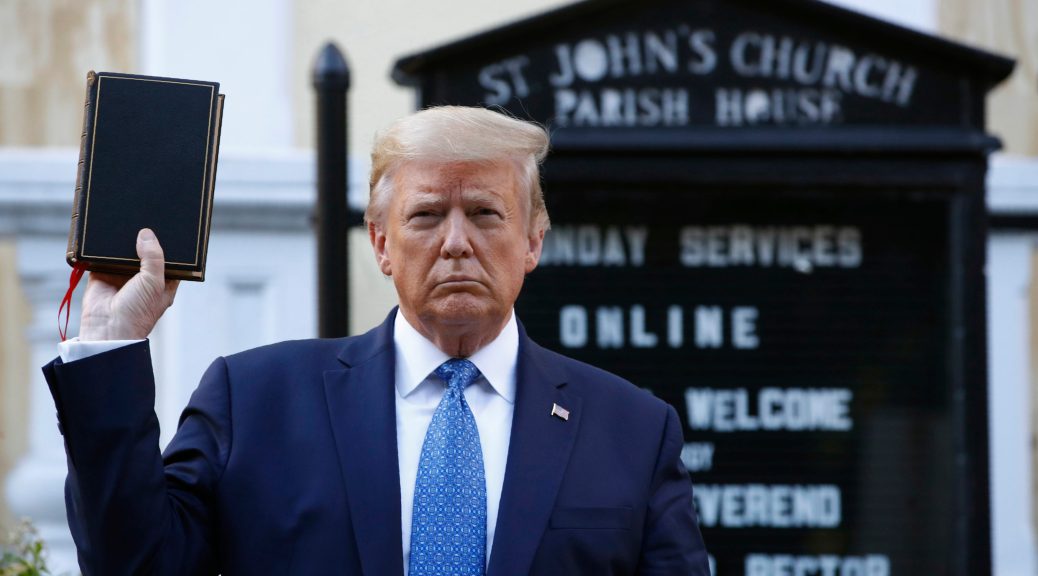
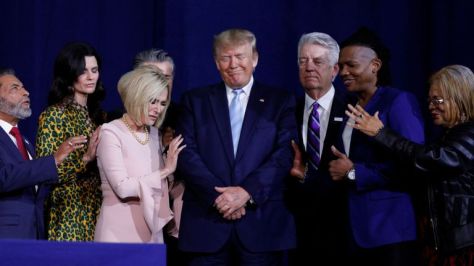
Thoughts on Christianity and Authoritarianism

Trump Christians

Should authoritarianism one day overtake the United States, we should expect evangelicals to reconcile themselves to it easily

✎  WAYNE K. SPEAR | SEPTEMBER 1, 2017 • Politics

I

F THE REPORTS ARE to be believed, one-third of Americans today approve of the President’s performance. The constituency most likely to go on approving of Mr. Trump is evangelical Christians, in particular middle-aged white evangelical Christians. Much has been written of this political alliance, along the line that Donald Trump is a man of un-christian character, angry and vain and materialistic, and so on. How can the faithful regard him as theirs?

They have done so by casting Mr. Trump as a modern-day Cyrus or Nebuchadnezzar, which is to say a flawed individual who nonetheless—perhaps even because of this—has been chosen by God and through whom the divine is achieving His will. Anyone who has been to an evangelical gathering, especially of the revivalist-testimonial type, knows that the best witness is also the most lurid. Invariably a solemn and clean-looking fellow will electrify his audience with a tale of debauchery, the lascivious details of his previous life of depravity serving to underscore the point that “if God could save a wretch like me ….” Before he was St. Paul, Saul of Tarsus by his own admission was a dangerous fanatic who went eagerly about the work of murdering the followers of Jesus. The tradition of playing up one’s nastiness in the service of a cracking testimony obtains from Saul through Augustine to the present day. Human wickedness is baked into the Christian religion in the way that class struggle is baked into Marxism, so that to point out Mr. Trump’s shortcomings is only to affirm a central tenet of evangelicalism, that God can and does work through even the most thoroughly fallen.

But why Mr Trump, when the field is crowded with flawed candidates? Perhaps a better line of inquiry is to consider what evangelical Christianity is, not as a religion, but as a political system.

When the plainly superstitious details of religion are removed, for example virgin births and ascensions to heaven etc, what remains is a set of propositions about the world and of our place within it. The propositions are as follows. The universe is a work of omniscience, governed by universal and immutable law. To go up against the law is to offend the Almighty and to invite His wrath. There is no court of appeal. God has put down His laws in writing from the beginning of time, and it is a work of supreme arrogance even to question. The only recourse of man is to follow the law and to conform to the natural order, which is to say God’s word. Do as you may, eventually everything is going to collapse in a conflagration of evil, a fate most of us deserve. The effect of St Paul’s teachings was to sublate the Jewish law into a doctrine of divine grace, but without altering the universal and fixed nature of God’s will. In the universe of Christianity, everything is presided by an all-seeing, all-knowing, all-powerful Father whose wrath or love is ineluctable as well as non-negotiable. One’s only options in this life are to accept the offer of divine grace on the terms advanced or to suffer eternally.

It takes little mental effort to translate this notion of an all-powerful, all-seeing, law-and-grace-issuing Father into a political system, and that system is best described as totalitarian. Say what you will of monotheism: it is not a democratic system or a working out of an evolutionary process. The only role of the demos in evangelicalism is to follow the law and to affirm over and again the glory of the Dear Leader. Evangelical Christianity as a political system is less about the negotiation of consensus and compromise, of inching laboriously toward the good if imperfect society, than it is about sorting the world into good and evil so that the final battle might get underway. The human heart is wicked in an irredeemable way, and thus unreliable as a moral guide. From this it follows that human solutions to human problems are also unreliable, so that the chief political task is to ensure that the good prevail upon the wicked by imposing upon them the strictures of law. What Christianity proposes is an authoritarian and not a pluralistic, liberal view of society.

I am not suggesting that all Christians or even most of them are totalitarian in outlook. What I am suggesting is that evangelicalism and authoritarianism are fellow-travellers. Should authoritarianism one day overtake the United States, we should expect evangelicals to reconcile themselves to it easily, provided it is an authoritarianism of the “Travail, Famille, Patrie” variety. The only thing Donald Trump had to do to win over evangelicals was to make pleasant noises about the importance of faith while advancing a law-and-order agenda that broadly repudiated the liberal belief in a society made better through the work of human social engineering. The President’s hyper-masculine persona could only be reassuring to someone who has cast her lot with a Father Who Art in Heaven, especially a law-giving Father obsessed with a tribalist program of sorting the wheat from the chaff. Trump’s grievance and resentment based cultural war of us-against-them ought to be familiar to the most casual student of monotheism, whether the subject is Twentieth-Century Ireland or present-day Islam.

A moment ago I alluded to “the work of human social engineering.” This phrase can be understood in more than one way. It can apply to the current materialist effort to deconstruct human sexuality and gender, the idea that male and female are nothing more than oppressive constructs. But the phrase also comprises the Enlightenment notion that human societies are malleable and not forever determined by divine precept. The term for this point-of-view, that our lot may be improved through the application of human reason, is liberalism. The ideology of liberalism emerged at about the time the United States of America was established, and against it stood the authoritarian principle—the Great Chain of Being, the divine sanctioning of the monarch and aristocracy, and so forth. To be a liberal is to believe in progress driven by human intelligence and reason and effort.

At bottom liberalism and monotheism are incompatible, although it is possible to hold both in one’s mind and to claim an allegiance to both simultaneously. Many of the monotheistic schisms are in fact over this exact question, and they take many forms. Jewish anti-Zionism repudiates the man-made state of Israel on the grounds that only the Messiah may establish the Kingdom. Likewise within Islam there is a disagreement over whether the Caliphate should be established now or only with the return of the hidden Imam. In any case the City of God will be by definition a theocracy, where votes are not cast and there are no protests or courts of appeal.

Even if I am wrong about everything I have written above, it is objectively the case that President Trump is the most perfect specimen of an evangelical President. Ronald Reagan and Dwight Eisenhower can not touch him for popularity. In an era when politicians are as a rule held in contempt, Mr. Trump consistently polls around 80% favourable among evangelical Christians—a useful fact, for it shows us what the ideal evangelical candidate looks like. “Vengeance is mine,” says the Lord, but of course this is not true. Vengeance is President Trump’s, and as a matter of proxy it is now also the province of evangelicals. For what must feel like the first time, they have something approximating real political power. They are set about the work of repudiating liberalism and re-establishing the law, if necessary at the expense of conventional politics itself.

When the Centre No Longer Holds: Trump and the Media

The day will arrive when the world is rid of this menace of a President, but just as the rot did not begin with him, neither will it end with him. The rot itself is that the centre cannot hold and that, as a result, America is today two warring nations. With each passing day it feels more and not less that mere anarchy will be loosed upon the world, or at least upon American streets. If recent trends continue, the President who succeeds Mr Trump will likely be despised by a large minority of the country, if not by a majority, and the disgruntled will immediately set to the business of conspiracy theory and dark-corner whispering and agitation-propaganda. In other words, business as usual. Optimistic invocations of healing and unity fall upon the ear like a sour quip. Who among us believes that sweetness and light await, and not blood and struggle?

Above I have perverted Yeats’ phrase “the centre cannot hold” to suit my own interest and ends. I subscribe neither to Yeats’ peculiar views of history nor his evident admiration of fascism. The centre that no longer holds is simply the proposition that America can be fashioned into a community of shared interests, a notion that has never been true but which has held enormous sway, much like the fiction that America has no classes or (what amounts to the same thing) one universal class, the middle-class. Still, even a lie can have its utility. As long as Americans believed in the universal middle class, the fiction obtained in a uniquely American form of positive thinking. Then, throughout the Reagan years and beyond, the progressive left took to chipping at the myth of a classless society, and by the 2000s the anti-globalist right had joined them in denouncing the elite. The Internet made it possible to cultivate and spread tribal grievances and provided adherents to the most outlandish views the comfort of knowing that they were not alone. With the election of Mr Trump, the conspiracy theorists and white supremacists could fancy themselves respectable and not the rejects of polite company they had long known themselves to be. The emotional charge that attended this must have been intoxicating.

The word I am reaching for is frisson—the vertiginous thrill at the thought that something extraordinary is occurring. Upon hearing of their election victory, the devotees of Trump doubtless felt what supporters of Mr. Obama felt in 2008. In the case of the Obama victory, intoxication led partisans to say plainly ridiculous things, for instance that America was now a post-racial society, healed of its past. Intoxication however is a passing state, as the alt-rightists discovered soon after concluding that it was now de rigueur to wave the Hitler flag in the Charlottesville daylight. Much has been written and said of the rally aftermath, but the pedigree of the present moment merits reflection also. For only a year ago, the generic Klansman knew to keep hooded and the fellow travellers of National-Socialism understood the public relations downside of chanting “Jews Will Not Replace Us” in the open air of a small American city. Only a long, occult incubation punctured by a sudden mainstreaming of fringe sentiment and style—and the resulting discharge of excitement—can account for the far-right’s present boldness. Once its nose is up against the unyielding glass of reality, however, Trumpism will probably fare no better than Obamaism.

Before we learned to decry the tribalism of social media, and to heap the blame for present ills upon it, the material world provided its own opportunities for tribal self-segregation. It is no mystery for example that a certain kind of person is attracted to the nation’s largest cities, whereas a different kind of person adverts to the rural heartland. Much is said of the liberal media, a category of person you will find clustered in New York and Los Angeles and not in Boise, Idaho or rural Arizona or the ranches of Montana. What makes the media liberal? Above all, an outlook formed by social class. Rarely will you find a big-city journalist who takes the Bible literally or who thinks that the biggest threats to America are abortion and gay marriage. Whatever his political views, the “liberal” journalist will look down upon evangelical Christianity not because it is conservative but because it is déclassé, hence a threat to respectability and advancement. And since the whole point of choosing where one lives is to ensure you are around others of roughly the same tastes, prejudices, habits, and outlook, the liberal journalist will feel himself no more liberal than the fundamentalist Christian will feel odd for believing the earth is only a matter of tens of thousands of years old. Most of the folks he rubs against will believe the same. Until Twitter arrived, it was unlikely that you would stumble upon your political antipodes in the course of daily commerce, and that’s how we liked it. The result of self-segregation generally speaking was that water found its level. Everyone felt that they lived in Their America, because the Other America was far away, in a city or town or heartland they would never, ever visit.

There is of course a way to connect two distant points, and that is to put something in the middle. The thing that is put in the middle is a medium, and more than one medium are media. The media bring us unpleasant word of the faraway, and we despise them for it, because they undo the subliminal mental and physical effort to which much of our interior life is dedicated, that is, insulating ourselves from unpleasant facts and people. Nor is this hatred of the media a recent turn. I can recall political phone-in shows of the early Reagan years where diatribes against the liberal media were a commonplace. The subtext of most liberal-media complaints, if not all, is that They (liberal journalists) are not Our kind of people. As a writer for the newspapers I encountered this sentiment as a matter of course. How dare I express the unpopular views of an outside caste! This attitude was evident also in the people who held me in high esteem merely because I happened to share with them a pet prejudice.

It is no longer possible to keep the old ways going, but it is also difficult to get beyond them using the tools of conventional electoral politics. The centre, where debate and nuance and consensus building used to live, no longer holds. In theory the media might be able to do something about this, but in theory television and the Internet were also poised to deliver us into the new enlightenment. There appears to be no way forward but toward the precipice. This, in a thimble, is the American problem today, just as it is a problem everywhere tribalism has taken root. Mr. Trump will soon be a memory, and the sooner the better. If we are lucky he will not do irreparable damage. The most we can reasonably hope for is that narcissism will keep him tethered to his obvious, chief concern—how he is spoken of on television. Incompetence and laziness might limit his reach, as may his utter lack of interest in anything that does not, or will not, bear his name. In the meanwhile the media have acquired a central place in the drama of this administration. It is worth considering to what extent journalists comprehend the position they are now in, the nature of the opportunities and dangers, and the probable consequences should the media themselves no longer hold.

Sonny Daze Meets the Orange Menace

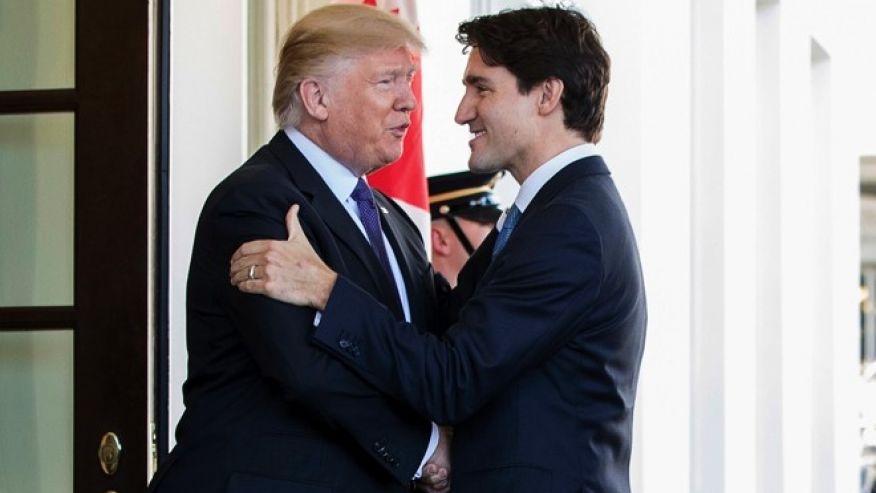
The two August Leaders, one the President of America and the other the President of that country somewhere in the vicinity of America, clashed in a fierce battle of handshake. The Orange Menace grimaced, jerking the arm of his rival. Sonny Daze stood his ground, dreamily smiling, his core muscles taut with alacrity. The Orange Menace worked the resolute limb, twisting and yanking as if extirpating a root. Yet the mighty tree could not be felled. The Orange Menace has met his match: he who spends an hour each morning at his hair now contends with he who also spends an hour each morning at his hair. One lives for the camera, the other for the camera lives. Each adoration craves. The Orange Menace applies brutal force in service of dominance, while Sonny Daze has charmed his way to this mountaintop.

– I am King of this Mountain, says the Orange Menace.

Sonny Daze does not speak. He adopts a Yoga pose and gazes dreamily into the cameras.

– I have done more in 100 days of being President than any President in the history of the world of Presidents.

Sonny Daze says nothing. He puts on a fringed buckskin jacket and portages to the river, dropping his canoe into the water. He paddles his vessel toward the cameras.

– Look upon my tremendous works! says the Orange Menace.

Sonny removes his buckskin jacket and rends his shirt. Bare-chested, he dashes four miles westward to a couple busied at their nuptials. Henceforth and forevermore shall he be immortalized on the mantelpiece photo where this day will be eternally commemorated.

A jealous and enraged Orange Menace takes to Twitter in an effort to regain the world’s attention. Sonny Daze puts on a faux Indian headdress. It is the War of The Manchildren, a force of personality against the force of personality, a clash of surfaces, a contest of brands, a struggle of perception against perception. They are different and yet the same. They are what you want them to be. They are yours and you must love them, if for no reason other than they are created for you and in your image.

Who will emerge victorious in this battle of the vanities?

– Look upon my mighty works, says the Orange Menace.
– Strong Together We Middle Class Better We Good We, says Sonny Daze.
– I will smite America’s enemies! says the Orange Menace.
– Love We Middle Class Together Good Together Canada Strong, says Sonny Daze.

They take their places. The battle proper has begun. Now we will see and judge them by their works.

The sky darkens as the Orange Menace lifts his adamantium scimitar heavenward. The mighty instrument draws an electric stream from the firmament. Energy ripples from the Orange Menace like an angry stone thrown into water. He shouts a primal scream

– Yyyyaaaaaaawwwwwwwwaaaaaaoooooooorrrrrrrraaaaaaaaggggggggaaaaa!

The Orange Menace points his scimitar to the West. He issues a tremendous bolt of energy with a roar that splits the Earth. The bolt in an instant strikes the ground at 719 Church Street, in Nashville, Tennessee, 666 miles distant. When the smoke dissipates, the Orange Menace gestures with pride toward the awe-inspiring deed.

– Look upon this hole, which by my own hand I now designate the future Fred D. Thompson Federal Building and United States Courthouse!

With a nice and supple hand, Sonny Daze takes up the Unicorn-feathered holly wand, gifted to his father by a once-Potentate of the Levant. He raises the wand to a swell of birdsong. Of a sudden, the air is redolent of neroli and mandarin. Across the world the humble pause momentarily their toil to hold the hand of a neighbor. The cameras chatter. Sonny Daze points his wand north to the Langevin Building of Ottawa, Canada, 565 miles away. A stream of glowing pixie dust issues from his magical tool, crossing Maryland, Pennsylvania, New York, and the US-Canada border into Ontario at the eastern edge of the Great Lake. Up goes the pixie dust, along Highways 401 and 416, turning east at Highway 417 where it exits at Bronson Avenue to travel north toward Wellington via Queen.

When the pixie dust arrives to its destination of Parliament Hill, Sonny Daze tucks the Instrument of Dreamy Wonder in an inner pocket of his suit jacket, designed specially for this purpose. He pauses dramatically, before saying

– I hereby re-name the Langevin Building “The Building Where Governmenty People Do Governmenties Stuff.”

The people cheer. Look at his eyes, he is so dreamy, they say.

Not to be outdone, the Orange Menace next names the Department of Veterans Affairs community-based outpatient clinic, in Pago Pago, American Samoa, the Faleomavaega Eni Fa’aua’a Hunkin VA Clinic.

Not to be outdone outdone, Sonny Daze renames National Aboriginal Day “National Indigenous Day.”

Not to be outdone outdone outdone, the Orange Menace renames the Department of Veterans Affairs health care center, in Center Township, Butler County, Pennsylvania, the “Abie Abraham VA Clinic.”

Sonny Daze renames the ten dollar bill the “Indigenous People Are Wonderful Bill.”

The Orange Menace re-renames French Fries “Freedom Fries.”

This goes on for hours and then days, with no clear victor emerging. Incapable, or perhaps unwilling, of anything of substance, they lock themselves into a shambolic war of pandering gesture. Their tribes applaud them, as the cameras record every word and facial expression. Meanwhile, for the rest of us, life goes on.

Introducing Ken Detective

Ken Detective takes the last of the bourbon. He of broad shoulders, square chin, chaws chaws the glass to tabletop, until a waitress arrives on a circuit that will soon return her bearing another.

Ken Detective eyes the courtyard. Birds fall from the clouds to walk the earth. The birds tell men secrets of sky-gods. The birds whisper to the sky-gods tales of human disappointment: the corn that does not grow, the infertile wife, the idiot President. The gods are bored but also indifferent. They do not listen. They have witnessed the efforts of men, Icarus on his waxy feathers, Neil Armstrong tumbling through space in a bucket. Long ago they decided that mankind is absurd. The birds return to earth, where the impotent men take note of their flight or eviscerate them, spilling the entrails for divination.

Today the birds reveal nothing to Ken Detective. The only thing certain is that the President, Mr Crusher, is a dangerous idiot. Detective takes the last of the bourbon, chaw chaws on the table, awaits his blessed comet of booze. The bar is dark, and if not for him it would be empty also, an ebony nothingness where no comet would bother to go. A good thing that he likes the darkness, likes to hunt it down, to invigilate it for intel. His best work, the real and true art of his occupation, happens in back alleys and taverns. Ken Detective has no use for the bright nonsense of men and their lucent delusions, or for people in general, unless they have information to spill. Then, by all means, find a dark place to slice em open. Shed some light on a shady subject.
*
The President is a shady character, a narcissistic con artist with a lot of low friends in high places. Russian mafia, Chinese crooks., pimps, hustlers, dirty operatives. The kind of people your mother told you to steer clear of when you were a child. You know the type: grubby and snotty-nosed lowlife bastards who pulled to the curb and offered you candy. Hucksters and shysters, perverts, liars, and creeps. All the President’s men. I haven’t nailed him yet, but jesus I will I swear, on whatever you got in those pockets of yours. I’ll get the bugger, if it’s the last act and the curtain is hitting me in the face. Shit on my corpse and never speak of me again if I don’t.

The thing about being a detective is you care about the facts like you care about oxygen and the kind attentions of a pretty woman. It’s in me like the piss and vinegar is in me, like the bourbon is in me, and although it burns and sometimes makes me go mad, I keep coming back for more. If I have to crack a head for my facts, by god I’ll crack a head. It’s only business. I get to the bottom, and sometimes, my friend, the bottom is a long way down. Not many men have the iron for it, I’ll tell you that. Look at the folks who went punch drunk mad building the Brooklyn bridge, diving and surfacing, diving and re-surfacing, until their brains turned to mush. But I ain’t like that, somehow. I keep on going, I push, I go to the bottom. And I come up and do it again, and then again some more, because the drive is in me. If there’s anything I hate it’s an up-to-no-good liar, covering his lying ass with a sack of lies. I want to kick that ass clear all the way to damn hell. So because I have it in me that’s the thing I’m going to do, so help me god.
*
Ken Detective takes the last of the bourbon and rises, dropping a bill on the table. He has an appointment in a dark place, with a fellow whose head just might need some cracking.

The Blue and the Red

They had absorbed WhoMeaning, as it came to be known, much the way a sponge takes water. WhoMeaning, if you are among the uninformed, refers to the now-common habit of assessing a message by noting the messenger.

Today it will be sunny, says the weatherman.
Today it will rain, says the other weatherman.

Both men are standing in the public square, pointing to the sky. The people have assembled, as they do every morning, to hear the forecast. The Red Shirt People heed the Red Shirt Weatherman, who is calling for rain. The Blue Shirt Weatherman, say the Red Shirts, is a fake weatherman and a liar and a scoundrel. Although it is sunny at that moment, without a cloud in sight, the Red Shirts prepare for rain.

It is the same in every fold of human existence. The Red Shirts watch the Red Shirt News. They shop at the Red Shirt Stores. The Blue Shirts keep to their side of the city, where they patronize the Blue Shirt Restaurants and the Blue Shirt Theatres and the Blue Shirt Temple. It used to be that, now and again, you would see a Blue Shirt Person in the Red Shirt Temple, but those days are long behind. Now, a heedless fool who transgresses the many unmarked boundaries is dealt a mob’s justice. The sight of a blue shirt inflames the Red Shirt People, just as a red shirt arouses Blue Shirt contempt. Everyone learned long ago that it was better to keep to one’s tribe. Certainly it was safer.

All agreed it was in everyone’s best interest to adopt the wearing of a colored shirt. The common spaces were abolished. The wearing of the shirt was only a minor imposition, a small step from the habits many had already adopted—for example the voluntary disclosure of affiliation, whether to the Blues or to the Reds, using symbols affixed to one’s house or automobile. Even in the absence of these symbols, it was a trifle working out the side on which a stranger stood. The shirts didn’t change anything, they merely made life easier.

It was not uncommon that a man would beat a woman to death in the street. In the past, justice had been a messy and complex business. But now, thanks to the shirts and to WhoMeaning, justice was easy. Whenever a Red Shirt bludgeoned a Blue Shirt, the Red Shirt People would deem the event just. The Red Shirts would advert to Blue Shirt crimes of a similar, indeed (they would say) worse, nature. The Blue Shirts would denounce Red Shirt acts but defend Blue Shirt People as patriots. In the Blue world everything blue was noble and majestic, everything Red diseased and evil. In the Red world, nothing Blue was to be trusted. The Blue were not even human, according to the Red People.

The arrangement worked, for a time. After the war and the introduction of the colored shirts, the Blues stayed in Blueland and the Reds in Redland. For a time, there was peace. Then came the tests of loyalty. Among the Blues, there were efforts to determine who among them was insufficiently Blue. The Reds began to purge themselves of those they called The Purples. Now that tribalism ran the land, there was no staunching its flow.

The Red Shirt People re-wrote the history of the Republic to satisfy Red desires. The Blue schools taught the young that their past, present, and future miseries were the work of the Reds. Everyone accepted that another war was on the way. Perhaps this time they would vanquish and extirpate their enemies.

I am writing this to you from the prison where they keep the ones who refuse to wear the colored shirts. By the time you receive this, I will likely be dead. Time is not on my side, perhaps also not on yours. There was a period when we thought, naively, that the war could be averted. Then the world went mad, as it often does. You don’t see it happening—or you do, but only when it is too late. The world is normal, and then, mad. In the meanwhile all that we had in our defence were words, principles, appeals to humanity’s higher nature. Truth and justice, in that small window of opportunity when these could mean something real, something solid, and not just anything that one pleased. And then, the madness, and it was too late.

Despite the constant negative press covfefe

Despite the constant negative press covfefe, it is true that my name is Kalashnikov. There are some who call me Nik. I say some, and perhaps these some are my friends, but perhaps also not, the ones who call me Nik. I am saying neither that they are friends nor that they are not friends, but only that they call me Nik, as a friend might, or as a friendly person might. If the friendly are friends then it follows that those who call me Nik, which is to say those who speak in the friendly manner of a friend, are friends. None of this solves the original problem however, the problem of the manner of arrival at this curious term Nik, which is not my name but instead a nikname. Ah, the clever pun! —entirely accidental but intended but also not at all what I meant to say.

It happened thusly. First, by extirpation of Kalash, leaving the rump of Nikov. Second, by excision of Ov, leaving the stump of Nik, a knuckle of truncated finger. Excision and extirpation, negation and elimination, and so on. They might have gone further, for example by extermination of the N, leaving a mere Ik. Or by pulverizing the Ik, leaving the mere desolation of N. But to call one by the name of N is an absurdity, something this world of ours could never tolerate. Absurdity, I mean, and not the man, N. Of course the man N, the N-Man would be tolerated, of course! Obviously, in America! Or somewhat tolerated. Or barely, perhaps even not at all. Yes, he would be tolerated not a bit. Of course a suitable epithet, a slander, a term of race hatred, would be confected and hurled at him with abandon, this stinking N fellow. An N-word, doubtless, but not that N-word. Rather another N-word, for there is no end of possibility, altogether unrelated to the N-word universally known to man but also universally to woman.

Despite the constant negative press covfefe, I sleep. It is true that I am awake, but not in the sense that I am not also asleep. I neither sleep nor wake, which is to say I am both asleep and awake. The President may need me at any moment, and so I am awake. There is no question of the thing. But the necessity of sleep is incontrovertible, if that is a word. And so I have found the perfect solution, a most reasonable solution of all, which is to make of sleeping a wakefulness, and to make of being awake a kind of sleep. The sleep of reason. In this state I lay, awaiting the President’s call of “N-word!” He does not say n-word, but rather the word itself—the word designed specifically as an insult to my nature. You see, the President enjoys this sort of thing. At his call I rise and go to the President. Despite the constant negative press covfefe, I discover him in good spirits. His spirit, not mine. It happens that 48% of the American people approve of him, and knowing this he is happy.

I must however play the Devil’s Advocate, the Adversary, and the Accuser. I must. That is to say, play the role, because the truth of any matter is in the dialectic. To his yin I am a yang, to his x an anti-x, as a matter of necessity, even of duty. I play the role.

– Doth the people love you for nought, Mr. President? For you have made an covfefe about them. But if thou takest away their covfefe, surely thine servants shalt curse Thee to Thy face.
– Behold, I will put forth Mine hand.

It happens then that the President puts forth His hand, and a pestilence falls upon His people. The President causes health care to be taken from His faithful servants. He causes their premiums to increase.

The President cuts taxes for those who possess the fattened calves and the yoke of oxen and the assess and the sheep. He causes the taxes of the mighty to be brought low and upon the meek He places His mighty burden. Everywhere He cuts and abolishes and rescinds. He smites His faithful servants with pre-existing conditions.

“Lo,” he says, “Take heed, N-word, that neither do they curse nor forsake Me.”

Again, He does not say “n-word,” but rather the word itself.

And it is true. Although they tear their raiment, and although they sit in ash and go about in sackcloth, the faithful do not curse the name of the President.

The stricken are visited daily by Eliphaz the Temanite and Bildad the Shuhite and Zophar the Naamathite. Each has a program on Fox News—Eliphaz at 8, Bildad at 9, and Zophar at 11.

“Your suffering is due to Hillary,” says Eliphaz. “Curse her and die.”
“Surely the lying media have forsaken you,” says Bildad. “Verily I say unto you that you suffer not, but that the President blesses thee.”
“Libtards!” says Zophar.

No matter how much the President smites His faithful servants, they do not curse His name. Smite their covfefe though He may, the faithful believe in Him and call upon His name.

“We know that Thou canst do every thing,” the faithful declare, “but that Thou shalt make things great again.”
“Tremendous, so tremendous” says the President.
“Who is he that hideth counsel without knowledge?” say the faithful ones.
“SAD!” says the President.
“These are things too wonderous for us, things which we know not,” say the faithful.
“Gird up thy loins now like a man!” says the President. “Despite the constant negative press covfefe!”

And so they gird their loins, like a man, despite the constant negative press covfefe.

The Ones Who Know Jesus

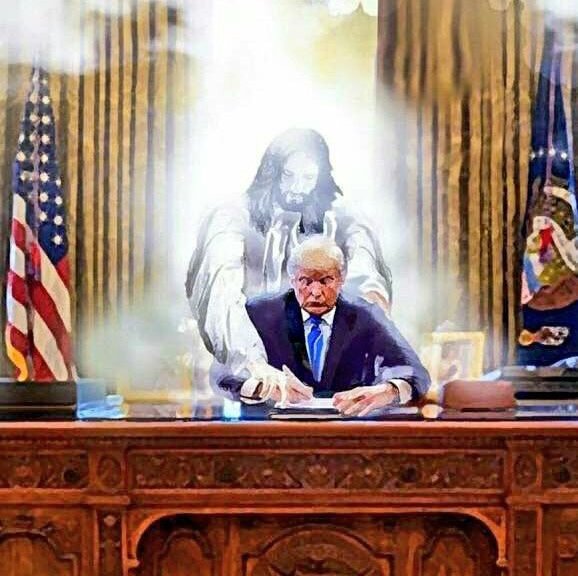
Trumpetsound, a fissure of sky. A midnight darkness visible yields to His glory. The firmament echoes of angelsong. Jesus has come, and the many see and fear.

Hallelujah! He has come!

For centuries He has tarried. For millennia His people have waited, reciting His words. “Soon,” they whispered. In the streets they declared: He will return! The people of Jesus have held to His promises, lo these passing generations, and now He is returned.

Thy Kingdom, come.

The people of Jesus behold his greatness. The people of Jesus rejoice. A time of greatness has begun.

The first to speak is the Holy Press Secretary.

“Hello everyone,” says the Holy Press Secretary. “This is a massive crowd, the greatest crowd ever. Much larger than the crowds of Satan, our adversary. Look at this crowd! And now, I would like to introduce your King, the Son of Man, Jesus.”

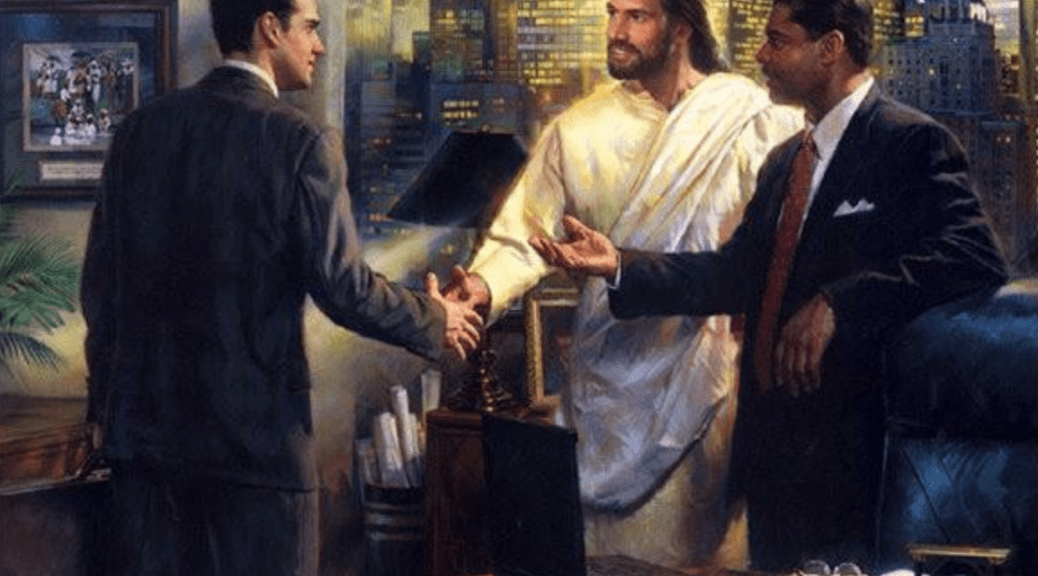
The Host of Holy Angels parts, and Jesus floats into view. He wears a business suit and a red tie. He smiles, waves to the adoring crowd. He gives a thumbs-up to someone in the audience. He claps, just as they are clapping. It is a good day, and Jesus is smiling.

“It’s great to be here,” says Jesus. “I love Florida,” says Jesus. “Tremendous people. The best people.”

The people of Jesus are ecstatic. The Chosen One is among them and the time has come to fulfil the Promise.

“Blessed are the businessmen,” says Jesus. “The CEOs, the hedge fund managers. The heads of companies, tremendous people, the best people. They are going to help Me make the Earth great again. That is why I have appointed them to lead you during the transition.”

Then a voice among the crowd: “Blessed are the weak and the poor!”

“Get him outta here,” says Jesus. Two angels comply. They take the man by his arms and walk him to the edge of the crowd, where they shove him to the pavement.

Later, the Holy Press Secretary will explain that Jesus did not say “Blessed are the poor” or that “the meek shall inherit the earth.” The Holy Press Secretary will explain that these words are the product of the lying media. These words are fake news. What Jesus said and what was written about Him are two different things, the Holy Press Secretary will say.

In the meanwhile Jesus tells them there will be streets of gold and rivers flowing of milk. “Our hard-working dairy farmers, tremendous farmers, are the best. My infrastructure plan will put gold on every street. You’ll get tired of seeing gold, there will be so much gold.”

The people of Jesus are thrilled by these promises. Jesus says they will live forever, and that all tears will be wiped away. He tells His followers that He will build a mighty kingdom, and He will smite their enemies. And it will happen fast, He says, so fast. You won’t believe it, He says. Believe me, He says.

The people of Jesus believe. They are, after all, believers. They believe in Jesus and they believe in believing in Jesus and they believe in belief. It is by faith that they live and are are saved. Believing in belief in belief, hungering and thirsting for things unseen, fingers in the darkness.

*

Jesus has come with a sword. Those who question Him are deserving of fire. His people gird for war. The unbelievers, the doubters, the naysayers, the blasphemers—all are deserving of their perdition. “We are the persecuted,” say the followers of Jesus. “But no longer. The time has come for battle against our enemies.”

In the kingdom there is bottomless provision for war, abundant provision for force. Provision for weapons, provisions for the squadrons of angels who now patrol the streets, provision for displays of threatened violence against dissenters. Jesus reminds them each day that they are one People under God, one in thought and in belief and in nature. They are one nation under the Leader, and the Leader is leading them to greatness.

“No one gets to the kingdom except through me,” says the Leader. “I am the way, the truth and the life.” The people know that their Leader speaks the Truth. There ought to be no room for dissent or challenge, no opportunity requested for clarification, no court of appeal. Those who question the Leader are unpatriotic traitors, and the vile filth of their nature will be remembered.

The Leader withdraws to His mansion. He delegates His work to minions. He makes occasional appearances where He basks in the adulation of His people. He becomes obsessed with the doubters and non-believers, issuing threats against them. “They treat Me so badly, so unfairly,” says the Leader. “But I will prevail.”

The months pass. Somehow the streets remain paved, not of gold, but of dehiscent tarmac. There are no rivers of milk. The tears that were supposed to be wiped away instead wet the faces of children. The Leader tells them that greatness is coming, that the Kingdom will be the best kingdom they have ever seen.

“The Leader said nothing about milk,” reports the Holy Press Secretary. “The greatness is coming, only our many enemies encircle and frustrate us. The ones who are against us are and against you. Look to the enemy!”

It doesn’t matter what happens, or what does not happen. It doesn’t matter what the Leader says, or does not say. Nothing matters, save that the people believe in Him. Fear and loathing of their enemies keeps them strong. What the Leader hates, they hate also. They have built their church, and the gates of hell shall not prevail against it.

The Leader enjoys His throne yet He is restless. He is a jealous Leader, desirous of universal adulation. Every knee must bend or be cast into a lake of fire. When the Leader is not enjoying the repose of His many stately properties, He broods over the resistance. Why are there some who do not believe? Why do they take His name in vain? Why do they not honor Him?

The frustration and anger of the Leader grow. He dismisses every Judas among Him, but another Judas soon rises. He cuts down every obstacle, but another obstacle springs from the earth. This work of His will take longer than He realized.

Once again, He appeals to His people. “I am your Leader,” He says. “And our enemies are against Us. We must wage war against Our enemies.”

“Yes,” they say. “We must fight our enemies. And then the Kingdom will come.”

Yes Mister President Yes

Through the fence between the curling flower spaces the ones who make the words the mean words can see us hitting later they bring me the papers the papers papers papers and I tell them I say Enough of the fucking papers no papers tell me in words use your fucking words the fucking words FUCKING not papers and they say Everything is good Mister President the people love you they say which they do I think so yes the people love me but how do I know well there are the rallies my huge rallies they adore me and clap and hold up signs I hear nice words nice and they love me they all do every one of them they adore me and they wear hats and shirts with my name CRUSHER my name me they love me at my rallies me love me how I wish I were there now instead of here on the floor they have hidden the remote control again perhaps under a chair or carpet so I will crawl along the ground feeling for the remote and my phone is gone also where could it be I must make the words that go out into the world the words for my people the people love me the news is all good they tell me this they say You are doing a fabulous job Mister President and Look here Fox News is saying nice things about you Mister President You are a good President and Yes I say I am a good President so good only inside that feeling like fire or smashing things falling falling I sweat and soon my hands are pounding pounding pounding they should love me all of them I am pounding why do they not love me everything coming apart to pieces I hate them all what is going to happen it is all going wrong now I am Crusher the greatest CRUSHER no one is smarter or stronger than I am I always win I will win I will crush them they will see now the television is on I see bright pictures faces moving nice people talking will they be nice to me are they nice people or mean people nice or mean I go to that place now I am hitting the ball and it goes wheeeeeeeeeee up into the air and falls falls somewhere up the fairway under a blue sky a steak and ketchup fries gold the people love me I am everywhere on the newspapers the televisions everywhere the gold of my home steak I hit the ball I am happy the people love me they adore me they are mean they are mean to me so I hit back I hit them HIT HIT HIT HIT HIT them they are fucking mean they are mean I HIT them FUCK FUCKING FUCK these motherfucking No Mister President they say Please Mister President Give us the phone I am shouting FUCK then pick pick pick words pick pick pick words it is full to 140 that means it is full and it is done pick it is done the words out in the world I HIT HIT HIT them the ball into the air I am calm now there the ball is in the air it is up in the blue sky I breathe where is the ball I can breathe ah the ball and steak and ketchup and fries and ice cream I am calm the people say They love you Mister President and it’s true I think it is true what is this I am hearing words I hear words I hear them say Crusher I hear them say words names I hear mean words bad people FUCK FUCK my hands pounding YOU ARE FIRED FUCK poundingpounding Please Mister President they say Please sit Look your picture here look the words are nice about you they are nice words about you love the people love love warm it is warm Please Mister President they are saying Look at the nice picture and then I am calm I hit the ball wheeeeeeeeeee look! it goes up into the air they take the flag out and I am hitting then they put the flag back and we go to the table and I hit and the other hits and I crawl on my hands and knees looking for the remote the phone I am crawling Listen at you now Lester says Was it on account of them Russians Lester Holt says I can see him now up on the TV he is nice Yes I say the Russians Yes I say Yes

Trumpists Triumphant

So much has been written of the current President that it feels almost a work of uselessness to sprinkle one’s grains on the ash pile. And yet, to a degree unmatched by his recent predecessors, Mr. Trump makes one feel both compelled to speak and, at the same time, exhausted by the thought of doing so. I’ve wondered what it would have been like to live under the regimes of, say, Saddam Hussein or Kim Jong-il, and the Trump administration provides a measure of insight into an important psychological aspect of authoritarianism. That aspect is the inescapability of the Dear Leader, the tendency of the regime to smother and exhaust its critics and their faculties. This raises the question of whether or not the President will succeed in his evident work of discrediting and confounding his critics, including those within the state who function in a constitutional capacity as a check and balance. Assuming the Trumpists do prevail, what might the world look like? That is the topic of this essay.

Read More

Who Are You: Podcast 74

Week of 02.01.2017
Podcasts

Honest Ed’s | Joseph Boyden | Mark Twain on Wearing White in Winter | Mr. Triplespeak | Streamlining the Intelligence Services | Drews Reviews: Money

The Roundtable Podcast 74


* Please note that in this podcast I incorrectly say that Robert Jago’s editorial,”Why I Question Joseph Boyden’s Indigenous Ancestry,” was published at APTN. It was in fact published at the Canadaland Podcast on December 24, 2016.

Download entire podcast (320 kbps mp3)