Turning things upside-down

Flying Lesson
Photo “flying lesson” courtesy of Peter Shanks on Flickr

We’ve all asked ourselves the question “Why bother?” We all have a To Do list. We all wish that some things in life were different.

When you turn something on its head, you get a new perspective.

The things in your life you’d be happy to never change, a Not To Do List, an answer to the question Why not bother?

My partner works the midnight shift. When all of a sudden you are eating lunch at 3 in the morning, your body gets confused. It knows what 3 am is, and it knows what to do with lasagna. But it doesn’t know what to do with lasagna at 3 in the morning. My point is that you learn a lot of new things when you stay up all night, instead of all day.

If you turn a problem upside-down, it looks like a solution. An upside-down barrier is an opportunity. The only way to get good answers is to turn a good question upside-down and shake it until what you’re looking for falls out.

All of the valuable lessons came to you in the toughest times of your life. The experiences you wanted to run away from at the time are the same experiences you keep returning to today for your wisdom.

A frown is a smile upside-down. Yesterday it was awful, but today you are laughing about it. We turn the world over all the time. It’s how we learn, discover, and grow.

The most delicious meals you’ve eaten were fertilized with some of the most unappetizing stuff. That’s the reality of nature, and of life. You can fight reality, or understand and use it to your advantage.

Opposites are connected. You can turn darkness into light, bitterness into contentment, emptiness into fulfillment. How? But turning over misery to discover gratitude.

What do you do? Who are you? Keeping two sets of books.

Ledger
Image “Vintage ledger paper tags” courtesy of Cutiepie Company

What do you do?

It’s the question most often asked at cocktail parties. “What do you do?” is an ice breaker, a cliché, a point of departure, or just something to say when you’re not sure what to say. It can also represent genuine curiosity.

Who are you?

It’s a big, and personal, question. That’s why we don’t ask it at cocktail parties. Rarely is the question Who are you? answered by what someone does.

– Who are you?
– I am Dentistry.

In a perfect world, What we do is Who we are, and Who we are is What we do. But we don’t live in that perfect world, so we keep two sets of books. In the day we do, in the evening we are.

We put our loves and priorities and hopes and passions—in short, our authentic selves—on a shelf, where they wait for us, until we return at the end of our shift.

A ledger of tasks, a ledger of love. Money and joy, productivity and meaning. What you do and Who you are.

Who are you? Ask, and tell. Keep one set of books. Start the revolution.

The idea virus

Cold
Image “Cold?” courtesy of Allan Foster on Flickr

When you ride the subway in fall, you’re reminded that this is the time of year when people share an invisible gift called The Cold.

There are hundreds of viruses that cause the common cold. All of them have one thing in common, which is that they are good at spreading.

The common cold is relatively harmless from a health perspective. Its impact is cumulative. Millions of people get a cold each year. A cold influences productivity and sociability. The true costs of a cold in most cases are social and economic, not physiological or epidemiological.

Every year, millions of small differences make one big difference. The cold season ends, and the gift exchange attenuates. In the meantime, the common cold feeds the medication industry and accounts for almost half of all the hours spent at home, away from work.

Cold viruses have the simplest of business models. Always be on the move, always adapt, and replicate over and over across a large population.

An idea has “gone viral” when it has met these conditions. It need only have a small, temporary impact on any one individual. If it has the ability to always be on the move, and to adapt across populations and cultures, it will have a cumulative impact.

Make your ideas simple, adaptable, and easy to share. Win over the individual but also consider the cumulative impact of your efforts.

On giving up

British Royal Marine Joe Townsend, a Wounded Warrior with the Allies Team, shot puts during the 2012 Marine Corps Trials, hosted by the Wounded Warrior Regiment, at Marine Corps Base Camp Pendleton, Calif., Feb. 19, 2012. Townsend, from Eastbourne, England, placed first in the 10-kilometer hand cycling competition and 200-meter wheelchair race. Wounded Warrior Marines, veterans and allies are competing in the second annual trials, which include swimming, wheelchair basketball, sitting volleyball, track and field, archery and shooting. The top 50 performing Marines will earn the opportunity to compete in the Warrior Games in Colorado Springs, Colo., in May.
Photo “Shot Put” courtesy of Daniel Wetzel on Flickr

Every success is the culmination of a series of failures. To get it right once you have to get it wrong a hundred, maybe a thousand, times. Then you get it almost-right a thousand times more. The day arrives, at last, when you succeed.

Or it doesn’t, because there are no success guarantees.

Not all visions will come true. Many businesses will fail. For every story of Olympic glory, there are a million stories of dreams unfulfilled.

Giving up on a dead-end strategy or a flawed prospect can be part of a powerful process. The challenge is knowing when to change course. How can we know the time has come to give up on a venture, a product, a career, or a goal?

There are two kinds of success—task success and life success.

Task success. If your goal is to go to Rio de Janeiro and win the 2016 gold medal in shot put, you have one pathway.

Life success. If your goal is to lead a happy, satisfying life in sports, there are infinite pathways: weekend warrior, coach, fan, collector, researcher, writer, historian, trainer, scout.

Task success is clear, discrete, and measurable. Either you win the gold or you don’t. You can assess progress and the likelihood of reaching your specific goals. Emotional success is the desired long-term condition of your life.

Imagine a thousand-mile trip. How do you navigate your way to the destination? By focusing on a visible, short-term point along the horizon that brings you ever closer to an end-point you can’t see.

Have a long-term pathway and a series of short-term pathways that support it.

One is a point on the near horizon, and the other is your final, desired destination. Both speak to the things that will enrich your life.

What is your value?

Beauty
Photo “Beauty Is Simplicity” courtesy of Reji, on Flickr

We express value, and we hold values. Honesty, authenticity, courage, beauty, integrity. Our values are conceived in the abstract realm and negotiated in the material world of objects. They are subjective but indivisible from our relationships with other living beings.

Value can be measured. Each day on eBay, thousands of bidders answer the question What is it worth?

What about loyalty, truth, or faith? We frown on the idea of putting dollar amounts to values. Loyalty transcends cash. Our values are precious and priceless. Money can’t buy you love.

A skill is an abstraction. So are competence and intelligence and professionalism. No one has an objective number indicating the value per hour of your skill or professional value. Yet, for business to happen, a value must be determined.

Value and values intersect. One of your clients recommends you. She says that you’re honest, reliable, professional, and pleasant. None of these things can be auctioned on eBay. They are values. They are also value.

Your value increases as its intersection with values becomes more clear and compelling in the mind of your customers. This is not a cheap marketing gimmick, it is an insight into value.

You can choose to make a widget, or you can choose to enrich people’s lives by doing something that supports and nourishes their values.

The choice is yours.

Things that don’t matter

Thirty years ago my university professor quoted a friend. “I’ll never forget this,” he said. “It’s one of the most wise things I’ve ever heard.”

Everything matters, and nothing matters.

In about 4.5 billion years, our galaxy will collide with another. They won’t actually touch—instead they’ll blend together. There’s a high chance our solar system will be ejected from this newly-merged galaxy, and will drift until it is absorbed, or destroyed, or otherwise transformed by an encounter with something else.

The good news is that our sun will have exhausted itself by then, and all of the inner planets, including Earth, will have been vaporized.

Does it matter?

The only difference between a weed and a plant is that you want one of them to die and the other to grow. Dandelions matter if you make dandelion wine.

Everyone has his own version of an emergency. We want the world to get out of our emergency’s way, and we’ll push past anyone else’s emergency to get where we’re going. An emergency is a weed, or a flower. It’s a matter of perspective.

Or it’s not.

The point is that I’ve had clients who for years have banged their heads on things that didn’t matter. They had their version of an emergency, and there they were, trying to solve riddles like How many angels can dance on the head of a pin?

Somehow it never occurred to them to ask “Does this really matter?”

Socrates once said that the way to overcome a fear was to fear something greater. If you have one big, overarching fear, you become a big-picture fearer. Your life gets some focus. You figure out what really truly matters, and what you most definitely want to see, and don’t want to see, happen in your life.

Problems are like friends. You have fewer than you realize. But, sure, go ahead and tell yourself you have a lot. Only, you probably don’t.

Identifying the problems that aren’t problems is a skill. Often there’s a problem behind the problem, and a problem behind that. A ten-layered onion is still only one onion. Sounds simple, but I’ve met the people who think they have ten onions.

That means 90% of their time is spent thinking about a layer of their problems and ignoring the core 10% where the one root problem is.

Maybe we should throw away our problems the way we clean out our closets. You don’t put on everything in there anyway.

How many comfortable pairs of jeans do you have? How many friends? How many problems? What really matters?

The world’s most effective people use this simple formula

Junior Detective
Photo “junior detective” courtesy of Jessica Lucia on Flickr

What sets the geniuses apart—in journalism, entrepreneurship, cosmology, business innovation, and the arts?

It’s not the school they went to. Some of the world’s most successful and brilliant people never had a formal education.

It’s not good luck, or connections. It’s not hard work, although hard work helps.

The world’s most effective people use a simple formula. With it, they get powerful insights that they can then use to reach their destination.

Here is the formula:

Ask good questions and have the tenacity to get answers

What is a good question?

A good question is clear, specific, and strategic. It’s a laser-guided missile. The person who asks good questions may not know the answers, but she knows where the answers are. Not just any answer: the true answer.

To get to the true answer, you have to be patient. You may have to ask the question two, three, or more times. You’ll have to knock down doors. Some answers prefer to go undiscovered. Some are shocking, embarrassing, or scandalous. Only the brave and tireless will discover them.

Learn how to ask good questions, and be tenacious.

Content marketing and discontent people

Shopping Despair
Photo “Shopping – Despair” courtesy of David Blackwell on Flickr

Newspapers have content, and the business of marketing content is, of course, content marketing.

Content marketing asks What gets and holds a reader’s attention? Then it says Do this, and you’ll get higher conversions.

We know that the news is mostly war, terrorism, political fighting, catastrophe, scandal, and tragedy. Newspapers sell discontent, or they try to. These days it’s not working so well.

The truth is that all marketing presumes discontent.

The worst thing that could happen to the global economy is a world of content people, 100% satisfied with their lives and uninterested in adding or subtracting anything from them.

Universal human satisfaction would be great, but it wouldn’t sell most products. For the economic system to function, we need millions of consumers who have a good life but not a “perfect” one.

What is the perfect life? Your life, plus an iPhone with a slightly larger screen than the iPhone screen you have. Once you have the new iPhone, the definition of perfect changes. The ideal consumer is restless and always wants bigger, brighter, more, newer, and different.

What if we were to practice content marketing in the second sense of the word—using our talents to encourage satisfied, centred, peaceful, and grateful human beings?

Lotteries and lattices

Lattice
Photo “Lattice” courtesy of Sam Cox on Flickr

I’ve never won a lottery. Maybe that’s because I’ve never bought a ticket, ever.

The lottery is a state of mind. Many of us try to win the lottery of the mind. I have lost this kind of lottery many times.

The lottery of the mind says it all depends on the lucky break. Get it, and you’re home-free. Don’t get it, and you’re a failure.

Your book, your pitch, your project, your investment.  You look for the big lucky break. But guess what. Big lucky breaks seldom happen in life, so chances are you’re a loser. If you’re playing the lottery of the mind, you know what I’m talking about it.

Sure, some of us will win the lottery, maybe even on the first ticket. And the rest of us? We’ll need lattices.

In the absence of one life-changing event, our lives will be built of many small events.

Not one huge best-seller, or one giant breakthrough, but ten or twenty moderate successes intersecting our many other efforts.

You can build a reliable structure of lattices, but it takes time. No one, individual lathe will suffice. The truth is most people won’t even notice that you’re putting the pieces together. Not until you’ve created the total effect out of a combination and coordination of units.

Play the lottery, and you’ll likely lose every time. You’ll feel your time and energy was wasted. All you’ll see is the prize you never got, and that you’ll probably never get.

Make something of lattices, and every effort—no matter how small—will contribute to the greater end. No work will ever be wasted, and every step will be meaningful.

Are you in a hole or a foundation?

Hole
Photo “Huge Hole revisit” courtesy of Sam on Flickr.

Down the street, there is an enormous hole. It was a hole one month ago, and it is a hole today. The day is coming when the hole will be a building in which thousands of people are living.

Somewhere there is a drawing of the building. The hole is part of that plan. When the workers look at the hole, they see a foundation.

Everything in life starts as a hole.

I was traveling to a job for a new client. I had $75 in my business account, and nothing in my personal account. I had debts. I wasn’t sure if there was even enough room left on my credit card to pay for my expenses. It was one of the happiest days of my life, because I was building a business of my own. Yes I was in a hole, but I had a plan. The hole was my foundation.

You don’t ever see a building being made. You see workers standing around, smoking. You see men carrying things. You see materials being piled up. You see a lot of apparently random activity. A sky-scraper is made in slow motion. It’s a long-run proposition. It only happens because there’s a plan, and they stick with it.

In the long-run, we’re all dead. In the long-run you find out what you’re really made of. In the long-run, all the facts see the light of day. So whatever you’re doing, get in it for the long-run.

In the day-to-day we have a lot of surprises, failures, tough lessons, and set-backs. Some days are smoking men. Some days feel like nothing but the seemingly pointless activity of a shirking work-crew. You can do anything, but right now the bank account is empty and more bills are on the way.

A hole is just a hole if you don’t have a long-term plan.

Money and wealth

Capitalism, entrepreneurship, industry. These terms are often used inter-changeably, but they are not the same.

Capitalism is a system of social, political, and economic governance. It is the rule of capital, of property, of surplus value. In a capitalist society, the rules of the game are determined by capital for the benefit of capital.

To some degree, the interests of the great mass of people—the public—must also be accommodated, or perhaps managed from above. Capitalism and democracy exist in tension, because the interests of the demos do not always align with the interests of capital.

Entrepreneurs create businesses. They deliver goods and services. They build, invest, and produce. You can be a capitalist without ever being an entrepreneur. Capitalism, especially finance capitalism, need never invent a product, start a business, or create a job.

Entrepreneurs make things, capitalists leverage capital in a restless effort to convert nature into capital. Surplus value begets more surplus value, which begets more surplus.

An entrepreneur becomes a capitalist when his chief and overwhelming purpose is to invest capital in order to accumulate greater capital. Eventually he will understand that making things is a poor wealth strategy.

Those who make things earn money. Those who leverage capital to convert the world into capital generate personal wealth. Indeed, those who own productive property are wealth.

Industry can exist without capitalism. Entrepreneurs can, and do, create jobs and factories and goods. From a capitalist perspective, shutting down factories, or substituting capital for labor, can be as lucrative as opening a factory and hiring workers.

Entrepreneurs, capitalism, and industrialism co-exist. They are related. But they are not the same.

Conclusions:

A job is not property. Industry is not capitalism. A capitalist is not necessarily an entrepreneur. Money is not wealth. America is not a democracy.

Motivation versus inspiration

A work-out for the soul. ✎ By Wayne K. Spear

We can be inspired by many things: a sunset, a song, an idea, the powerful stories of others.

Inspiration is a breath. A spirit. An infusion that quickens the mind. We take it in, and we are exalted.

Inspiration is the suggestion of grand possibility.

TV crime investigators seek motives. Every criminal is assumed to have a purpose, a reason for his actions which makes logical sense of them.

Motivation, like inspiration, stimulates the mind—but the stimulation points to a definite goal. Motivation is motion.

The difference between inspiration and motivation is perspiration.

Inspiration says, “It is possible.” Motivation says, “Here is the purpose and the path: Go!”

Infinity

Three chords and the truth. ✎ By Wayne K. Spear

There are tens of thousands of pop songs, going back dozens of centuries. We will never run out of pop songs, because human creativity is infinite.

The ingredients of a pop song are melody, beat, and (in most cases) lyrics.

The major and minor scales contain seven notes. The English alphabet contains twenty-six letters. The alphabets of other languages are even smaller.

Most pop songs are built on a few chords and a motif (or hook) of less than six notes.

From a few simple ingredients, infinite possibilities. This is the case not only in music but in the arts generally.

If you have a little bit, you have more than what you will ever need, because the world of the human imagination is infinite.

Change (and why your vote will never cause it)

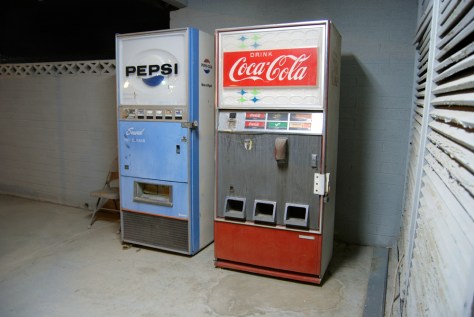
No Coke, Pepsi. ✎ By Wayne K. Spear

Coke or Pepsi

Photo Pepsi or Coca-Cola courtesy of Roadsidepictures on Flickr

The United States is dominated by two political parties. The major soft drink makers are Coke and Pepsi. Most of us own a Mac or a PC. In theory, free markets provide a range of choices, but this range of choice is constrained by the suppliers themselves.

Have you ever noticed that most restaurants serve Coke products or Pepsi products, rarely both? This is the outcome of corporate interests and policies that intentionally limit consumer choice. Adam Smith wrote about this phenomenon in 1776. It is well-known and uncontroversial.

Canada has three main federal political parties, all trying to capture enough of the political centre to form a government. The differences of their brands are small. Democratic political elections are fought over matters of style: personalities, like-ability, popularity. The candidate that “seems like” will win. The three parties tacitly agree on the acceptable range of debate: the middle class, taxes, growth, the economy.

Markets change only as a result of revolutionary upheaval. A revolution in a market occurs when an upstart/outsider introduces a game-changing idea. The giants are incapable of changing the market: they are too thoroughly invested in maintaining it to their advantage.

In a democracy, voting for one of the two or three political parties on offer is like ordering a Pepsi in a restaurant that has chosen to only serve Pepsi.

In a democracy, the upstart/outsider is an activist and agitator. Her business model is civil disobedience, resistance, and radical critique. She eats away at the market share of the giants. The IBMs of the world try to adapt.

But they are not the agents of change, they are interested only in a world that forever stays the same, and that forever serves their market interests.

One good idea

How to do anything with ideas. ✎ By Wayne K. Spear

What do Henry Ford, Steve Jobs, Albert Einstein, and Charles Darwin have in common?

All of them had one great idea.

What do you want? What do you need? Where do you want to go? All it takes is one good idea.

A software installation file is a self-contained package with step-by-step instructions. An idea is a self-contained package of step-by-step actions.

Doing begins with conceiving. Ideas beget actions.

Here is the simple, fool-proof formula for a great idea:

bad idea –> bad idea –> bad idea –> bad idea –> bad idea –> [etc.] –> great idea

What do Henry Ford, Steve Jobs, Albert Einstein, and Charles Darwin have in common?

All of them had bad ideas.

Having a great idea is the outcome of a banal and tedious process. That’s why so few of us bother.

In the land of the blind, the one-eyed man is king. In the land of people who have no idea, your one idea will make you a champion.

Every day, write your ideas: big ideas, small ideas, practical ideas, fantastical ideas, money-making ideas, life and love ideas, gratitude ideas, household ideas, book ideas, change ideas, self-improvement ideas, decorating ideas, organization ideas, planning ideas.

In one year, fill a 365-page book with (mostly bad) ideas.

If a million-dollar idea is also a one-in-a-million idea, you’ll need 1,000,000 ideas. Or you may get lucky. Your million-dollar idea could be your first idea, or your tenth, or your 129th. The point is to keep going. Don’t stop at 128.

One good idea can make your day. One great idea can change your life.

As soon as possible, have one good idea.