
Industrial Schools were about manual labour and indoctrination, fusing the holy and profane
✎ WAYNE K. SPEAR | June 8, 2021 • Current Events
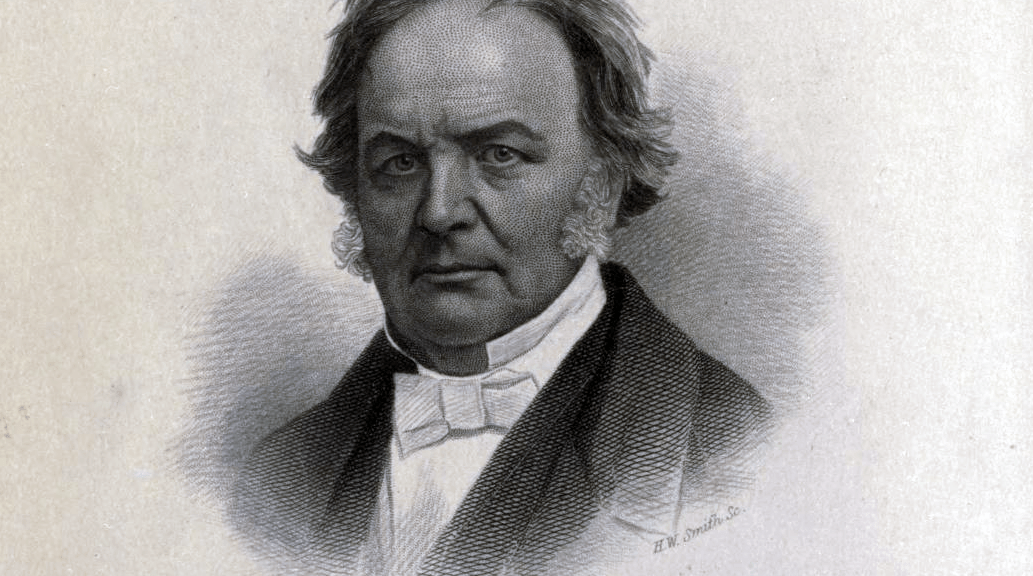
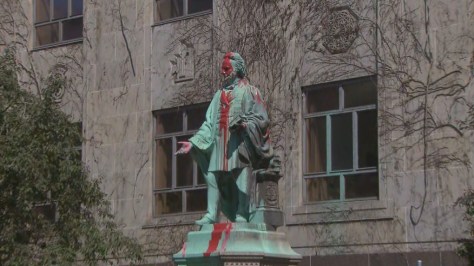
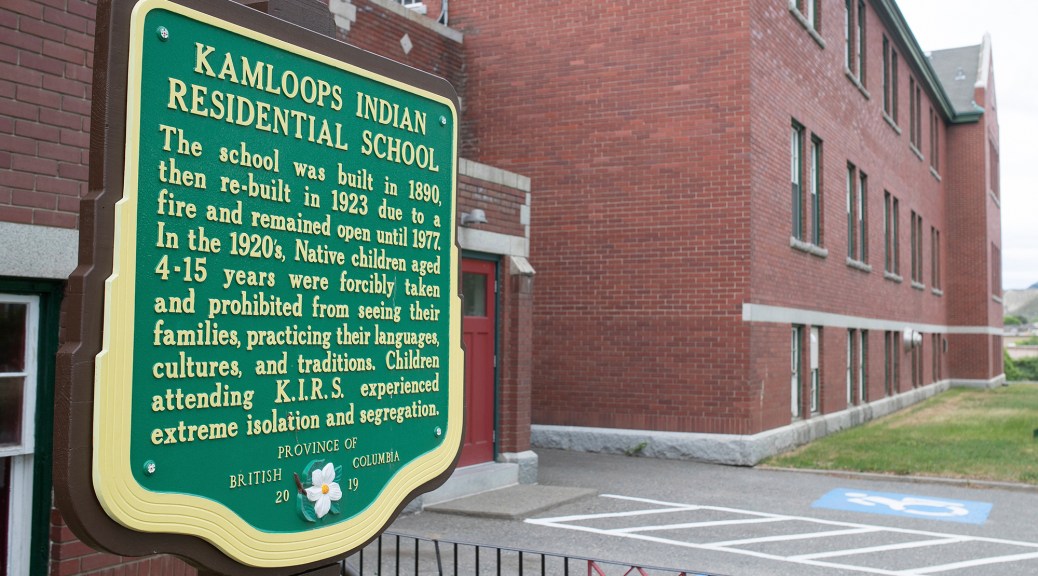
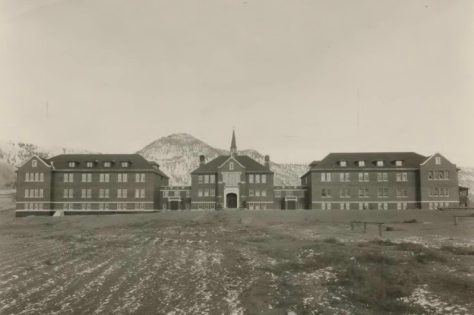
THIS WEEK’S FELLING of an Egerton Ryerson statue at an eponymous Toronto university, and its repurposing as a memorial for the 215 children interred in a Kamloops Indian Residential School mass grave, is the latest reckoning of the Indian Residential School System.
Some have argued that condemnation of Ryerson as an architect of the Indian Residential School System is unfair and that his critics either misconstrue or overstate his role, or both. Ryerson however was an eminent protagonist both of the church and state who distinguished himself first as a missionary and later as a bureaucrat. In other words, he played roles, and synthesized them as well: religion, he wrote, is essential to the welfare and even the existence of civil government. The 1847 Report of Dr. Ryerson on Industrial Schools preceded the 1892 establishment of the Indian Residential School System by forty-five years, at which time Ryerson had been dead for a decade, but when it did arrive the schools looked much as Ryerson had envisioned.
The Story of My Life, Ryerson’s posthumous memoir, rehearses his 1826–7 missionary work among the Mississauga of the Credit Mission of Upper Canada, when the future Chief Superintendent of Education for Upper Canada was twenty-three years old. Of this period, he writes that “my labours … were varied and severe.” A species of itinerant country preacher known as the circuit rider, he undertook work consisting of horseback travel on roads “bad beyond description” across a broad mission field that comprised current-day Toronto, Weston, and the Townships of Vaughan, King, West Gwillimbury, North Gwillimbury, East Gwillimbury, Whitchurch, Markham, Pickering, Scarborough, and York. The name given to him by a prominent member of the Mississauga refers to the missionary circuit: Cheehock, or bird on the wing.
His diary from the Credit Mission period attests that Ryerson was already entangled in sectarian disputes that would go on for another decade, foremost among them the Clergy Reserve controversy. As an ardent defender of Methodism, Ryerson clashed with John Strachan, the future Anglican Bishop of Toronto and a well-connected member of the Tory establishment, or Family Compact. Although the Indian Residential School System was established in 1892, there were of course residential schools long before this. The longest continuously-operated residential school was at Brantford, where construction of the Mohawk Institute began in 1828. In the pre-1892 period, before funding arrangements were formally systemized, the schools were a product of sectarian rivalry, supported by missionary societies and by government.
Ryerson was assisted in his missionary and educational work among the First Nations by the bilingual and bicultural Mississauga leader Peter Jones, a gifted orator and convert to Methodism who Ryerson had met in 1826 during his visit to the Credit Mission. Not everyone was impressed by Jones’ evangelical zeal for turning his fellow Mississauga into what some called Brown Europeans. The Credit Mission was to be a victim of the Methodist-Anglican rivalry. Both Strachan and Ryerson saw instantly the usefulness of Jones to their work of drawing the Indigenous people of Upper Canada into their respective flocks and hoped to enlist him, another contest in which Team Ryerson prevailed. Strachan had been an early champion of the community, but as Methodism spread among the Mississaugas, the Anglican-dominated establishment soured. Eventually the Mississauga were forced from their territory by the government, despite the assurances of Queen Victoria to the title deeds. They relocated to the New Credit reserve on lands given to them by the Six Nations of the Grand River.
Born into a loyalist Anglican family, Ryerson underwent a conversion which delivered him into Methodism. To many Anglicans of the nineteenth century, the Wesleyan Church was a cult of bumpkins and disloyal Yankee fanatics. As John Carrol reports in an 1869 history of Methodism in Canada, titled “Case and His Contemporaries,” Egerton’s three older brothers had also abandoned the stale religion of their father for a more enthusiastic brand of piety, meeting the “persecuting displeasure” of Ryerson Senior.
In the end the positions taken by Ryerson in the sacred and secular spheres prevailed. A combination of popular sentiment and the agitations of William Lyon Mackenzie blunted Strachan’s push for a unified church and state, with Anglicanism the established religion. The creation of a united Province of Canada and the establishment of Responsible Government further undermined the Family Compact. Ryerson climbed the bureaucratic ladder and in 1844 became Chief Superintendent of Education for Upper Canada, from which perch he oversaw the creation of Ontario’s education system. The Indian Residential School System materialized most if not all of his 1847 recommendations, although it was Nicholas Flood Davin and his report of 1879 that had the attention and patronage of John A. Macdonald.
Ryerson’s report on Industrial Schools is exactly what one would expect of a former travelling preacher. Concerned ultimately with the general system of truth and morals taught in the Holy Scriptures, he writes that “the animating and controlling spirit of each industrial school establishment should … be a religious one” and that “the great object of industrial schools should be to fit the pupils for becoming working farmers and agricultural labourers, fortified of course by Christian principles, feelings, and habits.”
The Report of Dr. Ryerson on Industrial Schools proposed a curriculum of “reading and the principles of the English language, arithmetic, elementary geometry, or knowledge of forms, geography and the elements of general history, natural history and agricultural chemistry, writing, drawing and vocal music, book-keeping (especially in reference to farmers’ accounts) religion and morals.” Ambitious and elevated, you might think, but there are further recommendations. Ryerson proposed “8 to 12 hours a day of labour during the summer, and instruction from 2 to 4 hours” and that “during the winter the amount of labour should be lessened, and that of study increased” by some unspecified number.
The details of Ryerson’s 1847 plan suggest that Industrial Schools were to be about manual labour and indoctrination, yet another Ryerson fusion of concerns both holy and profane. Just consider his recommended daily routine: rise at 5 am for chores and prayers; breakfast at 7; labour from 8 until noon; dinner 12 to 1; labour from 1 to 6; supper at 6; lessons until 8; prayers; bed between 8 and 9; on Sundays, rising, prayers, meals, and bed at the same times. This turned out to be a representative schedule of an Indian residential school well into the twentieth century, as numerous people who were there have attested. For generations the schools turned out products for sale, manufactured by a pool of cheap and captive labour trained in the holy Christian principles, feelings, and habits of industry.⌾
Read this article at the National Post.
 Journalism, Essays, Broadcasting, Books