Category Archives: Lifestyle

Food for thought

You think what you eat. ✎ By Wayne K. Spear

The brain is a hungry organ. In a human being, it makes up only 2% of total body mass but consumes 20% of available energy.

Input and output: these exist in balance.

The best way to be more creative, more thoughtful, and more productive is to feed your brain.

Better outputs begin with better inputs.

Read books, listen to podcasts, observe the world. Go for a walk. Notice what is going on in your environment. Take an interest in what you see, hear, feel, touch, smell. Be curious.

Feed your brain a healthy diet.

Authenticity

“I am, sincerely.” ✎ By Wayne K. Spear

Babe Ruth

Here is something that has happened to every parent:

Child: “Look, mommy. That person is fat!”
Parent: “We don’t say fat, dear.”

The child is authentic. Over time, she is socialized. She learns to be something that is socially acceptable. She simulates, equivocates, euphemizes, gets along.

This is called Being Polite.

An adult does not say, “That person is fat.” Unless he is running in the GOP primary.

Straight-talk, candor, directness, honesty—we value them so much that the simulation of authenticity has become a political art.

We call this hypocrisy.

To paraphrase Captain Pierce, of M*A*S*H: “Authenticity? I could fake that.”

An authentic Babe Ruth signature is extremely valuable. A fake one is worthless.

Give us the authentic goods, not the knock-offs; the original, not the derivatives; the Real Deal, not the imitations.

We cast our contempt upon lies. We want an honest opinion. We applaud sincerity. We are wounded by deception, white lies, double-talk, lack of candor.

“I’m looking through you. Where did you go?” sang Paul McCartney. “I thought I knew you, what did I know?”

What is real? What is authentic?

Deception is undertaken for gain. When authenticity is a valuable currency, expect counterfeit.

Authenticity is never for gain: it always costs something. It is risky.

To be authentic is to follow your conscience, not the consensus. It is to be true to oneself, even if it hurts.

And it will hurt.

That is because authenticity requires that we be open and vulnerable.

It is not enough to say “I am great,” even if that is objectively true. To speak only of your triumphs, strengths, virtues, and accomplishments is to fall short of the standard of real authenticity.

Authenticity demands that we be honest about our fears, doubts, failures, weaknesses, hopes, and loves.

The authentic person is exposed. His humanity is there for all to see in its glorious imperfection.

An authentic dollar is what it is. We accept it as legal tender, even when the bill is wrinkled and soiled.

Likewise we reject the counterfeit, no matter how shiny it may be.

Warning: this is bad for your health!

Warning: this article contains healthy subject matter ✎ By Wayne K. Spear

Warning
Photo courtesy of Thomas Leth-Olsen, Flickr

Some things are so bad for you, they come with warning labels.

WARNING: Smoking Causes Lung Cancer, Heart Disease, Emphysema, And May Complicate Pregnancy.

Many things that are bad for you don’t come with a warning label. Yet you know they are bad, because you can feel the badness.

Some things that are bad for you may be good for someone else. Health is complicated. It is individual. It comes in various forms.

Mental health, physical health, emotional health.

It is up to you to make your own labels.

WARNING: Reading The Comment Section Only Makes You Angry.

WARNING: You Are Getting Nothing Of Value From Social Media, And You Know It.

WARNING: You Are Surrounding Yourself With Toxic Relationships.

What do you love? What makes you feel good? What nourishes your body, soul, and mind? Make a health label for this, too.

WARNING: You have let your love of nature fall by the wayside. Put down the smart phone right now and go for a walk in the woods.

Write a list of ten things that make you feel good. A favorite song, a movie, a friend, a place, a meal, a book that changed your life, a vacation, a hobby. Whatever it may be, write it down.

When was the last time you enjoyed these pleasures? Days ago? Months? Years?

WARNING: Life is busy. We are all surrounded by distractions. It is easy to lose sight of the things that make you healthy, and to fill your life instead with unhealthy substitutes.

Put your list of loves where you are most assailed by distractions and toxicity. It is your personal warning label.

On knowing your limits

Everything is impossible, until it isn’t. ✎ By Wayne K. Spear
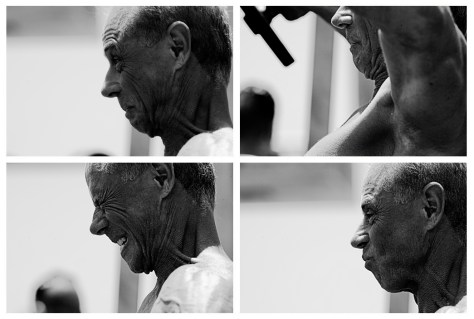
Weightlifter
Photo courtesy of Peter Reid, Flickr

What would it be like to live in another era, or another country? What would it be like to live your life as a king, as a slave, or as the opposite sex?

What would it be like?

The many answers to the many forms of this question may be less interesting, and less useful, than the observation that most of us never bother to answer it.

One of the most powerful insights into our human condition is the tendency of our species to live within the limits.

– the limits of our physical endurance and strength
– the limits of our understanding
– the limits of our beliefs
– the limits of our intelligence
– the limits of our will, knowledge, and comfort

There are names for those who test limits.

The weightlifter who can comfortably lift x pounds sets a goal to lift x+10 pounds.

The runner who can complete 3 miles in 25 minutes determines to run 3 miles in 20 minutes.

These people are called athletes.

The person who imagines what it would be like to wake up as a giant cockroach, and who writes a book about it, is called an artist.

The athlete wages a battle against physical and mental limits. The artist confronts the limits of imagination.

There is no name for the people who never test their limits, because they are simply ordinary human beings.

Limits show us where the possibility of growth exists.

The limits of political will define the status quo. Will is the wall that encircles every social order.

The politician says “that’s impossible,” when what he really means is, “I lack the will to do it.”

Don’t accept the world as it is, because it will be that and nothing more.

Questions push up against the limits of what is known. The answers lie beyond. Don’t ask questions, and you will forever live within the limits of your current knowledge.

There are emotional limits, mental limits, physical limits, psychological limits.

Fear, lack of confidence, comfort, doubt, resignation.

Everything has an absolute limit: but since we so often accept the given limits as if they were absolute, we don’t explore the realm of the possible.

What is impossible? Airplanes, medicine, going to the moon. A 2-hour marathon. Time travel. The line between what is and what could be is a line we are re-drawing every day.

Artists, athletes, explorers, innovators, and philosophers do not accept limits. They identify that which is unknowable, undiscovered, unseen, unthinkable. They know, discover, see, and think.

Find a limit and push against it. Accept nothing as it is, and it will soon be something else.

Time to trick your brain

Think outside the watts. ✎ By Wayne K. Spear

Brain

Your brain is lazy. Here is the proof.

Take a piece of paper and a pen. Make two dots. Below the dots, draw a line. Like this:

Smile

Your brain decides immediately that this is a face and files the information accordingly. But two dots and a line could be any number of things, or nothing.

We know it’s not a face, but we can’t not see a face. The brain is a tyrant.

Your brain, the lazy tyrant, takes the easiest route.

Every piece of information that the brain receives is treated in the same way, usually without your awareness. It organizes the world into boxes, whether you like it or not.

In a perfect world, from your brain’s point-of-view, nothing new or strange ever happens. Dots and lines are forever going to be faces. Your brain is not interested in whether or not it’s really a face. It’s interested in putting the information into a box, already.

Everything is assigned by the brain to pre-fabricated categories determined by assumption, prejudice, routine, familiarity, and efficiency.

To do this, your brain needs less than 20 watts of electricity.

According to Moore’s Law, the power of computers will double every two years. A computer as powerful as the brain would consume 10,000,000 watts of energy, about the amount required by a small city.

Your brain is more interested in efficiency than it is in insight or innovation. It has evolved to make quick decisions in potentially life-threatening situations, with minimal expenditure of energy.

The brain thrives on routine.

And so, we are creatures of habit, set in our ways.

The script in our head keeps us from considering new ways of seeing and being. The brain is happy to remain set in its ways. This is efficiency.

To change your life, you first have to overcome the lazy tyrant that is your brain.

Go somewhere you have never been before—a country, a neighborhood, a part of town. Surround yourself with unfamiliar people and languages. Eat new foods, redecorate your office, shake up your routine. Make your brain think new, more healthy thoughts.

Reinvent yourself and reinvigorate your life by making your brain do something it doesn’t like to do—break out of the routine.

This is the meaning of your life

When you die, the people who loved you unearth your significance. ✎ By Wayne K. Spear

There we all stood, looking at the man’s tattoo. We knew what it was, but no one could think of the word caduceus.

Everyone knows what a barber pole signifies, few know what it means.

No matter how long your life, it can be reduced to a sentence.

Joe is funny—he’s a man who will always help a friend: he has a big heart.

Significance and meaning.

The word fossil means something dug up. Many bones were dug up before their significance was known.

For centuries, astronomy was the reigning science. The word paleontology was invented in 1822, at a time when the significance of the earth sciences was finally understood.

Until the nineteenth century, we looked to the heavens for meaning. Then, geology taught us to look down.

We forget the dictionary meaning of things because that is not their significance. A barber pole signifies that “I can get a hair cut here”—a caduceus (because it is often confused with the Rod of Asclepius) that “I can get medicine and be well.”

While we live, we struggle with meaning. When we die, the people who loved us unearth our significance. They are the paleontologists of our lives. They are the experts.

Imagine what you want them to say, and live accordingly.