We’re in no mood for explaining ourselves to Canada

We don’t need, and we don’t want, a devil’s advocate to set us right about the value of Indigenous lives

✎  Wayne K. Spear | February 11, 2018 • Politics

I CAN’T IMAGINE ANYTHING worse than losing a child.

Now consider, for just a moment, how weak that sentence is. A cliché, wrapped around a euphemism, squatting on a conjecture. I don’t want to imagine the death of my son, or even to write the words, and I definitely don’t want to know what it’s like. Grant me the bliss of ignorance, now and forever.

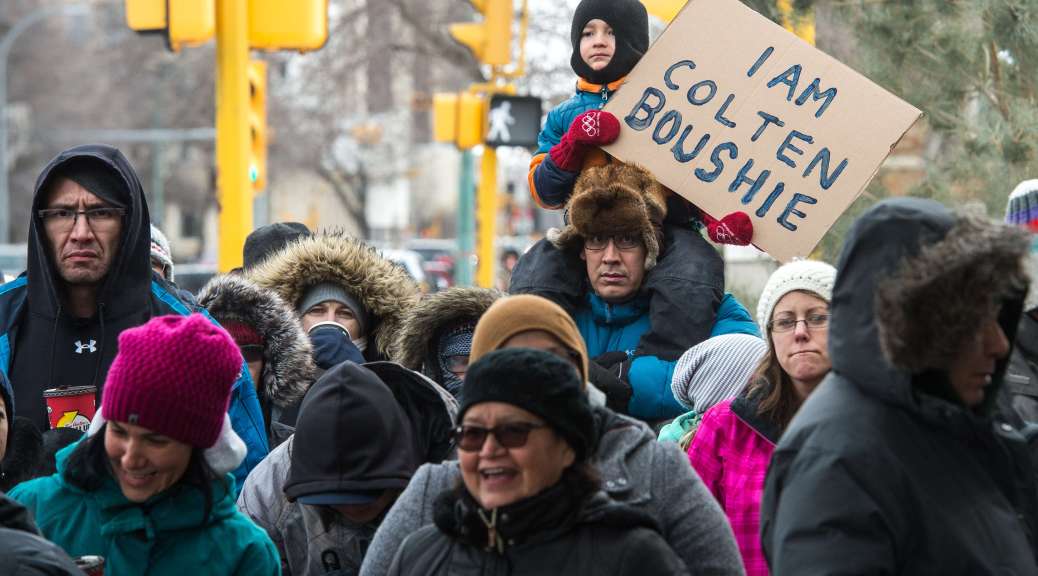
Colten Boushie

The trial of Gerald Stanley is about the death of a son, about pain that requires no explanation, about the worst of all possible nightmares come true. If Mr. Stanley were sitting in a cell at this moment, the family of Colten Boushie would be mourning a loss all the same. For those who knew and loved Colten, there is today an expansive, terrible hole the universe will never fill. Every parent across Canada can sympathize with this, and so too everyone who has lost a brother or sister. Some things are universal.

But some aren’t in Canada, and the trial of Gerald Stanley is about this too. When the acquittal arrived, I was shocked but not surprised, like Indigenous people everywhere. I felt a sickening, heavy weight come down on me. I was angry and sad, outraged and hopeless. I wanted to kick something over. Instead, I went to bed, thinking it best to check out for a while.

My show the next day was about Indigenous identity, and how we’re all different from one another. I couldn’t have arranged worse timing for this topic. Yes, we are all unique, but in the hours and days after the judgement of innocence was announced, we felt the same emotions and expressed ourselves in a shared language of pain. Indigenous people experienced the Stanley trial the same way because our lives have been shaped by common experiences. We know instinctively that other Indigenous people get it, without anyone having to explain a single thing.

At the Toronto #JusticeforColten gathering, a speaker said she was exhausted by reconciliation. Aren’t we all. At times like this we’re expected to go on television or to write moving newspaper articles explaining ourselves to Canada. Everything we have lived and known is fodder for debate: the suffering of Indian residential school survivors, the legitimacy of our expressions of pain, the continued existence of our communities. We are told that our past is something to get over, and that our aspirations for the future are impractical. As for our present, we should show more gratitude and get on with assimilating.

When I was twenty-four, the Oka confrontation taught my generation of Haudenosaunee that our lives were of less value and importance to Canada than golf. We were forever changed by the Summer of 1990. Twenty-eight years later, our young people are living their Oka, by which I mean they are having their place in the Canadian scheme of things underscored and re-affirmed. The message is clear: it’s okay and even necessary to shoot an Indigenous person over a quad, because a quad is a valuable piece of property.

Ah, but what about the other side? Balance and fairness. The devil’s advocates and the debate?

Some things are universal, like the grief of a bereft parent. Canadians should at least be capable of expressing sorrow over this without having it explained to them. Unfortunately, Indigenous people are forever expected to educate the country and to give an account of ourselves, over and over and over again, as if Canada would be moved by our pain to change its direction. We’re exhausted, and we’re in no mood for explaining ourselves right now, and after this week we may never be again.
The Once and Forever Candidate

If Doug Ford runs for everything, one day he just might catch something

✎  Wayne K. Spear | February 8, 2018 • Politics

DOUG FORD’s run for mayor had already started when a path to Queen’s Park appeared, and if Ford loses in June who doubts that October will coax his return? The man is always running, or teasing about running, as if there could be a doubt. The only variable is the destination. In the past five-or-so years, Doug Ford has imagined himself the succesor of Stephen Harper, Tim Hudak, Rob Ford, and now Patrick Brown. And in between he has run, or has said he would run, for municipal council and the provincial parliament. Doug Ford, the once and forever candidate, always ready to run everywhere for anything.

Doug Ford

The Etobicoke Kennedys, we locals sometimes call the Fords, and not entirely with irony. They are now a three-generation political dynasty, if you include nephew Michael. And before you dismiss this comparison as too generous, remember that the Kennedys had a more-than-passing familiarity with intrigue and pills and thuggery, and that the flattering myth of Camelot was just that. Doug lacks even an interest in the mechanics of charm, and his style tends more toward resentment. But resentment is a cheque that someone will eventually cash if only you carry it around long enough. The populism of Mike Harris enjoyed scant currency until Bob Rae had made the 905 sufficiently angry. For seven years, from 1995 to 2002, Harris’ nonsense was Common Sense. The voters didn’t want a government, they wanted a wrecking ball. Has Kathleen Wynne brought them back, yet, to this point? She seems to have been trying.

Doug Ford took a third of the vote in the last Toronto election. One in three voters, over 330,000, endorsed his message of rampant insider corruption and gravy-train elitism. He’s only ever had one message, of outgroup anger and burn-it-to-the-ground populism. Folks, he hates the people that you hate, and he’ll poke them in the eye. For you, folks. The Doug Ford myth is reverse Camelot, where the rotten elites are inside drinking Chardonnay and have locked all the good people out. Reverse Camelot isn’t a myth about public service or even ideology—it is an appeal to the tribe, a call to charge the gate, a war of cultures. That’s why Ford has been able to survive when his claims—such as being an ordinary outsider, rather than a wealthy and well-connected member of a multi-generational political family—turn out to be objectively false. It’s not about Doug Ford, it’s about the people and the things that Doug Ford hates and will endeavour to confound.

I’ve lived in Ontario long enough to know that phony populism, of the kind peddled by Doug Ford, goes around and comes around. He’ll tell you he’s running for Premier because it breaks his heart, folks, to see what’s happening to his beloved province, not because he was raised on the mother’s milk of political ambition. He’ll tell you he’s just like you. He’ll tell you he’s going to Queen’s Park to clean things up, not because he craves the power of office, of any and every office. He’ll tell you only he can fix what is broken, and that only he can drive out the elites. Maybe this time it will work. If it doesn’t, he’ll be back, running the path towards another office. When Doug Ford arrives at a fork in the road, he takes it, hoping that eventually it will come with a meal.

America’s Taliban Has Arrived

Let’s hope we can end it, before it ends us

✎  Wayne K. Spear | February 6, 2018 • Politics

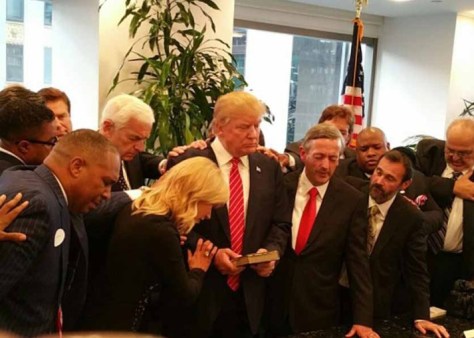
MICHAEL GERSON SAYS that the gag reflex of Trump-supporting Christian leaders is “entirely gone,” but think about the things American evangelicals have been swallowing from these so-called leaders, not only for years but decades. And not only swallowing but hungrily imbibing, as well as underwriting with outlays of their precious income. Televangelist con-artistry and snake oil salesmanship. Bigotry from the pulpit. A “Prosperity Gospel” which despises the poor, and which lobbies the government accordingly. A mean and self-promoting cult that not so much prays for the sick and the elderly, as preys upon them.

Kenneth Copeland Prays.jpg

I could keep going, but you don’t need me to. The long list of televangelism’s crimes and depravities has been well publicized, but none of this seems to have harmed the racket. Now that I’ve typed this sentence, I can’t but think of another crook and his well documented crimes, and how the stupid and credulous nonetheless threw in behind him. It gives me a horrible shiver to think that everything which is true of evangelical and especially televangelist Christianity is true also of Mr. Trump: the authoritarianism, the menacing bluster, the incoherent and impossible promises of rewards to the faithful, the love of money, the magical thinking, the incessant appeals for donations, and above all else the self-promotion on the backs and bank accounts of the duped. Trump and the evangelicals, in other words, are using the same playbook, and for the same ends. So, yes, they’re happy to take it, and happy to swallow, too.

It would all be simply ridiculous if it weren’t dangerous. Trump has weighted his cabinet with religious extremists, and he receives regular counsel from them in the form of a Faith Advisory Council, a rogue’s crew of bigots and hypocrites and money-grubbing sycophants. We’ve yet to know where they will steer him, but the prospects are not happy. As I write these words, Michelle (Earthquakes Are Punishments of an Angry God) Bachmann is seeking guidance from the Almighty on whether to seek the vacated congressional seat of Al Franken, but whether or not she wins, Bachmann will continue to exert a bad influence. The other news which got my attention this week was a video of Trump advisor Gloria Copeland, whose advice is not to get a flu shot but, instead, to inoculate oneself against sickness with the Word of God.

You can be confident that Ms. Copeland and her husband (also advisor to the President) get the flu shot, no matter what they counsel others. Kenneth Copeland Ministries is a do-as-I-say scam of the familiar televangelist sort, by means of which the Copelands have become fabulously rich through the fleecing of a flock. Some years ago their anti-vaccination propaganda led to a local outbreak of measles, as this “Jesus heals” nonsense so often does. Partly as a health precaution, the Copelands avoid contact with the unwashed masses, and Mr. Copeland himself once described commercial airline travel as “getting into a long tube with a bunch of demons.” He flies in a $3-million private jet purchased with the money of his congregants. Like every faith-based scam—ISIS or Hamas, Hezbollah and Qaeda—the foot soldiers are expected to carry the burden and to take the bullet, while the leaders amass their fortunes. (It’s true that Osama bin Laden and Yasser Arafat lived frugal lives, but make no mistake: extremism is a money-making operation.)

We’ve reached the point at which no one can be under an illusion, unless of course it’s an illusion of one’s willful choosing. President Trump’s administration is nothing more, but also nothing less, than the giant con and tax-avoidance scheme of every palace-and-botox Word-of-God blowhard. I repeat, the same playbook and the same end. This is why the President’s bottomless narcissism catches its reflection in fellow-travellers such as Paula White, Ralph Reed, Robert Jeffress, James Dobson, and Jerry Falwell, Jr., whose ignoramus followers constitute his base and best hope of political survival. At home these charlatans promote themselves by peddling stupidity and hatred, and abroad their end-of-times fantasies threaten the survival of our species. War in the Middle East? Nuclear holocaust? Well, well, it’s all in God’s plan, and whatever we might do to this world, the Lord will supply us another. Have faith, and let the End Times roll. The American Taliban has arrived, and let us hope we can put an end to it before it puts and end to us.

Podcast 94: Celebrating the Work of Cree Author, Larry Loyie, with Constance Brissenden


Podcast Season 5

Visit the Living Traditions Writers Group website to learn more about Larry’s work. You can also order the iBook version of Residential Schools with the words and images of Survivors here.

Why Do We Dream?

Would a life of only agreeable experiences be as rich and profound as a life of at least some struggle and suffering?

✎  Wayne K. Spear | February 1, 2018 • Personal Essay

WHY DO WE DREAM? Why the dreams of stress and misery, of being lost, of wandering, missing the train and having no phone nor money, sometimes not even clothing. The dreams are always of failure and disappointment, always of appointments about to be missed. A wrong bus taken, a wrong turn on a highway that allows no going back. And there I find myself, alone, in a wilderness, sometimes at a border I must but cannot cross. There is a sense of urgency, a deadline, a nameless necessary place I cannot reach. There is no one to call, nowhere to go. What is to be done?

I pick up the boxes or the bags, or whatever burden I am compelled to carry. A wagon, or a set of luggage. Something awkward and useless, but indispensable, on a path of deep mud. A cold wind, water, rough stones underfoot. It is dark, and the rain is heavy. My vision is obscured, by snow or by fog. I am miles from anywhere, from everywhere, arms filled with something that does not help me on the voyage but which I must carry, for reasons unknown. I don’t know who has given me these possessions, if that’s what they are, or where I will take them. There is always one thing I have managed to drop or otherwise misplace—the one, critical thing. A passport or a receipt, a map, instructions, a phone number. It is gone, and though I search for it again and again, I find nothing. I cannot go home or reach my destination. I am suspended in a story with no arc and no momentum. I may well remain here forever.

The landscape changes in an instant. I am on a bus, but now I am in a boat. We reach the shore, and I step out, but the dry land is suddenly an ocean and the boat is slipping away too fast for me to swim. I call out but no one hears, and I watch the boat get smaller and then vanish. The ocean becomes desert. I drag my belongings through deep sand. Nothing makes sense. Why am I in a desert? I know only that there is an appointment which must be kept. To miss it is to suffer an unbearable blow. I must find a phone. I must let them know that I have been delayed, that I am doing my best to arrive, only give me more time. I am trying as best I can, I will tell them, and I will be there. Just give me more time.

I have this dream almost every night. A dream of terror from which I wake in a panic, my heart pounding. My mind torments me in my sleep for reasons I cannot understand. I am lost without recourse and the world I have known slips away, but there is nothing I can do. A dream that means nothing, that warns me of nothing, that solves nothing. Why do I dream?

A night arrives when I lie down for sleep and I tell my mind the dream I want to have when I am gone. Where I have got this idea, I can’t say. It is an experiment, an act of desperation. I describe the dream in as much detail as I can manage. I don’t want to leave anything to chance. So I describe what I am doing in the dream, perhaps floating in water (but not drowning!) or flying in air (but not pursued!) and I choose a place, also, such as the tropics or a Mediterranean port town, Venice, or a house from my childhood. And the people I want to see there, I specify this too. What will we talk about? The happy times, things that draw laughter, beauty. All that is impossible in life, I describe. The departed will be there. I will breathe underwater. I will have dinner with the dead and a journey into space. I know that my mind has an agenda, to introduce monsters, so I interpolate the fantastic on my own terms. There will be palaces and ocean creatures and other-worldly beings, not of the menacing variety but come to reunite with their sundered kin.

They come not bearing unresolved guilt, but joy. Everything that has been buried remains buried, including the mind, submerged and inscrutable, burdened by its inheritance and longing to be set free. And so I am clear about my desire. I would prefer not to see the half-rotted faces, the ghosts, the brutal finality of cul-de-sacs. I don’t wish to be trapped or lost or set on a fool’s errand. I want to feel love, and not terror or sadness. I tell this to my mind as I prepare for sleep. I know that life is loss and pain, but if one can confect a dream, then why not a dream of happiness?

To my surprise I find that this works, even if imperfectly. The departed return to sit for tea. There is no grief, no dragging of luggage through a useless desert. I discover that the imagination invents pleasure as easily as it invents pain. Would a life of only agreeable experiences be as rich and profound as a life of at least some struggle and suffering? Perhaps, but this is invention, not life. In life, no one chooses the losses, the pain, the tragedy. In life, one is chosen.

The suffering return from their journey bearing wisdom. We whisper in their presence, awkwardly, our faces grown longer. Wherever they go, those who suffer find streets of dark water, and when we stumble upon them we phrase our greeting with care. They did not ask for the journey, and we don’t want to know too much about it, but they return holding a marvellous gem that they alone can explain. A gem from a dream of the departed who haunt them. A dream not of the day but of the relentless, interminable day. A fascinating gem that I do not want to ever hold.

Colten Boushie’s Death Must Have a Purpose

For Indigenous people, change is often a matter of life or death

✎  Wayne K. Spear | January 30, 2018 • Current Events

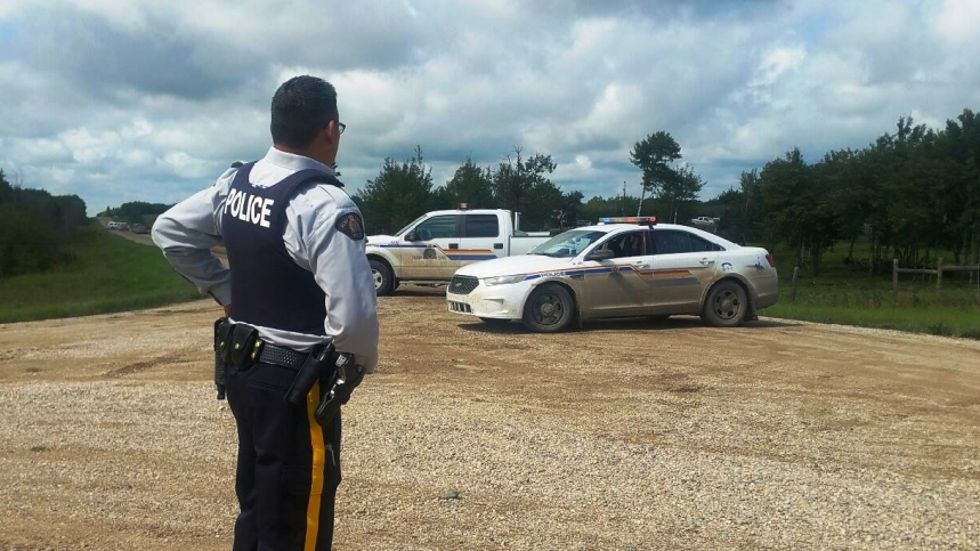
RCMP ROOFTOP SNIPERS were at-the-ready when Gerald Stanley arrived in North Battleford last April for his three-day preliminary hearing. There was drumming and a show of support for the family of Colten Boushie but no violence. There’s been no violence of any kind in the months since this Indigenous Rodney King (as some have called Boushie) was shot in the back of the head while sitting in a car stalled on Stanley’s Biggar, Saskatchewan property. The family has made it clear that what they want is not blood but justice and change.

Colten’s death must have a purpose. While his death revealed a deep divide that exists between many within this province, it has also brought us here to this courthouse, where we could come together and ask for a fair trial for everyone involved. We, Colten’s family, hope that this preliminary hearing and the issues that it raises about our relationships with each other will generate further discussion and dialogue to help us bring our communities together.

Biggar, Saskatchewan

It’s an understatement to characterise this sentiment as dignified, but then what isn’t an understatement when speaking of confronting the death of a child. As the family were grieving their dear lost son and grandson and brother and nephew, strangers were posting hateful comments on social media. The rooftop snipers, presumably deployed to snuff an incipient Indian uprising, turned out to be unnecessary. But there was rabble rousing and racial hatred to be shot down in the other column of the deep divide ledger, so the Premier stepped in to denounce racists and their racism. Before long a Browning municipal councillor named Ben Kautz had resigned over a posting on the Saskatchewan Farmer’s Facebook group, where a number of other mean-spirited comments could also be found. As if losing Colten wasn’t bad enough, random citizens heaped contempt on the family’s pain, and still the family called for healing.

There are good reasons why Indigenous people call for healing and peace at times like this. The first and perhaps most compelling is that we need healing and peace. At roughly five percent of the population, Indigenous people are not going to win a contest of force against Canada, and we know it. But there also isn’t an appetite for perpetuating the hatred and violence that has been commonly experienced by Indigenous people, for generations, whether in the residential schools or on the street. Far too many of us have become experts in trauma, intergenerational violence, and hate. We don’t just want something better, we need it, in a life-or-death way.

Last week the RCMP cleared themselves of a charge of misconduct made by the family of Colten Boushie. The officers can’t recall doing or saying the things that witnesses affirm that they did and said, in the course of their investigation of the Baptiste home. At the time of Colten Boushie’s death the RCMP issued a press release suggesting he was connected to an investigation of property theft. Then the RCMP allowed the 2003 Ford Escape in which Boushie was shot—a critical piece of evidence—to go to the salvage yard before it had undergone forensic (blood spatter) anaysis, thereby jeopardizing the integrity of any later trial. “The RCMP were, best case scenario, negligent,” the family lawyer Chris Murphy told a journalist. Still the RCMP seem to think they have done nothing wrong, which apparently means that they haven’t.

Next Spring Gerald Stanley will go to court, where he will face a charge of second-degree murder. In the meantime his rural Saskatchewan house has been put up for sale as he prepares for a new life either inside or ouside of prison. He has expressed regret for the death of Colten Boushie, just as Ben Kautz has expressed regret for his Facebook post, just as the RCMP has said it’s sorry for offences taken in the course of its faultless  investigation. The Saskatchewan Association of Rural Municipalities (SARM) meanwhile agitates for a broadened right to defend property against trespass. The two solitudes of Saskatchewan, the reserve and the farm, remain as estranged as ever, and Indigenous people everywhere hold their breath in anticipation of a trial they don’t dare allow themselves to believe will be fair and impartial.

Colten Boushie is gone and the white cattle ranchers found guilty of property theft of their neighbours remain alive and well in the community, despite their crimes. There is indeed a deep divide, deep as the chasm between life and death.

The Debate About Indian Residential Schools Misses the Point

It’s never been about good and bad experiences. It’s always been about Canada’s Indian Problem.

✎  Wayne K. Spear | January 25, 2018 • Current Events

TRC
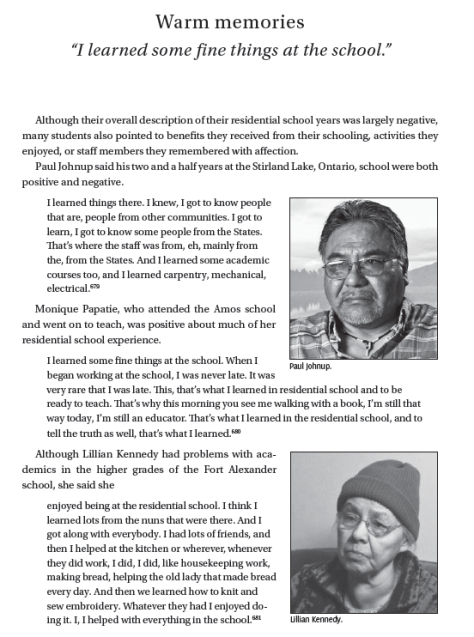
A page from the TRC report, “The Survivors Speak.”

SENATOR LYNN BEYAK laments that the histories of Indian residential school focus on the negative, and she has a point. A story about the abuse of a child does tend to capture one’s attention. So far as I’m aware, the Truth and Reconciliation Commission never once intervened mid-testimony to change the subject. “Yes, yes, we get it. But tell us about the knitting and the maths—you know, the good stuff.”

The topic of whether or not good things happened in the Indian residential schools, and whether they are sufficiently documented, is a mischaracterization of the debate we are now seeing. But while I’m on the subject, let me state once again that good things happened in the residential schools. Most scholarly sources describe them, including the Truth and Reconciliation Commission, whose reports include warm tributes to beloved teachers. (Every time residential school apologists claim that the TRC tells only the negative stories, they reveal their ignorance.) My own book, Residential Schools: With the Words and Images of Survivors, has entire chapters on movie and dance night, laughter, friendship, hijinks, and so on. My co-author, Larry Loyie, fondly recalled the teacher who encouraged him to write, and he had some fond and funny stories about his residential school days. He was however a writer of books, not of payroll ledgers, and never indulged the question of whether the arithmetic of good and bad arrived at a sum which could please critics like Beyak. We presented the whole truth, as best we could.

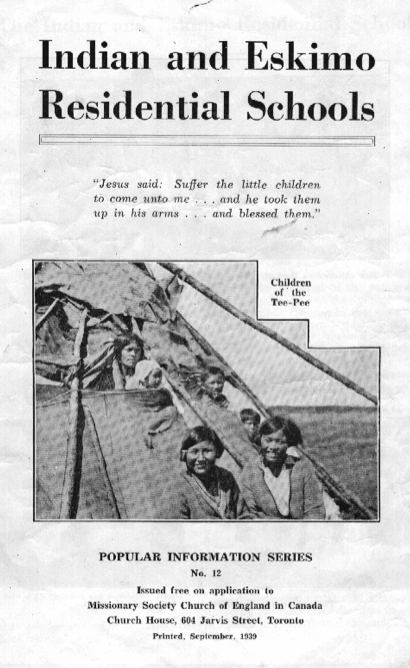
Indian and Eskimo Schools

Well, you can’t please everyone, but it’s useful to understand the character of a disagreement. The Indian residential school debate is and has always been about the right of one ethnic or cultural group to dominate and absorb another, and by doing so to appropriate and benefit from land and resources. The children, put into residential schools, often hundreds or even thousands of miles from home, could have learned English and grammar and grown up knowing the love of their mothers and fathers and grandparents. They could have got hockey lessons and a normal childhood. But the whole point of the Indian Residential School System as a system was to sever the bonds of family, so Indians could be turned into Christian Canadians free of the influence of their kin. Did Canada have the moral right, and moral obligation even, to do this? Does it have it now? Welcome to the real debate, ladies and gentleman.

The Let’s Focus On The Positive history of Indian residential schools was written, many times over, by women’s church auxiliaries, missionary societies, school administrators, Indian Agents, and government bureaucrats. Indian Affairs wrote it every year, in their annual reports. The folks who ran and oversaw the schools knew much, much more about them than today’s armchair apologists. When they declared the system a wise and benevolent success, math had nothing to do with it. Duncan Campbell Scott was aware that children were dying unnecessarily in the schools, of diseases caused by overcrowding and insufficient nutrition. The math was not on his side, and he knew it. “But this alone,” he wrote to an Indian Agent, in 1910, “does not justify a change in the policy of this Department, which is geared towards a final solution of our Indian Problem.” These folks knew what the debate was really about, and they made no effort to hide it. They were after a final solution of the Indian Problem, and no amount of bad news was going to make a difference.

I didn’t write this article to change anyone’s mind, because I’m not delusional. I wrote it to clarify. It was my day job for well over a decade to educate the public about the Indian Residential School System, and when I started, in the 1990s, most Canadians hadn’t even heard of it. Today there’s a consensus that the Indian Residential School System was not good, but a chunk of Canadian society can be depended upon to never take up that view. There are at present some thousands and maybe even millions of Duncan Campbell Scotts, looking forward to a day when there are no Indians in Canada and, as a consequence of this, no Indian Problem. There are also folks pained by the lost prestige of Mother Church, or by blemishes on the noble project of Empire. There are professional contrarians, skeptical of every affront to the status quo, a bag of human sand stubbornly anchoring the Old Order. I can’t explain the motives of every person who insists the residential schools were good, but I can ask them if they think Canada was right to attempt a wholesale assimilation of Indigenous people, and if they think Canada should stay on that course.

Life, edited

Would I even notice the absence of cream in my coffee, once my mind had let go the idea of it?

✎  Wayne K. Spear | January 18, 2018 • Essay

IN THE MORNING I make my coffee, sometimes I walk to the nearby cafe. When the barista sees me coming, she, or he, begins to make my drink: a large Americano. It is a routine whose origins I am unable to summon. There was a first time that I ordered an Americano at this shop, a first time I drank coffee. I don’t remember these firsts, I only know that they are so. Just as there are lasts.

My earliest memories of coffee are of the church basement where we gathered after service. An enormous stone building, with stained glass windows and many rows of pews, benches for the choir, a pipe organ, a vaulted ceiling. And below, a gymnasium, a Sunday school room, a large kitchen. For years we attended church on Sundays. There must have been weddings and funerals also, but I have no recollection of them. I have seen sun-bleached photos, of aunts and uncles, the happy brides and grooms whose future self will divorce and remarry, or perhaps not, retaining across the decades some small semblance of this person frozen in time, covered in wedding confetti, surrounded by those I remember as once living among us.

We went to church, as most others did. Afterward we gathered in the basement to drink coffee made in enormous steel percolators, or tea from mismatched cups and saucers, donated by kind ladies with blue hair. The same ladies who made the trays of triangle sandwiches. In one palm, the adults balancing a cup and saucer, in the other hand a wedge of sandwich nested in a paper napkin. The women in polyester dresses of harvest gold, the men in rayon jackets and chocolate brown slacks, shirts with enormous collars, the indistinct voices of grown-ups punctuated by the laughter of children. The kind ladies with blue hair appear from the kitchen, take note of the trays, and retreat. One imagines them forever baking, forever replenishing the silver trays with triangle sandwiches, even now.

One day we stopped going to church. Why, I don’t know, any more than I know why we started. Nothing was said about it, to me at least. We went, and then we didn’t. As the last of many other things arrives, must arrive, the end comes but without fanfare. “Goodbye,” you say, and “see you later,” to someone you will never say hello to again.

How does a ritual become a ritual? I used to drink my coffee with cream. I would often find myself without, sometimes on cold mornings, the coffee already made, me in my pyjamas not wanting to go outside. I couldn’t bear coffee without cream, back then. I found it too bitter, undrinkable, nasty even. And against this, the going out into the cold, to get cream from the nearby convenience store. First I would have to dress. Or at the least put on a coat and boots. I would hope to find enough change in the laundry dish. If the dish was emptied of laundry money I would have to use the bank machine. It was a scenario I grew tired of repeating.

I read that a person can learn to like something they find unpleasant, like black coffee. The article said it takes, on average, fifteen attempts. I think of the first time I drank Guinness, in a Kingston pub, on a cold December night. I found it disgusting, and yet the next week I was back, drinking another. And another after that. I became curious to know what black coffee would taste like to my re-calibrated brain. Would I even notice the absence of cream, once my mind had let go the idea of it, as it had let go so many other things? Habits, lovers, misguided notions, the many sordid details.

At first it was unpleasant. But I was surprised at how quickly I was able to edit the cream from my morning ritual and not miss it. I oughtn’t have been. After all, one day I disliked Guinness. And another day I sat in the Wellington, my back to the stage where Gerry O’Kane played his guitar and sang, drinking my Guinness at the windowfront table with my friends, walking home later in the clear December air, holding the hand of a woman to whom I was not romantically inclined when we arrived at the pub hours before. Life before and after, coffee with and without cream, love and loss, weddings and funerals. Sunday arrives. I drink my coffee black, my routine simplified, no need of cream or of choirs, of expired passions, of the rows of creaking pews, the moulding hymnals, or of kind old women with blue hair, gone but not to heaven.

The President is Not a Duck

Some people are never going to use the R-word to describe Donald Trump. No matter what.

✎  Wayne K. Spear | January 16, 2018 • Politics

Martin-Luther-King

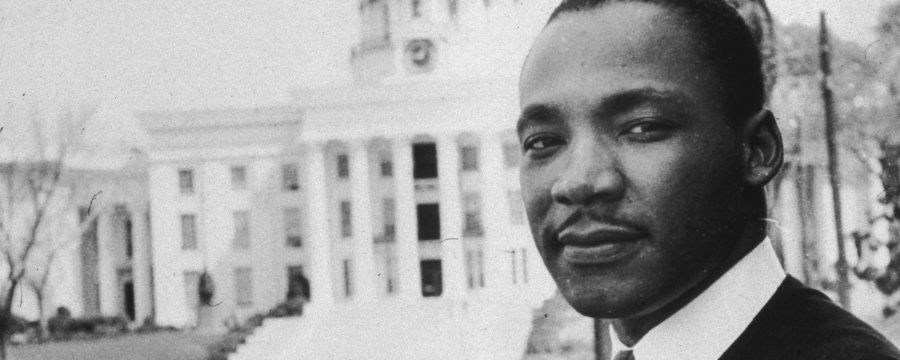
Were he alive, Martin Luther King Jr. would have turned eighty-nine on Monday. It seems a mercy that he isn’t, and didn’t, because nearly a nonagenarian, he’d be captive with the rest of us in a world where no one need ask, “How are things going on the race relations front?” It’s a question that answers itself. Race relations are in the shithole, as the president might say.

After dropping the s-word, the President was praised by David Duke and the neo-Nazi Daily Stormer, and by some other “very fine people,” and not for the first time. Peter Barker, in a New York Times article, “A President Who Fans, Rather Than Douses, the Nation’s Racial Fires,” catalogues a number of occasions on which Mr. Trump and his staff have been asked whether the president is racist. Well, I mean, if saying he’s not a racist is in your speaking notes… Anyways, Barker asks Jesse Jackson if the president is a duck and Mr. Jackson notes that the president indeed quacks, “but to categorize him by a name [duck] does not quite address the issue [that the president is using his webbed feet to bottom feed].” Got it.

https://twitter.com/DrDavidDuke/status/951881688015167489

Next, from Barker’s column, Dr. King’s nephew, Isaac Newton Farris Jr., thinks that “President Trump is racially ignorant and racially uninformed. But I don’t think he is a racist in the traditional sense.” Now try and imagine Martin Luther King speaking this way. “Hate cannot drive out hate, and by hate I mean not hate in the traditional sense but rather a condition marked by a state of insufficient emotional information.” Eight years ago a chunk of America thought they’d entered the Age of Post-Racialism, and now we live in an age that is almost exclusively characterized by tribal identitarianism. Yet notice how many people today cannot bring themselves to use the R-word, resorting instead to equivocation and whataboutism. King no doubt would have regarded “not racist but racially ignorant” as a distinction without a difference, if not a tautology. And he would have had something more interesting, and less ridiculous, to say.

But Trump! You have to give him credit for generating memorable quotes. Mexicans? Those people are rapists. Nigerians? Those people live in huts. Haitians? Those people have AIDS. Norwegians? Those people should come to America. Donald Trump is a Thoser who sees human beings in categorical terms. Every black neighborhood is a war zone, sustained by welfare cheques—”TRUMP THINKS ONLY BLACK PEOPLE ARE ON WELFARE,” says a Newsweek headline from last week—and every Iranian is an ayatollah, a foreigner with a nuclear bomb in their turban. Why else prevent Iranians, en masse, from coming to America? This broadbrush way of thinking discloses ignorance and racism, racism by definition being the habit of viewing people in categorical terms. (Note to the President: there are Norwegian rapists.)

It’s remarkable in retrospect how few infamous King quotes have to do explicitly with race. Even as he developed a radical critique of capitalism, his themes were freedom, hope, struggle, faith, solidarity, love, justice, brotherhood, dignity—in short, universal themes of our shared humanity. On the occasions in which he uses racial terms (“I want to be the white man’s brother, not his brother-in-law.”) it’s to push the notion of unity. But of course he knew the face and mind and methods of racism intimately, and targeted its foundation. His most famous quotation, “I have a dream that my four little children will one day live in a nation where they will not be judged by the color of their skin, but by the content of their character” could be a @realDonaldTrump subtweet. And it’s depressingly easy to imagine President Trump angrily quacking back a Twitter insult, in all-caps, while the usual suspects find a way to tell us he’s not a duck.

An Interview with Garnet Angeconeb

Last Summer, Garnet Angeconeb met with Senator Lynn Beyak to reconcile. Today he says she should resign.

✎  Wayne K. Spear | January 5, 2018 ◈ Interviews

Garnet Angeconeb
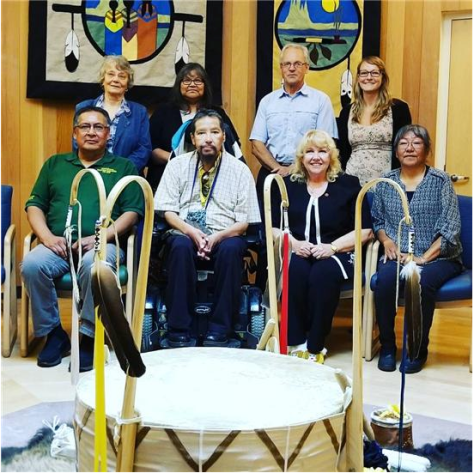
Above: Garnet (second from left, front row) meets with Senator Lynn Beyak in Sioux Lookout.

GARNET ANGECONEB is an Anishinaabe originally from the Lac Seul First Nation. He now lives in Sioux Lookout, Ontario.

 Garnet attended Pelican Indian Residential School near Sioux Lookout from 1963 to 1969. In 1975, he graduated from Queen Elizabeth High School in Sioux Lookout. In 1982, he graduated from the University of Western Ontario with a diploma in journalism.

 In 1985, Garnet was elected to the council of the municipality of Sioux Lookout. It was there that he spearheaded the founding of the Sioux Lookout Anti-racism Committee. Today the Sioux Lookout Anti-racism continues its work with an added dimension to mandate that being the Sioux Lookout Coalition for Healing and Reconciliation. The SLCHR membership comprises of local former Indian Residential School students, clergy and interested citizens. Its main purpose is to promote awareness and seek renewed relations as a result of the Indian residential school legacy. Garnet co-chairs the Sioux Lookout Coalition for Healing and Reconciliation.

 He is a recipient of the Queen’s Golden Jubilee award. Visit his website, Garnet’s Journey: from Residential School to Reconciliation.