

Reading of the ghost estates and the collapse of the Irish economy, my thoughts returned today to the small, southern Ontario town in which I was raised and which I recently visited. The surge and fall of the Celtic Tiger reminds one, as if reminder is needed, that life in the age of finance capitalism can be a matter both of spectacular rise and of sudden, disgraceful cadence. Or, as has been the case in my hometown, of lingering and even interminable decay. Continue reading Going Home
All posts by Wayne K. Spear
On Not Being There

As I took a cell phone and netbook, it is inaccurate to claim I “unplugged” on a recent trip to Chicago. I did however go without newspapers and without thinking about work and the many things left behind, and being outside my routines and therefore in a sense outside my habitual self, I do feel as though I had.
It is a telling metaphor, this unplugging. One employs the word in its broad sense, not only to the electrical circuit but to one’s own body and, specifically, brain. Such today is the comprehensive material burden of connectedness, a word which could once have been rendered only in human terms, but now invokes the clichés of social media. Pulling out the electrical plug seems uncomplicated enough. It is so easy to walk away from connections of the Internet sort that not to do so has become the only thing easier. Continue reading On Not Being There
The Klan Comes to Campbellford
 Often I find that an aid to arriving at my own understanding, as well as to the task of explaining something to others, is the drawing of an analogy. Find something familiar and which one already understands from the inside, and to that compare the unfamiliar, the novel, the exotic. It works quite well, with one noteworthy exception being racism.
Give it a try. You’ll discover there is no at-hand analogy in the Euro-Canadian cupboard for the systematic oppression and mob lynching of dark-skinned persons — nothing of which may be said, “It was like that for us, too.” For this reason, white people will never really understand the trauma of racism from the inside. Now that I have established that, let us consider what transpired this past Hallowe’en at the Campbellford Royal Canadian Legion, so that we may better separate the wheat of anti-racism from the chaff of rube blundering. Continue reading The Klan Comes to Campbellford
The Diminishing Marginal Utility of Torture
Across the past few days and in deliberation of the Guantanamo Bay trials we have, all of us, had ample opportunity to note the ideological, intellectual, and moral deficiencies of our opponents. Omar Khadr confesses in a military commission to his crimes, the case against Ahmed Ghailani unfolds in civilian court, and there arrives fresh news of terrorism originating in Yemen. Justice is done, or is undone, depending upon one’s perspective. What we perhaps fail adequately to clutch is that we are all of us in this together. I say this quite without sentiment, my point being only that an explosive device is indifferent to the bend of your politics. If that is not a compelling cause for solidarity, then it happens that nothing is.
Then there is the personal. Here is one example: the cargo planes destined for the United States and for a destruction prevented this past weekend were meant to have exploded in the coming days over Chicago. As it happens, I will myself be flying to Chicago this week. I know this is a facile pairing, but can you honestly say a thought such as this would never have crossed your mind, were you in the same position? Nor is this the first time I’ve had occasion to draw such an inference. From a statistical view of things, any one of us has little to fear — but you are quite probably on the list, comrade. Your kind is marked, by the Takbīr shouting killers, for destruction. If you are not on the list, it is because you are one of the murderers, in which case I will be happy to see your wish for martyrdom fulfilled in the least ceremonious and individual manner possible. That is, without harm to others and with the pointlessness of it all laid bare. Continue reading The Diminishing Marginal Utility of Torture
Just Say No To The War On Drugs
On November 2, California voters will be given an opportunity to vote upon Proposition 19, the “Regulate, Control, and Tax Cannabis Act of 2010,” thereby rendering a verdict upon legalization of the possession and consumption of marijuana, under certain conditions and restrictions. Proposition 19 may well fail, and the legalization of marijuana may be years or even decades away, but the era of drug legalization is coming. There is nothing — nothing — one can do to prevent that inevitable day from arriving. The reason is simple: the “war on drugs” is at best a stupid and expensive failure, and at worst a piece of dangerous propaganda, used to justify American military actions in Latin America and elsewhere. Every day, more of us enter the coalition of the knowing. The cause of drug legalization is so plainly correct, and so rational, that it appeals across the political spectrum: among its many advocates have been Tommy Chong, Christopher Hitchens (both during and after his Socialist International days), David Frum, and William F. Buckley. Continue reading Just Say No To The War On Drugs
Michael Ignatieff: You Can’t Have It Both Ways
Some hours ago, votes were cast upon Liberal Member of Parliament John McKay’s Bill C-300, “An Act respecting Corporate Accountability for the Activities of Mining, Oil or Gas in Developing Countries.” First introduced to the House of Commons on February 9, 2010, during the 2nd session of the 40th Parliament, and re-introduced on March 3, 2010, the bill was designed to hold Canada-based mining companies subsidized by Government accountable for human rights abuses committed abroad. The bill was defeated 140 to 134.
In September, former Liberal MP John Manley published a rebuttal of C-300, arguing that “the bill could result in […] companies losing business to corporations based elsewhere that do not have the same regard for environmental, safety and human rights standards” and “that it would encourage mining companies to locate in jurisdictions with less regulation and no commitment to corporate social responsibility.” Manley is today President and Chief Executive Officer of the Canadian Council of Chief Executives, a group which promotes the views and interests of (among others) Canada’s mining companies. Continue reading Michael Ignatieff: You Can’t Have It Both Ways
Jane Goodall
As I write these words, British Dame and ethologist Jane Goodall is arrived to the oil capital of Canada to promote an environmental conservation agenda and to reflect upon fifty years of chimpanzee research in the Gombe Stream National Park of Tanzania. With her work you are no doubt familiar: she has done all she can to make of that a certainty. An unrelenting traveler, if she is not on the road nor in the air, it is only because she is before an audience.
I also need not tell you that her research and advocacy have been occasions of disagreement and sometimes hostile opposition. On the subject of the environment’s rough handling by the human species I don’t share the hostile response to her message, but I think I understand why it exists. Her statement the other day that “we have really, really harmed Mother Nature and I don’t know how long she will retain this amazing ability to regenerate” makes me think, as all environmentalist-doomsday utterances do, of George Carlin’s brilliant commentary on “saving the planet.” If you’re not familiar, allow me to sum it up for you in his own words: “There is nothing wrong with the planet. The planet is fine. The people are fucked.” Who can argue? It is indeed the case that we’ll be long gone soon enough, and the Earth will go on as it did for billions of years before we arrived, quite by accident. Continue reading Jane Goodall
Jake Swamp, A Man of Roots
 Jake Swamp, 1941-2010
I didn’t know Jake Swamp, but as the saying goes I knew of him. Few are the Kanienkehaka who don’t. Or rather — I must get used to this now — didn’t. This morning I was informed of his passing, in the very early hours of Friday, October 15.
Tekaronianeken, or Jake Swamp as he was commonly known, was born at Akwesasne in 1941. He was of the generation born under the old dispensation of colonial shame but arriving to the 1960s and ’70s with a sense of purpose and a strong, proud voice. As a young man, he had been taught by Christian priests in St. Regis to consider the Longhouse a Pagan menace. So often the case with the Haudenosaunee (“People of the Longhouse”), a woman made short work of that. His wife Judy gradually brought him around, and so one year during Strawberry Festival time he went to the Longhouse and listened, out of curiosity. That decision changed his life. Continue reading Jake Swamp, A Man of Roots
The Dick Cavett Show
I dislike as a matter of course the plaintive themes of decline and decay, but stumbling upon some YouTube videos over the weekend, it did occur that the business of over-the-air talk has been cheapened. The occasion of this thought was a collection of episodes of the Dick Cavett show, some of which I had seen their first time around but had forgotten. Watching these programs again, years later, I can’t but notice how much the talk show format has changed, and how much for the worse.
If you doubt me on this, go through the archive yourself. You will find lengthy (in some cases seventy-minute) interviews, well-paced with twenty minutes or more between commercials and with (apparently) unscripted, spontaneous, and intelligent talk on a wide range of topics. Rather like a conversation in the real world. Note also that none of the guests whose interview I watched had a product to push: the conversation, for its own sake, was the thing.
Compare these facts to those of the current talk shows and I think you will readily discern the differences. The pace has quickened, the conversation now consists of rapid-fire and scripted question-and-answer organized around the selling of product, and the range of topics is thereby restricted. Get them on, push the product, play the commercials, show the guest the door — such is the current formula. Not quite a dumbing down, so much as a distillation of the medium to its industrial-capitalist quintessence.
Mr. Cavett has not left us, and I was gratified to find that the sharp old man keeps a blog on a website at the New York Times. He is and has always been a specimen of largeness, both in soul and in mind. His work is also unfortunately dated, and it’s difficult to watch those old broadcasts and not feel the distance between the now and the then. Could a program paced and executed as his was even be contemplated today? No, I don’t think so, and what a shame that is. The Dick Cavett show is wholly a matter of the past. I say this as an admirer both of the show and of the man, and as someone who understands well there is no going back. Usually I am at peace with this, but not tonight.
The Bigotry of Dr. Dobson
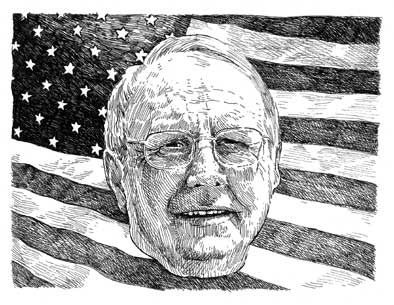 If you’ve not yet had the occasion to read Dr. James Dobson’s fantastic October 2008 “Letter from 2012 in Obama’s America,” you’ll not be aware that
in mid-2010, Iran launched a nuclear bomb that exploded in the middle of Tel Aviv, destroying much of that city. They then demanded that Israel cede huge amounts of territory to the Palestinians, and after an anguished all-night Cabinet meeting, Israel’s prime minister agreed.
I deploy fantastic in its archaic sense, to indicate the fantasy-based right-wing Christian paranoia with which anyone who has followed Focus on the Family over its thirty-three-year career, as I have, will be familiar. No, that’s not quite accurate: I did stop paying attention, for a time. However, with the recent suicides of young gay men in the news, the dirty and dishonest work of a Dobson/Focus on the Family creation called “True Tolerance” has got my attention. Apparently, what we must not do in these days of anti-gay bullying is promote the idea that anti-gay bullying is wrong. Continue reading The Bigotry of Dr. Dobson
Of Whisky, Pastis, Wagers, and Age
 If you’ve not yet heard of it, let me be the first to inform you on September 23 the world’s “official” oldest living twins, according to the 2011 Guinness Book of World Records, attained the age of ninety-eight. Welsh twins Ena Pugh and Lily Millward, born 4 January 1910, contradict this Guinness designation, but never mind that. The Guinness twins recommend drink as an aid to longevity. That rather seals it, for me. Continue reading Of Whisky, Pastis, Wagers, and Age
John Lennon
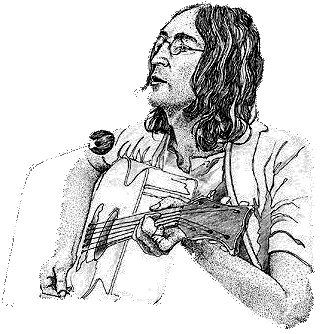 Among my personal store of mnemonic devices is the December 8, 1980 murder of John Lennon, on the day I turned fifteen. Henceforth I’ve had many an occasion to answer the question When is your birthday? with the response “On the day everyone is talking about the death of John Lennon.”
John Winston Lennon was born seventy years ago this week, but he is among those — John F. Kennedy is another — for whom the preponderance of their remembrance concerns the character and circumstances of their death rather than either their birth or life. This is not to say that the latter are overlooked or under-regarded. I know that the mourning and mythologizing were well underway on December the ninth, and that both were founded upon the conviction that the world had lost a man of peace as well as of artistic genius. The reputation of peace-maker was already by 1980 an anachronism, fed in infancy on the gruel of sentiment and then sustained only by easy nostalgia and the familiar convention of celebrity worship. The usefulness of the Lennon myth would increase for many who carried on and who thereby experienced with distress the fierce repudiation of the 1960s, first ascendant in the Reagan and Thatcher administrations, and through which we are still living. Continue reading John Lennon
Good Things, Bad Things, and the Ayodhya Dispute
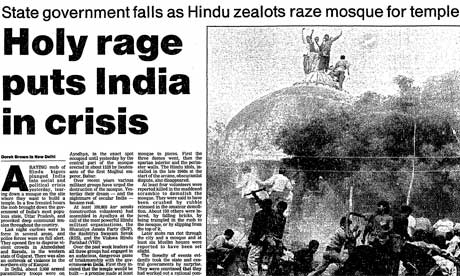
WHEN KARAN JOHAR’S excellent film, My Name Is Khan, was released worldwide this past January, the Hindu right-wing nationalist group Shiv Sena attempted a disgraceful and ultimately failed boycott. At the centre of this meddling was the film’s lead actor and owner of the Kolkata Knight Riders, Shahrukh Khan, who had recently said “Mumbai belongs to all Indians” and had supported the inclusion of Pakistani cricketers on the eight teams of the Indian Premier League. Due however to the IPL’s fears that Visas would be denied following the 2008 Mumbai terrorist attacks (the work of SIMI and Lashkar-e-Toiba, who today jointly operate as Indian Mujahideen), no Pakistani cricket players were chosen. Continue reading Good Things, Bad Things, and the Ayodhya Dispute
Gun Talk, Stephen Harper, and the Usefulness of Hate

On the list of things in which I myself am simply incapable of taking interest, but which appear to invoke a great deal of interest among a great many people — a list which includes Hollywood, professional sport, inspirational best-sellers, Twitter, and Lady Gaga — the issue of gun control is rather near the top. Perhaps I lack an otherwise commonplace enzyme, organ, or bit of DNA. In any case I could not care less about the current long-gun registry debate, and it is only the apparent fact that many could not care more which has my baffled attention. Continue reading Gun Talk, Stephen Harper, and the Usefulness of Hate
Facebook, Narcissism, And A Sociologist For Hire

Soraya Mehdizadeh’s study, “Cyberpsychology, Behavior, and Social Networking,” was cast into the cybersea earlier this month, and media bit the hook. How could they not, baited as it was with the suggestion that Facebook is “a particularly fertile ground for narcissists to self-regulate.” Google the name “York University,” and even before you go to the site, you’ll see a reference to the study, in the search engine’s results listing. You may well have Googled this topic already, Google being the most popular website on the Internet — and the only site, according to many sources, more popular than Facebook. There is however more to be said about the study than Facebook = Narcissism, which in any case is a mis-description. Let’s look a bit deeper into it, shall we. Continue reading Facebook, Narcissism, And A Sociologist For Hire
 Journalism, Essays, Broadcasting, Books
