Category Archives: Canada

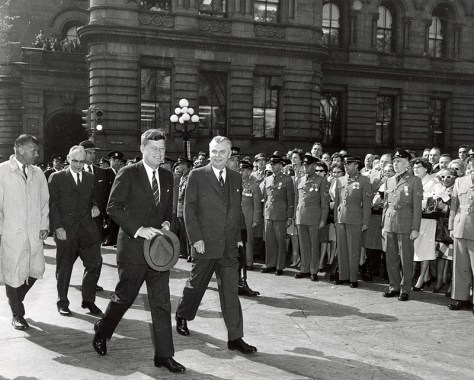
How gaudy baubles and military Keynesiasm gave birth to the F-35

Canada's F-35

A STRAIGHT-SHOOTING bureaucrat will admit that procurement processes are often initiated with the final selection a foregone conclusion. If you know in advance what you need, and you furthermore know who’s most qualified to deliver, then formalities intended to promote transparency and accountability are at best inconveniences to circumnavigate — and every public servant knows well how to steer that ship. That this occurs regularly within the bureaucracy is an open secret.

Read More

If Mulcair can’t hold the NDP’s gains, the merger whispers will begin

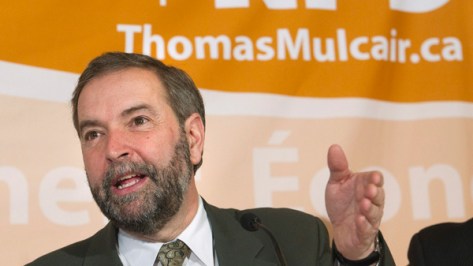
The rise of Thomas Mulcair brings Canada one step closer to a settling of its parliamentary landscape. This former Quebec Liberal, whose one-time boss was a former Progressive Conservative, will henceforth parry with the Liberal interim leader — a former NDPer — and the Conservative Prime Minister, previously of the Canadian Alliance, which not long ago went by the name of the Reform Party.

The preceding highlights the fluid, and in some cases opportunistic, character of recent Canadian politics. Mulcair’s candidacy invoked the familiar weighing of purity against pragmatism, a debate concerning whether one should advance the candidate who can win, rather than the candidate who is authentic. Given that the victor has among his assets deep-pocketed campaign contributors and experience in Quebec and a notoriously combative style, it appears pragmatism has won this time around. Refusing to cut a self-serving deal, Nathan Cullen has won the war of principle by foregoing what the author and politician Nicholas Flood Davin termed, in his 1876 satire The Fair Grit, the “buncombe struggle” — in which contestants “out-vie each other first in professions of purity, and then out-do each other, as far as it is possible, in acts of corruption.” Under Davin’s formulation, “In Opposition all is virtue; in power all the reverse.”

In a slightly modified form this principle, long familiar on the Social-Democrat left, demands of virtue and authenticity the rejection of compromise for the purpose of achieving political power. Considered from the perspective of expedience, however, Mulcair is impressive: a serial first-placer, he is chronologically second only to Phil Edmonston on the list of winning Quebec NDP candidates. (If one puts aside by-elections, Mulcair becomes the first NDP candidate to win a Quebec seat in a general federal election.) Regarding the second criterion, authenticity, there are skeptics and detractors. Judy Rebick asserts that “the NDP has elected an old-style patriarchal politician [who is] more of a liberal than a social democrat and who will move the party to the right, especially on international issues including free trade and Israel, two issues at the centre of Harper’s agenda.” As John Ivison notices, [“Thomas Mulcair’s challenge is to prove he is no political opportunist”] and Rebick discloses, Mulcair must now navigate a sea roughened not only by external challenges, but by internal rivalries and hostilities.

But let’s return to the theme of fluidity. I was in the East Block office of Senator Di Nino, and in the course of our conversation he produced a framed copy of the December 2003 voting card sealing the Progressive Conservative – Canadian Reform Conservative Alliance merger, signed by all involved. The Senator’s recollections made me mindful of how far, and in such short time, the Reform Party came from being an amateurish western grievance club (my wording, not his) to forming the Government of Canada. Along the way, the movement got a makeover — think Preston Manning — and learned to speak in a language comprehensible east of Winnipeg. In other words, another case of purity yielding somewhat to pragmatism, to the inevitable disappointment of some. Imagine where conservatives would be today, if their representation was parceled amongst two or three inter-warring parties.

Observers have been tempted to recommend a similar effort on the left, thereby forging a united opposition to the Conservatives. While there are no indications that a discussion along these lines has occurred, or even will occur, the NDP shall now be forced to divert precious resources into a fight with the Liberals for dominance. Bob Rae’s provincial record, brought fresh to the mind in recent attack ads, arguably makes him appear “more NDP” than the NDP. In any case, you must have noticed how similar is the diction of Mr. Rae to that of the Occupy movement, which is a tactical inconvenience if you are Mr. Mulcair. Should both remain long in leadership, there will hardly be an environmental niche sufficient to nourish them: something must give way. The New Democrats are well positioned to seize the Liberal party’s traditional ideological niche, just as they’ve occupied their traditional seats in Quebec. Mulcair’s chief problem is that the Liberal Party of Canada will soon sort out its internal affairs, and once it has done so it will be back to reclaim its lost territories. The party is too well-monied, too organized, and too much a feature of Canada’s political establishment to be kept down for long. In the short time he has, the NDP leader must apply his attention, not to defeating Harper, but to the long-term goal of holding recent and tenuous gains which the Grits are certain to contest.

If this turns out to be a draining and inconclusive battle, the topic of merger will arise. The ideologically pure will of course have none of it; nonetheless, there are reasons to suspect the years ahead will not be kind to these two parties. In his article, “A budget, a leadership race — and a nation split up the middle,” Andrew Coyne identifies the natural resource industry, demographics, and Quebec separatism as the three “fault lines” of current Canadian politics. Each of these three will doubtless present itself politically as a zero-sum prospect, posing winners against losers and fracturing the country more deeply along regional lines.

To get at the spoils, the parties have positioned themselves accordingly. An intriguing insight of Coyne’s piece is the unpredictable ways in which the politics of regionalism may intersect with the politics of resource extraction and demographics and fiscal federalism. As the loyal opposition, the NDP has an opportunity and a responsibility to take bold stands on these issues. Yet if Coyne is correct, the deepest fault lines are going to run straight through the NDP (and until recently, Liberal) territories. Quebec, for instance, has proven itself to be an especially fickle fair-weather friend. Looking ahead through Coyne’s lens, the political landscape is as fluid as it appears in the backward glance at the beginning of this essay. A sort of political climate change is underway. Interesting times are ahead, and one has to wonder if either the New Democrats or the Liberals are preparing.


Canada still lacks the political will to curb sexual abuse

SHORTLY AFTER the much discussed, and rightly much derided Graham James two-year sentence for sexual assault, I had a conversation with a journalist who is ghost writing the memoir of a sexual abuse survivor. Why, she asked me, do these abusers get such light sentences?

Continue …

The objective economic case against Granny and Gramps

In the days and weeks following Prime Minister Harper’s Davos speech, there’s been ample commentary, provoked by the following:

“As I said earlier, one of the backdrops for my concerns is Canada’s aging population. If not addressed promptly this has the capacity to undermine Canada’s economic position and, for that matter that of all western nations, well beyond the current economic crises. Immigration does help us address that and will even more so in the future. Our demographics also constitute a threat to the social programs and services that Canadians cherish. For this reason, we will be taking measures in the coming months. Not just to return to a balanced budget in the medium term, but also to ensure the sustainability of our social programs and fiscal position over the next generation. We have already taken steps to limit the growth of our health care spending over that period. We must do the same for our retirement income system.”

To some ears this prefigured a budgetary assault on grandma and grandpa, the spiteful Harperites ready to press every layabout 65 to 67- year-old into forced labour, for the greater good. Kevin Page, the parliamentary budget officer, was sufficiently stirred to report that It’s All Good, People. According to his math, the cost of Canada’s pension system will indeed rise, from the present 2.2% of GDP to 3.2% in 2036-37. Even further down the road, about seventy years ahead, costs will return to current levels. The reason, as any fool could guess, is purely demographic: there are today proportionally more old people — the baby boomers — than there are going to be in the next couple generations. Any balancing of this will probably have to be made up through immigration levels, birth rates being unlikely soon to change.

If you read Harper’s Davos speech, you’ll see it’s all there: the changing demographics, immigration, the need for reform. Even the fiscal soundness of the pension system is affirmed. The fortunate thing about demographics is that you can make decent predictions decades ahead. A big whack of young people today is a big whack of retirees in future. The Prime Minister has only said what demographers well know. Yet for some reason folks are bracing for the pension sky to fall, even though the Prime Minister acknowledges the fiscal soundness of the system and polls show overwhelming public resistance to OAS reform. Curiouser and curiouser.

Reading about this issue I was reminded of the first Canadian universal welfare program, the so-called “baby bonus.” Introduced after the Second World War, this modest monthly stipend was designed to encourage and assist anxious young families in the years following war and economic depression. I well recall my mother’s occasional references to this state allowance, when the topic of the family budget would come up. To be sure, that was a different time — but the baby bonus and the OAS are I think connected in several respects. Both are inherently matters of demographics, and both derive from the egalitarian logic of a previous era, the universality of social programs and benefits partaking of an “all in the same boat” ethic which itself followed logically from the collective sacrifices and efforts of the war.

After a generation, the seams of that wartime and depression ethic were giving way. One of the most vigorous attacks on universality, specifically in relation to senior benefits, was penned in the U.S. by the British journalist Henry Fairlie. In a 1988 New Republic piece called “Talkin’ ‘Bout My Generation,” Fairlie attacked the powerful retiree lobby and outlined the case for means testing and needs-based benefits. He was probably right to do so, the American entitlement system having uncoupled itself from fiscal logic. A similar discussion has yet to occur in Canada, for both fiscal and political reasons. Fortunately for Canadians, pension policy appears so far to have been informed less by the American-styled politics of interest group pressure and vote-seeking and more by objective economic analysis. That’s how it should stay.

The Non-Solutions of Minister Raitt

I‘VE PUBLISHED academic articles and personal essays and poetry, but a genre into which some of my best effort has gone is the Air Canada Epistolary Vituperation. Last week, in an exercise of covering one’s bases, federal Minister of Labour Lisa Raitt asked the Canada Industrial Relations Board to deliberate the question, Does Air Canada provide an essential service? Anyone who has endured Canadian air travel in the past ten years knows the answer to that one: Air Canada barely provides any services at all, and provides them poorly at that. Hence my letters of complaint at their evident indifference and inattention to customers. (I once received a boilerplate response which proved my point in the first sentence — it began, “Dear Mrs. Spear … .” )

Read More

Tories insult veterans by defending Rob Anders, serial buffoon

Rob Anders

SURVEYING the decade and-a-half career of the Member of Parliament, Rob Anders, I become the zazillionth person to note this Member’s principled objection in 2001 to making Nelson Mandela (by his measure a terrorist and Communist) an honourary Canadian citizen. By all means, debate the tactics of the ANC amongst yourself. In more recent times the riding news section of his personal website has been rather thin, not much by way of accomplishment or effort having been reported since last June. Other than his work of defunding the CBC and rebuking the Communist regime of China — in this latter effort, he and I have something in common — Mr. Anders’s CV is notably light. In the past year he has earned headlines by falling asleep twice on the job, something he tells us is the result of a car accident.

In February, Rob Anders arrived late to a Halifax meeting with war veterans who had assembled to inform the government about homelessness and emotional unwellness among former Canadian soldiers. I’ve met and on several occasions corresponded with the one-time Canadian Lieutenant-General and present Canadian Senator, Romeo Dellaire, and from this extraordinary man I’ve learned about the reality of war and trauma and post-traumatic stress disorder as well as the many other sordid human outcomes of organized human slaughter. When people who have seen combat in Rwanda and Bosnia and Afghanistan and other such hellish places speak, it is as a general rule a time to pay attention. Mr. Anders, unfortunately, fell asleep. And when his audience and government colleagues confirmed that this was so, Mr. Anders tumbled into attack mode and tossed about paranoid and bigoted insults.

Rob Anders has been a back bencher embarrassment for over a decade now. The Conservative Party of Canada has been careful to keep him ensconced, a media-proof fence around him. Anders’s longevity appears to be principally the effect of Albertans’ sincere and bone-deep anti-Liberalism, and I suspect many conservative Calgarians would happily vote for less cockeyed and more effective representatives, if only Ottawa would allow them that option. For reasons unknown, however, the party has actively suppressed Conservative challenges to Anders, making of him a sure and comfortable candidate. A shame, that. The man is a mediocrity and, for many a Conservative voter, a hold-your-nose lesser evil. Now there’s an effort afoot to empty his Standing Committee on Veteran Affairs seat for occupation by someone who brings an active interest to the job. Amen.

By way of parting, I leave you with an observation. In February 2012, Rob Anders arrived quite late to a meeting and promptly fell asleep during a discussion of homeless veterans. In November 2011, he fell asleep in the House of Commons during a discussion of inadequate housing in Attawapiskat. In July 2011, compelled by his job to read a government announcement on funding for affordable housing, Anders registered his irritation at this federal initiative. He attached an “I’m Supportin’ Morton” button to his lapel (Morton was a Calgary politician running in a local race), and informed his audience that he would utter a catchphrase each time his speech contained something with which he was “uncomfortable.” You’d have to admire this sticking it to the boss, if it weren’t so pitiful and childish and passive-aggressive. He lacks even the courage of his convictions. After this week’s antics, Mr. Anders’s credibility is paper thin. Perhaps he should yield his committee seat to someone with demonstrated interest in, and appreciation of, the needs of Canada’s war veterans. They deserve it.

Why Michael Sona will go down alone for the robocall scandal

LAST WEEK, Liberal leader Bob Rae warned that the federal political culture of Canada is ‘entering into a kind of Nixonian moment.’ This all-thumbs assertion lacks definite substance and grip — we’re in a kind of like, you know, moment thing — but has its use. For almost a year we’ve known of the Robocall mess, media reports having been issued since election day. Now the plot, and the rot, thicken. Here I refer to the top-shelf work of Stephen Maher and Glen McGregor of Postmedia News, under our present analogy the Bob Woodward and Carl Bernstein of this vote suppression scandal. Reviewing the evidence they’ve patiently assembled, can you now doubt a wide and active campaign of fraud in the 2011 election?

Read More

Teach Canadians the history of residential schools

CANADA’S TRUTH and Reconciliation Commission has received a dab of media attention, much of it for regrettable reasons. In October 2008, the TRC Chair Justice Harry LaForme resigned, citing the political interference of the Assembly of First Nations and the insubordination of his (AFN-appointed) co-commissioners, Claudette Dumont-Smith and Jane Brewin Morley. This inauspicious beginning yielded to inauspicious mid-points, the Canadian franchise of the TRC brand-name drawing attention for delays and the bureaucratic impediments which hindered its progress. The messenger aside, what about the message? On the final day of a three-day AFN National Justice Forum, in Vancouver, the Commission has been scheduled to release an Interim Report.

Read More

What Getting Tough on Crime is Really About

IT’S NOT EXACTLY courage-forming to see the ideologues of the Conservative Party of Canada once again lining up for a one-way ticket —  this expense to be drawn from the public purses of the provinces and territories — to the fantasy island of Getting Tough on Crime. By my count this is at least the third and maybe the fourth attempt to enact mandatory minimum legislation, previous bills having been put to rest (as often occurs) at the end of a parliamentary session.

Read More

The Keystone Kops and the Kase for Ethical Oil

I WAS AT the infamous Portage and Main intersection of Winnipeg when I learned yesterday of US President Barack Obama’s disingenuous move to decline the Keystone XL pipeline proposal. Standing in the open air of that corner on a January morning, my only resolve was to get out of the elements and into some environment under the influence of burning fossil fuel. A current project of our species however must be to find alternatives not only to the organic muck, but this other muck of the propagandist in which we are all now thickly coated.

Read More

The Once and Future Liberal Party of Canada

A FEW DAYS to the weekend’s Liberal policy convention, I had a conversation with the former deputy prime minister of Canada at his Ottawa home. Most of it a trip down memory lane (Herb Gray, now 80, holds the record for longest-serving Canadian MP and has a long lane indeed), we covered topics ranging from Indian residential schools to the Polish city of Lublin, only at the end turning our attention to the future of the Liberal party of Canada.

Read More

Watch Yourself, Canada

SpyABOVE THE fold of October 4th’s Globe and Mail there was featured a piece by the fine journalist Steven Chase, “Military intelligence unit keeps watch on native groups.” A more candid and accurate phrasing (Chase, not a writer given to mealy-mouthing, is not responsible for the headline) would be “Canada is spying on indigenous people.”
Read More

The Harper Government: Merchants of Death

LOOK OUT the window of my Elgin and Albert Streets office, one block south of Parliament Hill in Canada’s Capital, and you will see before you a building in part reduced to rubble. The reason is that this Government of Canada edifice contains asbestos, or as it is now more commonly known, chrysotile. Across the city and the nation, this poisonous stuff is being extirpated. And, at the same time, the current Prime Minister of Canada is actively abroad promoting its sale, in what are euphemistically termed developing countries. If that in itself is of insufficient force to turn your stomach, please do yourself the favour of reading on, for there’s more.

Continue reading The Harper Government: Merchants of Death

John Baird Raises His Red Lantern

It appears (to me at least) that the Foreign Affairs Minister, John Baird, is learning about the world and its localized histories in public and in real-time. On the first of June, he admitted as much to Canadian Press journalist Bruce Cheadle, saying he was “hazy on the history of the Israeli-Palestinian conflict.”

Continue reading John Baird Raises His Red Lantern