Category Archives: History

Commemorating The War of 1812

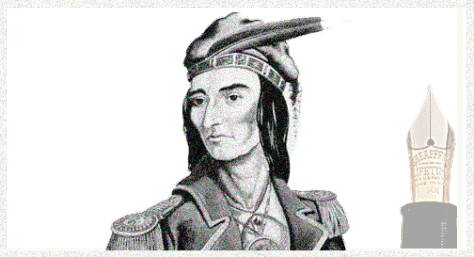
THERE IS a debate these days in the Canadian media over the Harper Government decision to spend a yet-undetermined sum (I’ve come across an amount of twelve or-so million dollars) commemorating the War of 1812. I expect the Americans will overlook this bit of their history, but I’m unable to imagine any Canadian government ignoring the two-hundred-year anniversary of a war that could have converted Upper and Lower Canada into the coldest states of the Union.

Read More

Class Warfare Comes Home

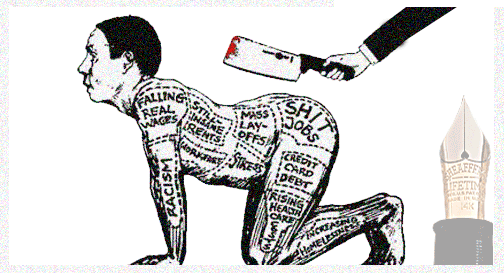
OF THE MANY, tedious American delusions, perhaps the most insistent and counter-factual materialist superstition is the daft creed that America is a classless society. How useful then for so many citizens to chuck this nonsense and have at it in the open October air, and in the precise manner that Karl Marx identified as the very engine of historical development: the struggle between the haves and the have-nots. Or, as the Wall Street Occupation puts it, the struggle of the ninety-nine have-not percent against the has-it one.

Read More

Britain and the Illegitimacy of Fascism


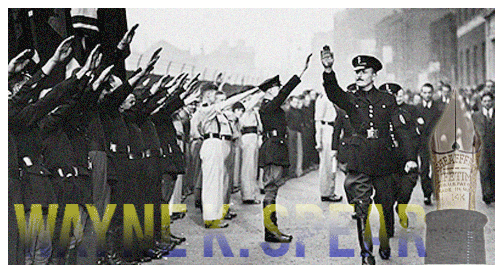
REVISIONIST CLAIMS of a website dedicated to the British fascist and politician Sir Oswald Mosley bring to mind the expression “damned with faint praise.” This, for example, cited from the historian A. J. P. Taylor: “He was never anti-Semitic — only opposed to a Second World War for the sake of Jews elsewhere. He was never unpatriotic — only indifferent to German conquests in eastern Europe … A superb political thinker, the best of our age.”

READ MORE

“Caravaggio and His Followers in Rome”

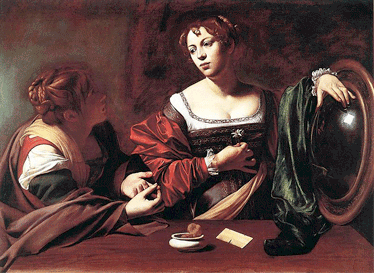
“Martha and Mary Magdalene”

IF MICHELANGELO Merisi da Caravaggio, known today simply as Caravaggio, were our contemporary, he would be often in the news. Violent, captious, cruel, and reckless, he was notorious even by the standards of late 16th-Century Rome. A good source on the Italian capital circa 1600 is John L. Varriano’s “Caravaggio: the art of realism,” which catalogues “a level of sadism that would be shocking in any age.” But to give you an idea of the sort of man Caravaggio was, I can think of nothing better than to cite his flirtation with the Knights of Malta, who soon having deemed the painter “foul and rotten” expelled him from their ranks.

Continue reading “Caravaggio and His Followers in Rome”

19th Century British Photographs

A year ago I took in the National Gallery of Canada exhibit “19th-Century French Photographs,” and today I took in the British equivalent, which of course is designated “19th-Century British Photographs.”

The King’s Speech and The Revenge of Metaphor

King George VI

it is difficult to go on believing in the essentially conservative idea of nobility when you have regarded the dripping underpants of the Prince hanging upon the line

✎  WAYNE K. SPEAR | DECEMBER 29, 2010 • Film

T

HERE WAS A remarkable showing of blue in the theatre this week when I saw The King’s Speech, which is why I begin with remarking it. It indicates that most of this audience would have been alive in 1936, when Albert Frederick Arthur George Windsor assumed the throne of the United Kingdom, just abdicated by his brother, thereby becoming King George VI. Continue reading The King’s Speech and The Revenge of Metaphor

Why the US Should Not Apologize for the Bombings of Hiroshima and Nagasaki

Looking backwards at the savagery, at the irrational and disgusting business of industrial murder which was World War Two, it seems a fool’s errand to sort out the matter of guilt and innocence in any manner which nicely assigns positive moral value to what happened between the years 1939-1945. There is never an honourable soldier and never a good war: war is a positive evil which makes everyone, and everything, dirty. So surely the legacy of the August 1945 bombings of Hiroshima and Nagasaki ought to be universal commitment to the denuclearization of our world.

The call for an American apology for these acts of mass killing may seem on its surface reasonable enough, but to apologize would be to engage in hypocrisy and would misrepresent both history and current attitudes in the United States. Many of the Americans who would have been there far from feeling apologetic after the war were thankful. (A good and representative example is Paul Fussell’s essay, “Thank God for the Atom Bomb.”) The simple fact of the August 6 and 9 murders is that the war was brought to an immediate end, preventing the certain deaths of many hundreds of thousands who would have been compelled to fight on land in a gruesome and bloodied exercise of attrition. Nor should we forget by whom they would have been compelled — specifically, the Emperor Showa, who, claiming himself to be an arahitogami (god), lived in extreme comfort on his massive conclave-estate while forcefully urging upon his subjects the honour of suicide. His defeat and displacement made possible a democratic and prosperous Japan, and though it is not today fashionable to say so, often only violence (or the credible threat of violence) can accomplish the fascism-to-democracy transformation. If you wish to blame someone for the death and misery which follow from this vile truism, let me recommend the fascists.

In my opinion it is one of the principal shames of the post-war period that the Emperor was allowed to keep his material possessions and to avoid facing prosecution as a war criminal, particularly for his sanctioning of the 1937 invasion of China and the depravity which thereby ensued. General MacArthur appears to have thought him useful as a stabilizing presence during the post-war occupation, and it may be that the Allies wished to avoid imposing the humiliating terms of the previous war, resentments over which abetted the successes of militarist regimes. The Emperor appears in retrospect to have cultivated the notion that decisions were made by the gozen kaigi, or Imperial Conference, and that he himself was a mere figurehead — a fiction which would perhaps have been credible.

This is speculation. What is certain is that the Emperor Showa exploited all the Twentieth Century signature barbarisms, which is to say fascism, religious fanaticism, and militaristic nationalism. A self-aggrandizing god when it suited him, or a mere mortal figurehead on a walkabout with foreign heads of state — when that had become the ticket — the man for many years was as deadly for the Japanese as any bomb. Yet he was allowed to enjoy a long and privileged life, during which no apology ever came from his lips.