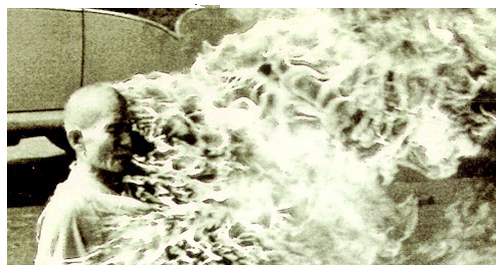
I‘LL WAGER that you weren’t informed of it by the media, but it happens that yesterday was the Global Day of Action undertaken by the International Campaign for Tibet. I was on Parliament Hill in Ottawa when a large crowd assembled and marched down Elgin Street in a desperate effort to raise awareness here in Canada of China’s official policy of slow-motion genocide.
Tag Archives: Ottawa
Remembering Jack Layton: 1950-2011
I WAS INFORMED of the death earlier this morning of Federal New Democratic Party leader, Jack Layton, by Twitter. There, in an uninterrupted chain of entries numbering in the dozens (and perhaps into the hundreds: I gave up counting) were expressions of sorrow. Never have I seen such universalism of sentiment, such spontaneous participation in a mood which appears to have touched everyone, really everyone, down to a person.
A Faggot On The Alexandra Bridge
I’m not one given to the media fetish of the Ten (or One or Twenty or …) Years Ago Today. We knew, for instance, there would be a gush at the moment Michael Jackson had been dead for precisely three hundred and sixty-five days. It’s an arbitrary and meaningless trope, a cheap hook on which to hang a cheap rag.
However, there are some anniversaries that are with me throughout the year — one of them being the 1989 murder of Alain Brosseau. This then thirty-three year-old man worked in downtown Ottawa and lived in Hull, which necessitated a crossing after each shift of the Alexandra Bridge. On August 21 he was attacked by a group of men, who dropped him head-first from the bridge onto the rocks below, resulting in his death. The piece of information considered essential in this senseless incident is that Mr Brosseau’s attackers killed him because they assumed — wrongly — he was gay.
On the twentieth anniversary of this vile act, civilians and the Ottawa and Gatineau Chiefs of Police met at the middle of the Alexandra bridge at dusk in a symbolic “lighting” of the bridge with flashlights. The idea was to represent a commitment to ensuring “gay-bashing” does not go unreported or unnoticed.
It’s an important commitment, and worth renewing. But of course it won’t and cannot prevent future attacks. Only a three-hundred and sixty-five effort toward discrediting and finally extirpating homophobia will do that. The lesson taken away by many from the murder of Alain Brosseau is that “it can happen to anyone.” I’ve always felt this both hit and missed the target. What if it could only happen to one in ten? Would that make it okay, or less urgent, if your name weren’t on the list of those Not Wanted On The Voyage? In that case you are complicit in the crime — another bystander who allowed it to happen.
I’d prefer to stand in solidarity; and as it happened on my way to work today, crossing the Alexandra Bridge (as I do each day), I was called a faggot by three drunken and menacing-looking men. Apparently it can happen to anyone. But even if it couldn’t happen to “just anyone,” it should never happen. We still have a lot of work to do.
Ottawa — Random Notes Toward A Portrait
It perhaps goes without needing to be said that persons born and raised here find it to be an exemplary place. The “native Ottawan” boasts of the beauty, quiet, decency, and niceness of the place. And it is true that Ottawa is nice, in the manner that your East Side Mario’s waiter is nice — that is, in a formal and superficial sense. But you understand his niceness is not connected to his being your friend, and you know also that it is part of an effort to extract from you the largest payment possible. In much the same way, Ottawa is a place where form, process, procedure, and placement have become all-encompassing cultural imperatives. Here one finds politics in its largest sense fully domesticated, so that the business of politics itself is the business of the family and of the society, with the attendant result that the attitudes and outlook of the bureaucrat come uppermost in all that takes place.
Ottawa is perhaps the only place in Canada in which you will observe the individual who truly and deeply believes in the concept of “public service” (Ottawa may be they only place in Canada where the public service is a concept, and not the inevitable occasion of a joke or slander), and who labours in earnestness on behalf of that notion. Elsewhere in the country, as anyone knows, one abundantly finds the prejudice that bureaucrats are lazy and over-fed, and are at bottom cynical parasites who do no work and reap enormous material benefits at the expense of everyone else. This is not true, and yet Ottawa is correctly associated with the bureaucratic outlook. Here, it is believed by many employees that Government is engaged in important, meaningful, and even noble work. But note that in Ottawa when one speaks of Government in this fashion, it is the public service, or bureaucracy, which is meant.
Here is a rough and quickly made list of word associations which came off the top of my head, but which I think define Ottawa: bilingualism, French, Government, tourism, the National Capital Commission, museums, politics, national symbols, conservative, Toronto (against), NGOs, protest industry.
The list, which I did not edit and which therefore came out as above, is telling. For instance, so much of Ottawa is determined by two things, government and tourism. It may not be apparent at first, but when one considers the role of the federal government in language and language politics, buildings, uses of property, the cycle of public events, the economy, as well as of the presence of professional lobbyists and “protestors,” there is very little that remains untouched. If it weren’t for the cash-cow tourism, Ottawa would be a whiter Brampton — a land of shopping malls, minivans, and the living dead of the middle and upper middle classes. So little that is done here is done for the people of Ottawa. It is instead the sure payoff, in foreign currencies, which drives every effort at lending to the landscape a touch of grace. Also in the list above you will find Toronto, the official dislike of which is very much an Ottawa character trait, and which doubtless has at its root an inferiority complex. As for the term conservative (meaning cautious, boring, parochial, dull, somnambulant, and unimaginative), Ottawa is universally regarded as such, so that it is difficult to get through the day without hearing someone make note of the fact. Even those who argue on its behalf tend to concede the point in advance.
A cluster of sleepy bedroom communities, that is the feel of the place. It became this in the 1950s-1960s and has settled into it without much thought or resistance. Orleans, Gloucester, Kanata, Nepean, Barrhaven, Aylmer, Hull: this and not the downtown, or city proper, are best understood by the term Ottawa. It is a hodge-podge with a transit system that tries to cope but that is not quite up to the modern city standard. It is not uncommon to see the buses go by utterly cloyed with humanity in the mornings. An Ottawa bus is the closest I’ve ever come to a living resemblance of a Daumier print, specifically the desperate, slightly irritated state of being you see in the faces of the passengers in Daumier’s satires. For years we heard about plans to “modernize” this sorry state of affairs, and a good deal of money was thrown at the idea, but with no results. This too seems typical of the place.
Another thing which is remarkable about Ottawa, but is also perfectly natural and understandable, is the presence of bilingual and bicultural Canadians. Ottawa and Cape Breton are perhaps the only places where the vision of official bilingualism has been realized, excepting of course that it hasn’t been a policy which has been “realized” so much as a mere geographical fact. Nowhere else in Canada will you find people who are unable to say whether English of French is their first language. In the National Capital Region the two, French and English, fully bleed one into another. That is, if one has grown up here. Otherwise, one is always and unavoidably defined in their relation to this tedious division.
You might expect politics to be a highly visible affair in Ottawa, but such is not generally the case. Having moved here I found it astonishing how quickly Parliament becomes simply a part of the background, something one takes for granted. There it is: Canada’s capital building, the epicentre of political life. And yet in a matter of weeks I hardly noticed it any more. It may as well have been a hardware store, or a dental therapy clinic. As a piece of architecture it is interesting, but it has none of the status that I imagine it holds for the tourist.
Likewise, Ottawa is not overly a civic city. Politics is somehow everyone’s profession here; either you are one of them (a politician) or you are trying to influence, or oppose, or placate, or replace one of them. In any event, it is probably your job to have some sort of relation to the political affairs of the city, and even the country. Probably nothing is so harmful to civic life as getting paid to mind politics. It changes everything. For one thing, if you have been politically active elsewhere it makes you think differently about what you did before. Here you are, in Ottawa, surrounded by the symbols of wealth and power and the state. I remember seeing a sign affixed by some optimistic rabble-rouser to a pole on Elgin street, several hundred yards from Parliament Hill. Perhaps in Kingston a clever sign could seem subversive, but here it is only silly. Here everyone is too busy making decisions and busying themselves with their affairs to notice what posters are where. Even the activists are up in the office towers.
As for the ideological character of the place, there are too many people here depending on government for a job to allow reactionary sentiments a foothold. Government is an unalterable fact of this city. You may as well take it as a feature of your environment, the way one takes earthquakes in California or demon possession in the New Testament. People here are neither for nor against in any active way, because neither position would seem to make any difference. Interestingly, this is more true of Federal than of local politics, the latter often evoking great acrimony. Mostly this has been due to the recent perceptions of corruption and a high-profile trial of Mayor Larry O’Brien.
Some other stray observations:
Good service is hard to find in the Ottawa restaurants. It is expensive to live here, and the prices have shot up very sharply in only a few years. Partly this is a result of Ottawa’s success. But the place has gentrified now to such a degree it makes one wonder how anyone can afford to live in the city.
While many efforts have been made to make the waterfront useful, even Kingston offers better access for the person wanting to picnic, or just sit, by the water. There are parks west of the downtown, but you will need a car to get to them. The waterfront in the core is mostly occupied by government buildings. There are no beaches. Waterfront access consists mostly of paved avenues where people rollerblade or cycle. A very nice idea, but of little use if you intend to be immobile. Ottawa is a city for people on the move. Only the commercial spaces allow you to park yourself, and very few of these will be found on water.
The bike paths are very good and the transit system, despite its drawbacks, functions well enough, especially outside of rush hour. For all the talk about community, however, there is really no such thing in Ottawa which I have been able to discern. Ottawa is neither like Kingston, a small town with a small town feel, or Toronto, a large city made up of many distinct neighbourhoods. While you may say that the Glebe is a “neighbourhood community,” or that Westboro is a “neighbourhood community” (and so on), in reality they are simply distinct socio-economic groupings. Ottawa in the past decade has undertaken a sort of ruthless shakedown operation in which entire neighbourhoods have been emptied of the working classes and stores up-scaled to suit the tastes of the affluent. A collection of pigeon holes, not communities, and sooner rather than later your place will be sorted out and you will be duly stuffed where your resources determine. In other words, that warm neighbourly feeling you are supposed to get in the Glebe is the graceful charm, not of neighbourliness, but of money.
All of this occurred to me one day as I was walking to work. I found it odd that, even though I walk to work at roughly the same time each morning, I recognise almost no one. You would suppose everyone else is following a routine also. That would mean you would see the same people each day, week after week and month after month. And yet I cannot recognise a familiar face, excepting some of the panhandlers. It is as if every morning an alien spaceship beamed down a new city-full of strangers, having swept away yesterday’s strangers.

Homelessness Considered
Although regarded as extraordinary, homeless persons in general I find are in no way unusual. Every city has them, and it is only because no adequate effort has ever been made to ensure all people have a home. I am unable to say what might constitute an “adequate effort,” except by way of noting that the public’s money would be required, something which would be broadly objectionable, and of course might well end in failure. As I write this, the Ottawa-Carleton government seems to have made no co-ordinated effort to get the homeless out of sight.
I remember some years ago (in 1996) there was a sharp rise in the number of people pan-handling in downtown Kingston. This would have been shortly after the government of Ontario decided to ‘get tough’ on the crime of not having a house in which to live. For a period of about one year you could commonly find someone sleeping on the ground whenever you went into a public building at night – as I did to pick up my mail, for instance, or to get money from the ‘automated teller.’ All of a sudden they were gone (the homeless, I mean.) The Kingston solution, as best as I can infer, was to have people rounded up and sent elsewhere, that is, to other cities and towns with precisely the same attitudes and approach to the problem of homelessness. This practice was widespread enough that the phrase Beggar-thy-neighbour was applied to describe it. I expected something similar of Ottawa, but it may be that the scale of the problem has discouraged the effort. Or perhaps they have not yet got around to it.
In any case, homelessness would be a scandal if people cared. The gut feeling that The poor will always be with us induces resignation even in individuals who are of generous disposition. Then there is the human psychological tendency to see an individual misfortune as tragic, whereas apprehended in large quantities misfortune causes one to numb to the matter. There are so many living on the street that you take it for granted, the way you take for granted the certainty of crowded buses and noise and inconvenience. Anyone who dwells on the shame of it all is likely being hypocritical. There is no doubt that it is a terrible thing to be homeless, but the real obstacle to changing conditions has never been a general absence of pity. The greatest enemy to improvement is the idea that the solutions have all been tried, and look what happened.
What ‘successful’ persons rarely consider – for the thought is unbearable – is how precarious their own existence is. Hardly anyone under thirty-five is able to sustain what is today called a middle-class standard of living without assistance of some sort along the way, typically from family. In my own case, well into my adult years an objective description of my economic status, considering in isolation my income, was that I was poor. A ridiculous notion, for I lacked nothing essential. What stood between me and ruin? One might argue education and talent and effort, but the correct view is that the essential facts all concern good fortune. Even my education, talent, and effort all in the end are matters of circumstance beyond my control. For I had the good fortune to be healthy enough to make an effort, and I had the economic status I needed to get an education, and talent was given to me at birth.
Even to look for work requires an amount of economic security. You cannot improve your lot when your energy is going into the mere animal struggle for body survival. It was pure good fortune that I had a supportive family that could and would keep a roof over my head while I looked for work, and it was pure good fortune that I have the intelligence and skills I need to, as they say, compete in the global economy and succeed in what is after all a ruthless world. From this it follows that the lack of these things is a matter of bad fortune. Probably the chief difference then between a homeless person and a person who has a home is this: the former is alone in the world, and the latter is not. And yet the ‘pick yourself up’ speeches never stop and probably never will, even though they are as out-dated and irrelevant as bootstraps.
Concerning ‘panhandlers’ I’ve made a sort of catalogue of the actual people who you will find in Ottawa asking for change. As a point of fact, I should mention very few actually ask for change, preferring instead the convention of placing a hat or some such receptacle on the sidewalk.
· Two men regularly stand on either side of the Kent Street St Patrick Catholic Church entranceway before and after masses. They are not aggressive, but they appear to be exploiting either Catholic guilt or the vulnerability of worshippers about the time of mass. As a matter of scientific curiosity, I’ve wondered how the church folk measure up to a non-church crowd of passers-by. Does this strategy yield a better return?
· There is a man with a reddish beard at the Bank Street bus stop on Albert who I believe is the happiest man in Ottawa. He smiles at each passer-by and says hello. When I took the bus in from Nepean I got out of the bus early, at Bank, just to say hello to him. (It’s probably also relevant that to me he looks like a leprechaun.)
· On O’Connor Street, in front of the Druxy’s delicatessen, a man gives out photocopied newsletters which I presume he himself has made. They are full of odd bits and pieces of information. The last I read was about Schizophrenia. Sometimes he produces muck-raking articles on the government.
· There is a man with two dogs at the corner of Metcalfe and Albert. This is the busiest downtown intersection because all westbound buses stop here at all hours of the day. Many people take the time to talk to this man. He must have some clout to have got this corner.
· A man stands in front of the Ottawa public library with his cap in hand. He has very sad eyes. He reminds me of someone, but I don’t know who. In my imagination I see him dressed for winter. All you can see are his eyes.
I could go on, but you will already have noticed how innocuous, even banal, these descriptions are. These folks seem to have a routine from which they appear hardly to deviate, and most of them are no more aggressive than a lamp post. I’ve no doubt I am in danger only of the aggression of the ‘gainfully employed,’ and since I was nearly run over by one of them recently I can say this without irony.
As far as the style of panhandling goes, there are, as I’ve suggested, certain conventions. Some hold a cup, others put a newspaper on the pavement. Some make eye contact as you pass, others do not. But the principal convention of panhandling is the cap, apparel’s lowest common denominator and the contemporary symbol of Everyman. It is the chief tool of the trade. And panhandling is a trade, something done each day with the same inevitableness of rising for the office job. The principal difference is that the office of a homeless person affords no amenities, even of the most basic character.
As for the idea that a little job training will help … an intelligent person ought to question this idea. Job training for the homeless? Without a proper residence, everything else is near impossible. And while a job seems like the common sense route to a house, you’ve got to have a shower, some decent sleep, and a meal to undertake the considerable task of finding work. Homelessness sweeps away the foundation one needs for a ‘normal’ life to take shape. And in the case of panhandlers often mental problems are involved as well.
I know I am dwelling on this, but it’s only because I sometimes feel the needless, active stupidity of people is rather too much to take. You can hardly get away from the self-congratulation over the ‘new economy’ long enough to suggest some very old things are still with us, and in growing measure. [- December 2000]