At the mall today I noticed a shop employee dressed in what I could only describe as beach wear. This I noted some years ago to be a trend, the putting on of flip-flops and short shorts and tank tops for an on-concrete walkabout. It may merely be the return of beach weather, but whatever it is I have had the ritual on the mind for a while now. Allow me to pull my white cotton pants over my nipples as I settle into the plush rocker to address the under-thirty crowd assembled at my feet — for today I shall talk about the lost pastime of going to the beach.
All posts by Wayne K. Spear
So What If Quebec Separates?
In an astute article of today’s (April 23) National Post, “Liberal remedy to Layton is to look in the mirror,” Kelly McParland writes,
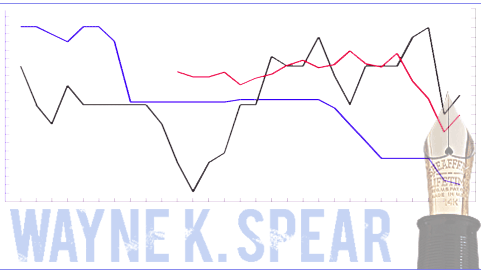
In 21 elections between 1921 and 1993, when the Liberals won it was because of Quebec. They took the overwhelming majority of Quebec seats in every winning campaign, and only once were they popular enough in the rest of the country to have won without Quebec (and even then, in 1935, it would have been iffy). The Liberal party was about keeping Quebec happy; that’s where power lay. It all changed when the Bloc Quebecois came along and stole their meal ticket. Since 1993, when the Liberals win it’s because of Ontario, yet the party has never put the effort into pleasing Ontario that it did into Quebec.
The Sponsorship Scandal Still Matters
One of the very few politically insignificant legacies of the Sponsorship Scandal is that ever since I have been of a sympathetic disposition toward the then Minister of Human Resources Development, Jane Stewart. She more than any politician — and here I include Paul Martin, who clearly was designated by the early-retiring Jean Chrétien as the bag holder — was bespattered by the ill-will which finally brought to an end what seemed the inevitability of Liberal rule in Canada.
Bill Hicks and the Comedy of Wishing Things Were Otherwise
Autopoetics
Autopoetics: Autobiographical Representations of the Indian and the Making of the Self [the following is an introduction to my Ph.D. Thesis. See also the entries on this site for Eleanor Brass, Maria Campbell, and James Tyman.]
AUTOBIOGRAPHY, BIOGRAPHY AND THE DEATH OF THE SUBJECT
Philippe Lejeune has called the discourse of subjectivity “the myth of our civilization.” The demise of this discourse, among a number of academics at least, seems all but complete. The work of Roland Barthes and Michel Foucault has determined that the death of the subject is a matter almost of common sense among many (see, for instance, Foucault, “What is an Author?”, Roland Barthes, Roland Barthes par Roland Barthes, Derrida “Structure, Sign and Play in the Discourse of the Human Sciences”, Jacques Lacan, “The Agency of the Letter in the Unconscious or Reason Since Freud”.) However, there are theorists who are critical of postructuralist proclamations that the subject is dead, or that human agency is a fiction discursively produced. Leigh Gilmore reminds us that “it has been a crucial insight of many feminisms that it is a good deal easier to abandon yourself to disappearance and Nietzschean death if you already dominate all you survey. This insight is instructive, and yet among theorists of autobiography and biography, feminist or otherwise, there is no agreement over the question Does the “myth of our civilization” bear any political utility? Leigh Gilmore asserts that “writing an autobiography can be a political act because it asserts a right to speak rather than be spoken for,” and argues also that “politics is conceivable without a foundational subject”:
The Lost Art Of Penmanship

As I recall it now, the awards day was for all of us gathered in the school’s auditorium a day of anticipation as well as of obligatory observance. In my case it needn’t be a matter of suspense: indifferent, distracted, and, above all else, bored, I was the worst of students. Each and every year toward the end of the proceedings I received the brown and gold felt badge in the category designated for those of us who in reality had earned no prize. I am speaking of course of the award for Penmanship.
C.D. Howe And The Three-Point Tempest
This week the election campaign delivered another manufactured controversy in which Canadians will take no interest: should the level of corporate taxes be 15%, or 18%?
19th Century British Photographs
A year ago I took in the National Gallery of Canada exhibit “19th-Century French Photographs,” and today I took in the British equivalent, which of course is designated “19th-Century British Photographs.”The Sundae And The Mere Production Of Happiness
In his best-known satire of 1726, Jonathan Swift confects a historical account of the “civil commotions” which have claimed eleven thousand Lilliputian and Blefescusian lives and at the centre of which stands the deadly matter of the end, big or little, at which an egg is to be broken. The passage, which casts a withering gaze over English religious history from the time of Henry VIII forward, merits a generous citation:
Continue reading The Sundae And The Mere Production Of Happiness
Is Fox News Coming To Canada?
We all knew someone was going to say it, but how appropriate that it was Toronto Mayor Rob Ford and on April Fool’s day.
News networks remain an integral part of the information and communication age, bringing audiences a fair and balanced view of the world around us. The official launch of Sun News Network in Toronto is a wonderful addition of another network offering high quality and distinctive local content. We welcome you to Toronto and we wish you much success.
The People Versus The Minister of Nothing
Notes On Adulthood In A Time Of Stress
The day that my son was born, I knew I’d passed irreversibly beneath the lintel demarcating the antechamber of my as it then seemed trivial youth from the salon of for-keeps adulthood. I expected as much. What I did not anticipate was the arresting shock of the first time staring into the depths of a mortgage amortization table, the reckoning with the fact that you are now a name and number in someone’s file, and that this constitutes a bond backed up by the full force of the state. What was I thinking, marching willfully into this arrangement?
The Haudenosaunee | Part Three, That Which Divides Us
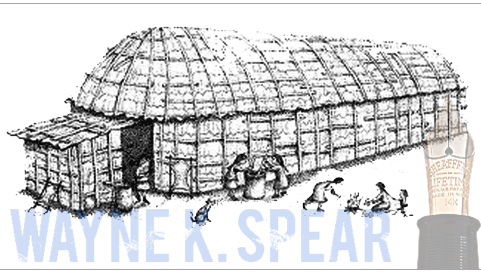
The history of the Haudenosaunee (the people who are building a longhouse) is one of unceasing challenges, from without but often also from within. It was no foregone conclusion that the eventual five constituting nations of the “Iroquois League” would accede to the Peacemaker’s vision of unity. Suspicion and hostility posed an enormous impediment to the cause of peace. The impediment obtains to this day.
Continue reading The Haudenosaunee | Part Three, That Which Divides Us
Remembering Rick Martin
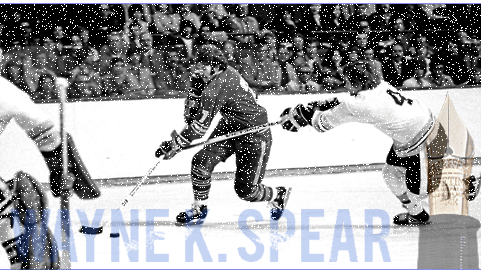
It’s odd what one recalls years after — the expression of a face, a sound, words spoken which at the time seemed of no special importance. I remember the smell of the glossy hockey programs sold in the 1970s and 1980s at the Buffalo Memorial Auditorium. For some years my uncle Mark held seasons tickets, and together we watched a number of games. But of course everyone with a connection to the French Connection will recall above everything else the 1975 Stanley Cup final, the Buffalo Sabres versus the Philadelphia Flyers. I watched those games in the bedroom of my grandparents’ Fort Erie house where my father had grown up, and I can recall with great clarity the bats and fog which constitute a good part of Sabres legend.