Category Archives: First Nations

How to Look at Canada’s Indian Residential Schools Archive

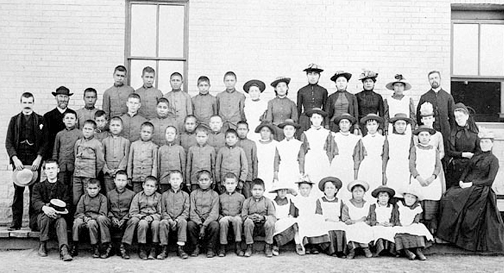
Photo: Rupert’s Land Indian Industrial School / later St. Paul’s Indian Residential School, 1901. Library and Archives Canada PA-182251.
WITH VERY few exceptions, the men and women who created and sustained Canada’s Indian Residential School System believed that the policy of “aggressive assimilation”* was benevolent and forward-looking. The absorption of the Indian into Canadian society, necessary to possess land and resources and to build a nation-state, was the desired outcome of policies and the final solution of the Indian Problem envisioned by Deputy Superintendent General of Indian Affairs, Duncan Campbell Scott. The policy of assimilation neither began nor ended with the Indian Residential School System. The program of assimilation continues to this day, for the simple reason that nation-building, from sea to shining sea, continues.

READ MORE

The Derelict Honourary Chief of the Blood Tribe

It’s been more than a few years now since my afternoon Calgary chat with a Kainai (Blood) acquaintance, but I do remember a bit of the history lesson I received that day. One thing I recall above all else is a sensation of correspondence: the Haudenosaunee have the largest population within Canada’s borders, the Kainai the largest land base; the Haudenosaunee are known to be of an independent cast of mind, so too I gathered from my interlocutor the Kainai. (The name is pronounced “Ken-Eye,” and fittingly means something like Many Chiefs.) I left the conversation that day rather feeling a sense of kinship, which is unusual for me in most any social encounter.

Continue reading The Derelict Honourary Chief of the Blood Tribe

The Missing, Murdered Women

Murdered, Missing Women rally in Ottawa

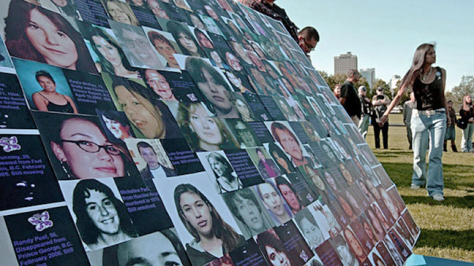
THAT LONG STRIP of the Trans-Canada highway connecting Prince Rupert to Prince George was already well established as a “Highway of Tears” when I drove it in the Summer of 1999, weeks before I moved to Ottawa. Deena Lynn Braem was shortly thereafter added to the list of women, many of them Aboriginal, disappeared and murdered amidst the generalized indifference of Canadians. The trial a few years back of pig-farmer and sexual sadist, Robert Pickton, simply reinforced what those of us paying even a speck of attention already knew: that it was entirely reasonable to assume you could abduct, torture, rape, and dispose of Vancouver’s street women and get away with it.

Continue …

Indian Affairs Gets a Gender Reassignment

I now have unchallengeable objective proof that I’ve lived too long in Ottawa, and it’s this: I caught myself today wondering how the bureaucrats are going to say the new acronym AANDC, the stand-in for Aboriginal Affairs and Northern Development Canada. For over a century, the Department of Indian Affairs and Northern Development (known also as the Department of Indian and Northern Affairs) was Diane or Diand, or even at times Diana. Now I imagine it will be Andy or Andick, both of which lead me unavoidably to the conclusion that gender reassignment has taken place and The Man now really is that.

Continue reading Indian Affairs Gets a Gender Reassignment

The Haudenosaunee | Part Three, That Which Divides Us

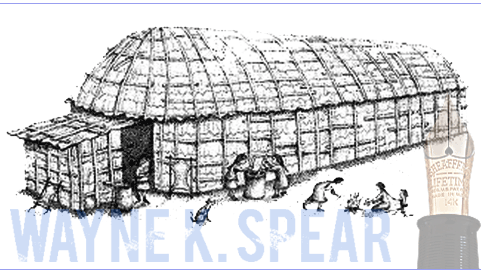
The history of the Haudenosaunee (the people who are building a longhouse) is one of unceasing challenges, from without but often also from within. It was no foregone conclusion that the eventual five constituting nations of the “Iroquois League” would accede to the Peacemaker’s vision of unity. Suspicion and hostility posed an enormous impediment to the cause of peace. The impediment obtains to this day.

Continue reading The Haudenosaunee | Part Three, That Which Divides Us

The Continuing Story Of A Continuing Relationship


There was a time when Aboriginal peoples and Europeans newly-arrived to this land conducted affairs between them with mutual respect. There’s no need to romanticize the character of these relations. It was an era of alliances, political intrigue, war, and nastiness. But even warfare indicates respect. It bears an implicit acknowledgement of a foe’s strength and independence. In the initial phase of contact between Europeans and the indigenous peoples of this land, indigenous peoples had the advantages. They knew how to live on the land and how to navigate the rivers and the forests, and in battle there were more of them. Perhaps this is why mutual respect characterized the early relationship. Continue reading The Continuing Story Of A Continuing Relationship

The Haudenosaunee | Part Two, Ohentonkariwatehkwen

I suggested in the previous instalment of this series that the improbable unity of the Rotinonsion:ni (Iroquois) arrived as a matter of extraordinary good fortune, in combination with great effort and practical necessity. One is well advised not to take such a thing for granted, and so we arrive at the Ohentonkariwatehkwen, or “the words which come before all others,” also known as the Thanksgiving Address. Continue reading The Haudenosaunee | Part Two, Ohentonkariwatehkwen

The Haudenosaunee | Part One, Origins

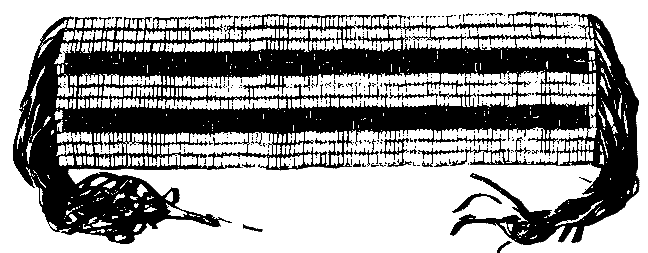
The image above represents the story of the five founding nations of the Haudenosaunee (pronounced ho-din-oh-show-nay and meaning “the people who are building a longhouse”), in English the “League of Nations.”  This graphic is a stylized digital version of the original Peacemaker belt, a wampum belt made of the purple and white quahog shell, strung onto thread of sinew or plant fibre. There is an enormous amount of information stored in this belt, so let’s begin the story. Continue reading The Haudenosaunee | Part One, Origins

Chief Shirley Clarke, brought to you by the Indian Act

You may not be aware, so allow me to begin this discourse by mentioning that Glooscap is the name of a Trickster figure, that curious mythical creature who is part fool, part teacher, and in composition an improbable union of the human and supernatural realms. One is well advised to pay close attention to the Trickster, even if only for the reason that something is certain to be revealed. Continue reading Chief Shirley Clarke, brought to you by the Indian Act

The Haudenosaunee

Over the coming weeks, I shall be writing a series of articles concerning the Haudenosaunee, known also by the English renderings, “People of the Longhouse” or the “Six Nations Confederacy,” and by the derogatory Huron term rendered in French as “the Iroquois.” As I am myself a citizen of the Haudenosaunee, I will begin the series with some historical considerations written from my personal point-of-view. Along the way I will present something approaching a narrative of the Haudenosaunee, the intentions of which will be: Continue reading The Haudenosaunee

Jake Swamp, A Man of Roots

Jake SwampJake Swamp, 1941-2010


I didn’t know Jake Swamp, but as the saying goes I knew of him. Few are the Kanienkehaka who don’t. Or rather — I must get used to this now — didn’t. This morning I was informed of his passing, in the very early hours of Friday, October 15.

Tekaronianeken, or Jake Swamp as he was commonly known, was born at Akwesasne in 1941. He was of the generation born under the old dispensation of colonial shame but arriving to the 1960s and ’70s with a sense of purpose and a strong, proud voice. As a young man, he had been taught by Christian priests in St. Regis to consider the Longhouse a Pagan menace. So often the case with the Haudenosaunee (“People of the Longhouse”), a woman made short work of that. His wife Judy gradually brought him around, and so one year during Strawberry Festival time he went to the Longhouse and listened, out of curiosity. That decision changed his life. Continue reading Jake Swamp, A Man of Roots

The High Arctic Relocation

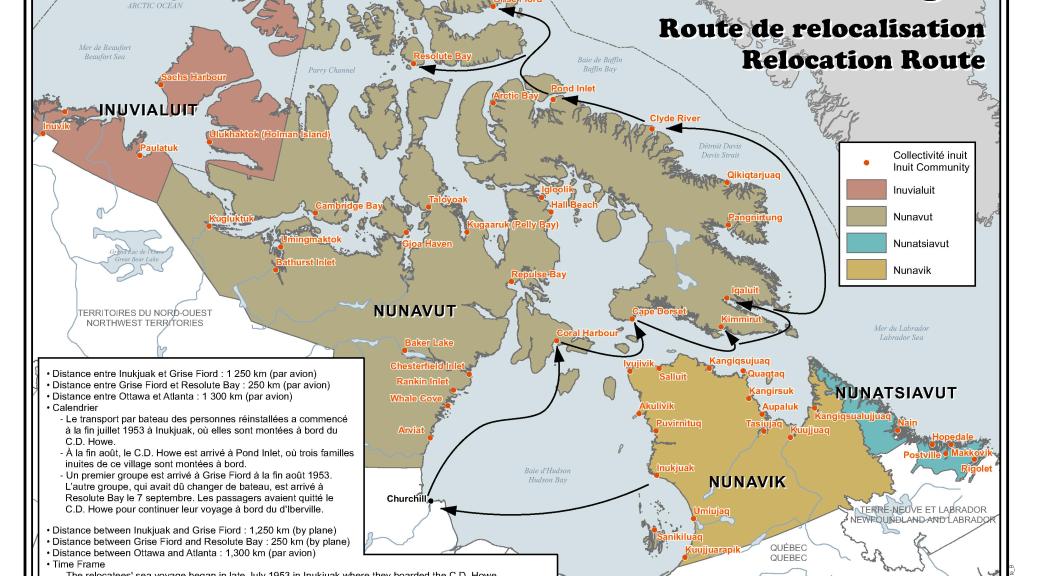
THE FIRST public act of Canada’s Minister of Indian Affairs and Northern Development, John Duncan, came today in the form of an apology to the nineteen Inuit families of Inukjuak and the three of Pond Inlet relocated to the barren landscapes of Resolute Bay and Grise Fiord, on Cornwallis and Ellesmere Islands, respectively, in 1953.

One today commonly refers to this region as “the northernmost inhabited part of Canada,” Cape Columbia being the northernmost point on the map of Canada. However, during the Cold War, when these eighty-nine Inuit were taken on a 2,000 km journey (the trip was shorter for the Pond Inlet residents, relocated to assist the southern Inuit in adjusting to their new life) and then unceremoniously divided up and abandoned to an entirely foreign ecosystem in their ill-adapted clothing, the United States and Greenland had at least as much substantive claim to the territory, if not more.

This detail matters because since the 1980s, when the Inuit initiated their claim against the Canadian government, a stumbling block of negotiations toward a proper settlement has been the suggestion that the relocation was part of an effort to assert Canada’s sovereignty over the “High Arctic.” Arctic Sovereignty is a pressing matter for the Canadian government of our own day, and would have been in the 1950s, when the menacing prospect of Soviet encroachment in the North constituted something beyond a political and economic challenge. It was the Communists after all that drove the Canadian military north in the first place, and many Inuit living today went from tundra to TV, and caribou to cash, within a decade — most never having seen a white man or a dollar bill until the trucks rolled in. Few are the Canadians who have even tried to imagine the trauma doubtless brought on by this sort of encounter, and the truth in any case is that they couldn’t do it.

Canada’s position has always been that the 1953/’55 relocations were a well-intentioned solution to over-crowding, the decline of hunting, and welfare dependency in Inukjuak. (It’s odd to think a place named Giant in Inuktitut would be overcrowded.) Today’s Government apology reiterates the official position that the move had nothing to do with concerns over Arctic Sovereignty, hedging the matter by stating that the “Government of Canada recognizes that these communities have contributed to a strong Canadian presence in the High Arctic.” Those relocated however believe that, in addition to the physical and emotional suffering brought upon them by a poorly conceived and badly executed policy, lies the ironic insult of having been exploited by a Government eager to claim an uninhabited region of the North as its Sovereign Domain. If the claim is true, then the blows do fall rather below the belt. It means that the pointless and avoidable suffering of these individuals was all for the benefit of a colonizing power contemptuous of “its” indigenous people.

The Government’s claims raise many objections, among them the odd choice of destination and the all-too-convenient coincidence of the timing and geographical placement of the families with the evident Government agenda at the time. At the very least, Government officials would have been aware of the nice convenience of having preemptively populated contested land with individuals they could claim belong there anyway. The for-your-own-good line is a familiar convention, a self-serving trope brought out for public consumption on those frequent occasions when Government wants to enjoy the exquisite pleasure of having it both ways. Those who pay careful attention to language will notice that even the name of the department, “Indian Affairs and Northern Development,” is a contradiction as well as a confession.

I have further cause to doubt the Government’s position. The relocation is portrayed in two films, Marquise Lepage’s “Martha of the North” and Zacharias Kunuk’s “Exile.” As it happens, I know the Martha in question, and I knew her when only a few years ago she learned herself the reason why her family had been chosen to be among those moved across a continent. (Around that time I had lunch with her and Zacharias Kunuk in Iqaluit.) You will have to wait for the book she is writing to learn that, but let it suffice that her own relocation was not for the reasons given by Government. And so in at least one case I am certain the official version is wrong, from which it follows that today at least one person has received no more than one-half an apology.

Follow me on Twitter

Of Truth and Reconciliation

The Truth and Reconciliation Commission of Canada (whose website may be accessed here) is faring poorly of late in the court of public opinion, for reasons that have been widely reported. Foremost concerns have been the acrimonious resignations and dismissals of senior staff, a two-year delay of primary activities such as staffing and office-assembly, the apparent compromising of the Commission’s independence, and the inability of the Truth and Reconciliation Commission to compel testimony by means of subpoena, or even to name perpetrators. Many are wondering if the Truth and Reconciliation Commission will be able to accomplish anything of value.

One might well begin in fairness by acknowledging the extraordinary burden of the “truth and reconciliation commission” brand name. It’s rather like coming into the world christened Brock Skyconqueror. Even before the business cards were printed and the phones were installed, people were day-dreaming about 1989 — Nelson Mandela and the crumbling walls of the prison, that sort of thing. It may however help the cause of expectation management to familiarize yourself, if you haven’t already, with the precise character of this institution:

2. Establishment, Powers, Duties and Procedures of the Commission. Pursuant to the Court-approved final settlement agreement and the class action judgements, the Commissioners: (a) in fulfilling their Truth and Reconciliation Mandate, are authorized to receive statements and documents from former students, their families, community and all other interested participants ….

This is to say, the Commission’s authority consists in the power to listen, under conditions which actively forbid assignment of responsibility:

[the Commissioners] (g) shall not name names in their events, activities, public statements, report or recommendations, or make use of personal information or of statements which identify a person, without the express consent of that individual, unless that information and/or the identity of the person so identified has already been established through legal proceedings, by admission, or by public disclosure by that individual.

I could go on quoting legalese from Schedule N of the Indian Residential School Settlement Agreement, and no doubt you’d be enthralled by my doing so, but most of the twelve-page document establishing the scope of the Truth and Reconciliation Commission of Canada is contained in these extracts. The rest of it is amplification, that the Commission shall “adopt methods and procedures which it deems necessary to achieve its goals” and shall “have available the use of such facilities and equipment as is required …,” etc.

Part of the burden of this Commission, and quite a large part, is truth — specifically the expectation that it will root out and present to Canada The Truth of the Indian Residential School System. But since the TRC is neither a public inquiry (see 4. Exercise of Duties: “… the Commission is not to act as a public inquiry”) nor a legal process, truth can only mean personal truth, the truth of one’s convictions and experiences as presented to the Commission. Another term for this is subjective truth.

It’s for me impossible to imagine the Government of Canada, the Churches, and their many respective lawyers agreeing to the establishment of an independent investigative body with quasi-judicial powers. Canada’s Truth and Reconciliation Commission is precisely what one would expect of a court-mandated, lawyer-negotiated instrument: it is a circumspect compromise between parties, an admission of responsibility which carefully circumscribes consequences.

As an agent of public education it does hold promise. The TRC is mandated to create from its gatherings, as well as from other source documents (voluntarily yielded), “as complete an historical record as possible of the IRS system and legacy.” The importance of this cannot be overstated. But the challenge here is on the distribution, and not on the production, end. The Royal Commission on Aboriginal Peoples generated enormous material and testimony related to residential schools, much more than could be contained in its Final Report, but few have seen it. Many Canadians remain ignorant of Canada’s Indian Residential School System, and are therefore ignorant of its consequences and legacy. Without a sustained campaign of public education, which means actually getting the stuff into the public domain, the Canadian public is certain to remain in its bubble on not-knowing. So far the degree of effective public outreach is the principal difference between Canada’s and South Africa’s truth and reconciliation efforts,  according to comments made by South African professor Piet Meiring. But even here, we must acknowledge that the Truth and Reconciliation Commission has resources unequal to the work of educating a country. It must have public and private sector partners in this endeavour.

So to recap: there’s a modest potential for some good in this Truth and Reconciliation Commission, only don’t expect an uncovering of Truth and the reconciliation of Canada and Aboriginal peoples. Rather, hope that individual truths will reach the individuals who can be reached, and that some small, personal acts of reconciliation will result. Expectation of anything more is a mere dream.