Category Archives: Personal Essay

The Decay Of Poetry In The Year Of Revolution


When the terrible European war which everyone had known for years was coming finally did arrive, W. H. Auden composed a poem, “September 1, 1939,” which begins:

I sit in one of the dives
On Fifty-second Street
Uncertain and afraid
As the clever hopes expire
Of a low dishonest decade:
Waves of anger and fear
Circulate over the bright
And darkened lands of the earth,
Obsessing our private lives;
The unmentionable odour of death
Offends the September night.

Continue reading The Decay Of Poetry In The Year Of Revolution

And Now For Something Completely Different

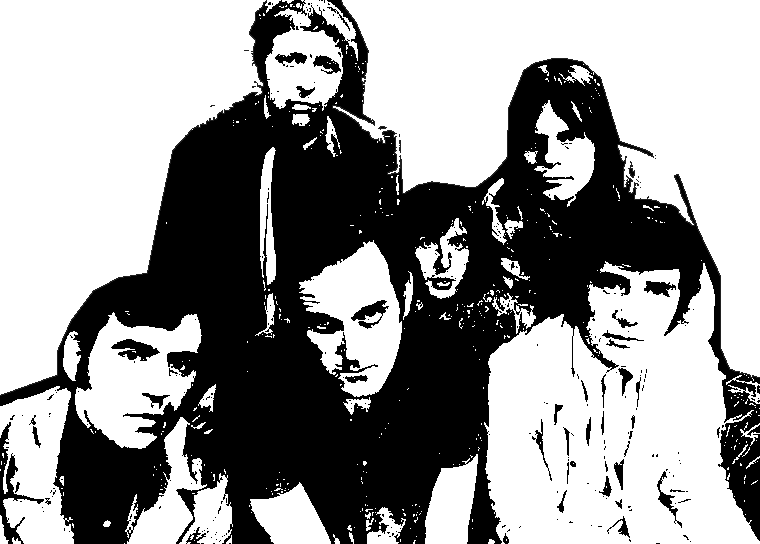
I am most at home among those who’ve an appreciation of the absurd. To detractors this would perhaps be characterized as the silly or, at further depths of condescension, the juvenile. I don’t much mind either characterization and will plead guilty as charged if pressed to do so. You see, my people have a touch of anarchy about them as well as a suspicion (perhaps more than a suspicion) that human pretension, and especially the human pretension toward civilization, is at bottom ridiculous and thus fit for ridicule. An effective mode of ridicule I find is the raspberry, the gesture which indicates that its object is regarded with a lowly contempt precluding a need of serious rebuke. Better still is whimsy for its own sake. On that foundation rests my preference for comedy and comedians aspiring to no identifiable social purpose, for examples and in no particular order Gilda Radner, Jackass, The Mighty Boosh, and Monty Python’s Flying Circus. This preference took root in my childhood, which suggests the term juvenile does have merit.  Continue reading And Now For Something Completely Different

Flecton Big Sky, “Homage”

Liner notes for the album Homage, by Flecton Big Sky


Like you and me, like everyone, making it up as we go along, Flecton Big Sky has turned out a few … let us say, debatable … decisions in life along the way. Life by necessity is material for improvisation: when the results are harmonious, it’s out of sight — and when it’s a fuckup, it’s a case for hindsight. Well, friends, that’s life. But then there’s music, and in music Flecton Big Sky has made excellent decisions. In his choices of songs and collaborators, he’s demonstrated over the years a knack for creating, to borrow from Pablo Neruda, “a generous, vast wholeness / a crepitant fragrance.” Harmonious, out of sight, sound — all without a plan, without a thought of road’s end. It happens that I’ve been around when some of the improvisation was going down, and I could never figure out how he does it, how he makes music without ever thinking about making music. Without ever preconceiving. Here is a man who goes into the studio tabula rasa, a blank slate. A few days later, out he comes, improbably, with these sounds of his. What’s the deal? I puzzled over that one for a good long time. The problem was that I was looking at it from the music point of view, not the life point of view. Sure, Flecton the man is also Flecton the musician. They’re both just making it up as they go along. It comes down to decisions, but not of the musical variety. Flecton is a man with a great, sensitive soul. He trusts his instincts, and his instincts serve him well. He trusts his friends, and his friends trust him — as well they should, because there’s no one more trustworthy than Flecton. This is the secret to his music, this trust. Flecton connects to certain music and musicians through gut instinct and sensitivity. And once he’s connected, he stays connected. He’s never forgotten his roots. They continue to nourish him. He’s loyal to a fault. Respect, loyalty, due acknowledgment of one’s indebtedness, and music as a soulful connection: these are the meanings of homage, a word derived simply from the word “man.” In this case, the man who is Flecton Big Sky.

– December 2010

Flecton on Bandcamp | Flecton on Kelp Records | Facebook

Going Home


Reading of the ghost estates and the collapse of the Irish economy, my thoughts returned today to the small, southern Ontario town in which I was raised and which I recently visited. The surge and fall of the Celtic Tiger reminds one, as if reminder is needed, that life in the age of finance capitalism can be a matter both of spectacular rise and of sudden, disgraceful cadence. Or, as has been the case in my hometown, of lingering and even interminable decay. Continue reading Going Home

On Not Being There


As I took a cell phone and netbook, it is inaccurate to claim I “unplugged” on a recent trip to Chicago. I did however go without newspapers and without thinking about work and the many things left behind, and being outside my routines and therefore in a sense outside my habitual self, I do feel as though I had.

It is a telling metaphor, this unplugging. One employs the word in its broad sense, not only to the electrical circuit but to one’s own body and, specifically, brain. Such today is the comprehensive material burden of connectedness, a word which could once have been rendered only in human terms, but now invokes the clichés of social media. Pulling out the electrical plug seems uncomplicated enough. It is so easy to walk away from connections of the Internet sort that not to do so has become the only thing easier. Continue reading On Not Being There

Jane Goodall

As I write these words, British Dame and ethologist Jane Goodall is arrived to the oil capital of Canada to promote an environmental conservation agenda and to reflect upon fifty years of chimpanzee research in the Gombe Stream National Park of Tanzania. With her work you are no doubt familiar: she has done all she can to make of that a certainty. An unrelenting traveler, if she is not on the road nor in the air, it is only because she is before an audience.

I also need not tell you that her research and advocacy have been occasions of disagreement and sometimes hostile opposition. On the subject of the environment’s rough handling by the human species I don’t share the hostile response to her message, but I think I understand why it exists. Her statement the other day that “we have really, really harmed Mother Nature and I don’t know how long she will retain this amazing ability to regenerate” makes me think, as all environmentalist-doomsday utterances do, of George Carlin’s brilliant commentary on “saving the planet.” If you’re not familiar, allow me to sum it up for you in his own words: “There is nothing wrong with the planet. The planet is fine. The people are fucked.” Who can argue? It is indeed the case that we’ll be long gone soon enough, and the Earth will go on as it did for billions of years before we arrived, quite by accident. Continue reading Jane Goodall

The Dick Cavett Show

I dislike as a matter of course the plaintive themes of decline and decay, but stumbling upon some YouTube videos over the weekend, it did occur that the business of over-the-air talk has been cheapened. The occasion of this thought was a collection of episodes of the Dick Cavett show, some of which I had seen their first time around but had forgotten. Watching these programs again, years later, I can’t but notice how much the talk show format has changed, and how much for the worse.

If you doubt me on this, go through the archive yourself. You will find lengthy (in some cases seventy-minute) interviews, well-paced with twenty minutes or more between commercials and with (apparently) unscripted, spontaneous, and intelligent talk on a wide range of topics. Rather like a conversation in the real world. Note also that none of the guests whose interview I watched had a product to push: the conversation, for its own sake, was the thing.

Compare these facts to those of the current talk shows and I think you will readily discern the differences. The pace has quickened, the conversation now consists of rapid-fire and scripted question-and-answer organized around the selling of product, and the range of topics is thereby restricted. Get them on, push the product, play the commercials, show the guest the door — such is the current formula. Not quite a dumbing down, so much as a distillation of the medium to its industrial-capitalist quintessence.

Mr. Cavett has not left us, and I was gratified to find that the sharp old man keeps a blog on a website at the New York Times. He is and has always been a specimen of largeness, both in soul and in mind. His work is also unfortunately dated, and it’s difficult to watch those old broadcasts and not feel the distance between the now and the then. Could a program paced and executed as his was even be contemplated today? No, I don’t think so, and what a shame that is. The Dick Cavett show is wholly a matter of the past. I say this as an admirer both of the show and of the man, and as someone who understands well there is no going back. Usually I am at peace with this, but not tonight.

Of Whisky, Pastis, Wagers, and Age

If you’ve not yet heard of it, let me be the first to inform you on September 23 the world’s “official” oldest living twins, according to the 2011 Guinness Book of World Records, attained the age of ninety-eight. Welsh twins Ena Pugh and Lily Millward, born 4 January 1910, contradict this Guinness designation, but never mind that. The Guinness twins recommend drink as an aid to longevity. That rather seals it, for me. Continue reading Of Whisky, Pastis, Wagers, and Age

John Lennon

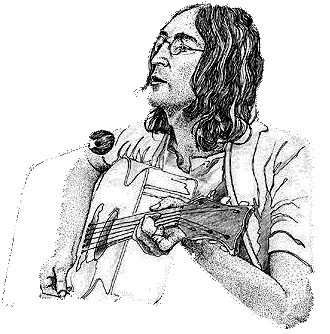
Among my personal store of mnemonic devices is the December 8, 1980 murder of John Lennon, on the day I turned fifteen. Henceforth I’ve had many an occasion to answer the question When is your birthday? with the response “On the day everyone is talking about the death of John Lennon.”

John Winston Lennon was born seventy years ago this week, but he is among those — John F. Kennedy is another — for whom the preponderance of their remembrance concerns the character and circumstances of their death rather than either their birth or life. This is not to say that the latter are overlooked or under-regarded. I know that the mourning and mythologizing were well underway on December the ninth, and that both were founded upon the conviction that the world had lost a man of peace as well as of artistic genius. The reputation of peace-maker was already by 1980 an anachronism, fed in infancy on the gruel of sentiment and then sustained only by easy nostalgia and the familiar convention of celebrity worship. The usefulness of the Lennon myth would increase for many who carried on and who thereby experienced with distress the fierce repudiation of the 1960s, first ascendant in the Reagan and Thatcher administrations, and through which we are still living. Continue reading John Lennon

Facebook, Narcissism, And A Sociologist For Hire

Soraya Mehdizadeh’s study, “Cyberpsychology, Behavior, and Social Networking,” was cast into the cybersea earlier this month, and media bit the hook. How could they not, baited as it was with the suggestion that Facebook is “a particularly fertile ground for narcissists to self-regulate.” Google the name “York University,” and even before you go to the site, you’ll see a reference to the study, in the search engine’s results listing. You may well have Googled this topic already, Google being the most popular website on the Internet — and the only site, according to many sources, more popular than Facebook. There is however more to be said about the study than Facebook = Narcissism, which in any case is a mis-description. Let’s look a bit deeper into it, shall we. Continue reading Facebook, Narcissism, And A Sociologist For Hire

My Grandmother

Among the unwritten and as I understood them incontrovertible laws of life was the cardinal indication never to disregard the wishes of my grandmother.

When I was a teenager my grandmother told me: stay in school and don’t get married until you are thirty. It would be some years before I could appreciate how dearly she’d paid for this wisdom. Seeing my Latin homework, she took the occasion to say, as a matter of fact, she had always been interested in languages and that her generation of Native people had been unable to have an education. She was married at tender age to a man who had befriended her mother, and from that source derived a courtship with my grandmother to-be.

Rhoda Rhodes, whose mother had been a Six Nations Garlow, bore children across four decades — the 20s, 30s, 40s, and 50s. During the Depression and the war the first six came into the world, and following the 1945 surrenders of Japan and Germany, three more would follow, my mother (b. November 1945) being the first. My grandmother was so long at it that she was pregnant concurrently with one of her daughters. I had always assumed that in those days this was just “how it was.” Indeed, but what I did not know were the common reasons. It was only after her death in 1991 that I learned my grandfather, William Johns, “did not like birth control.” In the days before “the pill” a woman had very little power in the matters of sex and sexual reproduction, which went a distance toward ensuring that a man would get his way. This detail said so much, falling as it did into the puzzle, along with other pieces that would emerge in the years after my grandmother was gone.

She had never forgotten from where she had come. “I hate John Wayne,” she once told me. She was proud to be Mohawk, and would not suffer the bellicose ignorance of others. She marshaled all that she had, which was considerable, in furtherance of the family’s dignity and self-respect. She understood that we would be derided as dirty and stupid, but she never gave the haters ground upon which to stand. My mother once came home to recount the slurs. “Look around,” said my grandmother. “Are we dirty? Is our house dirty?” The very fact of her being who she was powerfully repudiated the charge. In this way she lifted us out of depths into which we could have been cast only by ourselves, by surrender to self-doubt, self-hate, and self-disgrace.

One of the last conversations I had with her, in late 1990, took place as they often did at her kitchen table. I don’t know where my grandfather was, but we were alone — an unusual thing in a vast family that considered her kitchen its emotional and gravitational centre. The door was always open, and thirty-five grandchildren (and eventually as many great-grandchildren) could and did come by unexpectedly. That night may have been the only in my life I was alone with my grandmother, and in any case it is the only I can recall.

It was an extraordinary night for another reason. She brought the conversation around to the topic of “what I want to do with my life.” I want to write, I said. Then she told me something I had never known, that in her youth she had been interested in writing and had composed a number of stories. To appreciate the significance of this you need to know that I was a quiet, introverted, and highly imaginative child, which is to say an oddity. For many years I imagined I must have arrived into the world by some sort of magic, surely not by means of descent through the family tree. At eight years old I knew I wanted to be a writer. Clearly my wit and ironic outlook had come from my father. He however had been a high-school athlete of some promise, and it was to sports he had set himself early in life. Nor did my mother show any artistic inclination. Even among the extended family, most of whom were handy at a trade, there was no evidence I’d come by my constitution honestly. In my vocation, I was a singularity.

I suspect this feeling of being the odd one out, which was reinforced in other ways when I entered school, explains my tendency to side with the minority, the opposition, and the underdog. Bookish and uninterested in sport, I grew up in a dying steel town where the hockey rink was the centre of all things and where boys dreamed only of the League. (If you want a sense of how it felt to me growing up there, I can recommend nothing better than Peter Bogdanovich’s portrayal of Anarene in “The Last Picture Show.”) Occupied in the late 1700s by Pennsylvania Dutch, Fort Erie has to this day a Spear Road named for ancestors on my father’s side, which should have meant that I at least half-belonged but never quite did. I was a southpaw in the remnant of an era when people still knew enough Latin to know that sinister means “left” and when conformity was in all things an overriding imperative. A good deal of effort went into the failed attempt of a few teachers to reform me in this and other areas, and it is with some pride that I report their failure. I don’t wish to overstate any of this and leave an impression that my education was harsh. It was only typical of the time, but was nevertheless a good environment to form an oppositional personality.

At the end of her life, my grandmother had disclosed to me a detail which altered everything. In fact, I was not a singularity nor an oddball, at least not in the way I had always imagined. I had indeed come from somewhere, and my grandmother was the living proof. Shortly after she died I wrote a play called The Name Is A Vestige, which was about the many feelings and insights engendered by this revelation. I should also say that I had always felt a connection, and that if you were to look at any photograph of a Johns family gathering, you would see that I am sitting next to my grandmother. But now I had a more definite sense of this connection’s meaning.

Soon she would be gone, but from then on a part of me would feel an obligation to write, and to write well, “for” her. She doubtless had seen who I was and who I might become, with a little luck, and had given me precisely the advice which had perhaps been the obstacles to her own creative fulfillment.

It is rather harsh putting this thought into print. I don’t at all doubt that my grandmother loved her children, grandchildren, and great-grandchildren. I never once heard her complain of her lot. When she told me about her desire to be a writer, there was no bitterness or self-indulgence. Yet everything I learned once she was gone contributed to my growing sense that her life could only have been one of great frustration. She had married young and would discover, certain to her horror and disgust, that her husband was a drunk and a lay-about. In his thirties, my grandfather would find the Lord, going from one extreme to another. He was a harsh and obsessive proselytizer. You could not go to his house without getting the sermon, always over the decades the same sermon, focused ever on the vengeance of God and the torments of hell. His God was of the undiluted, high-proof variety, jealous and uncompromising. No one was spared his gospel. My grandmother would tell him to “stop it,” and he would, but not before citing as self-justification Ezekiel 3:18.

When I say unto the wicked, Thou shalt surely die; and thou givest him not warning, nor speakest to warn the wicked from his wicked way, to save his life; the same wicked man shall die in his iniquity; but his blood will I require at thine hand.

Now that I am older, I have come to see this as child abuse. I think my grandmother, who always stood up for us, would have agreed. Her actions suggested as much. I can’t recall his sermonizing without feeling rather ill at the thought of how vicious, ugly, and deforming it all was. She however met him blow for blow, and he was in the end no match. His brand of religion belied the fact that he was deep down self-loathing and self-defeating, no doubt a carry-over from his days of being bullied by priests in an Indian residential school. My understanding of this, gained as has so often been the case too late, prevents me from judging him too harshly and lends a certain compassion to my reflections. I’ll never know what the world looked like through his eyes.

To the end of his life, which arrived in 1996 after a period of dementia, William Johns was attached to the idea of returning to his thirty-three acre Six Nations farm. It was my grandmother who insisted they leave the desperation, poverty, and self-defeat of the reserve in those days. I often wonder how life would have been different for all of us had she not taken that stand and, as she often did, prevailed. I also wonder what she would have made of her life had she been granted the opportunities of my, let’s admit it, pampered generation. She lived at a time when a woman was expected to give up everything as a matter of duty. The idea that a woman had a right to an independent life and to her human fulfillment, to a Room Of Her Own, was only beginning to advance. The way was doubly, even quadruply difficult, for an Indian woman. For this reason I could never be casual about my education or my opportunities. I worked very hard and, as quaint as it may sound, I resolved to hold myself to a certain standard.

My grandparents had little money, and with over seventy descendants, they were not in the habit of acknowledging birthdays and such. I only ever received one card. My grandmother gave it to me after my graduation from university, and inside she has written “I am so proud of you.” She had lived to see me fulfill one of the two guarantors of my betterment, and if she had lived another five years, that is to say beyond my thirtieth birthday, I would have had the joy of introducing her to my partner and best friend. To have had that day I would give, I think, anything.

Pop Culture: an essay

[Originally published in ASH Magazine, volume 3 number three Summer 1996.]

First, a definition. You will notice that the phrase is made from separable units: popular, and culture. Popular, I think, expresses the essential character of a high-tech, media-dominated age. Hence, by popular culture, I do not mean a culture everyone “likes” — as common usage would have it (“she’s the most popular gal in grade nine!”). If the media are correct, this is emphatically not the character of popular culture. No: pop culture is a “popular” one because it addresses itself to and thereby captivates the attention of The People. Every day each person is addressed by cultural institutions — television for instance — which assume as their audience nothing short of the Collective Man. It is the nature of popular culture to get into one’s daily life, whether discussions, chat, entertainment, or sex. And it does not matter who one is, popular culture makes few rhetorical distinctions, for we are all “of the people.” Innovations in technology guarantee that this will be the case not only in North America, but increasingly also in (for examples) Tokyo, Paris, and Beijing, each of which is becoming increasingly “Americanised.” Another way of saying this: the world is increasingly adopting the trappings of mass-produced popular culture, a culture “of the people.” And we are all of us of the people.

By Culture I intend those instituted actions and objects expressing that which is held in high esteem. For the public articulation of personal beliefs is never free from institutional mediation, such as when a newspaper reporter elicits our private opinion of the Conservative Harris agenda, using carefully-worded questions. Culture does not issue from a vacuum, and not even from the sincere, spontaneous expression of an individual. Culture is the institutionally-determined expression of “values”: admirable actions, appropriate behaviours, moral codes of conduct, aesthetic tastes, religious orthodoxies. And let us not forget perversions and heresies as well; for a culture, if it is to be vibrant, must somehow appropriate to itself that which issues a threatening challenge or a deplored variation. The language in which we express “that which is held in high esteem” will be necessarily variegated; not the Queen’s English certainly, but a jostling Creole, what Mikhail Bakhtin called “heteroglossia,” or “differing tongues.” Culture is a grab-bag of contending but mostly peacefully coexisting perceptions and representations of the world and of our place within it. The strength of a culture is therefore to be judged by the ability (or relative inability) of its institutions to respect diversity while representing to its constituents a public: that is, a collective self-image, construed more-or-less as a people. Aristocracies accomplish this by appealing to the metaphor of the body politic, of which the King serves as head, and we ordinary folk presumably as toes, elbows, and the like. Our tastes however, inclining as they do toward democratic models, are supposedly gratified not by distinctions, but by uniformity. Hence, pop institutions labour toward the illusion that, whatever our superficial peculiarities, we are all of us of a mass, sharing certain fundamental values.

There is one further point I wish to advance before I move on. In an industrialised capitalist nation, the expression of that “which is held in high esteem,” the present definition of culture, is inextricable from the logic and ends of capitalism. That is why capitalist differ from non-capitalist societies, tribal or socialist for examples, which nonetheless also conceive of themselves as a “people.” Capitalist societies express values with dollars and cents. And I know it might sound extreme, but I suggest that everything about persons subject to capitalist social organization, including (as I’ve earlier suggested) their sex lives, is in some manner related to capitalism. (If you doubt this, call me on the 14TH of February). Popular culture is mass-produced by corporations for profit: monetary profit of course, but political and personal profit as well. And most of the time, most people are quite comfortable with this. The relations of culture, values and capitalism — and ultimately one’s personal pathway through them —  are ongoing negotiations between the agenda of the individual and the agenda of her culture’s institutions.

Last year’s attack on Time Warner, issued by American Senate leader and Republican presidential candidate Bob Dole, was an ostensible defence of the values of the people against those of popular culture. Given my argument thus far, this would appear absurd. How does one defend the values of the people against the culture of the people? Dole’s manoeuvre is a familiar one: he accused Time Warner of representing, not the people, but the “elitist” interests of capital. Whether Dole was right to accuse Time Warner of disregarding the values of the people in their quest for profit I won’t here explore (if I did, I would have to answer a disturbing question: from whence did the profit come?), but the fact that a Republican could even articulate such a critique, for indubitable political gain, is itself telling. Dole’s views are not peculiar; his comments were greeted sympathetically by Liberals and Conservatives alike, amply demonstrating that “popular” culture is widely judged not very popular in either sense of the term: for critics contend it can today claim neither to have achieved uniform popularity (in the vulgar sense) nor an acceptable representation of a public — that is, of a People. Of course, the common wisdom, promulgated with great (self-) interest by the media, is that institutions are under the attack of the people also for their “elitism.” I suggest that such propositions however are hopelessly abstract, even if most individuals are in fact at odds with institutions (and it is not clear to me that they are, for I don’t know “most” individuals).

You might have concluded that Dole’s attack on popular culture represents, or even constitutes, a tear in the national fabric,  but I myself doubt this. The popular culture industry feeds on attack, and is indeed founded upon it. The music industry, for one, has been richly rewarded for its appropriation of rebellion and critique, whether it was the 60s youth culture or 90s Gangsta Rap. Establishment record companies promptly soak up the disposable income of anti-establishment teens, to the apparent satisfaction of all involved. This is precisely the genius of capitalism, which swiftly commodifies fringe lunatics, malcontents, and would-be subversives, the latter learning to express their politics in terms compatible with the interests of capital (and being rewarded for it), or else losing their public voice if they don’t. Capitalism thrives because it can sell even anti-capitalism.

What do we learn from all of this? Perhaps that Dole’s attack was germane not because it posed a genuine threat to a cynical elite (it did not), but because it asserted two fundamental truths of capitalist democracy: that pop culture institutions — and the market forces which guide them — play an active role in civic life, and are no less capable of moral neutrality than we are. I do think Dole is correct when he suggests that our media are fundamentally anti-democratic, and that he is in agreement on this point with Noam Chomsky only supports this conclusion. But attacks on “elitism” help little, and might even distract us from more fruitful investigations.

Why an issue of ASH on popular culture? First, we might be instructed if we reflect on the very idea of a popular culture. Inherent in the notion is the belief that people (and not only kings, or some other elite) are competent to imagine, assemble, express and debate visions of their collectivity. Popular culture issues from an implicitly constructive, democratic and hopeful assessment of the human lot. Thus, if constructivism, equity, and hope are not frequent features of public discourse, or “culture,” we might well find this odd, and question why it is so. We will be suspicious of the artist’s mantra that “I am only showing what I see,” which you’ll notice discloses a passive formulation of creativity indeed. Second, considered as a historical development, popular culture is profoundly progressive, anti-elitist, and anti-authoritarian. And yet popular culture too often glamourises ill-gotten wealth, sexism, invidious class and race stereotypes, petty atrocities, and brutal excess. What has become of the notion that all women and men are worthy of justice, respect and dignity? Dole’s attack, for all its hypocrisy (he praised Arnold Schwarzenegger, a Republican booster), raises important questions about the character of popular culture and its relationship to democracy. Dole’s jeremiad inspired the media to ask the question, What judgement have the people passed on popular culture? But I have been waiting for someone to consider another question: What judgement has popular culture passed on the people?

Follow me on Twitter

All In A Day’s Work

It happens that Stockwell Day once again has the misfortune to be rather thickly in the news. You must have noted the tautology in that: Stockwell Day in the news is always a misfortune, never anything else. Quite without needing to, the man is perennially at the habit of putting himself before microphone and camera, only to make a bung of it.

Do you recall the extraordinary media hyperventilation which attended his farcical lunge, conducted partly by Jet Ski, at the Canadian Alliance leadership, in 2000? As Finance Minister, in the Ralph Klein government, Day had paid down debt and balanced the provincial budget. On these accomplishments, and little else, rested the extraordinary enthusiasm for an unexamined man who began to dismay as soon as the shrink wrap was off.

Everywhere Stockwell Day went throughout his leadership campaign against Preston Manning, he said plainly wrong things, made an ass of himself, and in the end split the Alliance Party in two. It is worth remembering that Day has a federal political career only as a result of a deal made with Stephen Harper — a deal which brought prominent party members disgusted with Day back into the fold, restoring the Alliance and enabling them to take power. There’s another, even less kind, way to say this: the Conservative Party of Canada is today united and in power because its absurd and impossible leader got out of the way and let someone competent take over.

One is tempted in speaking of Day’s political career to produce the actuarial. Well then, one instructive example of the real-world liability he represents is his illogical and tub-thumping attack on Lorne Goddard, which cost the Albertan taxpayers over $700,000, again needlessly. The expression, “it is better to keep one’s mouth shut and be thought a fool than to open it and remove all doubt,” could have been written about Stockwell Day and in any case would provide him some sound direction. His mistakes were at one time innocent and therefore merely comical, such as when he got the direction of the Niagara River backward. This is no longer the case. His lazy indifference to the assimilation and production of relevant facts, and his recourse to settled ideological conviction, are liabilities and nothing beside.

Nor are these character traits limited within the Harper Government to the Treasury Board President. He is unique only in that looking over his career one can see that he always brings the misery upon himself, and upon his party, despite there being an alternative within an easy reach. Now it appears the misery will overtake Canadians as well, as they endure yet another avoidable controversy, this time about whether crime is going up or down. All that, and more, in a Day’s work.

(Big) Business As Usual

[Originally published in ASH Magaine, Volume Four Number Three, Summer 1997.]

Now and then I find myself in a philosophical mood, pondering the evolution of this creature called ASH. I think it’s a healthy activity, the more so since I’m inclined these days not to take the magazine too seriously. I’d like to leave behind me a respectable corpus when I at long last turn my attention elsewhere, but I know also that ASH is likely never to attain a status beyond the obscurity common to small publications.

I confess this disappoints me — and not merely for its humbling effect on the ego. You see, I had a conversation once with a business-minded fellow, who maintained that the market should decide the outcome in all matters. He noted the widespread reliance of Canadian magazines on government funding (ASH is an exception) and wondered aloud: Why sustain a magazine read by so few that it needs taxpayers’ money just to survive? Indeed. I must say the logic, bolstered by economic concepts such as “utility maximization,” seemed to me to be solid. But when I drew out its implications and followed them to their conclusions, I was left with a rather troubling picture.

The image I had in my mind was of a culture that could never have enough movie celebrities, rock stars, elite athletes, arms traders, investment bankers, futures speculators, and corporate lawyers: for their market value is, it appears, without limit. As for, say, motherhood (that sacred job which is praised to the skies at appropriate occasions by businessmen and politicians), well, it has no market value whatsoever; and nearly the same is true of all the so-called “caring” professions and the many wage-labour jobs which have long sustained our privileged standard of living. Think about it: much that we might reasonably claim dignifies and enriches life, much which makes this world more than merely bearable, is practically valueless, economically speaking. Remember Mike Harris’s contempt, oft-expressed in the 1995 Ontario election campaign, for welfare mothers, who don’t do anything? Such contempt is one of the free market’s proud accomplishments, and a remarkable accomplishment it is.

I suspect my business-minded acquaintance is now pleased. His vision of an efficient, competitive, rational, growth-centred world has triumphed, and we shall live for many years to come its social and ecological consequences. The New World Order has its bureaucracy (the economists, policy experts, and investment gurus who now make regular appearances on the evening news and the bestseller lists), its constitution (the General Agreement on Trade and Tarrifs), and its Bill of Rights (the Multilateral Agreement on Investment). The message for the masses is also vaguely familiar: believe, submit, and you’ll be rewarded in a future life.

Perhaps the market knows best in some matters — magazines, for instance. In any case, I’m inclined these days to keep ASH going, if only that it might be a voice crying in the market wilderness. It’s an obscure voice, as I’ve already acknowledged, and so there’s little hope ASH might counter effectively the fallacious claims of the economic experts who dominate the landscape. The very attempt risks the pomposity and the intolerable self-righteousness that usually attend those who are convinced they’re on a mission from God. So much, you might then say, for not taking ASH too seriously.

Self-righteousness isn’t the only temptation to which the dissenters are susceptible, as the global economic empire discloses what appears to many to be a heartless agenda. Have you noticed the abundance of books in the last few years with the phrase “The End Of” in their titles? All about us, the horsemen are assuming the saddle in gleeful anticipation of the apocalypse. Unfortunately for them, there’s no end in sight. It’s (big) business as usual.

Not long ago I read George Orwell’s The Road To Wigan Pier, a book that makes me wonder why Orwell is represented in the school curricula by Animal Farm and 1984. Wigan Pier is really two books in one: the first half describes in horrific detail the lives of U.K. miners during the 1930s, and the second half is a scathing look at the people who propose to improve matters by adopting socialism. Orwell of course considered himself a socialist, but his temperament was such that he could never settle into a dogmatic understanding of human affairs. The possessor of a keen, sceptical mind, Orwell had the habit of bringing into his work troubling details — such as his observation that many a would-be “bourgeois Socialist” of his day was at heart an “old Etonian”:

Perhaps once, out of sheer bravado, he has smoked a cigar with the band on, but it would be almost physically impossible for him to put pieces of cheese into his mouth on the point of his knife, or to sit indoors with his cap on, or even to drink his tea out of the saucer. … It can only be because in his heart he feels that proletarian manners are disgusting.

Wigan Pier is full of such scandal, much of it delivered at the author’s expense. Orwell could be, and often was, indignant in the face of injustice, but I’ve yet to catch him indulging in self-righteous cant or doom-saying. It’s this balanced cast of mind that strikes me as Orwell’s greatest contribution to the dissenters’ canon, a contribution well worth recalling.

As it has turned out, Orwell’s works have thus far escaped obscurity. It would be silly to hope for the same outcome in the case of ASH, but that isn’t the point. In the here and now, there’s plenty of Orwellian work to be done — and after all, I’ve only said I’d like to leave a respectable corpus.