Tag Archives: Canada

Ripples from the War of 1812 are still being felt

IN RECENT MONTHS, there has been debate over the federal government’s decision to spend a yet-undisclosed sum commemorating the War of 1812. The Americans will doubtless overlook this bit of their history, but I’m unable to imagine any Canadian government ignoring the two-hundred-year anniversary of a conflict that could have converted Upper and Lower Canada into two of the coldest states of the Union.

According to the official government website announcing the initiative, “Canadians gave [the Harper Government] a strong mandate to celebrate important historical events”: in this instance a war which — again, from the Government’s website —

… helped establish Canada’s path toward becoming an independent and free country, united under the Crown, with respect for linguistic and ethnic diversity. Simply put, the War of 1812 helped define who we are today, what side of the border we live on, and which flag we honour. Against great odds, it took the combined efforts of Canadians of all ancestries to repel the American invasion and defend Canada in a time of crisis.

A grand feel-good take on the conflict, and who could disagree? Jeffrey Simpson, for one, who on October 7, 2011 characterized the war as horrible and stupid, and “among the dumbest ever fought.” Whether agreeing with this assessment or agreeing not, one should probably award points for the spot-on retort of Dorchester Review editor, C.P. Champion:

Jeffrey Simpson, a columnist at The Globe & Mail, thinks Canada should not celebrate the upcoming 200th anniversary of the War of 1812 because the conflict was “stupid” and “dumb,” with “bad leadership” and “messy battles.” If that is the standard, we had better forget celebrating much of our history. Get out your calendar and scratch off Remembrance Day, November 11. That date commemorates the allied victory in 1918 that marked the end of the First World War — a conflict that presumably fits Simpson’s definition of a stupid and messy war.

A good point. All wars are indeed irrational and vicious and stupid, even when necessary, their accomplishments invariably measured in the numbers of children turned into corpses and summoning to one’s mind these lines of Hamlet:

… to my shame I see
The imminent death of twenty thousand men
That for a fantasy and trick of fame
Go to their graves like beds, fight for a plot
Whereon the numbers cannot try the cause,
Which is not tomb enough and continent
To hide the slain.

So the question remains, Why commemorate war in general, and the War of 1812 in particular?

Journalist Steven Chase has reported a Department of Canadian Heritage study showing in detail what we should already know, that most Canadians are unfamiliar with the details of the War of 1812 — the countries involved, the causes, the individuals who played prominent roles, the locations of battles, and so on. The figures are as a general rule appalling and culminate in the pronouncement that “only one of the 1,835 respondents correctly identified all six of the historical figures from a list.” Here one should put due emphasis on the cadence from a list, which tells us that the respondents probably didn’t know anything about other historical events either, and therefore were unable to arrive at an answer by means of elimination. This state of collective amnesia is probably as good a reason as any to do some commemorative work, commemorate being a verb meaning “to bring to remembrance.”

An honest and candid assessment of the period 1812-1814 will show that the war was started on false grounds, by American jingoists and super-patriots, as Simpson asserts. However, once started, the people of Upper and Lower Canada had good reason to fight. Also, while the war was lost by the inept and over-confident Americans as much as it was won by the British and the Canadians —and the Canadiens — the character and accomplishments of — for example — Major General Isaac Brock were what they were. The 1814 Treaty of Ghent confirmed the pre-war, and indeed post-Revolution, territories and borders of British North America and the United States, and while the Harper government will tell you that peace followed as a result and ever since, the fact may well be that the Americans would have accomplished at a later date what they could not accomplish in 1812-1814, had they not had vast western and southern frontiers to divert their apparent boundless attention and energy.

In other words, the legacy of the war was neither territorial nor geopolitical, but rather psychological. After 1814 the occupants of territories north of the 49th parallel were possessed of what is today termed “Canadian identity,” which may be summarized in the phrase “not American”. Although there has been peace between Canada and the United States ever since 1814, suspicion and a vague condescension toward the Americans was henceforth a permanent feature of the Canadian psyche. An early example of the Canadian apprehension of Uncle Sam — and of the Canadian habit of arriving at self-understanding by looking south — can be found in Thomas Haliburton’s acerbic 1836 novel The Clockmaker. In this work the satire cuts both ways, reflecting a deeper and uncomfortable awareness that Canada must either side with Britain or else be absorbed by America.

In the preceding paragraph I have stated that “after 1814 the occupants of territories north of the 49th parallel were possessed of what is today termed Canadian identity.” There is of course a large and important exception, the indigenous peoples of this land. One of the principal immediate causes of the war was the growing conflict between a brutal and expansionist settler population and its indigenous resistance, among whose most famous leaders in 1812 was Tecumseh. In the three decades leading up to 1812, the Haudenosaunee (like Tecumseh’s people, and indeed all indigenous groups) had been dispossessed of their land base at an alarming rate. The 1812 war offered an opportunity to extract concessions from Britain and Canada through military alliance, a strategy which had served the League in the past and might do so again. It was a military alliance with Britain, during the American Revolution, which yielded to the Six Nations the Haldimand Tract, in Ontario. Ninety-five percent of this land would eventually revert to Canada through a series of transfers, some of which are held by the Six Nations to have involved deception and outright theft. (The current-day Caledonia dispute is a direct legacy of this period.) Not a promising record, but in 1812 military alliances still counted for something, and then as now there were things for which it was worth fighting.

As it happened, the War of 1812 marked the end of the historical era of British-Indian and French-Indian military alliances. European rivalries having been settled on the continent, the provinces within a couple decades of the war’s conclusion were formulating a new, inward-looking Indian policy at the centre of which was assimilation and absorption of indigenous peoples into the sea-sea-sea body politic. Before the War of 1812, indigenous peoples were viewed by Canadian and American alike either as dangerous enemies or as military allies; after the war, they were increasingly viewed as a problem to be resolved through absorption and legislation. The war probably hastened what would have occurred anyway. Nonetheless, whatever victory Canada may justly claim, it is the case that to the indigenous people who fought alongside the British loyalists, as to the later generations who would do the same on European soil, there fell few of the spoils. An emergent outward-facing nation became after 1814 preponderantly inward-looking, the Indian problem thereafter, and to this day, displacing colonial rivalries of the previous centuries.
Abortion, Augie and the March for Life

SUBMITTING MYSELF TO the Ottawa weather, which today possessed all the charm of wet underpants, I lingered while the wind carried my way the Parliament Hill speeches of the March for Life assembly. In the middle of one characteristically sonorous appeal, I found myself thinking about a passage from Saul Bellow’s The Adventures of Augie March:

Read More

How J.S. Woodsworth opposed the war and saved capitalism

J. S. Woodsworth

ONE MIGHT HAVE anticipated, with all the recent talk of conscience rights, that J.S. Woodsworth would soon enough become a hash tag. But not as the object of a slander. The man who once led the Co-operative Commonwealth Federation was nothing if not conscience driven. His lifelong, principled commitments to the Social Gospel, socialism and pacifism were amply rewarded — both by the Methodist church and the nation which he dutifully served — with accusations of sedition, criminal charges, harassment and imprisonment. Whatever one’s politics, one could do worse than to emulate the spine of this man.

Read More

Canada still lacks the political will to curb sexual abuse

SHORTLY AFTER the much discussed, and rightly much derided Graham James two-year sentence for sexual assault, I had a conversation with a journalist who is ghost writing the memoir of a sexual abuse survivor. Why, she asked me, do these abusers get such light sentences?

Continue …

The Non-Solutions of Minister Raitt

I‘VE PUBLISHED academic articles and personal essays and poetry, but a genre into which some of my best effort has gone is the Air Canada Epistolary Vituperation. Last week, in an exercise of covering one’s bases, federal Minister of Labour Lisa Raitt asked the Canada Industrial Relations Board to deliberate the question, Does Air Canada provide an essential service? Anyone who has endured Canadian air travel in the past ten years knows the answer to that one: Air Canada barely provides any services at all, and provides them poorly at that. Hence my letters of complaint at their evident indifference and inattention to customers. (I once received a boilerplate response which proved my point in the first sentence — it began, “Dear Mrs. Spear … .” )

Read More

Dr. Depression’s Bitter Elixir Now Available in Ontario

SOME DAYS AGO I spoke to the former Finance Minister and Prime Minister of Canada, Paul Martin, who in 1995 tabled the federal budget balancing Canada’s books. It’s become an established (and easily falsifiable) political cliché that Liberals tax and spend whilst Conservatives tidy the fiscal house. Speaking to Mr. Martin, I was reminded of the conspiracy theory that Reagan had tripled the US deficit in order to undermine the welfare state. Well, some thought it a conspiracy theory — and then David Stockman, the Office of Management and Budget Director, confirmed the supply side ruse.

Read More

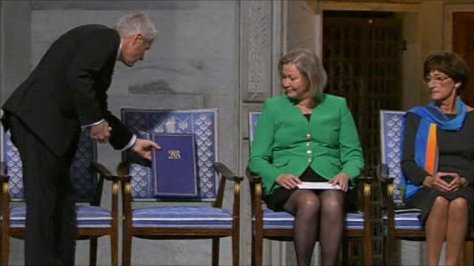
One Empty Chair and Many Empty Words

THERE ARE A few rules to which I’ve held myself as a professional speech writer. Do your homework, know and respect your audience and the protocols governing the occasion, and always prefer the plain truth that will not please your audience over nice-sounding and gratifying words that aren’t so. Or, as I’ve had occasion to summarize: it’s better to deliver bad news that you can guarantee than it is good news that you are confident you can’t.

Read More

The Conservative Party’s courting of China is shameful

I KNOW FROM experience the most efficient way to start a fist-fight in some circles is to use, without irony, the word evil. As in the phrase Axis of Evil. On this principle, George W. Bush was mocked for years by lefties who noted condescendingly (though correctly) that the President’s eyes were just a bit too close together for the nation’s good. One afternoon in the mid 90s, the man who would memorably link Iran, Iraq and North Korea — Bush Jr’s speechwriter, David Frum — passed in front of my car while I was at a red light. I confess repressing an urge to step on the gas. Some years on, however, I’ve a greater respect for Mr. Frum, and in part it’s due to the fact that I think there really is such a thing as evil, perhaps even in axis form.

Read More

The Keystone Kops and the Kase for Ethical Oil

I WAS AT the infamous Portage and Main intersection of Winnipeg when I learned yesterday of US President Barack Obama’s disingenuous move to decline the Keystone XL pipeline proposal. Standing in the open air of that corner on a January morning, my only resolve was to get out of the elements and into some environment under the influence of burning fossil fuel. A current project of our species however must be to find alternatives not only to the organic muck, but this other muck of the propagandist in which we are all now thickly coated.

Read More

Canada’s Eighth Step to Roseau River

IF YOU’VE lived among Anishinabe, you’ve heard the phrase “too many chiefs and not enough indians.” It refers to the familiar spectacle of an environment which is rich in big ideas and big talk, but rather poor in the getting of things done. At the Roseau River Anishinabe First Nation in southern Manitoba, near the U.S. border, two chiefs have been elected within the last year, and the community is now facing a February referendum to sort out a bit of a jurisdictional mess. I advise you to put on your seatbelt as I rehearse a fascinating story which tells us quite a bit about how things work in the world of Indian Country.

Read More

The Richard Smoke Trial

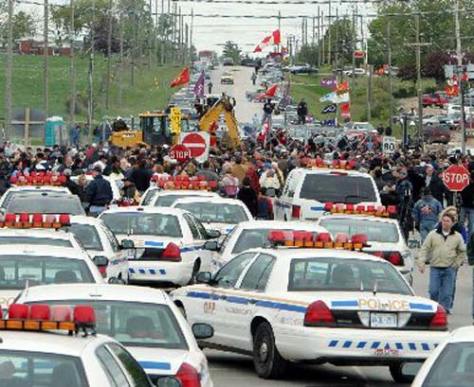
ON DECEMBER 23, 2011, Ontario Superior Court Justice the Honourable Alan C. R. Whitten rendered his verdict in the case of a vicious beating in Caledonia of builder Sam Gualtieri, by defendant and Six Nations resident Richard Smoke. The judgement has received only a smattering of press attention, most of it issuing from the National Post. My feeling is that there ought to be more attention paid, but of a sort which begins by acknowledging universal failure and the urgent need to do something constructive before southern Ontario becomes a Gaza strip of AK-47-wielding Warriors, rock throwing children, and the Canadian army. If you think this is a dramatic and paranoid fantasy, then you are simply one of the many sleep-walking Canadians who has forgotten (or never bothered to notice) that such a thing has already happened. There is no reason at present to conclude it can’t happen again.

Read More

The Niqab in Living Colour

IN AZAR NAFISI’S book, “Reading Lolita in Tehran,” the act of removing the veil is a metaphor for transitioning from the world of black-and-white into colour, and of shedding the state-imposed self to be liberated into one’s authentic, willed identity. “Black and white” is itself a good description of the cruel and stupid absolutism imposed upon Iran by the Velayat-e faqih, its antithesis colour indicating the actual and liveable world of vibrant diversity: irony, dialectic, humour, uncertainty, skepticism and multiplicity — whether in literary, moral, or political matters. In the “clash of civilizations,” the West is on the polychromatic side of the ledger against the monochrome despotisms.

Read More

Onkwehonwe-Neha: A Guide to Integrating into Turtle Island

Editor’s Note: We have noticed a great deal of controversy following the release of “Énoncé de valeurs: Des clés pour mon intégration à Gatineau.” This strikes us as curious, since documents of this sort have existed for centuries, without causing similar uproar. To cite one well-known example, we present the following English-language translation of the pamphlet, “Onkwehonwe-Neha [Our Ways]: A Guide to Integrating into Turtle Island,” published in 1557 by the Haudenosaunee and given to each new immigrant on arrival to Haudenosaunee territory.

Read More

Doing the Math in Attawapiskat

EARLY IN THE week, during an interview whose topic was the relationship in Canada between aboriginal and non-aboriginal people, I was asked what I would hope for “in an ideal world.” My answer was an alteration of political will, and more specific a beyond-mere-rhetoric commitment to a renewal of the relationship on the principle of mutual respect. I then felt it necessary to argue, along the lines of Theodor Herzl’s “If you will …” , that the only impediment to progress in Canada is the absence of political will.

Read More