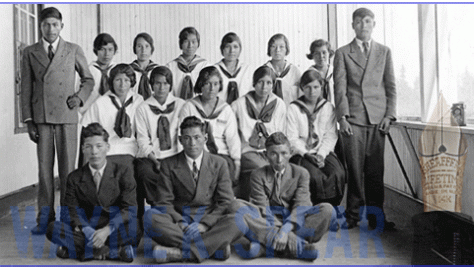
Indian residential schools were “really detrimental to the development of the human being”
CANADA’S INDIAN RESIDENTIAL School System began officially in 1892 with an Order-in- Council, yet many features of the system are older than Canada itself. Indeed, the residential school’s origins reach as far back as the 1600s – to the early days of Christian missionary infiltrations into North America.
For over 300 years, Europeans and Aboriginal peoples regarded one another as distinct nations. In war, colonists and Indians formed alliances, and in trade each enjoyed the economic benefits of co-operation. By the mid-nineteenth century, however, European hunger for land had expanded dramatically, and the economic base of the colonies shifted from fur to agriculture. Alliances of the early colonial era gave way, during the period of settlement expansion and nation-building, to direct competition for land and resources. Settlers began to view Aboriginal people as a “problem.”
The so-called “Indian problem” was the mere fact that Indians existed. They were seen as an obstacle to the spread of “civilization” – that is to say, the spread of European, and later Canadian, economic, social, and political interests. Duncan Campbell Scott, Deputy Superintendent of Indian Affairs from 1913 to 1932, summed up the Government’s position when he said, in 1920, “I want to get rid of the Indian problem. […] Our objective is to continue until there is not a single Indian in Canada that has not been absorbed into the body politic and there is no Indian Question and no Indian Department.”
In 1842, the Bagot Commission produced one of the earliest official documents to recommend education as a means of ridding the Dominion of Indians. In this instance, the proposal concerned farm-based boarding schools placed far from parental influence. The document was followed, in immediate successive decades, by others of similar substance: the Gradual Civilization Act (1857), an Act for the Gradual Enfranchisement of the Indian (1869), and the Nicholas Flood Davin Report of 1879, which noted that “the industrial school is the principal feature of the policy known as that of ‘aggressive civilization.’” This policy dictated that
the Indians should, as far as practicable, be consolidated on few reservations, and provided with “permanent individual homes” ; that the tribal relation should be abolished ; that lands should be allotted in severalty and not in common ; that the Indian should speedily become a citizen […] enjoy the protection of the law, and be made amenable thereto ; that, finally, it was the duty of the Government to afford the Indians all reasonable aid in their preparation for citizenship by educating them in the industry and in the arts of civilization.
A product of the times, Davin disclosed in this report the assumptions of his era – that “Indian culture” was a contradiction in terms, Indians were uncivilized, and the aim of education must be to destroy the Indian. In 1879 he returned from his study of the United States’ handling of the Indian Problem with a recommendation to Canada’s Minister of the Interior – John A. Macdonald – of industrial boarding schools.
The assumptions, and their complementary policies, were convenient. Policy writers such as Davin believed that the Indian must soon vanish, for the Government had Industrial Age plans they could not advantageously resolve with Aboriginal cultures. The economic communism of Indians – that is to say, the Indians’ ignorance (from a European perspective) of individual property rights – was met with hostility by settlers eager for ownership of the land. Colonization required the conversion of Indians into individualistic economic agents who would submit themselves to British, and later, Canadian institutions and laws.
The federal government and the churches – Anglican, Roman Catholic, Methodist and Presbyterian – therefore applied to their “Indian Problem” the instrument of education, also known as the policy of aggressive civilization. The initial education model was the industrial school, which focused on the labour skills of an agriculture-based household economy.
From the beginning, the schools exhibited systemic problems. Per capita Government grants to Indian residential schools – an arrangement which prevailed from 1892 to 1957 and which represented only a fraction of the expenditures dedicated to non- Aboriginal education – were inadequate to the needs of the children. Broad occurrences of disease, hunger, and overcrowding were noted by Government officials as early as 1897. In 1907 Indian Affairs’ chief medical officer, P.H. Bryce, reported a death toll among the schools’ children ranging from 15-24% – and rising to 42% in Aboriginal homes, where sick children were sometimes sent to die. In some individual institutions, for example Old Sun’s school on the Blackfoot reserve, Bryce found death rates which were even higher.
F.H. Paget, an Indian Affairs accountant, reported that the school buildings themselves were often in disrepair, having been constructed and maintained (as Davin himself had recommended) in the cheapest fashion possible. Indian Affairs Superintendent Duncan Campbell Scott told Arthur Meighen in 1918 that the buildings were “undoubtedly chargeable with a very high death rate among the pupils.” But nothing was done, for reasons Scott himself had made clear eight years earlier, in a letter to British Columbia Indian Agent General-Major D. MacKay:
It is readily acknowledged that Indian children lose their natural resistance to illness by habituating so closely in the residential schools, and that they die at a much higher rate than in their villages. But this alone does not justify a change in the policy of this Department, which is geared towards a final solution of our Indian Problem.
As a consequence of under-funding, residential schools were typically places of physical, emotional and intellectual deprivation. The quality of education was quite low, when compared to non-Aboriginal schools. In 1930, for instance, only 3 of 100 Aboriginal students managed to advance past grade 6, and few found themselves prepared for life after school – either on the reserve or off. The effect of the schools for many students was to prevent the transmission of Aboriginal skills and cultures without putting in their place, as educators had proposed to do, a socially useful, Canadian alternative.
No matter how one regarded it – as a place for child-rearing or as an educational institution – the Indian residential school system fell well short even of contemporary standards, a fact recorded by successive inspectors. A letter to the Medical Director of Indian Affairs noted in 1953 that “children … are not being fed properly to the extent that they are garbaging around in the barns for food that should only be fed to the Barn occupants.” S.H. Blake, Q.C., argued in 1907 that the Department’s neglect of the schools’ problems brought it “within unpleasant nearness to the charge of manslaughter.” P.H. Bryce, whose efforts earned him the enmity of the Department (and an eventual dismissal), was so appalled – not only by the abuses themselves but by subsequent Government indifference as well – that he published his 1907 findings in a 1922 pamphlet entitled “A National Crime.” In the pamphlet, Bryce noted that
Recommendations made in this report followed the examinations of hundreds of children; but owing to the active opposition of Mr. D.C. Scott, and his advice to the then Deputy Minister, no action was taken by the Department to give effect to the recommendations made.
Bryce’s 1907 report received the attention of The Montreal Star and Saturday Night Magazine, the latter of which characterized residential schools “a situation disgraceful to the country.” These publications, and others like them, make it clear that the conditions of the schools were generally knowable and known, by officials of the church and government, and by the public-at-large.
Because contempt for Aboriginal languages and cultures, and for the children themselves, shaped Canada’s policies toward Indians, matters continued as before despite internal reports and published accounts of abuse. In 1883, General Milroy was quoted in a British Columbia petition for industrial boarding schools as saying that “Indian children can learn and absorb nothing from their ignorant parents but barbarism.” The residential school system, designed to produce in the Aboriginal child “a horror of Savages and their filth” (in the words of Jesuit missionary Fr. Paul LeJeune), was rationalized by this contemptuous belief.
Individual beliefs about Indians, which in any case varied, did not determine the character of the individual schools. Nor were the conditions identical in each institution: students today recall diverse memories of both good and bad experiences, as well as good and bad teachers. Nonetheless, the widespread occurrence of certain residential school features suggests that structural elements were in effect. The Royal Commission on Aboriginal Peoples (RCAP) concluded in 1996 that the schools themselves were, for readily identifiable and known reasons, “opportunistic sites of abuse”:
Isolated in distant establishments, divorced from opportunities for social intercourse, and placed in closed communities of co-workers with the potential for strained interpersonal relations heightened by inadequate privacy, the staff not only taught but supervised the children’s work, play and personal care. Their hours were long, the remuneration below that of other educational institutions, and the working conditions irksome.
In short, the schools constituted a closed institutional culture that made scrutiny difficult, if not impossible. For staff the result was, in the words of RCAP, a “struggle against children and their culture […] conducted in an atmosphere of considerable stress, fatigue and anxiety.” In such conditions, abuses were not unlikely – a fact to which the experts of the day attested.
Then there are the testimonies of hundreds of former students, whose list of abuses suffered includes kidnapping, sexual abuse, beatings, needles pushed through tongues as punishment for speaking Aboriginal languages, forced wearing of soiled underwear on the head or wet bedsheets on the body, faces rubbed in human excrement, forced eating of rotten and/or maggot infested food, being stripped naked and ridiculed in front of other students, forced to stand upright for several hours – on two feet and sometimes one – until collapsing, immersion in ice water, hair ripped from heads, use of students in eugenics and medical experiments, bondage and confinement in closets without food or water, application of electric shocks, forced to sleep outside – or to walk barefoot – in winter, forced labour, and on and on. Former students concluded in a 1965 Government consultation that the experiences of the residential school were “really detrimental to the development of the human being.”
This system of forced assimilation has had consequences which are with Aboriginal people today. Many of those who went through the schools were denied an opportunity to develop parenting skills. They struggled with the destruction of their identities as Aboriginal people, and with the destruction of their cultures and languages. Generations of Aboriginal people today recall memories of trauma, neglect, shame, and poverty. Thousands of former students have come forward to reveal that physical, emotional and sexual abuse were rampant in the system and that little was done to stop it, to punish the abusers, or to improve conditions. The residential school system is not alone responsible for the current conditions of Aboriginal lives, but it did play a role. Following the demise of the Indian residential school, the systemic policy known as “aggressive civilization” has continued in other forms.
Many of the abuses of the residential school system were, we should keep in mind, exercised in deliberate promotion of a “final solution of the Indian Problem,” in the words of Deputy Superintendent of Indian Affairs, Duncan Campbell Scott. If development of the healthy Aboriginal human being meant respect of Aboriginal cultures, then indeed the regimented culture of the schools was designed precisely to be detrimental. As noted in the 1991 Manitoba Justice Inquiry, the residential school “is where the alienation began” – alienation of Aboriginal children from family, community, and from themselves. Or to put the matter another way, the purpose of the schools was, like all forced assimilationist schemes, to kill the Indian in the Indian – an effort many survivors today describe as cultural genocide. [-May 2002.]
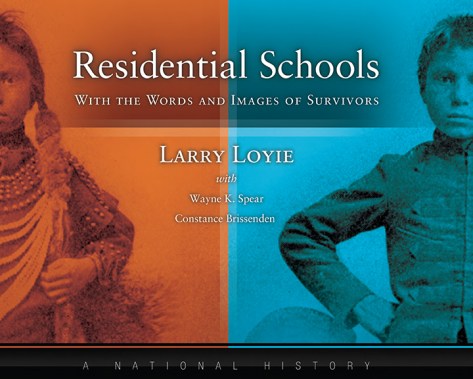
My Fall 2014 book “Residential Schools, With the Words and Images of Survivors, A National History,” is available from Goodminds. Order by phone, toll-free 1-877-862-8483.
Sources
Duncan Campbell Scott quotation from secondary source in the Royal Commission on Aboriginal Peoples. Final Report, Volume One, Chapter 13, “Conclusions” section 1. Primary source: DCS 1920 HC Special Committee.
Quotations from primary source in Nicholas Flood Davin, “Report on Industrial Schools For Indians and Half-Breeds” (March 14, 1879).
Bryce on his tour of inspection of Indian Schools in Manitoba, Saskatchewan, and Alberta. RG 10, Indian Affairs, Volume 4037, Reel C-10177, File: 317021.
Duncan Campbell Scott to Arthur Meighen quoted from secondary source in the Royal Commission on Aboriginal Peoples Final Report, Chapter 10. Primary source: NAC RG 10 VOL 6001 file 1-1-1- (1) MRC 8134. Memo for A. Meighen from DCS, Jan. 1918.
Duncan Campbell Scott to D. MacKay: DCS to BC Indian Agent Gen. Major D. MacKay. 12 Apr. 1910. DIA Archives RG 10 series.
Education attainment (“3 of 100 Aboriginal students”) quoted from the Royal Commission on Aboriginal Peoples Final Report, Chapter 10.
Quotation from National Archives photo. See also David Napier, “Sins of the Fathers” in the Anglican Journal (May 2000).
S. Q. Blake quotation from secondary source in the Royal Commission on Aboriginal Peoples Final Report, Chapter 10 note 168. Primary source: Anglican Church of Canada General Synod Archives. SH Blake File G. S. 75-103. “To the Honourable Frank Oliver, Minister of the Interior,” 27 Jan. 1907, quoted in “To the Members of the Board of Management of the Missionary of the Church of England,” 19 Feb 1907.
P. H. Bryce quotation from P.H. Bryce, “Report by Dr. P.H. Bryce on his tour of inspection of Indian Schools in Manitoba, Saskatchewan, and Alberta.” RG 10, Indian Affairs, Volume 4037, Reel C-10177, File: 317021.
Saturday Night quotation from secondary source in Royal Commission on Aboriginal Peoples Final Report, Chapter 10. See note 161 for primary source: NAC RG 10 Vol. 4037 file 317021 MRC 10177. Articles appeared in Montreal Star on 15 Nov. 1907 and in Saturday Night on 23 Nov. 1907.
General Milroy quotation from Tolmie, William Fraser, “On Utilization of the Indians of British Columbia,” (Victoria: Munroe Miller, 1885).
Fr. Paul LeJeune quotation from secondary source in McGillivray, Anne, “Therapies of Freedom: The Colonization of Aboriginal Childhood” in McGillivray, Anne, ed., Governing Childhood. (Aldershot: Dartmouth, 1997). See note 55 for primary source.
Quotation from Royal Commission on Aboriginal Peoples Final Report, Chapter 10.
Personal testimonies taken from the Royal Commission on Aboriginal Peoples Final Report, and from Breaking the Silence: An Interpretive Study of Residential School Impact and Healing, as Illustrated by the Stories of First Nation Individuals. (Ottawa: Assembly of First Nations, 1994).
Government consultation quoted from secondary source in the Royal Commission on Aboriginal Peoples Final Report, Chapter 10. See note 291 for primary source: INAC File 1/25-20-1 Volume 1. “To Miss …. From L. Jampolsky.” 16 Feb. 1966 and attached correspondence.


 Journalism, Essays, Broadcasting, Books