Tag Archives: Stephen Harper

Ottawa’s policy vacuum undermines its oil sands rhetoric

OIL: it’s an imposing and multi-faceted topic, into whose orbit come geopolitical intrigue, war and empire building. Oil fuels our modern industrial comforts and conveniences, as well as our controversies. In many parts of the petroleum-rich world — Iraq, Saudi Arabia, Sudan, Nigeria —  it has engendered violence and state corruption. A blessing of mixed character, oil production and its inevitable politics have arrived on a massive scale to Canada, most of it in the form of bitumen. Civil war and autocracy are unlikely in this democratic, rule-of-law nation, but don’t expect a smooth journey. There are battles ahead, and the evidence suggests Canada is ill-prepared both for its scope and scale.

Read More

Ottawa mixes platitudes with parsimony for Canada’s veterans

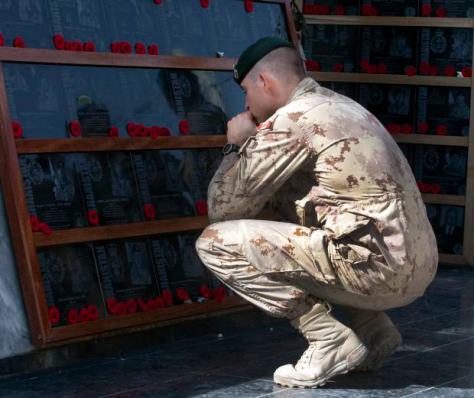
AT FIRST GLANCE the federal government’s proposed changes to the Department of National Defence’s soldier suicide prevention program is an offense against common human decency, and it doesn’t much inspire confidence that this news arrives from the Minister of National Defence, who has made headlines in recent months for indulging himself needlessly on the public dollar. The principle that Austerity Is Good For Everyone Else is a familiar hypocrisy, and on this foundation we now apprehend Parliamentarians such as Peter MacKay and Bev Oda.

Indulgence necessarily brings us to the question, Why are these under-performing lugs still warming their over-priced Centre Block seats? Why is a mediocrity and liability like MacKay able to preside over the affairs of veterans, praised by politicians when it’s a matter of expedience but otherwise under-valued, in this supposed time of cost-consciousness? Was Conservative MP Rob Anders representing the sentiments of his caucus when he fell asleep in a Halifax meeting with veterans? Perhaps Ottawa is no longer alive to the pulse of the nation anywhere. One thing is certain. To promote the interests of soldiers has been, in recent years, to know the indifference of the federal government. Speaking of Halifax: consider the five-year battle of Nova Scotian Dennis Manuge, which this week ended with a Federal Court of Canada ruling against the government’s claw-backs of SISIP long term disability benefits for disabled veterans. According to a May 2 press release of the Veterans Ombudsman, “all witnesses who appeared before us, with the exception of witnesses from the Department of National Defence, felt the reductions were indeed unfair.”

This business of nickel-and-diming those who have served in the armed forces is neither new nor restricted to Canada, but it rankles nonetheless. Mr. MacKay claims that “Canada has become a world leader in fighting the stigmatization and raising awareness of PTSD and other operational stress injuries,” but in the meanwhile his department has forced veterans to take legal action and has brought substantial grief to Canada’s Veterans Ombudsman Guy Parent, on issues ranging from denied claims for the Agent Orange ex gratia payment to decisions made by the Veterans Review and Appeal Board. Now, despite the Department of National Defence’s acknowledged priority of post-deployment PTSD treatment and suicide prevention, the politicians appear to be offering little more than vague platitudes and assurances of commitment.

It’s not only bad politics to deny services to disabled and distressed veterans, it’s bad policy. As bad policy, the government’s ill-considered parsimony undermines the relationship of trust and reciprocity between those who serve and those who are served. As bad politics, this instance of mealy-mouthing and short-changing makes the Harper Government look distant from, and unresponsive to, Canadians of every variety. But these are matters for Canadians themselves to weigh — and, Mr. Harper, you can be certain that they will.

How J.S. Woodsworth opposed the war and saved capitalism

J. S. Woodsworth

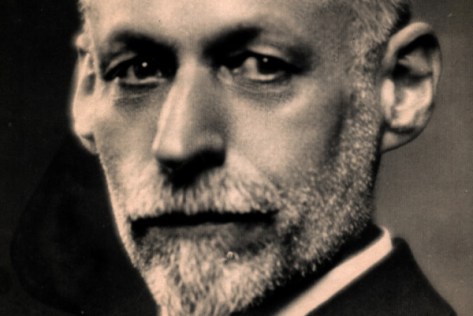
ONE MIGHT HAVE anticipated, with all the recent talk of conscience rights, that J.S. Woodsworth would soon enough become a hash tag. But not as the object of a slander. The man who once led the Co-operative Commonwealth Federation was nothing if not conscience driven. His lifelong, principled commitments to the Social Gospel, socialism and pacifism were amply rewarded — both by the Methodist church and the nation which he dutifully served — with accusations of sedition, criminal charges, harassment and imprisonment. Whatever one’s politics, one could do worse than to emulate the spine of this man.

Read More

Why Michael Sona will go down alone for the robocall scandal

LAST WEEK, Liberal leader Bob Rae warned that the federal political culture of Canada is ‘entering into a kind of Nixonian moment.’ This all-thumbs assertion lacks definite substance and grip — we’re in a kind of like, you know, moment thing — but has its use. For almost a year we’ve known of the Robocall mess, media reports having been issued since election day. Now the plot, and the rot, thicken. Here I refer to the top-shelf work of Stephen Maher and Glen McGregor of Postmedia News, under our present analogy the Bob Woodward and Carl Bernstein of this vote suppression scandal. Reviewing the evidence they’ve patiently assembled, can you now doubt a wide and active campaign of fraud in the 2011 election?

Read More

One Empty Chair and Many Empty Words

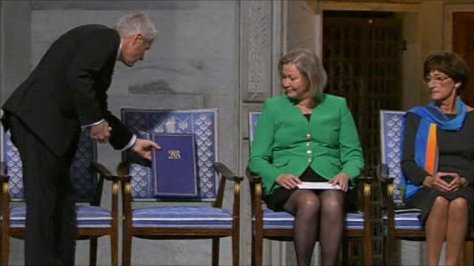
THERE ARE A few rules to which I’ve held myself as a professional speech writer. Do your homework, know and respect your audience and the protocols governing the occasion, and always prefer the plain truth that will not please your audience over nice-sounding and gratifying words that aren’t so. Or, as I’ve had occasion to summarize: it’s better to deliver bad news that you can guarantee than it is good news that you are confident you can’t.

Read More

The Conservative Party’s courting of China is shameful

I KNOW FROM experience the most efficient way to start a fist-fight in some circles is to use, without irony, the word evil. As in the phrase Axis of Evil. On this principle, George W. Bush was mocked for years by lefties who noted condescendingly (though correctly) that the President’s eyes were just a bit too close together for the nation’s good. One afternoon in the mid 90s, the man who would memorably link Iran, Iraq and North Korea — Bush Jr’s speechwriter, David Frum — passed in front of my car while I was at a red light. I confess repressing an urge to step on the gas. Some years on, however, I’ve a greater respect for Mr. Frum, and in part it’s due to the fact that I think there really is such a thing as evil, perhaps even in axis form.

Read More

The Crown-First Nations Gathering: a parting of the ways

OVER THE PAST few years I’ve had some off-the-record discussions with senior federal bureaucrats and politicians, folks who are in a position to know of what they speak. In such company the prospect of the politically practicable invariably rises to the river’s surface, through implication or, more often, inferences. Here the word “inference” alludes to the immovable fact that even in those cases where the spirit is willing, the flesh is bound to cabinet confidence and other such protocols of discretion. Hearing what I’ve heard, and seeing what I’ve seen, I’m not at all surprised by the outcome of the recent Crown-First Nation Gathering in Ottawa.

Read More

Palestinian Statehood: a plague on your houses

AT SOME point, without the help either of the nudge or the wink, I’ll wager you have grasped through one commonplace observation the cynical and fraudulent character of the more crude manifestations of American nationalism. Well, are you in? Good. The observation to which I refer is the Chinese manufacture of so many American flags.

Read More

The Harper Government: Merchants of Death

LOOK OUT the window of my Elgin and Albert Streets office, one block south of Parliament Hill in Canada’s Capital, and you will see before you a building in part reduced to rubble. The reason is that this Government of Canada edifice contains asbestos, or as it is now more commonly known, chrysotile. Across the city and the nation, this poisonous stuff is being extirpated. And, at the same time, the current Prime Minister of Canada is actively abroad promoting its sale, in what are euphemistically termed developing countries. If that in itself is of insufficient force to turn your stomach, please do yourself the favour of reading on, for there’s more.

Continue reading The Harper Government: Merchants of Death

The Derelict Honourary Chief of the Blood Tribe

It’s been more than a few years now since my afternoon Calgary chat with a Kainai (Blood) acquaintance, but I do remember a bit of the history lesson I received that day. One thing I recall above all else is a sensation of correspondence: the Haudenosaunee have the largest population within Canada’s borders, the Kainai the largest land base; the Haudenosaunee are known to be of an independent cast of mind, so too I gathered from my interlocutor the Kainai. (The name is pronounced “Ken-Eye,” and fittingly means something like Many Chiefs.) I left the conversation that day rather feeling a sense of kinship, which is unusual for me in most any social encounter.

Continue reading The Derelict Honourary Chief of the Blood Tribe

The Sponsorship Scandal Still Matters

One of the very few politically  insignificant legacies of the Sponsorship Scandal is that ever since I have been of a sympathetic disposition toward the then Minister of Human Resources Development, Jane Stewart. She more than any politician — and here I include Paul Martin, who clearly was designated by the early-retiring Jean Chrétien as the bag holder — was bespattered by the ill-will which finally brought to an end what seemed the inevitability of Liberal rule in Canada.

Continue reading The Sponsorship Scandal Still Matters

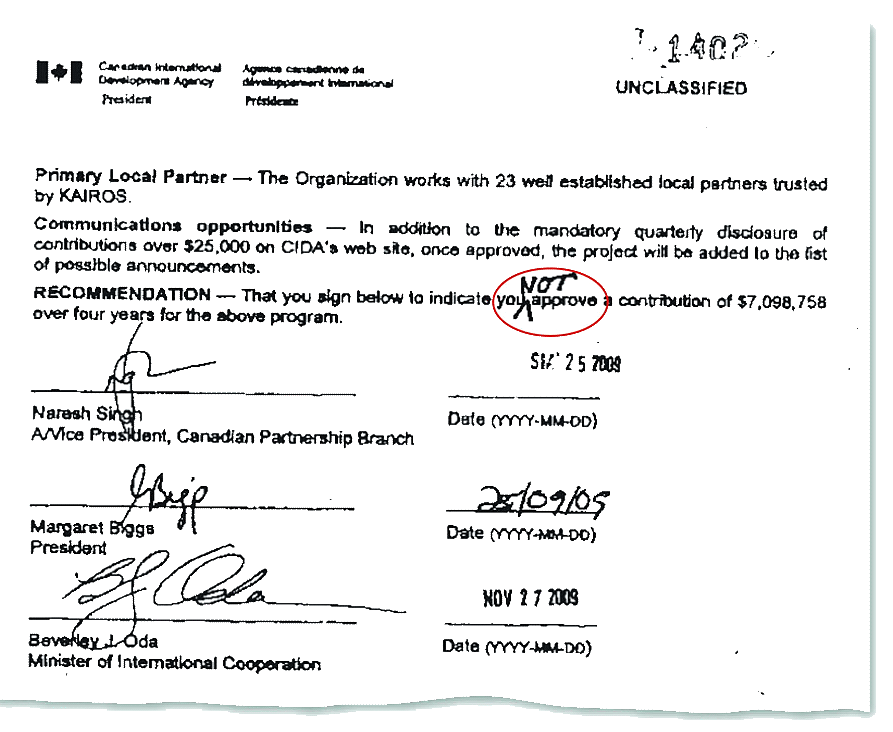
Stephen Harper’s Kairos Smear Campaign

Among the most offensive character traits of the Harper Government is the indolence of its cynicism. How stupid does the current occupant of 24 Sussex Drive take us to be, and how easily lost does he suppose we will become amidst the transparent undergrowth of non-sequitur, evasion, and the changings of the subject? Quite and very, it would appear.

Continue reading Stephen Harper’s Kairos Smear Campaign

Gun Talk, Stephen Harper, and the Usefulness of Hate

On the list of things in which I myself am simply incapable of taking interest, but which appear to invoke a great deal of interest among a great many people — a list which includes Hollywood, professional sport, inspirational best-sellers, Twitter, and Lady Gaga — the issue of gun control is rather near the top. Perhaps I lack an otherwise commonplace enzyme, organ, or bit of DNA. In any case I could not care less about the current long-gun registry debate, and it is only the apparent fact that many could not care more which has my baffled attention. Continue reading Gun Talk, Stephen Harper, and the Usefulness of Hate

The G20 and the Bullet Dodged

If you are like me, you spent the past week looking forward to the end of the Toronto G20 summit, hopeful you could ignore it entirely; and if you are very much like me, you further hoped the event would pass without cause for comment.

Just so, most of it did pass without comment. Very little appears to have been written about the discussions themselves, which involved the usual stuff: growth, reductions of deficits and of taxes on capital, increased taxation of consumption, promotion of trade liberalization. The very things forever recommended by the World Bank and the International Monetary Fund, the agencies under whose auspices the G20 briefing documents were drafted. Now the “premier forum for international economic cooperation,” the G20 summit is a technical affair, not nearly as exciting as, say, burning police cars.

There is a patch of Canadian society which boasts the agitprop cliché that Canada is a police state. This idea is an instance of intellectual laziness, leveling the world’s moral terrain to make easier for the discontented their ascent to the heights of indignation. The Left, in Europe and North America, is now populated by “moral equivalentists” – folks who opposed the invasion of Iraq on the grounds that there is no difference between George W. Bush and Saddam Hussein. They have read enough Noam Chomsky to know that Robert McNamara and Henry Kissinger were wicked, and that U.S. foreign policy has been responsible for enormous human suffering around the world. So it has. The unfortunate legacy of Chomsky’s brilliant, original, and useful writings on, for example, East Timor, is a generation of half-educated rabble-rousers who will side with anything that is “against” the United States of America. Well, that simplifies things: The Saddamists are against America, so let’s be for that. The 2001 attacks on the World Trade Center buildings were attacks on Capitalism and American arrogance, so of course let’s sympathise with the attackers.

This kind of reasoning — if that’s even what it is — evidently relishes the destruction and taints a good measure of the political spectrum, from liberal democrat to anarchist. But consider: the time is not far off when the U.S. won’t even be the leading player in global politics, particularly in Africa, Southeast and Central Asia. That dubious honour will go, and is already going, to China. As for the idea that violent jihadism is a response to U.S. foreign policy, I’ll only suggest that this narcissistic idea misses the point. What we are seeing today in Central Asia and the Middle East is the continuation of a civil war in the Islamic world which predates American foreign policy and which has nothing to do with it whatsoever. One is better served on this topic by an understanding of the history and demise of the Ottoman Empire than by, say, a working knowledge of the Marshall Plan. (Better yet would be both.) This may seem a straying from the topic, but it is not. The people who see no difference, or at the least claim to see no difference, between the Taliban and Starbucks, are the same who constitute the flame-and-truncheon photo-ops. So let’s be clear: Canada is not a police state, and intellectual rigour demands of us a higher standard of analysis and more careful use of language.

It is however disheartening and discouraging, don’t you find, to witness the state playing dress-up, flirting momentarily with the trappings of dictatorship? I expect it’s been pointed out to you that the G20 summit was mostly a peaceful event, and indeed that is the case. Yet it could well have been otherwise. A great deal has been said and written of the Black Bloc tactics, with particular attention to the menace of their head-to-toe black clothing. A strategy of deliberate intimidation, it perfectly mirrors the contemporary riot squad, who have adopted precisely the same look. Why on earth are governments, and in this case the Canadian Government, needlessly cultivating such a vulgar dialectic? – and in the heart of Canada’s most densely populated city? What stupidity, and what vain recklessness, to roll the dice on the public’s safety in this manner. Perhaps the next time (and there will be a next time, maybe in your city) the peaceful bits will be the anomaly. If that is the case, the Government won’t even have the benefit of our doubt. They must know, as those familiar with mass human behaviour know, that in a moment things can go terribly wrong. And when they do, the inquiries and assignments of blame will be of no use to the victims.

Nothing asserted to this point has considered the value of these meetings and the conduct of the police. Even if one assumes that the G20 summits are of great utility, and that the police have over the past week behaved in an excellent manner (and these are far from settled assertions), the brick-headed folly informing this past weekend is, I hope, apparent. For it is unnecessary, irresponsible, reckless, and grossly wasteful of Canada to abet these periodic episodes of impromptu mass political theatre. Bullets were dodged this weekend, and fortunately, this time, that is a metaphor.