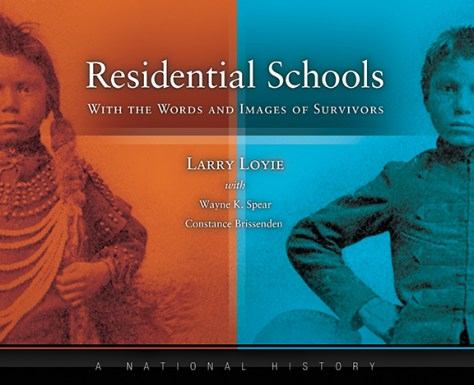
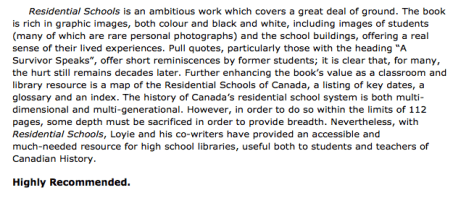
Click on the image to go to the CM Magazine review.

Click on the image to go to the CM Magazine review.

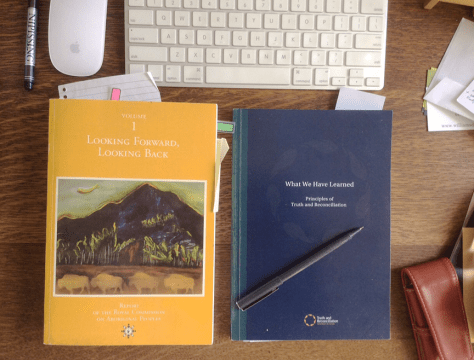
A COUPLE WEEKS AGO, Zoe Todd posted a YouTube video inviting people to read from the Truth and Reconciliation Commission of Canada’s 388-page executive summary. The video was conceived by Erica Violet Lee and co-organized by Zoe Todd and Joseph Murdoch-Flowers, and its inspiration came from Chelsea Vowel’s blog post “Reaction to the TRC: Not all opinions are equal or valid.” Ever good one, that.
You can read a CBC article about this project here.
As a result of these amazing folks, people are now posting their readings of the TRC summary on YouTube.
Chelsea’s post, which I recommend, was itself a response to Conrad Black’s National Post article “Canada’s treatment of aboriginals was shameful, but it was not genocide.”
Black took up a Utilitarian argument, heavily inflected by 19th-century tropes and by the White Man’s Burden—arguing that European civilization was such a gift to the natives that there’s no way you could call what Canada attempted genocide, even if you preface it with the qualifier cultural.
His point-of-view, that aboriginal people should be thankful for the gifts of human civilization, has a vocal following. Maybe not a majority following, but likely a sizeable minority. And since it’s a common enough position, it should be aired and not just dwell in the dirty cracks of CBC’s comment section.
I love a heated debate, and I’d be happy to undertake one in my (limited) spare time. But, OK, I’m coming down now from the soapbox. Lord Black is not the point of this post!
That National Post article has indirectly inspired a YouTube campaign, in which ordinary people—i.e. people who are not referred to in public as “Lord Such & Such”—are reading the very report that Black dismisses—without having read it! Seems to me like a decent turn.
But I had another idea, too. That’s the real reason I have written this post—to tell you about my idea.
It’s called 94ways. I’m not 100% settled on this name, but it’s the best I’ve come up with so far, in my opinion.
The idea is to create a website and the related social media where people can post simple, practical, actionable ideas related to each of the 94 recommendations of the TRC’s document Calls to Action. It could be an idea they are planning to do, or one they’ve already done. We could all brainstorm. We could trade experiences and stories. We could bring the report to life.
Nowadays you can even do things like organize a Meetup or host a Webinar. All of this could be part of the 94ways.com or 94campaign.com or 94toRestore.com or whatever it ends up being called.
All of this and more. The only limits are imagination, human will, and courage.
Years ago I had a conversation with Georges Erasmus about RCAP—the Royal Commission on Aboriginal Peoples. (Actually, we had a lot of conversations over the years about RCAP!)
Georges was reflecting on the 1996 final report. It had just come out, and he was looking forward to a holiday, after his intense traveling and media work around that extraordinary and unprecedented five-volume, 4,000-page work.
You see, he went straight from being National Chief of the AFN to being co-chair of the Royal Commission. Every time the man tried to take a holiday, someone would arm-twist him into another job. In fact, that’s what happened after RCAP. Phil Fontaine called and said, “Georges, you’ve got to come help create this Aboriginal Healing Foundation. If we don’t do it by April 1st, we’ll lose the $350 million.”
Georges said, “I’m not looking for a job, Phil!” But it was futile.
He spent the next 14 years at the AHF, and even today he is hard-at-work, building up a nation run by the Dene, for the Dene.
Anyway, what Georges told me was that, just as the report was to be distributed, the feds pulled the funding. As a result, RCAP lacked the resources it needed to properly and effectively get the report into the hands of Canadians.
Remember, this is before YouTube and Twitter and Facebook. It would be years before the technology existed to put RCAP on the Internet, and even more years before anyone did. (You can now find it here.) So back then, if you didn’t have an actual printed copy, you were pretty much out of luck.
And most of us did not have printed copies.
RCAP’s final report became a cliché: you know, the report that collects dust sitting on a shelf. Only I doubt it even did sit on a shelf in more than a couple Parliamentary offices. There were some great efforts to get the word out, for example by reading the entire report, page-by-page, on the radio.
A few lucky people (like me) managed to get the report on CD, but back then the technology was so primitive that they may as well not have bothered. It was designed for installation on a server running Windows NT, because back then a five-volume report was basically an unimaginably huge amount of data—certainly not something you’d pop into your lousy desktop.
I never did get that darn RCAP CD-ROM to work!
I’m sure the feds were happy to have a report no one could access. Because that meant no one could challenge the government to do something.
Well, it’s now 2015, and the people can do all sort of things. It will be 100% impossible for Mr. Harper and his kind to bury the TRC report, the way RCAP was buried, although they will try as best they can.
And they will fail.
Contact me if you think 94ways is a good idea.
Update (06/25): I have registered the domain 94ways.com and am gradually building the site. You can now visit and have a look around. The next step is to create the social media accounts. I hope to have this done in the coming days. Please share your comments, ideas, suggestions or other content here, or at 94ways.com. Thanks!

BRITISH COLUMBIA’S Education Minister, Peter Fassbender, announced late last week that the province will introduce a new education curriculum on Aboriginal cultures and history this autumn.
Education was a focus of the Truth and Reconciliation Commission of Canada’s 94 recommendations. (Download the TRC’s “Calls to Action” document here.)
Here’s an excerpt from the TRC’s education-specific recommendations:
Education for reconciliation
62. We call upon the federal, provincial, and territorial governments, in consultation and collaboration with Survivors, Aboriginal peoples, and educators, to:
i. Make age-appropriate curriculum on residential schools, Treaties, and Aboriginal peoples’ historical and contemporary contributions to Canada a mandatory education requirement for Kindergarten to Grade Twelve students.
ii. Provide the necessary funding to post-secondary institutions to educate teachers on how to integrate Indigenous knowledge and teaching methods into classrooms.
iii. Provide the necessary funding to Aboriginal schools to utilize Indigenous knowledge and teaching methods in classrooms.
iv. Establish senior-level positions in government at the assistant deputy minister level or higher dedicated to Aboriginal content in education.
63. We call upon the Council of Ministers of Education, Canada to maintain an annual commitment to Aboriginal education issues, including:
i. Developing and implementing Kindergarten to Grade Twelve curriculum and learning resources on Aboriginal peoples in Canadian history, and the history and legacy of residential schools.
ii. Sharing information and best practices on teaching curriculum related to residential schools and Aboriginal history.
iii. Building student capacity for intercultural understanding, empathy, and mutual respect.
iv. Identifying teacher-training needs relating to the above.
There are many more education recommendations in Calls to Action. Murray Sinclair, Chair of the TRC, has said that “Education is the key to reconciliation.”
It makes sense for him to say this. The residential school system was an education system of a sort. It didn’t provide much at all by way of skills or learning. Mostly, it was a child labor system.
Always poorly-funded, the residential schools depended upon the output of child workers. Relatively little teaching and learning took place, especially until the 1950s, when reforms gradually were introduced.
The point is that the present-day education system can help to redress what was done by an education system of the past.
For this reason, I’ve been working for years on residential school curriculum. One of the projects with which I’ve been involved—”100 Year of Loss”—is already in use in two Canadian school systems, Nunavut and Northwest Territories.
Next month, I’ll start work on an exciting new curriculum project which I will say more about when the time arrives.
In the meantime, I commend British Columbia. And I look forward to more school systems responding to the TRC’s recommendation to “make age-appropriate curriculum on residential schools, Treaties, and Aboriginal peoples’ historical and contemporary contributions to Canada a mandatory education requirement for Kindergarten to Grade Twelve students,” in “consultation and collaboration with Survivors, Aboriginal peoples, and educators.”
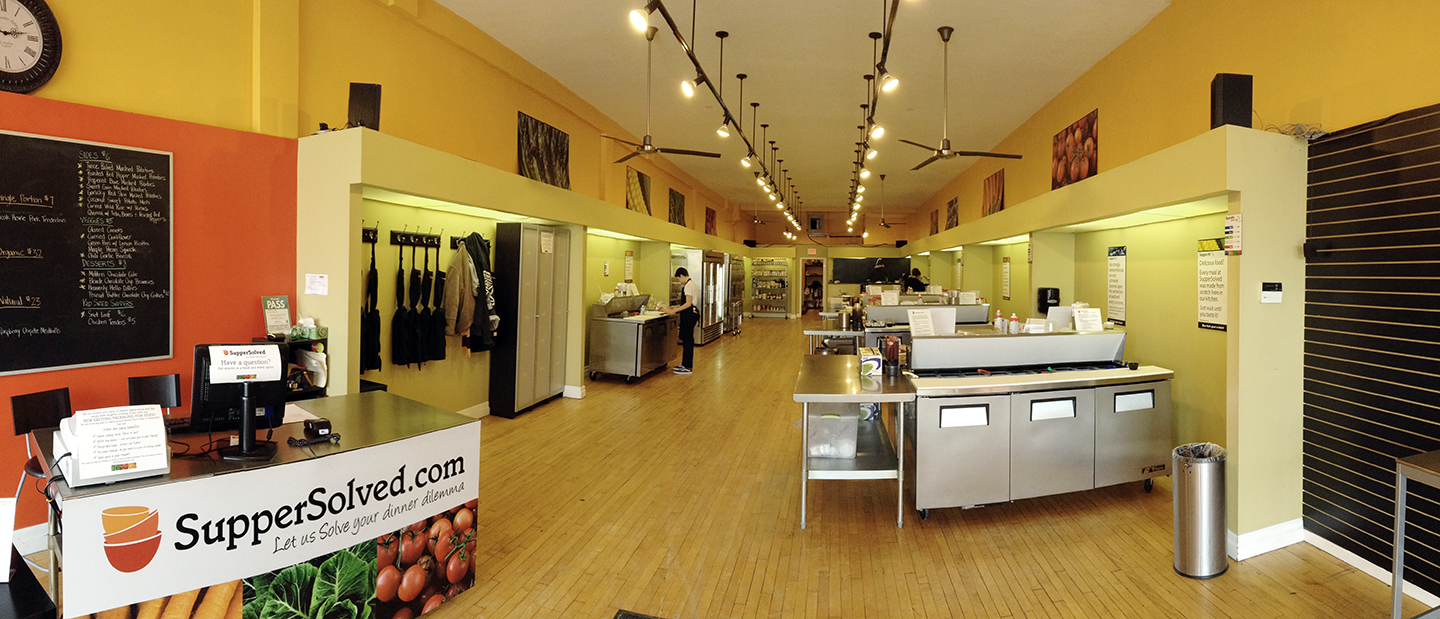
I RECEIVED SAD news this week that a neighbourhood business, SupperSolved, will be closing after eight years of operation.
I only found out about this service months ago, and have only been using it since March. And, yet, it’s become an integral part of my daily life.
SupperSolved is one of the most well-thought-out businesses I’ve come across. You can tell attention has been paid to every detail, and to the overall experience of the customer.
The idea is simple, but brilliant. For a reasonable cost (a month’s worth of entrées costs me $360) you get access to a beautiful, clean work space and all the ingredients you need to make meals. Everything is pre-cut and arranged when you arrive. It’s like having your own sous chef. All you do is follow the recipes and assemble the meals, placing them into the provided foil trays. Then you take the trays home and freeze them. It takes an hour-and-a-half for my son and I to assemble a full month’s worth of meals.
He enjoys preparing the dishes, as do I. I think that learning to cook is such an important life skill that I take him out of school to do this. And I enjoy having with me. The staff also tell me they love seeing father and son working side-by-side, cooking their family meals. Everyone is sad that, at the end of this month, this will all come to an end.
It’s such a great business model that I would buy it if I had the time and energy to run another business. I’m told the owners are looking for another space. The issue is condos. All around the area of Toronto where I live, land owners are selling their properties to developers. Businesses are being driven out. And I get it: we need places to live at least as much as we need shops. I’m not among Toronto’s many high-rise haters. I think population density is the only way we can go. We have to build up, and there;s limited real estate on which to do it.
Still, I’m sad to see this business go. I’m also inspired by it. As someone who helps clients build powerhouse businesses, I’m forever on the lookout for good models and success stories. SupperSolved was one. The staff were friendly and helpful. The cost was reasonable. The space was big, bright, clean, organized and pleasant. The level of organization and attention to detail was extraordinary. SupperSolved took all the stress out of meal planning. Having found them, I was liberated from the awful daily chore of taking time from my busy working day to think about dinner—and then to shop, clean, prep, and serve. And clean again.
I dread going back to the stressful, inefficient, costly and irksome daily routine I had before. The fact is I’ve experienced liberation. And because of that, I don’t think I can go back. When you come into contact with a brilliant idea—and, more important, a brilliant system—”going back” isn’t an option.
The experience has given me insight into what I want in my own work. I want to have just this effect on my clients. I want my business to be a comprehensive, well-thought-out system that changes the lives of people who use it for the better. I want to make a practical difference, the way that SupperSolved has made a practical, pleasant, liberating difference in my life. And I want them not to go away, but that’s another matter.

THERE’S A coin-operated laundry room in the building where I live. Each load, washer and dryer, is $1.75. That’s $3.50 for a full, wash-and-dry cycle. The machine-mounted coin collector has one slot for loonies (that’s a one-dollar-coin, for you non-Canadians) and one slot for quarters.
Yes, it sounds like the beginning of a math quiz. But in reality this a tale about human psychology.
For three years, I’ve been buying rolls of quarters and loonies from the bank to feed the laundry machines. Because there is a slot for both loonies and quarters, I enter my $1.75 in the form of one looney and three quarters. I’ve done it this way every time, for three years.
The coin tray is regularly raided for soft drinks, bus fare, coffee, and other items. Every day pockets are emptied, and coins are deposited in the tray. Eventually either the looney or quarter supply is depleted. The dollar coins are typically the first to go, leaving behind a bunch of quarters.
That’s what happened recently. So I go to the nearby convenience store to rebalance the quarter-looney ratio, because it’s one looney and three quarters to do a load of laundry. And all I have is a tray of measly quarters.
Have you spotted the fallacy I’ve been under for three years? It’s obvious once someone points it out to you, as it was pointed out to me this week.
It’s not one looney and three quarters to do laundry, it’s $1.75.
One of my family members came up with the idea. What if we just took the quarters and put 7 of them into the machine? The answer, of course, is that you get to do a load of laundry. No loonies required.
It’s remarkable to me that a household of highly-educated people could have missed this for so long. Talk about the obvious. And yet a machine with one slot for quarters and one for loonies has a subliminal ambiguity built into it. Is this a system which provides options, or is it delineating the requirements? Sub-consciouly we had decided upon the latter: there’s a slot for loonies and quarters because 1+3 is the inviolable rule.
It got me wondering about how many versions of this I’m living in my life, right now. Where else am I unnecessarily putting loonies and quarters into slots, metaphorically speaking? What else am I doing uncritically, mechanically, unconsciously? How many insights, breakthroughs, leaps, mind expansions, and personal liberations could I be effecting?
The lesson I’ve drawn is that opportunity is all around. What is required is a mindset that is ever-vigilant, always on the lookout for a new and better way: a mental attitude that says “don’t limit yourself by tacitly accepting things as they are.” There is always another way, if you go looking for it.
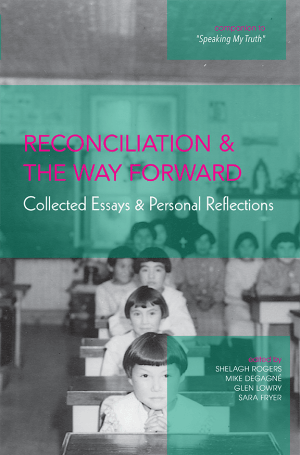
LAST WEEK in Ottawa I had the pleasure of launching the book Reconciliation & the Way Forward with my friends Shelagh Rogers, Glen Lowry, Sara Fryer and Mike DeGagné. I contributed an essay (“Time to Get Our Indian Act Together for First Nations Students”) that was previously published at the National Post. Click on the image above to download a 4.2Mb PDF version of the book.
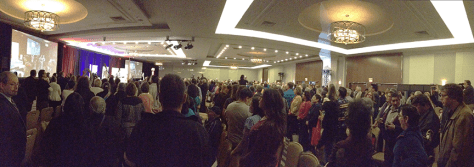
It’s a sunny Tuesday in Ottawa, and I’m having shawarma with my son on Bank Street. We are the only customers this late in the afternoon. On the TV there’s a live broadcast from the nearby Delta Hotel, where I too had been only minutes ago. Earlier in the day, the Truth and Reconciliation Commission of Canada released its report “What We Have Learned: Principles of Truth and Reconciliation.” As I eat my shawarma I try to imagine all the restaurants, all the bars and lobbies and lounges across Canada, and elsewhere, that this broadcast is reaching.
It’s difficult to summarize how I feel.
It’s earlier in the week and I am tucked into a corner of the second-floor balcony, looking into the Delta foyer. There are people everywhere. It smells of burning sage and the grilled chicken from the restaurant below. Voices combine to an indecipherable roar that resembles crashing water. The noise is punctuated by the sounds of forks surrendered to exhausted plates, of drumming, of abrupt laughter. A drum group whose members include Wab Kinew plays a song, and right above the drummers, on the same second-floor balcony to which I’ve escaped, the Primate of the Anglican Church of Canada taps his foot.
My senses are numbed. It’s relieving, and also a bit strange, to realize that I can walk two blocks in any direction and find myself in the sleepy day-to-day of downtown Ottawa.
I see many familiar faces. I’ve been at this long enough now that I catch myself reminiscing about the old days. The people I talk to agree: it was different then.
Twenty years ago the pain of Indian residential schools was raw. It tore through the rooms where we gathered. Anger and hurt so fresh, so intense, it was frightening to behold. I’ve lost count of the gatherings of residential school survivors I’ve attended—some well over a decade before there was a TRC—but the emotions are something you can never forget. I knew more than a few senior bureaucrats who didn’t mind admitting they were terrified, half-convinced they wouldn’t get out unscathed.
All these years later, there are survivors of terrible abuse who are telling their story for the first time. The familiar anger, and the hurt, remain. But the mood at this week’s final event is not what is used to be at gatherings of this sort. We aboriginal people are stronger than we were. We are no longer so filled with shame and self-loathing that we are unable to talk about what happened in those institutions. Survivors know that it wasn’t their fault, and one by one they are letting go of the destructive emotions which have held them back. We are looking to the future, and we’re in no mood to settle for anything less than what we consider good and just.
Healing and reconciliation, as Justice Murray Sinclair notes, are personal matters. It’s up to individual survivors to assess progress. Everyone wants to believe, but when it comes to the relationship between aboriginal people and the Canadian government we are all agnostic. For a century now native people have complained of politicians who deal only in fine-sounding words. Although the mood of the week is positive, I note the standing ovations given to people who, like Ellen Gabriel, have had their goodwill and patience depleted—not only by inaction but by government actions which are seen to contradict the spirit of reconciliation.
Here, at the Truth and Reconciliation Commission’s final event, we are reliving the June 2008 apology. On that day the painful experiences of aboriginal people were recognized and validated by every political party, including the Prime Minister of Canada, Stephen Harper. No longer could anyone credibly argue (as I remember people did) that there was nothing to apologize for, beyond perhaps the unfortunate zeal or wickedness of “a few bad apples.” Now, as in 2008, we were receiving official acknowledgement of the pain and injustices inflicted on us.
It took decades to get here. Years of survivors telling their stories, year after year pushing for recognition, apology and restitution. It’s been over 20 years since Phil Fontaine saw his story of residential school abuse on the front page of the Globe and Mail. (He later told me he didn’t expect this airport conversation to end up in print.) In the years following this revelation, many hundreds of survivors organized themselves.
A remarkable coalition formed around the cause of truth-telling, healing and reconciliation. Survivors, churches, activists, artists, politicians, elders, front-line workers, citizens, and other joined for a common cause. Survivors and their supporters published books and commissioned reports. They created support groups and lobbied for an apology. They launched what would become Canada’s largest-ever class action lawsuit, the Indian Residential School Settlement Agreement.
Out of this exhausting and relentless effort came the Truth and Reconciliation Commission. To understand the feelings in that room, as the TRC summarized its findings, you have to understand the amount of time and work that went into making that day a reality. In terms of sheer human will and commitment, the determination to have the history of Indian residential schools properly recognized rivals anything else this country can put up—including the building of a transcontinental railroad, or the establishment of a nation from sea to sea.
It’s done now. There’s no turning back.
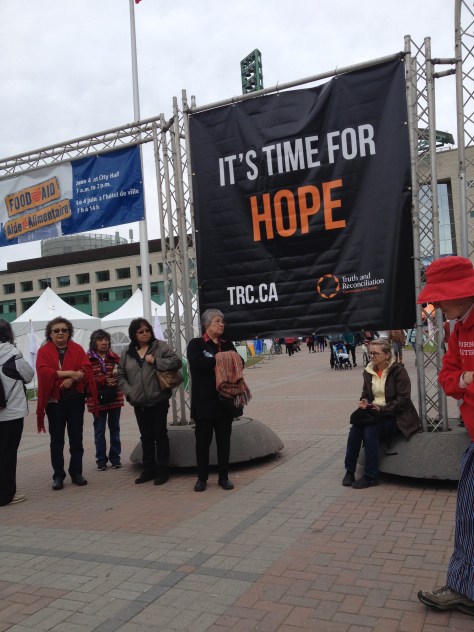
Will Canadians learn anything of useful value from the Truth and Reconciliation Commission of Canada? Will they even be interested in doing so?
These and other questions are on my mind as I prepare for the final closing events of the TRC, from May 31 to June 3. I don’t expect to find the answers to my questions in Ottawa. It will take years to assess the efficacy of this commission. And ordinary Canadians, not the Establishment, will be the ones who decide. Or perhaps not.
I’ve been asking questions about the Indian residential schools, and looking for answers, for a quarter century now.
In the early years of the last century, my grandfather Gowandehsonh was in the Anglican-run Mohawk Institute (the longest-running Indian residential School, better known today as the Mush Hole). He rarely spoke of it, mentioning as we drove by the building that he used to dig in the moonlight for raw potatoes to eat. This information—delivered casually and in passing—came without context or further explanation, and young as I was I could do nothing but sit in confused silence.
In the 1990s I began studying the residential schools for my doctoral thesis. Around the time former AFN National Chief Phil Fontaine went public with his story of residential school abuses, and others soon came forward. In 1992 I had my first candid conversation with a former student, or “inmate” as Indian Affairs had once termed them, about what really happened.
Since then I’ve interviewed hundreds of people and written several books, including Full Circle: the Aboriginal Healing Foundation & the unfinished work of hope, healing & reconciliation (get your free ebook version here) and Residential Schools: with the words and images of survivors.
Bob Watts, who played an instrumental role in setting up the Truth and Reconciliation Commission, said something to me I’ll never forget. It’s quoted in my book Full Circle:
I don’t think of reconciliation as the Prime Minister of Canada and the National Chief of the Assembly of First Nations having some sort of hug-fest on Parliament Hill, and then everything will be okay. I think about my friend Ken, who was in his sixties when he told his daughter for the first time that he loved her. He didn’t know that was part of the deal being a parent, because he never got that himself as a kid. To me that’s reconciliation. I think there’s going to be hundreds and thousands and maybe tens of thousands of little wee tiny reconciliations. But all those have a force.
I’ve interviewed former students, church leaders, therapists, lawyers, journalists and government officials from the front-lines right up to the Prime Minister. I’ve found that everyone has their own ideas about what reconciliation is and how we get there. My book ended up being a collection of personal truths, jostling against and conflicting with one another. I expect the TRC’s final report to be the same, offering to Canadians myriad reflections on the truth of experience rather than the objective Truth of a judicial inquiry. I also think my friend Bob is closest to being right about the nature of reconciliation.
I was in the House of Commons when the Prime Minister of Canada apologized for the government’s role in residential schools. It was a powerful speech, and I was frightened at how unprepared I’d been for my nearly-overwhelming emotional reaction. But even then I knew that, on their own speeches and slogans and photo-ops are not going to get us very far. This isn’t about the National Chief nor the Prime Minister, although they doubtless have a role to play. The thousands of unseen, unreported, uncelebrated gestures of ordinary folks are what will make the difference—if there’s going to be a difference at all.
I’m going to Ottawa in search of this.
You can join me this weekend, wherever you are, by participating in the Legacy of Hope Foundation’s #hopeis social media campaign.
Thirty years ago, I had an idea.
Actually, let’s call it dream. Sure, that sounds lofty, but I’m talking about something more than a moment of creative spark. More than a concept for a novel, a solution to a problem, or a way to make a better widget.
I’m talking about a vision of the life I wanted to lead.
It was a simple dream. In it, I’m part of a community of interesting, dynamic, creative people. Painters, inventors, philosophers, novelists, leaders. We are having dinner. The conversation is rowdy, ribald, and urbane. There’s a lot of wordplay and laughter. We’re having a hell of a lot of fun.
I must have been in my early 20s when I first imagined this rich and abundant life. The apartment I saw myself in was humble. There wasn’t much to it, materially. Only things conducive to fraternity, curiosity, and joy: books, a large table where meals would be had, a well-stocked bar.
I suppose the clichéd term for this kind of life is Bohemian. If it fits, I don’t much mind. I’ve been called worse.
Over the years, I went to a lot of places and did a lot of things. I joined many types of communities, of genres ranging from political activism to educational radicalism. I met a lot of people, and a few of them became friends.
The community I had once imagined never materialized. What friends I did have were soon dispersed across the planet. Several times, I too changed cities. You may have heard of the book Bowling Alone, which, when it was published, made me realize that you’re by no means alone if you’re alone.
I’m not alone. I have a family, and I have a good life. Together we have made a little island in the city. Still, there’s a part of me that wants to connect to this amazing community that I had long-ago imagined.
Maybe it doesn’t exist. Maybe it never did.
I once interviewed an activist and writer who laughed off the utopian vision of community—you know, a bunch of progressive-minded people living in perfect harmony and respect. Democracy, she said, was about learning to live with someone’s bad breath. I’d add that at least 90% of the grief you’ll have in life will be caused by people. There’s a case to be made for bowling alone.
About a year ago I began to re-evaluate things in my life. For example: why was I spending so much time writing for the newspapers? And what was I getting in return? What did I want in my business? What was the point of all my work?
I could have answered “money,” except for the fact that the newspapers didn’t pay me. And even in my business I was doing a lot of jobs pro bono.
There followed a great deal of deliberation and introspection. I remembered that dream, and got to wondering what happened.
I believed, at a barely conscious level, that my writing—by which I mean my blogging—would fulfill my dream, but it didn’t happen. That took away much of my motivation. Writing is a solitary act, not very much fun while you’re doing it. I realized that I had needs and requirements that weren’t being met.
So I made a deal with myself: from now on, I was going to be more intentional in my work. I know who am and want I want, and I’m only going to invest in the things that honor these. Call it a contract. Helping others is important, so just as I want my work to be meaningful and to have value, I want to help others achieve the same.
When I started to focus on my motivations and needs, it changed everything. I could distinguish what was important from what was a mere distraction. I could see the way forward. And it all began by recalling a dream I’d had almost thirty years ago, and which I had lost sight of in my chasing down of jobs and an income and something called security.
How I wish I had taken more risks!
Or, maybe it’s good that I hadn’t. My family has had a healthy, mostly stress-free life. We’ve been very fortunate, and I’m grateful.
But when you have a dream, you sometimes need to take chances to fulfill it. It’s never too late, at least until it’s too late.
Audience recording. Dmitri Koev, bass; Simon Meilleur, drums; Terry Calder, guitar, b. vocal; Wayne K. Spear, guitar, vocal.
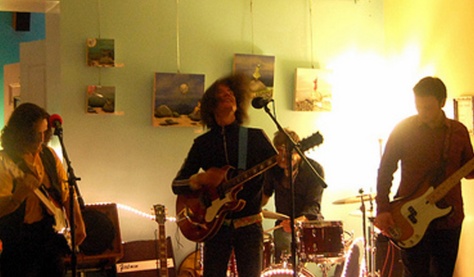
CBC radio’s Amanda Putz had just done a feature on our new album, To Be, so there was a bit of buzz in the air when we took to the stage in October of 2009. We were doing shows every week somewhere in town, which in retrospect was pushing things a bit into over-exposure.
This was a fun show. The audience was pretty low-key and sedate, but it was a good crowd and we were playing in a cafe, after all. This recording was made from the audience, and the quality is not great. Four of the songs we played were only partially recorded, and are not included. Yulia Teryaeva captured the evening in photos with her keen eye, as she did on many other occasions. I also asked a photographer named Jennifer Lapierre to come out to the show, which she did. It’s a funky and intimate venue, and we were really stoked to play this show. A lot of bands love Raw Sugar Cafe.
Set
1. The Wars
2. Trigger of Your Soul
3. A Crack in My Cup
4. Bitter Sense of Melody
5. Ragged Doll
6. River Wide Road
7. Late Bloom
8. Hook and Eye
9. I Guess I’ll Need A Miracle
10. North of Wasomee
11. Four Leaf Clover
For the 6th Bloomistry album I turned, as so often before and after, to the poets to get my ideas. To be or not to be, that was the question. And the answer was “Let’s be, and let’s make another album.”
But I didn’t want to make just another Bloomistry record. So I indulged every crazy idea, the crazier the better. I recorded twenty-minute songs, atonal compositions, and tunes with invented time signatures. I filled the studio with things that I banged together, in an attempt to make music without conventional instruments. Some of it was pretty interesting, at least to me, but other than Arrow of Time (which was my attempt to sound like the band Califone) the weirder stuff didn’t make it to the record.
Some of the songs, like Feet On the Mountain and Medley, were in fact ground-breaking for me. I don’t think there’s anything like it on the earlier records. And Never Gonna Nadia was the first Bloomistry song I could imagine hearing on the radio—and then one day, in Montreal, I did hear it on the radio. That and High Beam, a clearly Lennon-esque song—though I didn’t consciously intend that—were in college radio rotation for a time.
The 2008 recession was digging in, and To Be was a record about the rot of politics and rogue capitalism. The song Roses was dedicated to Anne Rogovin and its lyrics alluded to Rose Schneiderman as well as to the poem “Bread and Roses.” I was not very happy at this time, for a lot of reasons, most of them having to do with living in a staid bureaucratic city (as I saw it) where it seemed to be winter ten months a year. Maybe that’s why this record bogged down.
I’ve never been able to decide whether or not these songs are any good, or whether they work as a whole. The middle section—Wine and Women, On Top of the World, and To The Bottom—were taken from another project, Laketown. I call this section of the record the Tape Hiss Trio (listen and you’ll know what I mean) and it bothers me to this day that it’s there. Still, this is the most polished of my records, and I did a lot of interesting trickery in the studio to pull it off.
Simon Meilleur overdubbed the drums on Never Gonna Nadia and The Wars. I was never a strong drummer (I learned to play drums as I made these records!) so there was always timing issues. His contribution took things to a new level. And Edith Boucher’s artwork for this record was the first time I actually thought about such things in a serious way. So this is also my best-looking album.
On February 16, 2009, I started recording The Gutter and the Gut, as it was called. Phil Bova mixed the album on August 12–13 and we mastered on September 22, two weeks after I had mixed Laketown with Dave Draves. I took three songs off that record and substituted them on To Be. The rest is history.
Tracks.
1. High Beam
2. A Crack in my Cup
3. Four Leaf Clover
4. Wine and Women
5. On Top of the World
6. To the Bottom
7. Never Gonna Nadia
8. Feet on the Mountain
9. Broken (Medley)
10. Arrow of Time
11. Roses
12. The Wars
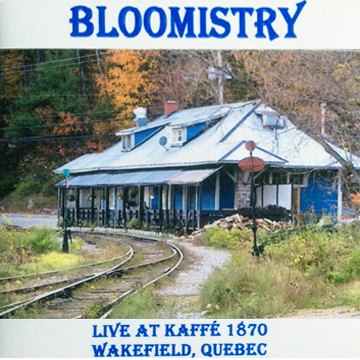
Audience recording. Dmitri Koev, bass; Simon Meilleur, drums; Terry Calder, guitar, b. vocal; Wayne K. Spear, guitar, vocal.
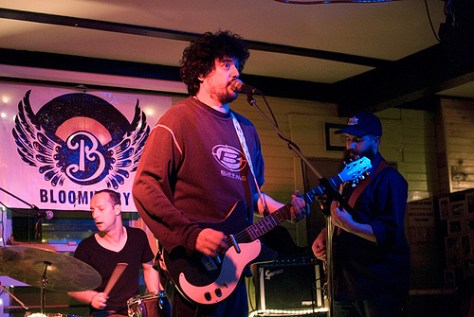
We did a bunch of shows at Kaffé 1870, a bar in the postcard-perfect, riverside village of Wakefield, Quebec, run by members of The Fiftymen. It was a great venue, and I remembered this being one of those beautiful, clear fall nights when the autumn leaves are at their peak and the air is crisp in a good way that makes you feel alive. But then I listened to the recording this week for the very first time, and in one of the songs I mention it’s raining outside! So either I was remembering the show I did a week earlier with Chris Page, or my brain is just making this all up.
The crowd that night was rowdy and ready. We were never a dance band, and I wasn’t prepared for a crowded dance floor—but when it happened, I loved it. My friend Flecton Big Sky shared the bill, joined by his band The Dreamcatchers, featuring Scott Terry on guitar and Tom Werbowetski on drums. Scott was my first drummer, and you’ll hear him heckling in good fun. As for The Dreamcatchers, I think this may have been the last time they performed together, but like my recollection of the weather I could be wrong.
We did a photo shoot with Yulia Teryaeva before this show in Mackenzie King Park and spent the day in and around the village. I don’t remember when we took the stage, but it was a long night. I went home exhausted but happy.
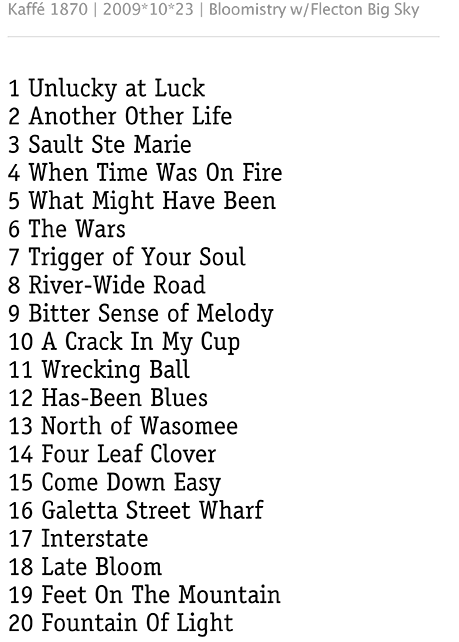
This recording is rough, but it gives you an idea of the night. The set list doesn’t exactly match the recording, but it wasn’t unusual for us to change things up on the fly. Or maybe I just didn’t read the set list properly. We played three songs that we didn’t often perform—What Might Have Been, The Wars, and Fountain of Light. I’ve always thought Fountain of Light was among my better songs, maybe because of how it happened. I was struggling with something in the studio, so I just took a break and went off to the side with my guitar to decompress. And in one uninterrupted go, out came this song, exactly like it is on the record. I recorded it right then and there. Creepy. That had never happened to me before, and it’s never happened to me since.
Set List
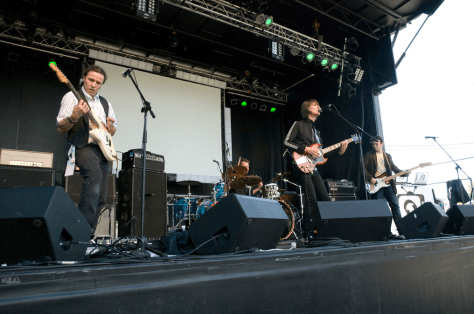
Soundboard recording, MP3 (320 kbps). Dmitri Koev, bass; Simon Meilleur, drums; Terry Calder, guitar, b. vocal; Wayne K. Spear, guitar, vocal.
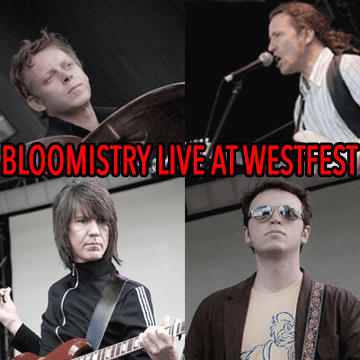
Westfest is a yearly Ottawa music festival started by Elaina Martin. In 2010, I had the privilege of being invited by Elaina to play on the Saturday night slot, with Sloan headlining. The weather was perfect and the sound was great, although with this recording (taken from the soundboard) the instruments are a bit unbalanced and you can’t hear the audience. We didn’t get a sound check, so on the first song the engineer is figuring out the levels. Hang in, it gets better. For what it’s worth, on stage the sound was a great, big stadium sound.
By this point To Be had been out for around 8 months and we had a well-established set list drawn from 6 albums and a bunch of other, unreleased material. We rotated songs in and out to keep it fresh. I think we had about 30 songs in total that were stage-ready, plus a few rarities that we threw in on special nights like this. For Westfest we played Hook & Eye, a song we hardly ever played. I think we may have even rehearsed it specifically for this show.
It was a great day, and one of the Bloomistry highlights of 2010. Enjoy.
Playlist
Introduction: Amanda Putz, CBC Bandwidth
1. Trigger of Your Soul
2. As Far As Wheels Go
3. Wrecking Ball
4. Late Bloom
5. The All About A Girl
6. Four Leaf Clover
7. Feet On The Mountain
8. Hook & Eye
9. Come Down Easy
10. Unlucky at Luck
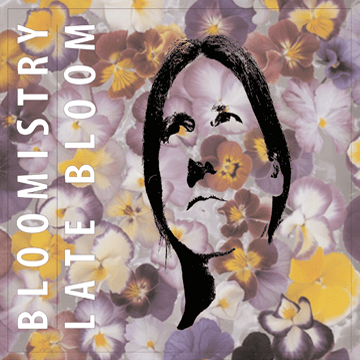
The third Bloomistry album, Late Bloom, was recorded from January 4 to March 31, 2007 and released on August 28—14 months after its predecessor, Ca Marche. In the coming 14 months, there would be three more albums worth of new Bloomistry material. This was the “bloom” to which the title referred.
As the preceeding suggests, this would be the most autobiographical of the early Bloomistry records. The opening track, Late Bloom, rehearses the project’s background: “It started years ago, in a basement in our town.” It was the 1980s, the town was St. Catharines, and I was in a band called The Shade, hauling a Fender Dual Showman amp head that my cousin Al had integrated into a customized maple cabinet. (The song mentions a Fender Twin, but my Showman was just as back-breaking all the same). The next track, When Time Was on Fire, recalls the same period. Come Down Easy takes an ironic and self-deprecating look at the musical aspirations of those days: “Your face/Never on a magazine/You never made the hipster scene.” This is rock and roll seen from my 42-year-old perspective.
I asked my friend Ken McClelland to do the piano overdubs. We were in The Shade together, and it meant a lot to me that this nostalgia album of mine would have him on it. I felt like I was doing with Bloomistry what I’d been unable to do with The Shade: find my voice and my own writing style. “Oh well—better late than never” was the basic philosophy of this record.
(Ken’s parts were recorded on Sunday, March 4, 2007. That’s him playing the organ and piano on the songs Late Bloom, When Time Was on Fire, and Walk On. I especially love the piano at the end of When Time Was on Fire: so, so simple, and yet I can’t imagine the song without it.)
All of the Bloomistry albums were recorded in my basement home studio, often between midnight and 3 am, at very low cost, with me playing all the instruments, unless otherwise noted. Bloomistry albums are all lo-fi (I actually consider them demos and hope to re-record the better songs one day with a professional studio band) but with Late Bloom the production took a step forward.
It was also at this time that I performed the songs live for the first time, in a pub called The Manx. It would be over a year before I formed a band, with Ottawa musicians Dmitri Koev, Terry Calder and Scott Terry (on drums, later replaced by Simon Meilleur). But the band never recorded, even though that was my eventual plan: all the albums were solo projects, made in the same Hull, Quebec basement studio.
Late Bloom was mixed on April 14–15, 2007 by engineer Dave Draves (who also overdubbed, while mixing, the Vox organ on Hook and Eye and the Mellotron vibraphone on Interstate) and released on August 28.
Tracks.
1. Late Bloom
2. When Time Was On Fire
3. Come Down Easy
4. Walk On
5. Left Behind
6. Sault Ste Marie
7. Hook and Eye
8. Bone Club
9. Interstate
 Journalism, Essays, Broadcasting, Books