All posts by Wayne K. Spear

waynekspear.com

“Caravaggio and His Followers in Rome”

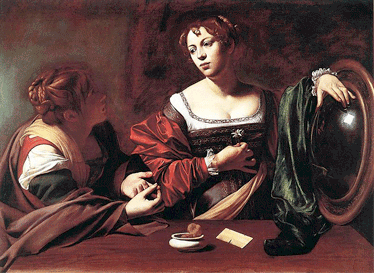
“Martha and Mary Magdalene”

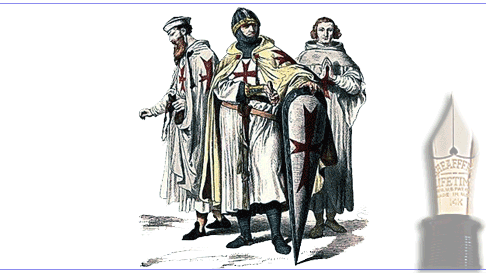
IF MICHELANGELO Merisi da Caravaggio, known today simply as Caravaggio, were our contemporary, he would be often in the news. Violent, captious, cruel, and reckless, he was notorious even by the standards of late 16th-Century Rome. A good source on the Italian capital circa 1600 is John L. Varriano’s “Caravaggio: the art of realism,” which catalogues “a level of sadism that would be shocking in any age.” But to give you an idea of the sort of man Caravaggio was, I can think of nothing better than to cite his flirtation with the Knights of Malta, who soon having deemed the painter “foul and rotten” expelled him from their ranks.
Continue reading “Caravaggio and His Followers in Rome”

Crazy, Stupid, Love and the Comedy of Middle Aged Failure

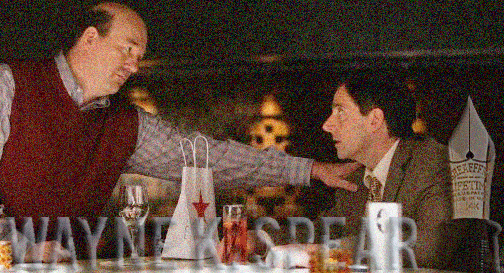
LET US BEGIN by acknowledging the obvious, that the 2011 movie Crazy, Stupid, Love is light and pleasant, adult fare but hardly a work of depth or of high seriousness. Its architecture is thoroughly of a Shakespearean cast, in which a main plot is complemented by and interweaved with two sub-plots. A moment arrives when the characters and their dramatic trajectories, hitherto discrete, collide one with another to calamitous effect. Things fall to pieces, and from this seeming state of irreparable chaos order is reinstated. This narrative arc, from social order to disorder and back to order once again, with no lasting harm done, is the essence of Comedy.

Continue reading Crazy, Stupid, Love and the Comedy of Middle Aged Failure

Anders Behring Breivik: when an enemy of your enemy is your enemy

ONE MIGHT hope a journalist working for a media outlet under the “Christian Science Monitor” brand would gloss the Knight’s Templar, but in this case the hope would be misplaced:

[Anders Behring Breivik’s] manifesto says he is among 12 “knights” fighting within a dozen regions in Europe and the US, but not India. It’s not known yet whether this group, which he calls the Knights Templar Europe, actually exists.

Continue reading Anders Behring Breivik: when an enemy of your enemy is your enemy

John Baird Raises His Red Lantern

It appears (to me at least) that the Foreign Affairs Minister, John Baird, is learning about the world and its localized histories in public and in real-time. On the first of June, he admitted as much to Canadian Press journalist Bruce Cheadle, saying he was “hazy on the history of the Israeli-Palestinian conflict.”

Continue reading John Baird Raises His Red Lantern

The Protestant Work Ethic Versus This Bottle of Wine


Years ago an upstart magazine based in a smallish Ontario city/biggish Ontario town asked me to write an article for the premiere issue. I wrote the article and got paid a small honorarium, but the magazine itself collapsed before even the first edition was printed. No one has ever read that article.

Continue reading The Protestant Work Ethic Versus This Bottle of Wine

In Which I Lose My Passport and Very Nearly Also My Mind


I discovered some days ago that my passport wasn’t where I was certain I’d put it. I had just moved one and-a-half miles, crossing the border between Hull, Quebec and Ottawa, Ontario. I needed that passport to transfer my life (car registration, driver’s licence, and other various bits of ID) to my new-old place of residence. No ticket, no laundry. Thus begins what is for me a too-familiar recurring scene, in which yours truly is cast into the leading role of the identification theatre’s latest production.

Continue reading In Which I Lose My Passport and Very Nearly Also My Mind

The Derelict Honourary Chief of the Blood Tribe

It’s been more than a few years now since my afternoon Calgary chat with a Kainai (Blood) acquaintance, but I do remember a bit of the history lesson I received that day. One thing I recall above all else is a sensation of correspondence: the Haudenosaunee have the largest population within Canada’s borders, the Kainai the largest land base; the Haudenosaunee are known to be of an independent cast of mind, so too I gathered from my interlocutor the Kainai. (The name is pronounced “Ken-Eye,” and fittingly means something like Many Chiefs.) I left the conversation that day rather feeling a sense of kinship, which is unusual for me in most any social encounter.

Continue reading The Derelict Honourary Chief of the Blood Tribe

News of the World and the Ethics of Journalism

The demise of Rupert Murdoch’s News of the World, though sensational, is of little significance either economically or journalistically. Now and again a journalist is found to be in breach of her profession’s code of ethics, or in more scandalous instances of common decency, and the requisite heads come off. The ordinary business of journalism — which ought itself to be the scandal, but isn’t — goes unremarked.

Continue reading News of the World and the Ethics of Journalism

The Missing, Murdered Women

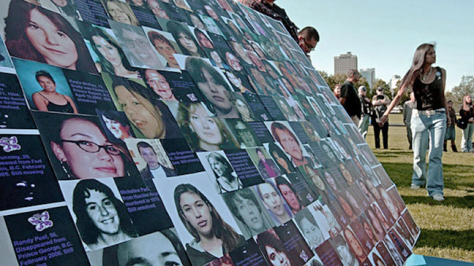
Murdered, Missing Women rally in Ottawa

THAT LONG STRIP of the Trans-Canada highway connecting Prince Rupert to Prince George was already well established as a “Highway of Tears” when I drove it in the Summer of 1999, weeks before I moved to Ottawa. Deena Lynn Braem was shortly thereafter added to the list of women, many of them Aboriginal, disappeared and murdered amidst the generalized indifference of Canadians. The trial a few years back of pig-farmer and sexual sadist, Robert Pickton, simply reinforced what those of us paying even a speck of attention already knew: that it was entirely reasonable to assume you could abduct, torture, rape, and dispose of Vancouver’s street women and get away with it.

Continue …

The Real Losers and the Phony Winners


If you are old enough to have witnessed the not-so-distant arc of Bob Dole’s political career in real time, you will have some context for the apparent re-invention of Tim Pawlenty. You will also know the precise manner in which the Evangelical Christian right has debased the Republican primary to the current level at which it yields every four years a depressing spectacle of hypocrisy, hateful demagoguery, and anti-intellectualism.

Continue reading The Real Losers and the Phony Winners

The Problem with Identity Politics

It wasn’t long ago that one would hear it said the world will be a different place when women are in charge. But then came the masculine regimes of Indira Gandhi — from whom a politician as dirty and ruthless as Richard Nixon recoiled — and Margaret Thatcher. From then forward, the essentialist claim that female leadership is distinct from its male counterpart could be put forward only with laboured qualifications and irony.

Continue reading The Problem with Identity Politics

Ulysses, Bloomsday, and the Best of All Literary Parties

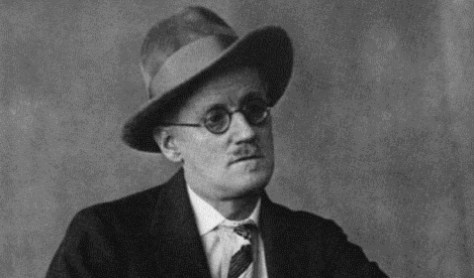
James Joyce

IN AN AGE which commends novels by citing their “accessibility,” one praises James Joyce’s Ulysses before a good many deafened ears. This singular 1922 work demands much from the reader, but the reward of one’s efforts is enormous. The highest tribute I can pay is this: I derive pleasure beyond what I can describe from the time I’ve lived among the fictional citizens of Dublin on June 16, 1904. I feel a bit sorry for anyone who doesn’t, or can’t, understand why I say this.

Read More

Indian Affairs Gets a Gender Reassignment

I now have unchallengeable objective proof that I’ve lived too long in Ottawa, and it’s this: I caught myself today wondering how the bureaucrats are going to say the new acronym AANDC, the stand-in for Aboriginal Affairs and Northern Development Canada. For over a century, the Department of Indian Affairs and Northern Development (known also as the Department of Indian and Northern Affairs) was Diane or Diand, or even at times Diana. Now I imagine it will be Andy or Andick, both of which lead me unavoidably to the conclusion that gender reassignment has taken place and The Man now really is that.

Continue reading Indian Affairs Gets a Gender Reassignment

The Kindness of Sinister Bitterness


The English language contains abundant terms both for approbation and contempt, most disclosing a bias of which its speakers are unaware. If, for example, you say that someone is “adroit” or “dextrous,” you invoke the moral privilege of the majority — a privilege grounded in the numerically dominant status of the right-handed. From the same source, the language derives “sinister,” the Latin word for left.

Continue reading The Kindness of Sinister Bitterness

When the Bookish Finish Last

There is a famous anecdote concerning two nineteenth-century British Prime Ministers and bitter rivals, Benjamin Disraeli and William Gladstone. The former may be credited with first articulating “Progressive Conservatism” — by way of his 1844 novel Coningsby, or The New Generation — and the latter with both establishing and dominating the British Liberal Party, having ended his affiliation to the High Tories. According to the standard account, Gladstone asserted (doubtless with approval) “I predict, Sir, that you will die either by hanging or of some vile disease.” Disraeli’s response was characteristically immediate, biting, and witty: “That all depends, sir, upon whether I embrace your principles or your mistress.”

Continue reading When the Bookish Finish Last