See you in 2018

I’m taking a proper Christmas holiday. Here’s to a year of big ideas

✎  Wayne K. Spear | December 14, 2017 ◈ Updates

2017 HAS BEEN MANY THINGS, and boring isn’t one of them. At waynekspear.com I launched the fifth season of The Roundtable Podcast, a program that first aired in June 2012, and I will soon produce my 100th episode. This website has grown steadily the past seven years and I’m leaving for the holiday having had my busiest and best month ever. I’m committed to the look and feel and format that I unveiled this fall: an article will come out Tuesdays and Thursdays at 8 am, and Saturdays at 10 am The Roundtable Podcast will be published. I hope you’ll agree that Season 5 has been the best so far. And there is much more to come throughout the months of January–April.

2018.gif

I’m not going to reveal all of my big ideas for 2018. But here are some highlights. Next year I am planning to introduce guest posting and some longer investigative pieces. I will be focused on Indigenous people, politics, and current events, and there will be more coverage of the arts—including on the podcast, where I hope to feature writers, painters, musicians, and other creatives. My hope and my plan is that I will continue to do in 2018 what I’ve done in 2017—bring you guests who are (or, in my opinion, should be) making headlines.

On Saturday, December 16, the amazing Cindy Blackstock will be my guest on The Roundtable Podcast, Season 5 Episode 90. The podcast will then be on holiday until Saturday, January 13, 2018, and I will return with a new article on Tuesday, January 16.

Life in a time of moral clarity

My enemies are admitting they want to go back to a time when white men could own human beings. This is progress of a kind.

✎  Wayne K. Spear | December 12, 2017 ◈ Politics

UNDER THE OLD dispensation politics was a bipartisan craft and the interests of the country superseded those of the party. Or so was the theory. In any case, that was then and this is now. Not long after this article is published, Alabama may well have elected to office a man already twice removed from office, for refusing to uphold the oath which he had sworn. As Senator, Moore will go to Washington in the mode of a Trumpist, which is to say contemptuous of the rule of law, of the constitution, of the norms of the legal profession, of most of his colleagues, of the separation of church and state, and of the American culture itself.

Before Roy Moore was notorious as a Gadsen, Alabama deputy district attorney with an appetite for teenage girls, he was the notorious champion of a Ten Commandments monument who was removed from office for (among other things) refusing to follow the law and for abuse of administrative authority. Roy Moore’s career has been a lifelong effort to play a both-ways game, as a simultaneous officer of the law and a conscientious objector to the law. Courts and judges and rules and norms are all fine and good, for you and for me, but Mr. Moore recognizes the legitimacy only of the subjective interpretations of his personal God. The law is what Judge Moore decides that God wants it to be.

The Trumpists have not simply endorsed or welcomed Moore, they have made him into a figure of existential significance. And it’s not wrong-headed for them to do so. Either the Party of Trump is going to take the country further along the trajectory of autocracy and vengeance, and in doing so flourish, or else it will stall and maybe even perish. The bits of their souls “establishment” Republicans were unable to sell they’ve now given away, by making a final bargain with the racists and authoritarians of which Moore is of a piece. Let’s go over the inventory: candidate Moore is now on record for linking 9-11 to American godlessness, for glancing nostalgically upon the era of American slavery, for recommending elimination of all constitutional amendments 11–27, for wanting to keep women and Muslims out of politics, for comparing homosexuality to bestiality, and for supporting Birtherism. And this is only a partial list.

His opinions are not illegal but they are necessarily a matter of law, or will be if once again the people of Alabama choose to hand Moore the power to legislate. It’s not hard to imagine what laws a Senator Moore would champion. He’s told us time and again. But apart from any individual law, Roy Moore is eager to take America back to the cultural norms and atmosphere of the 1800s, when African Americans were property and women knew their place and the South had not yet suffered ignominy. To get there Moore will doubtless support Trump in the work of persecuting, prosecuting, firing, intimidating, or otherwise eliminating any and every critic and obstacle, including institutional and constitutional checks and balances.

The onset of my adulthood arrived roughly at a time when the Roy Moores of our world were in retreat, forced by the advances of civil rights and feminism to rephrase themselves. The terms of that long yet superficial armistice have now been repudiated. We are now firmly in the Trump Era, where abolition of the 15th Amendment is a Twitter hash tag and where deliberations of the coming white ethnostate are occurring in an urban coffee house near you. Donald Trump has clarified the landscape in an exhilarating way. The people who love and admire him are emboldened to undertake his cause, and the rest of us should likewise be emboldened—to fight and to prevail. We are living in a time of moral clarity, and that’s progress of a kind.

NatChief PB is Doing Very Good Great Things at the AFN

I watched the AFN Special Chiefs Assembly. This is what I saw

✎  Wayne K. Spear | December 7, 2017 • Current Events

IF YOU FOLLOWED THE Assembly of First Nations Special Chiefs Assembly this week, like I did, you heard two federal cabinet ministers (and omg one of them is Indigenous) say that Canada did some very no good very bad things in the past—but the Trudeau Liberal government is a new and different government altogether. And on account of this differentlyness very good great things are going to happen to us very soon because. WAIT shouted the chiefs WE HAVE SOME QUESTIONS ABOUT THAT but the Ministers had to leave the moment their speeches were over. Just like pretty much every Minister at an AFN gathering ever but different.

National Chief Perry Bellegarde said much the same things the government people did—almost as if his speaking notes were coordinated with those of Ministers Carolyn Bennett and Jody Wilson-Raybould, who omg is Indigenous just like the rest of us. NatCheef B-Garde enjoys one of the warmest Crown-Chief relationships of the AFN’s history, so it was no surprise when his leather went all buttery-soft and he said dreamily that we are “in the midst of a tremendous opportunity” and that federal money is about to rain down upon us from the sky, along with big bucketsful of inherent Indigenous rights, no strings attached. The dangers, said Ency BeauGardz, are acrimony and division. Also, totally unrelated, there’s a National Chief election next year. The takeaway is that we must re-elect NC PeeBee (don’t get all dividey now, Chiefs!) and then also PeeEMJayT, so the wonderful things we have been promised will happen. In their second terms, for sure. Because.

Who Wants an Eagle Staff, Yo!

No Indigenous person outside of Ottawa actually knows what the AFN has been up to over the past few years. There’s an UNDRIP which sounds like a plumbing issue (if you’re fortunate enough to have actual plumbing) but isn’t. Also the AFN wants to close The Gap, which is fine because no Indian shops there anyway. None of us can point to a single improvement in our lives and say “Thank-you, National Chief, for this wonderful [fill in the blank]” but most of us can point to something that really sucks, like undrinkable water and moldy schools, and say ruefully that nothing appears to be changing. Fortunately that is all going to change lickety-split, because there’s a new Prime Minister in town who loves us, and we know this because tears fall from his dreamy bedroom eyes when he apologizes. He cares so much that, for the first time in Canada’s history, a federal government has a plan for the Indigenous people that is going to be great for them. We are going to love it! And it’s going to be different from the past because in the past governments never came up with ideas to make the Indians better-off.

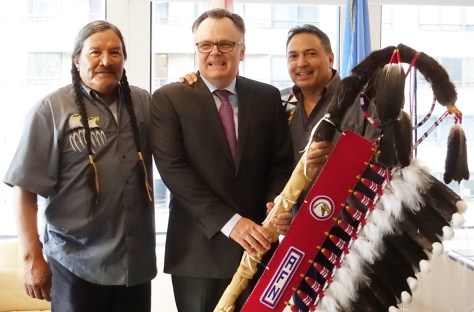
For some reason there are Indigenous people who don’t trust the government or the AFN. (No, really.) These people say silly things like “Well what’s the plan exactly?” And by people I mean, of course, dangerous radicals. One of these unhinged extremists, the AFN’s Anishinabe Elder, Elmer Courchene, suggested that the AFN Chiefs were guilty of collaboration, which he defined as traitorous cooperation with the enemy. Whoa there, cultural Marxist SJW Elder Courchene! Not only that, he accused the AFN of disrespecting elders, then brought up National Chief Bellegarde’s gifting of an eagle staff to Marc-Andre Blanchard, Canada’s representative to the United Nations. I mean, what has the world come to when a Chief gets grief simply for handing sacred Indigenous objects over to random white guys?

Then other radicals jumped in and all hell broke loose. Even the youth took shots at poor nc/pErRyB. Mark Hill, Co-Chair of the AFN’s Youth Council, accused the AFN executive of centralizing power and authority, and he reminded everyone that the AFN is a lobby group and not a government elected to negotiate on our behalf. “The nation-to-nation relationship is between our peoples and the Crown,” he shouted, while setting his hair on fire. (Not really. I made that part up to sound more radical.) NatchyCheef PeBellGeGard didn’t look very happy about any of this, but later on he reminded everyone that this is a pivotal moment for a legacy so we are moving forward with much work to do it’s the grassroots let me tell you the youth they are our future. This didn’t convince anyone, so he pulled an 11.8-billion-dollar bill out of his headdress and waved it around until it was time for everyone to go to the casino.

Trump is Today But The Mess Will Stay

Whitehouse

It’s Time To Think About The Post-Trump Future

✎  Wayne K. Spear | December 4, 2017 • Current Events

ONE DAY Donald J. Trump will no longer be the President of the United States of America. Whether he is impeached (unlikely in my view) or he serves two terms (more likely) or congress abolishes the 22nd Amendment and he occupies the office until his death at age 107 (one can never know) Trump will one day stop being President.

Perhaps you think this is a wonderful thought. But have you considered: what happens when this President is gone?

Even if Trump were impeached tomorrow, he would already have what we’ve learned to call a legacy. He talks a good deal of his supreme court nominee, Neil Gorsuch, and he’s been busy making lifetime judicial appointments at a near-record-setting pace, but these are the least of it. More important are the multiple ways he’s altered the business of politics itself, whether it’s the coarseness of his style or the clear disregard for norms of civil behavior. Donald Trump boasted in the Republican primaries that he’d brought millions of hitherto non-voters into electoral politics, and we now have a definite sense of those voters as well as of the reasons why they were, before the arrival of Mr. Trump, non-participants. Shunned from polite company, the ethno-nationalists and neo-fascists and white supremacists jumped back into the game when they could see it was becoming suitably nasty.

Everyone should understand that Trump has opened a Pandora’s box. The mass to which he has given voice and leadership will not stop being a cohesive political constituency in the post-Trump world, even if a Trumpist successor does not appear on the scene to lead it. And imitative although politics is, it is unlikely that there will be a political candidate who has Trump’s peculiar combination of characteristics. More likely is that some politicians will reject the Trump model outright while others (perhaps the majority on the Republican side) will adopt bits of the performance—the use of social media, shameless attacks on opponents, and so on. We are only one year into the Trump era, and for that reason it is impossible to say how deeply into the wood this President is going to burrow. At the very least Trump has made it possible to think that a President might go up against the media and the state and survive. Tomorrow this proposition could be proved wrong, but if this President serves two full terms it is difficult to imagine the country will be the same as it was when Mr. Trump found it. Either the President is going to change or America is, and that is less a proposition than it is an acknowledgement of the political experiment that is taking place before our eyes.

It is very difficult to see the Untied States coming out of the Trump years less and not more divided. If this president is able to change the country in the ways he plainly wishes to, there will be an appetite among one political tribe to hold firm and even to expand the advances, while among the other there will be an equal desire to push back. The use of executive power, that goes back at least to the Bush and Obama years, will continue under future presidents. Congress will have few incentives to find middle ground on any matters of importance. The broader polarization of the public will ensure that extremism is rewarded, as we see today in the candidacy of Roy Moore. Just as political conciliation and compromise live in the middle-ground, so too do the norms of political decorum. In 2017 we have set to blowing up all the norms, and with them all interest in outdated and unacceptable notions like shared interests and common ground. Politics today is a zero-sum proposition, and you are either (for example) with the sexual predator of teenaged girls who is running for the Senate or you are against God and Christian values.

Donald Trump did not and could not have created this mad world of value-speak. He discerned and then exploited it, which is the form of genius he shares with his fellow authoritarians, past and present. He is a symptom of the grievances and resentments and anxieties and aspirations that have long bubbled just below the surface of conventional political civility. His words are the unspoken and long-inadmissible words of millions of Americans. After Trump is gone, the things which he represented will live on. But they will live on in a world that Trump has had years to shape and influence. The post-Trump world will not be the pre-Trump world. That world is gone.

Building a Foundation for the Sixties Scoop Survivors

My personal thoughts on how it should be done

✎  Wayne K. Spear | November 30, 2017 • Current Events

THIS WEEK I participated in a discussion about the agency that will manage the $50 million fund negotiated as part of the Sixties Scoop class action settlement. The substance of that meeting, and the information provided in preparation for it, was shared with me in confidence. The purpose of this article is to reflect on what this agency might look like and what it might do, from my perspective as someone who has been involved in work of this nature. The people I was invited to meet with are in the initial stage of building the organization that will receive and manage the settlement funds. I was there as someone with experience and expertise in organizational development, in particular Indigenous organizations.

At the time I write this there is an agreement-in-principle awaiting the approval of the court. There are some criticisms of the AIP, one being that it doesn’t include Métis. My feeling, and this is based upon nothing but speculation and some experience with the Indian Residential School Settlement Agreement, or IRSSA, is that the AIP will receive court approval and that outstanding concerns (such as redress for the Métis) will be taken up in a separate effort. As it happens I found myself sitting next to the lawyer who represents the Métis, a fellow named Tony Merchant, who I first came across during the IRSSA years. This settlement took a lot longer to reach than the residential school agreement did. But the finish-line is near, owing to the sustained work of many people, some of whom I remember talking to more than a decade ago on this very subject. I also met the lawyer who created and managed the class action, and he seemed to me a very agreeable as well as decent and principled fellow.

Everything I have written to this point is public knowledge, which is to say non-confidential, and readily available. Anyone who wants to get information of the kind I’ve presented can go to the website sixtiesscoopclaim.com and find it. If you have never created a national organization from scratch then you can only imagine what it is like to do so. There are a thousand divergent considerations, many of them critical, and pitfalls await you at every turn. A single error made at the outset can doom everything. In the current case there is the additional fact that a good many angry and traumatized people are expecting swift remedies, which in my opinion they deserve, and it won’t do to not earn their trust. The work in short is heavy and delicate and complex beyond description.

Fifty million dollars sounds like a lot of money, and compared to a household budget it is, but when you confront the needs of Indigenous people you realize what a pittance this amount is. The Aboriginal Healing Foundation had 350 million dollars yet we turned away many dozens of communities and found ourselves unable to support worthy and credible proposals totalling hundreds of millions of dollars. For generations, Indigenous people have been abused and impoverished and have had their inner lives submitted to the attentions of a paternalistic and sometimes hostile state. There is no deprivation nor depravity we haven’t experienced from the hands of the authorities, and for this reason it is absurd to think a few hundred millions of dollars, spent over a few years, will turn the night into day.

In my opinion, whatever the interim board eventually build should have a life beyond a few years. Governments only think in months and at most a term of office, but the work of restitution is a work of decades if not of generations. Getting the politicians to accept the logical conclusions that follow from this is in my experience a work of supreme difficulty. Partly the problem is that the politicians and bureaucrats are constrained by rules and by the nature of the bureaucracy itself, so that even when they want to do what they know to be right they are unable. Then there are the political considerations, not least of which is the inevitable backlash whenever Indians are perceived as getting favours from the taxpayer. Successive auditor generals have made it likely there will never again be an Aboriginal Healing Foundation type of agency, despite the universal opinion that it was a good and successful model. Whatever its merits, the AHF was an arms-length delegated authority with a degree of independence, something that auditor generals look down upon. The idea that Indians might take possession of a considerable pot of money and with some autonomy is the kind of thing that keeps the Treasury Board and the Privy Council awake at night, and as a matter of course they are dead-set against it.

The agency should be governed by Indigenous people. This may seem an obvious and uncontroversial point but it’s worth emphasizing. Already words have been put on paper, by the non-Indigenous lawyers who are working out the terms of a settlement. Next these same lawyers will presumably make decisions about the kind of an agency they are going to create, and only then will they turn it over to the people who will run it. Along the way there will be consultation, which is fine and good but in itself insufficient for any agency calling itself Indigenous. Sooner rather than later competent and ethical Indigenous community people, preferably people who are not driven by the needs of their ego, should be brought in. And the lawyers and consultants (like me) should get out of their way and let them lead.

The Missing and Murdered Indigenous Women and Girls National Inquiry is a mess. Another mess, in the form of a national Indigenous agency seeded by taxpayer dollars, will do damage of a kind it is unpleasant to contemplate. The victims of abuse would be victimized once again, and a generation of Canadians would be provided ample evidence that native people are incompetent and probably corrupt as well. There would be calls for a reigning-in of every kind of program or service, and it would be difficult for politicians to resist, even if they wanted to do so. Every effort should be made to ensure that the Sixties Scoop foundation is governed and staffed by competent and reliable people and not by well-connected Liberal loyalists.

This agency will have to work very hard to develop relationships, and it will have to be open and candid in its communication. It will only have money to do a small number of things, for a limited number of people, and excessive expectations are certain to arise. I have often said it is better to give bad news that you can back up than it is to give pleasant news you can’t, and this agency is going to have to give bad news. People will forgive you for telling them a truth they would have preferred not to be true, but they will not forgive you for misleading them. The currency of our world is trust. Every day you are building up or else depleting your most precious asset.

An organization is people and systems. The critical thing now is to seek out and recruit the right people, which is to say the people who will build the right systems and perform the right tasks in the right way. If this is not done then no amount of money is going to make a positive difference. No consultant and no intervention will help if the first people through the door can’t or won’t understand, and build relationships with, the people they are meant to serve. The people of the Sixties Scoop have had unique experiences, and their needs are likewise. It’s no small thing to have lived in this world not knowing what many of us take for granted—who we are, where we have come from, where we belong, and the like. Already people are looking for information about the Sixties Scoop foundation, or whatever it will be called, as well as for opportunities to be involved in its creation. A great many things were discussed at the meeting, and the ten individuals present (including me) all felt the pressure to set things in motion so that the people could be heard and their needs answered. There are no shortcuts when it comes to building relationships, and if the right people can be brought into the fold, to do the right things in the right way, I trust that no shortcuts will be taken.

Martyrs and Millionaires

Why I defend free speech rights

✎  Wayne K. Spear | November 23, 2017 • Current Events

THE KERFUFFLE THIS PAST WEEK over Lindsay Shepherd looks like a debate about free speech, but it isn’t. In reality it’s yet another ingroup / outgroup event in the culture war.

We wouldn’t be discussing gender pronouns had transgendered and non-binary people not fought across past decades for recognition of their experiences and humanity. First-wave feminists fought to be at the table and second-wave feminists pointed out that it was a rotten table, accessible to white men and middle-class white women but not much else. Accessible spaces were not granted by the able-bodied, they were demanded by folks who faced everyday and omnipresent mobility barriers. Indigenous people in Canada were not given constitutional recognition and affirmation of their rights, they raised hell to take them. The history of social and economic progress is a history of struggle—of oppressed and silenced and exploited outgroups refusing to be kept forever to the sidelines of a society governed by privileged ingroups.

WLU

That’s the context for the gender pronoun battle, as well as for every other aspect of left-progressivism and anti-PC conservatism. Seen from one point-of-view, university safe spaces are a logical next-step from intellectual analysis and consciousness raising. First you identify and catalogue offensive speech, then you purge the speech and, with any luck, the oppressive systems and ideologies that go with it. From the opposing points-of-view, attacks on free speech are offences against liberalism itself: intellectual freedom, individual rights, the free-play of ideas, and progress through dialectic.

When I was a university student I had unpopular ideas. I got into arguments with professors over Duncan Campbell Scott and the prevailing notions of Canadian literature and history in general. The university may well have been incubating radical leftism: nonetheless I had no trouble finding conservative professors (and yes, they were usually white, cis-gendered and male) to tell me I was wrong. But I refused to be silenced. As a Haudenosaunee person, my ancestors’ lives and experiences had been undervalued and dismissed and erased, to make way for the views of colonizers, and every day the formal education system proved it to me. For a long long time in this country freedom of speech meant tolerance of diversity within the ethnic and cultural homogeneity of a dominant ingroup. “Should we turn these inferior savage Indians into labourers, or do they have the potential to be domestic servants? Discuss.” The aspirations of Indigenous people were beyond the boundaries of polite conversation.

The environment of the university is bad today, but it was bad in my day also. There’s no use pretending there were no unpopular nor unallowable ideas in the past, or that we’ve lost some golden age. But it was much easier to police and limit speech in the past than it is now. Unless you owned a newspaper or a television studio or a radio station, it was near impossible to get your perspective out into the world as little as 20 years ago. It’s ironic that we’re even discussing free speech at a time like this. Only hours after Lindsay Shepherd was disciplined, an electronic device that fits in a pocket allowed her to broadcast the event to the world. Similarly Jordan Peterson has made his silencing into a speaking point, and the speaking point has enriched him while broadening his fame.

I’m a free-speech advocate, and I’m dismayed to find that this position now puts me in the company of the alt-right, mens-rights, Jordan Peterson ingroup.

ABOVE: a typical alt-right Jordan Peterson shithead fanboyIf I were the only person on earth who felt the defence of unpopular views was a vital principle, it would be logically necessary for me to defend that position with greater eloquence and vigour, not less.  I’m certainly in the minority among the Indigenous people I’ve heard from. I have always defended the freedom-of-speech rights of people with whom I disagree, including my greatest enemies, because the rights of people who think differently are the only rights that need defending. Harmony can only be arrived at through negotiation and consensus building or by suppression and repression of offending ideas. In the latter case, who is going to be the judge and arbiter of admissible speech? There isn’t anyone I would trust to edit the world on my behalf. To enter into such a bargain is to invite the silencing of one’s own voice at some future point. And I will not abide that.

I don’t know where all of this is going, but I suspect that the Overton window is shifting, as it always has and always will. I don’t think pronouns are going to be a big deal for our grandchildren. Jordan Peterson will not be silenced (and I don’t think he should be) but we’re also not going to return to the days when girls were girls and men were men. The world is changing. In place of the old we will negotiate, and struggle for, the new. There will be disagreement and litigation and protest. People’s sentiments will be outraged on all sides. In an age of YouTube and Twitter it will be impossible to silence anyone, and the attempt to do so will only create martyrs and millionaires.

Gord Downie will not make things better

Canadians forgot about Chanie Wenjack before. They can forget about him again.

✎  Wayne K. Spear | November 16, 2017 • Current Events

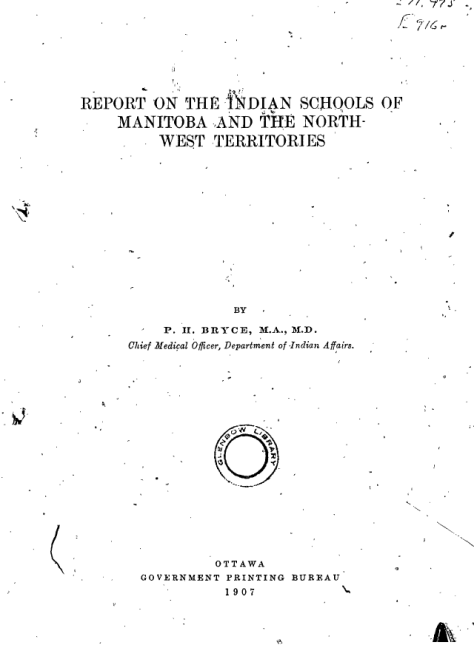
IN 1904 CANADA’S DEPARTMENT of Indian Affairs recruited the Chief Medical Officer of the Department of Immigration to study the health conditions throughout the western territories of the Indian residential school system. P.H. Bryce’s report, submitted on June 19, 1907 to Frank Pedley, Deputy Superintendent General of Indian Affairs, did not please his superiors. Not only were Bryce’s meticulous observations unpleasant, they were submitted on the false assumption that the federal government was in fact interested in improving the health and welfare of the children in its care. At the time Bryce was witnessing the substandard living conditions of the residential schools (where hunger, fires, overcrowding, and death rates of 20 percent and higher were common) the future head of Indian Affairs, Duncan Campbell Scott, was a treaty commisioner and the author of a 1905 collection of poetry, New World Lyrics and Ballads. Scott would eventually push the troublesome Bryce out of his job, admitting that

It is readily acknowledged that Indian children lose their natural resistance to illness by habituating so closely in the residential schools, and that they die at a much higher rate than in their villages. But this alone does not justify a change in the policy of this Department, which is geared towards a final solution of our Indian Problem.

Screen Shot 2017-11-15 at 7.27.06 PM

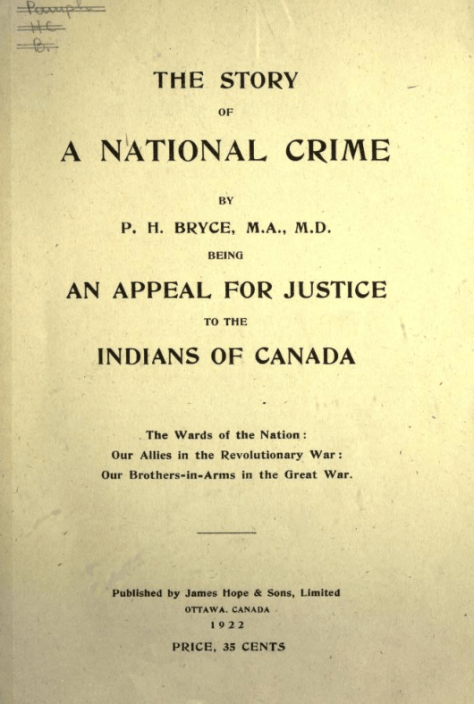
You’ve probably heard of P.H. Bryce, and you’ve also likely seen the Scott quotation. The effort of Duncan Campbell Scott to silence Bryce was a failed one, as such efforts often are. In 1922 Bryce’s medical report was turned into a book, under the fulsome title The Story of a National Crime: Being an Appeal for Justice to the Indians of Canada, the Wards of the Nation, Our Allies in the Revolutionary War, Our Brothers-in-Arms in the Great War.” Bryce’s book gave rise to newspaper headlines and to articles in well-circulated Canadian publications like Saturday Night Magazine and presumably also to momentary outrage and scandal. As early as the 1920s the general Canadian public could and did know that (for example) preventable deaths of children had occured in the residential schools at rates between 30 and 60 percent, and that “ a trail of disease and death has gone on almost unchecked by any serious efforts on the part of the Department of Indian Affairs.” Bryce not only had pointed figures, he had pointed fingers, specifcally assigning blame over the failure to improve matters to “the active opposition of Mr. D.C. Scott.”

Today Bryce is considered a rare example of a principled and outspoken critic of the Indian residential school system. He lost his career advocating on behalf of Indigenous children, and having found himself dismissed from the federal government, he took his crusade to the public. As far as I can tell, Bryce’s efforts changed nothing. The Indian residential schools would remain for another 47 years beyond the publication of The Story of a National Crime, and the conditions of the schools would slowly improve, because in the post-war years everything was improving. But the improvements didn’t prevent further, unnecessary deaths.

Chanie Wenjack was a public school student, boarded at the Cecilia Jeffrey Indian Residential School. You have almost certainly heard of him, and of his story, from Gord Downie. You know that he ran away from the residential school in October 1966 (just as many, many children ran way) and that he died of hunger and exposure longing to see the faces and to feel the embrace of his distant family. What you might not know is that Chanie’s story also had a P.H. Bryce figure, in the form of Ian Adams, a journalist whose February 1967 Maclean’s article, “The Lonely Death of Charlie Wenjack,” also received national attention. The article was turned into a chapter of Adams’ 1970 book, The Poverty Wall is Guilt of Greed, Racism, and the Misery of 6,000,000 Canadians. In the meanwhile, considerations raised by the death of Chanie Wenjack were the subject of additional media attention, including a front-page, June 21, 1969 Toronto Star report by Glen Allen. Over and over again, the “plight” of Indigenous people has been brought to the front pages, and to the attention of Canadians, to little if any effect.

In Thunder Bay there was an inquest recently into the deaths of seven Indigenous youth who had come south to attend high school. These young students, like Chanie Wenjack, were boarded many miles from home. In 1966 the jurors of a coroner’s inquest into the death of Chanie Wenjack questioned the wisdom of the education system. The jurors (none of whom was Indigenous) were able to see that the “Indian education system causes tremendous emotional & adjustment problems for these children.” They were baffled by the residential school system—specfically by the evident lack of the moral and practical wisdom of removing children from familes to have them educated far from home. The inquest recommendations directed that “a study be made of the present Indian Affairs’ education system and philosophy. Is it right?”—but none of the recommendations went anywhere. As Tanya Talaga has shown, in her book Seven Fallen Feathers, a straight line can be drawn from the residential schools to the death of Chanie Wenjack to the Thunder Bay deaths. Is the Indian Affairs education system and philosophy right? Do the deaths of Indigenous children justify a change in the policy of this Department? As the years go on, it seems more and more likely that Duncan Campbell Scott spoke for Canada and Canadians.

It isn’t true that nothing changes. But the deaths of Indigenous children, attending schools hundreds of miles from family and home, because there are no schools nearby, continue.

Bryce

And the rediscovery of this reality, over and over, through articles and books and songs, continues also. A generation ago the title of Bryce’s 1922 book appeared on John Milloy’s 1999 A National Crime: The Canadian Government and the Residential School System, 1879 to 1986. A country that had forgotten all about Indian residential schools in the 77 years since Bryce, and in the 32 years since Chanie Wenjack, was once again scandalised to discover its poorly-hidden history. The Royal Commission on Aboriginal Peoples released its final report in 1996 (John Milloy, author of A National Crime, wrote the RCAP chapter on Indian residential schools) and the Truth and Reconciliation Commission of Canada released its final report in December 2015. In the quarter century between 1990 and 2015, dozens and perhaps even hundreds of memoirs were written by the survivors of abuses in Canada’s Indian Residential School System. Yet somehow a good number of Canadians were shocked and surprised to learn about a piece of their history from a singer in a rock band.

Heroes, Saviours, and Jordan Peterson

Peterson is at bottom a generic conservative—a believer in the moral and civilizational necessity of established authorities and traditions

✎  Wayne K. Spear | November 14, 2017 • Current Events

IT’S BEYOND REASONABLE DOUBT that we are living in a time of cultural warfare, and as a rule at such times heroes or saviour figures are lifted up to lead in battle. For the self-designated enemies of feminism, political correctness, and leftism, Jordan B. Peterson is such a figure.

Jordan Peterson

I first stumbled over this University of Toronto professor for the reason many others did—his vocal opposition to Canada’s Bill C-16, amending the Canadian Human Rights Act to add gender identity and gender expression to the list of prohibited grounds of discrimination. C-16 further amends the Criminal Code

to extend the protection against hate propaganda set out in that Act to any section of the public that is distinguished by gender identity or expression and to clearly set out that evidence that an offence was motivated by bias, prejudice or hate based on gender identity or expression constitutes an aggravating circumstance that a court must take into consideration when it imposes a sentence.

Peterson objects to many aspects of this bill. He’s deemed it compelled speech and has stated many times that he will not use non-gendered pronouns such as xe or xyr. His broader objection to non-binary (or perhaps it is extra-binary) gender identity and expression is that these are make-believe notions with no grounding either in biological or social reality. And so he has declared war against something he calls cultural neo-marxism, as well as against postmodernism, principally in the form of the propositions that all structures are oppressive and that Western civilization is white supremacist patriarchal rot, and little more, and thus must be overthrown and replaced by more progressive, inclusive, and egalitarian arrangements.

A simple Google search will yield many interviews, podcasts, news articles, and university lectures featuring Mr. Peterson. His notoriety is worldwide, and despite his fame originating in a claim that the university and the laws were out to silence and imprison and ultimately ruin him, Jordan Peterson’s views saturate the air and earn him many hundreds of thousands of dollars each year. Between his income as a tenured professor and his $50,000USD/month (and growing) Patreon subscriptions, to say nothing of his other income streams, Mr. Peterson is a millionaire, or will be one soon. He has a large following, mostly made up of the alt-right, white nationalist, libertarian, and MRM, or men’s rights movement, types of person. He is also admired by a good many atheists, who see him (wrongly, in my view) as a defender of science against faith.

What is it that Jordan Peterson proposes, and why have his statements and positions raised him to his current prominence? These are the questions I am setting out to answer, and along the way I will consider secondary matters, for example the prospect of his efforts to starve certain university professors and disciplines of students and therefore of income.

At the highest level of analysis (and here I am relying on his published lectures) Jordan Peterson appears to be concerned with the relationship of truth and value. Or, to put it as a question, what truth or set of truths will provide the values that allow us to live in this world in a manner that fulfils our individual and collective human potential? It is worth noting that questions of this sort, having to do with ultimate truths and the ideal human society, will as a rule land us in the territory of religion and politics, and so it is in the present case. Jordan Peterson studied political science and was a member of the New Democratic Party until he decided that the political solutions on offer were so much nonsense and turned instead to clinical psychology. But even his interest in psychology is largely an interest in the truth-value of ancient myths and archetypes, as they are rendered in religion and in particular in Judaism and Christianity. So he has in fact migrated from politics to religion, and it is through the door of religion that his thinking is best approached.

Much can be learned about a man from the company that he keeps, and Peterson appears to have ingested a good deal of Nietzsche and Jung and Piaget and Dostoevsky. This is a logical diet of someone who is in search of values by which to live, especially someone of an unconventional, non-conformist outlook who desires a heroic inner life. In college I knew a few Philosophy majors enamoured of Nietzsche, and to a man (they were all men: I have yet to meet a female devotee of Nietzsche) they were oddballs and misfits but I suspected with an imagination that made up for their outward limitations. With Dostoevsky it is much the same, except that Dostoevsky is perhaps even more a moralist than Nietzsche and with somewhat less of the Nietzschean self-aggrandizing bombast—especially of the later, Ecce Homo years, when tertiary syphilis was just around the corner. Piaget is of course an authority of psychological development, having focused on the socialization of children, and from him Peterson would have got the evolutionary-biological basis of the psyche as well as the notion that identity is the product of social negotiation. From his other major influence, Jung, Peterson derived an interest in mythic archetypes and probably in religion also. This brief review covers about 80% of Peterson’s evident influences, and most of the rest has to do with ethology (especially dominance hierarchies and mate selection) and the five-factor model of personality, with which I happen to be very familiar.

Peterson often has recourse to Darwinian natural selection, as well as to evolutionary psychology, and for this reason many atheists mistakenly see Peterson as a fellow-traveller. On his surface he is a rationalist and empiricist, and even to a degree below the surface as well. But if you listen to Jordan Peterson carefully for even one lecture, it becomes clear that he is not a philosophical materialist at bottom but rather some kind of believing Christian. It becomes clear also that his ethology and Darwinism—which is to say his science—are in service of subjective concerns related to masculinity and competitive success and whatnot. (It’s not hard to see why Men’s Rights activists have gravitated to Peterson.) He’s not a doctrinal Christian of an identifiable denomination, but he is a Christian nonetheless. And, being a Christian, he believes—this is I think the proper word for it—in the moral and civilizational necessity of tradition, including the moral Christian traditions that inform marriage and gender roles and so on. In other words his interest in myth and archetype is a prescriptive interest and not a theoretical or abstract one, in the way that an evangelical Christian’s interest in Koiné or ancient Hebrew is not merely intellectual but rather serves a practical goal, that is, attaining a closer relationship with Jesus. He means to apply his observations of things like the hero archetype and the dominance hierarchy and the five-factor model of personality to his life, and it seems to me he wants his students to do the same. Nor is this remarkable, most professors being self-consciously evangelical where their pet ideas are concerned. In short, his life has been a quest for the Guidebook, and now that he has it, he is not going to give up its counsel, or witness its denigration, without a fight.

If my admittedly superficial analysis is correct, what Jordan Peterson proposes is what all tradition-minded conservatives propose—that the answers to our most pressing questions will be found in the past and not in the innovations of radicals and revolutionaries, or even of liberals. Peterson’s exchanges with the podcaster and neuroscientist Sam Harris exhibit a clash of left-versus-right thinking, Harris taking the “left” position that myths from tribal bronze age societies, no matter how laden with practical wisdom, can not guide us successfully through the terrain of urban, high-tech societies. Peterson evidently not only believes that Christianity can guide us, he believes that if we abandon it we will find ourselves between the Scylla and Charybdis of nihilism and totalitarianism. When the news of Louis C.K.’s sexual assaults broke last week, Peterson tweeted that “we are going to soon remember why sex was traditionally enshrined in marriage….” The many casual observers of Jordan Peterson who had assigned him to the Darwinist-materialist camp were confused by this leap, but those of us who have discerned the conservative Christian moralist lurking within his views were not. Without believing in the literal truth of the Christian story, Peterson nonetheless is able to believe in its practical and prescriptive truth. His allegiance to Judeo-Christian values puts him in the company of many radical right figures who are fighting for Western civilization (their preferred tactic is always war) which is to say the institutions, laws, habits, and arrangements of Judeo-Christianity.

The answer to the second question is obvious once the first has been answered. Jordan B. Peterson’s statements and positions have raised him to his current prominence because the need of a strong leader and even of a fierce hero-saviour type is hardwired into the conservative-traditionalist worldview, an essentially hierarchical world that defers to authority. As Jerry Falwell Jr. correctly said of Donald Trump, “We’re not electing a pastor. We’re electing a president.” In Donald Trump, white conservative evangelicals found their outspoken, combative, strong-man leader. They were not looking for meek and mild Jesus and did not want him for the mission. And of course candidate Trump, like Professor Peterson, says what many are thinking, in a way that makes clear his indifference to political correctness and hurt feelings. The main difference between Trump and Peterson (whose constituencies largely overlap) is that Trump dissembles in plain language whereas Peterson is candid but in terms that are complex, hence easily misconstrued. The result is that both have within their followings people who are in the dark where the actual convictions and objectives of their hero are concerned.

As for the prospect of Peterson’s efforts, a few observations seem in order. The first is that Peterson is fighting over, and for, real-world things that go far beyond pronouns—things like traditional gender roles and marriage and sexual norms and the cultural authority of Christian teachings and values. In the future we will either be saying faerself or we will not, most of the battles being of the zero-sum variety. In a society where a minority of people read the Bible and where the general drift has been away from traditional authorities like the church and toward secularism and plurality, only an aggressive and sustained reaction to the developments of the modern world seems likely to reverse course. Such a reaction is not impossible to imagine, and in fact it is now underway both here and in Europe, but by definition the conservative cause is a doomed one. No one knows this more than conservatives, whose conception of historical development has at its core the notion of decline, or, in other words, the abandonment of a golden age and its values and institutions and the drifting away from natural law. If the tendency of the world were stasis, there would be no need of conservatives or of conservatism. The whole point of being a conservative is to fight for the impossible, which is to say the preservation of a world that is forever changing.

On the other side of this argument are the agents of change, who believe in the future perfection (or at least improvement) of the human being, as well as in the upward arc of human societies, driven by repudiation of the revealed wisdom and the norms embedded in and perpetuated by ancient institutions and authorities. Their disagreement with Peterson is deep and will probably occupy our species for the next century and more. In the meanwhile should Jordan Peterson be fired or silenced, as some of his opponents foolishly hope he will be, his followers will add martyr to the CV and promote him further up the dominance hierarchy, where greater helpings of prestige and American dollars and media celebrity await.

There is no use ignoring the points on which Jordan Peterson is doubtless correct. A society can not undergo rapid and enormous changes and not suffer, often in ways that are wholly unanticipated. Whatever its advances and improvements, the culture that jettisons its traditions and re-invents its values wholesale will invariably introduce an element of uncertainty and even of chaos. But no one born in the past one hundred years can believe that the world will not continue to change, likely at an increased pace and in ways it is impossible to imagine. We are, all of us, wondering what is going to happen and hoping it will not be catastrophic. Peterson’s defiance is doubtless grounded in a pessimism informed by this very point. Nor is he foolish to posit a future in which we have leapt the rails. Such a thing may well occur, and the agents of progress and social justice could well be responsible, and probably will be, since the most dangerous thing is to leap into the unknown. Whenever and wherever the refashioning of societies has been undertaken along tribal identitarian lines, the result has been bloodshed and barbarism, so much so that our survival will likely come down to our ability to transcend the evolutionary inheritance of our tribal ape ancestors. Here we are in a world of particle accelerators and nanorobotics, with our reptilian brains primed for a flight or a fight. One day we will have to learn how to live with this unfortunate paradox, if we are to live at all.


An honest telling of Canada’s story will make Canadians uncomfortable

Still, the truths of history are better than lies

✎  Wayne K. Spear | November 9, 2017 • Current Events

BEFORE BRONWYN EYRE was Saskatchewan’s Education Minister, she was an opinion columnist battling godlessness, political correctness, the myth of global warming, and other menaces. Her broadcasts were hosted at CKOM and CJME, and the Saskatoon StarPhoenix featured her columns, as did lesser-known publications like the Saskatchewan Pro-Life Association’s “Saskatchewan Choose Life News.”

bronwyn-eyre.png

Why do I mention this? To establish that Bronwyn Eyre is an experienced writer of opinion columns and, as such, a person able to put thoughts into words. And yet when she was asked recently to clarify comments she made in the Legislative Assembly of Saskatchewan, Bronwyn Eyre produced gobbledegook. Her initial comment however was plain enough and had the courage-of-conviction candour that you’ll find in her articles: “I would submit that there has come to be at once too much wholesale infusion into the curriculum, and at the same time, too many attempts to mandate material into it both from the inside and by outside groups.” Later on in her comments, made during the Throne Speech Debate of November 1, 2017, she says exactly what she means by wholesale infusion:

My grade 8 son brought a homework sheet home the other day — they’re always sheets — in which he was asked to outline nothing less than his vision of his collective past, his country, and his world. As background, however, he’d copied from the board the following facts which were presented as fact: that European and European settlers were colonialists, pillagers of the land who knew only buying and selling and didn’t respect mother earth. He asked me if it was okay if he could write that he associated with his pioneer great- and great-great-grandparents because no one was writing down their vision of the world. And I said yes, of course, and that after all, they had known poverty in Norway or Ukraine, or war in Germany, that they had come here and tilled the land that produced food for everybody and loved their families and tried to create whole, stable communities in this province, and had loved it here.

And here is the non-clarifying clarification Eyre offered a reporter:

What I was trying to highlight is that it’s maybe something that we all feel on some level that I think we can acknowledge that, you know, we’re perhaps free to love the story and our families and for him too to love the story without excluding loving anybody else. That’s really all I’m saying.

Anyone who has read Eyre’s works, as I have, will doubt “all she is saying” is that we should be free to love our stories and our families. She disapproves of the drift of current changes to the curriculum, just as she disapproves of the drift of politically correct modern society, and if she weren’t a politician she would have found the cahones to say so. But if her point were only about love, I would agree with her. It’s a good message: love your family and your ancestors and your country. We all need this love. And this love is what Indigenous people were denied for generations, by residential schools and the Sixties Scoop and the story of Canada.

I grew up in Canada in the 60s and 70s. I went to a public school and the history I was taught was definitely infused. Infused with lies. The textbooks had nothing to say of the inner life or aspirations of my Kanien’kehá:ka (Mohawk) ancestors, who suffered losses of every kind so that settlers could start a new life. It would have been nice to hear stories that made me love who and what I was, and where I was from, but there was no love, and no compassion, for Indians in the curriculum. My teachers told me stories about Indigenous people that justified the casual daily racism every Indigenous child experienced in the playground and in the town. The story of Canada wasn’t a story you could love as an Indigenous person, because it made you feel stupid and ashamed and worthless. Our schools didn’t give us a vision of the future, they told us we Indians belonged to the distant past. It’s no wonder so many gave up on life and took the leap into an early oblivion.

An honest telling of Canada’s story will make Canadians uncomfortable, but in the long-run Canada will be better for it. The truth is often unpleasant, but it’s morally and practically more defenisible to live a life informed by what’s true and real than it is to live under the sway of comforting half-truths and lies. In 2002 I wrote a speech for the launch of a residential school exhibit, at the National Archives of Canada, that began:

The National Archives of Canada is a solemn place, dedicated to the service of the nation’s identity. It gathers what has been as an endowment to what will be. Because no legacy is enriched by counterfeit, a nation is ill-served by history which is not genuine. And so, we are here today to consider a national institution committed, not to the preservation of a people, but to their forced assimilation.

“Because no legacy is enriched by counterfeit, a nation is ill-served by history which is not genuine”—I wrote these words 15 years ago and they guide me still. I care about truth, and I care about authenticity, and I consider it a tragedy to live without either. I’d like to think Canadians of honour feel the same. I used the metaphor of an inheritance of fake money because that is what I believe Canadians have received from their educators, for generations—a counterfeit. I know it’s what I received, and as a result I’ve been a skeptical person my entire adult life.

Ms Eyre, you can love your family and your ancestors and your accomplishments without sacrificing intellectual and moral honesty. In fact, you have to. Otherwise it’s not really love.