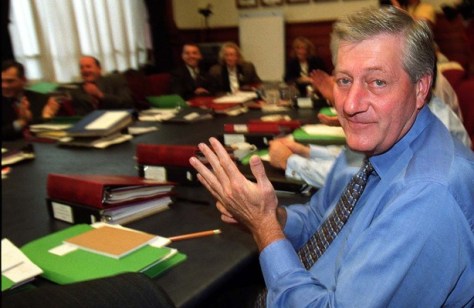
WHENEVER THE TOPIC turns to politics I am thoughtful of this aphorism, written by H.L. Mencken: “Democracy is the theory that the common people know what they want, and deserve to get it good and hard.” So far as I know, Premier Mike Harris has never offered his definition of democracy. Yet I imagine if he did offer it, it would come out something like that – dressed up perhaps, but not substantially different.
Democracy is one of those words, and there are many, whose meaning is inseparable from its speaker. I am led to understand, by the local MP, that democracy consists in sending a representative to Ottawa for 5 years because you fancy him brilliant and competent, hence able to act as a matter of course on your behalf. Labour leaders appear to define democracy in relation to their wages and benefits, which doubtless offers a scientific means of measuring precisely what quantity of democracy we’ve got at any given moment. My mock-favourite definition however comes from Samuel P. Huntington’s The Crisis of Democracy, and could fairly be called an ‘elite’ view. Here, democracy designates a general uppityness to be contained by government, that is, bankers, heads of state, and the CIA. In other words: Democracy is the theory that the common people know what they want, and we must keep them from getting it.
The first thing to notice about these definitions is that they are all rather self-serving, and the last thing to notice is that they don’t get us very far on the road to a useful understanding of democracy. I begin with these considerations of democracy because what you think of Mike Harris is related to what you conceive democratic government to be. One’s definition of democracy involves a value judgement, and this value judgement extends not only to government in the abstract, but to particular governments as well. If you believe democratic government means higher wages for unionized workers, you’re not likely to be a Harris supporter. I do not claim this is impossible, only that it is not very likely. Democracy is not an object, and we do not regard it objectively. Even the commonplace definition, ‘government of the people, by the people, for the people’, only introduces more controversy. What do you mean by government? – representation, or direct rule? And so on and so on.
As the title of this essay suggests, I am not interested in democracy or government in themselves, but instead in Ontario under the Harris government. This is a specific topic, and calls for specific language. Already the debate has stagnated, one team asserting the Death of Democracy and the other, quite incongruously, retorting, If you think so, save it till the next election! (There are other teams as well, yelling from the sidelines.) They are speaking past one another, because they have incompatible assumptions. Is there anything to be said of Ontario under Harris which goes beyond this sorry state of affairs?
There are some remarkable facts about Mike Harris that are worthy of recollection. For instance his CV: Born in Toronto in 1945, briefly studied math and science at Waterloo Lutheran University (1 year), ski instructor, attended teacher’s college, public school teacher, Chair of Nipissing Board of Education, President of the Northern Ontario School Trustees Association, professional golfer and golf-shop manager, owner of a tourist resort and ski centre. What is remarkable about this? Only that it is not remarkable. It does not point in any direction. The next entry could as easily be accountant or hotel manager or disc jockey as it could politician. Harris is a Premier ex nihilo (or ‘deus ex machina’ if you prefer). He came from nowhere, unlike the majority of Canadian politicians, whose CVs, one feels, destined them to become leaders. This is the case with politicians as far apart in temperament, class, and ideology as Sir John A. MacDonald, Tommy Douglas, Preston Manning, and John Chrètien. Consider the CV of the man who Harris replaced, Bob Rae: Born in Ottawa in 1948, son of an ambassador, summer work as a Parliament guide in 1966, studied at U of T, involved in student politics, attended Oxford (Balliol) and again U of T (Law School), briefly practiced labour law before running first as a Federal NDP candidate (in 1978) and afterward as a Provincial NDP candidate. This is by no means an exhaustive list, but it is enough to establish the point: Harris is a different species of politician, even an anti-politician. This is the key to understanding the nature of his government and Ontario’s support for his agenda.
There is nothing inherently wrong or right with the route Mike Harris has taken to Queen’s Park. I have not put Harris beside Rae in order to disparage one or elevate the other. They differ, and Bob Rae is the more typical politician of the two. Harris has been often ridiculed, unfairly I think, for being little more than a jock. The revelation that his reading consists exclusively of Mr Silly and He Shoots, He Scores was attended by snobbish ridicule, but one should understand this is part of his appeal. If Bob Rae is a certain recognizable type of man, the ‘millionaire Socialist,’ so too is Harris a certain type of man. He is the man who comes riding into town to shake things up. Essential to this role is his status as an outsider. Indeed, what we are discussing here is an archetype. Harris is Perseus, come to slay Medusa, or John Wayne, come to set things right (or, more recently, William Munny of Unforgiven). For reasons that are easy enough to guess, the archetype is fondly regarded especially among the corporate elite, of whom ‘Chainsaw’ Al Dunlop is the most infamous example. To some the archetype is repellent, and it is interesting to read Rae’s memoirs and find him arguing against Harris, armed with Edmund Burke’s writings on the French Revolution. Rae’s principal grievance against Harris is not that he is too ‘conservative’, whatever that means, but that he doesn’t see the useful and positive aspects of the things he has set out to reform. Why? ‘Ideology’ is Rae’s answer; Harris has come riding into town, determined to impose his vision of justice.
This helps us to analyse Harris the ‘revolutionary,’ whose arrival for many was long overdue. What Ontario needs, according both to his supporters and detractors, is Change. At the bottom of this vague call for change is a generalized hostility toward bureaucracy in general and government in particular. Mike Harris appeals to that part of each of us that has patiently endured the irrationalities, injustices, and arbitrariness of the System. This is not a left vs. right nor rich vs. poor issue, but rather transcends political and class affiliations. We all know what it’s like to deal with ‘Big Government.’ Canadians have a shared sense that their governments are not working. This shared sense is a Common Sense in every meaning of the phrase. Every day an Ontarian tells his houseguests about the absurd encounter he’s just had with the bureaucrats, and they all shake their heads and commiserate because, as they say, they’ve been there too. It’s so obvious to us what’s wrong, why don’t the politicians get it? The answer is usually that they don’t get it because they’re ‘part of the system.’ If only someone like us, an outsider, could be in charge. That is the fantasy, and it’s revolutionary in the sense that the bureaucratic elite by definition are never one of us.
Change is the universal language. The working poor would like some things to change and so would the Canadian Bankers Association. Ontario voters swim in every direction, but cast a wide enough net, such as the promise of change, and you’ll catch them. The Harris government’s strategy tells us much about Ontario. Harris is not a reformer, he is a terminator. He is a politician against politicians, a governor against government, a public servant against public service. In no other career may you reasonably expect to succeed on the basis of your professed dislike of the profession. Who would hire a Doctor who promises to stamp out the practice of medicine? What would you make of a writer motivated by a dislike of books? Such things suggest that an odd psychology is at work. Does the public like Ontario, and perhaps even Ontarians, so little that they wish the White Horseman of the Apocalypse to pass through and give it to them good and hard? Rhetorically this is of course extreme, but one should be conscious of the fact that the year 2000 approaches. Fin de siècle mass psychology is not lightly to be dismissed. It infects everything, including the computer-programming profession. Today it would seem the end is at hand; only the means are disputed. Will it be the deficit or the debt? Inflation? Perhaps global warming or El Niño? Or will special interest groups, or international terrorism, or global competition, or AIDS, or the flesh-eating disease, destroy us all? And let us not forget the Quebec Separatists. And on and on and on and on. Nor does mass psychology yield to the so-called educated, who are busy churning out books with titles asserting ‘The End of’ – as in The End of Work and The End of History. Do such psychological conditions perhaps call forth a certain type of politician?
While I suspect the millennium informs the current political mood, I don’t feel it’s a satisfactory explanation of that mood. But the mood itself is unmistakable. We are anxious, cranky, impatient, frustrated, and restless. We have good reasons to be. Furthermore, where reasons have been lacking, Harris has been obliged to come to our assistance. We are oppressed, he has told us, by big government in the service of special interests, the latter meaning organized labour, women’s groups, environmentalists, misguided advocates of the poor and disabled, and welfare recipients. On the principle that a man declares himself by the enemies that he keeps, we can learn much from this litany. The chief thing to note is that each of the groups in this list represents a net social cost; these people seem always to be demanding, in popular parlance, a ‘handout.’ Labour wants wage increases, women’s groups want pay equity and funding for shelters, environmentalists want to curb production and to spend money on conservation, the disabled want more ramps, etc., etc. In their relation to government and society, they are demanders and dependants, like children. They are seen to take more than they contribute. No doubt these last 2 sentences are offensive. Nonetheless, it stands that Mike Harris is repulsed by what we may term ‘maternal relations,’ which is precisely how he construes the coddling welfare state. (In August 1995, he complained that mothers on welfare ‘do not work.’ Paula Todd was present and asked him what his mother did all day, but there was no answer.) Nor does he care for poverty because it is to him ugly and offensive, as, let’s be honest, it is to most if not all of us. Our instinctive reaction to the poor is to wish they were otherwise. Their principal effect is to bring out feelings in us we prefer not to have: especially anxiety and disgust. The function of political discourse is to exorcise these feelings and thereby make us feel things can change.
Since I’ve lived in a city with a good number of poor people, I will do as an example of the psychology I am describing. As I’m out walking a homeless man comes into view. I suspect he will want money. My first impulse is to cross the street, or at least move to the further edge of the sidewalk. It is not the money itself that is the issue. I avoid eye contact because he is a different species of being. (The street homeless are mostly male, by the way; women tend to flee into marriage and/or prostitution). His difference makes me suspect he may be dangerous, or mad, or both. In any case, I am sure he is not of my class, and this makes him offensive. He is dirty and no doubt smells bad, and anyway, the encounter would be terribly awkward because I could not possibly strike up a conversation with him. This latter detail sounds trivializing, but for the middle classes it is a devastating indictment, no less serious than physical repulsiveness. And so I pass. I am not finished with him, however, for now something else happens. I begin to wonder about his life story. What brought him to this? Where did things go wrong? Could it happen also to me? This is an unpleasant thought, so I flatter myself that, given his fortunes, I would nonetheless overcome. I even imagine myself, in a momentary fantasy, doing so. I embrace the myth of the self-made man, and I tell myself that he could better himself also, if only he made an effort. Notice that up close I find him unpleasant and pitiful, but from a safe distance I overcome the unpleasantness and the pity by means of a mental exercise. The principal function of the psychological twists and turns I have briefly described is to minimize my discomfort. I begin by feeling fear and disgust, but by the end I have convinced myself that he perhaps deserves his fate, or at least that my charity won’t make a difference. And I find solace in the conviction that he, and others like him, would cease to be a blight on our streets if they just made an effort.
I do not believe any of this nonsense. I feel it, as I feel wishfully the world would be a better place if only people behaved differently. Such is the stuff of the Common Sense Revolution. Harris wishes sincerely that the special interests shall go away, for their own good, by behaving differently. And he will force them to behave differently if he must, because he is the tough-loving father who knows what is best. Please note I am not endorsing the current cliché that Mike Harris hates women. Rather, he is nostalgic for the mythical 1950s, when father’s common sense was unchallenged and brought to the home peace and prosperity. That the 1950s ‘worked’ is held to be self-evident. The ‘progressive agenda’ thereby is associated with dissolution of the family and the rot that naturally follows. Harris thus trivializes dissension not only because that is what leaders do, but because his familial model tells him the children should only be expected to make a fuss. The essential thing is to maintain your authority, because in this rests the cohesion of the family. The children will protest, and you may listen as a loving father when they do, but it would be irresponsible of you, and dangerous to the interests of the family, if you let them each run her own life as she saw fit. Your job, as father, is to guide them along and keep things together.
Extrapolate from this and you’ll have a coherent conception of democracy. It is a literally home-made and not elite view. Mike Harris mistrusts the scholar-expert and disparages political theory, while he respects the practical. His ideal person, as the Ontario cabinet indicates, dropped out of school before learning too much and made the first $1 million or inherited it by age 30. Regarding professional enemies, the career advocates for the poor for instance, he dislikes their ‘elitism,’ that is, their impractical university education. The idea of a business elite makes little sense to him because the corporate culture in which he lives has mythologized the drop-out. What matters is practical knowledge, preferably got in the School of Hard Knocks. The poor and their advocates are united in Harris’s mythology by a lack of practical (read ‘common’) sense, which alone keeps them from getting ahead in the world. People like them must be forced to swim, and then to swim in a certain direction, for their own good. Mike Harris’s conception of democracy is a paradox: manufactured populism. Consensus and cohesion are its touchstones, but not a consensus and cohesion brought about by active mediation between opposing views. Instead, consensus in his view is something into which the passive citizen ought to be delivered, like a child into its family. This is why Harris chose the metaphor of common sense. How could you possibly disagree with common sense? It is the definition of consensus and as natural for you as your family. Thus, the quintessential Harris challenge is not how to resolve competing interests, but what to do about the black sheep.
No one of these explanations – the family, millennium psychology, anti-government sentiment, masculinist archetypes – captures entirely the character of Ontario under Harris, but each captures something of it. Each tells us a bit about what we are. (By ‘we’ I mean ‘the Ontario public,’ which is of course an abstraction.) Harris is not the cause, but the expression, and when he is gone from public office Ontario will go on. Its character will change in some ways, but in many it will not. We will continue to argue about democracy, and most of us will talk past, rather than to, one another. We will insist that we know what we want, and we will elect folks to give it to us good and hard. [-June 1998]





 Journalism, Essays, Broadcasting, Books