All posts by Wayne K. Spear

waynekspear.com

Commemorating The War of 1812

THERE IS a debate these days in the Canadian media over the Harper Government decision to spend a yet-undetermined sum (I’ve come across an amount of twelve or-so million dollars) commemorating the War of 1812. I expect the Americans will overlook this bit of their history, but I’m unable to imagine any Canadian government ignoring the two-hundred-year anniversary of a war that could have converted Upper and Lower Canada into the coldest states of the Union.

Read More

Steve Jobs: an imperfect perfectionist

IN THE present context, the metaphor may well be an anachronism; nonetheless, I will begin with bookends drawn from my personal relationship with Apple products. The computer on which I have typed the words you are reading is an Apple MacBook Air which I bought this week. The first piece I ever composed by means of the personal computer — an essay on metaphor in Charles Darwin’s Origin of Species — was typed over twenty years ago on an Apple II. I am no lover of computers, and even less a Mac enthusiast: and yet here I am a citizen of the Empire.

Read More

Class Warfare Comes Home

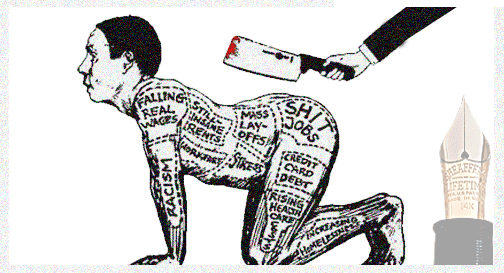
OF THE MANY, tedious American delusions, perhaps the most insistent and counter-factual materialist superstition is the daft creed that America is a classless society. How useful then for so many citizens to chuck this nonsense and have at it in the open October air, and in the precise manner that Karl Marx identified as the very engine of historical development: the struggle between the haves and the have-nots. Or, as the Wall Street Occupation puts it, the struggle of the ninety-nine have-not percent against the has-it one.

Read More

Palestinian Statehood: a plague on your houses

AT SOME point, without the help either of the nudge or the wink, I’ll wager you have grasped through one commonplace observation the cynical and fraudulent character of the more crude manifestations of American nationalism. Well, are you in? Good. The observation to which I refer is the Chinese manufacture of so many American flags.

Read More

Mel Gibson and the Holy War Against Secular Modernity

THIS PAST week news arrived of a forthcoming Mel Gibson project, a Warner Brothers “biopic” concerning the life of Judah Maccabee. The announcement provoked the inevitable outrage, an example of which is Rabbi Marvin Hier of the Simon Wiesenthal Center, who stated the proposed film is akin to “having a white supremacist portray Martin Luther King Jr.” The analogy however is founded, even if understandably and legitimately enough, not upon logic but rather emotion. Considered on logical grounds alone, Gibson’s fitness to portray sympathetically the life of a guerilla war hero and anti-secular reactionary religious fundamentalist is beyond question.

Read More

Making a living, dead languages, and why so many pros write so badly

RARE IS the day that I do not find a piece of bad writing in the New York Times, Washington Post, National Post, or Globe and Mail. This statement, I am confident, could be applied with justice to any newspaper of your choosing. The badness is delivered in many varieties, and in fairness I must observe that some errors are a product of working conditions, deadlines and the under-resourcing of bureaus and so on. Most bad writing however has as its root a more troubling fact: its creators do not know what words mean.

Read More

How Writers Write

THERE IS an enormous store of narrative concerning the working habits of authors, much of it interesting and in my case consumed with amusement but skepticism also.

Read More

Britain and the Illegitimacy of Fascism


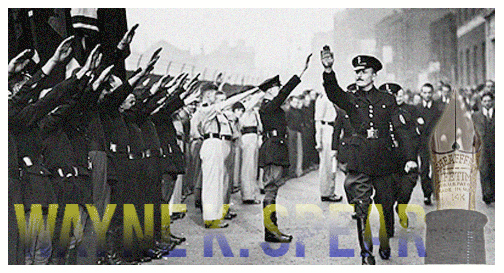
REVISIONIST CLAIMS of a website dedicated to the British fascist and politician Sir Oswald Mosley bring to mind the expression “damned with faint praise.” This, for example, cited from the historian A. J. P. Taylor: “He was never anti-Semitic — only opposed to a Second World War for the sake of Jews elsewhere. He was never unpatriotic — only indifferent to German conquests in eastern Europe … A superb political thinker, the best of our age.”

READ MORE

There’s much talk about debate these days, but do we even know how to do it?

WHEN I was in high school, I had the good and (even in those days) atypical experience of passing through the classroom of a teacher who held fast to the discipline of the formal debate. Looking back, I regret that I hadn’t had more of it, and I wonder to what degree today’s students are similarly deprived by a culture which mechanically genuflects before the shrine of debate while refusing to nourish the conditions which make it possible.

READ MORE

Michele Bachmann’s Line Item Lord

THE DISCERNMENT of the Almighty’s will in weather is a practice of such antiquity that one may consider it a founding art, and until the early 16th century our species’ principal mode of meteorology. Much of the Old Testament is dedicated to the routine business of parsing natural disaster, for the exclusive purpose of teasing out its esoteric grammar of retribution. At the professional apex of this undertaking one finds the prophets. The Book of Amos for instance may be termed weather-centric, organized as it is around cataclysm and opening with the following pronouncement: “The words of Amos, one of the shepherds of Tekoa — what he saw concerning Israel two years before the earthquake, when Uzziah was king of Judah and Jeroboam son of Jehoash was king of Israel.”

READ MORE

How Different are Anna Hazare and Mohandas Gandhi?

IN RECENT days, critics of the so-called anti-corruption activist and Lokpal Bill agitator, Anna Hazare, have contested the notion that a Gandhi-like leader today walks among us. A National Post article, “Gandhian lookalike good for the messiah business, bad for democracy,” summarizes the efforts to refute the analogy. The question arises however: is Hazare really that different from the man with whom he so eagerly connects himself?

READ MORE

Remembering Jack Layton: 1950-2011

I WAS INFORMED of the death earlier this morning of Federal New Democratic Party leader, Jack Layton, by Twitter. There, in an uninterrupted chain of entries numbering in the dozens (and perhaps into the hundreds: I gave up counting) were expressions of sorrow. Never have I seen such universalism of sentiment, such spontaneous participation in a mood which appears to have touched everyone, really everyone, down to a person.

READ MORE

How to Look at Canada’s Indian Residential Schools Archive

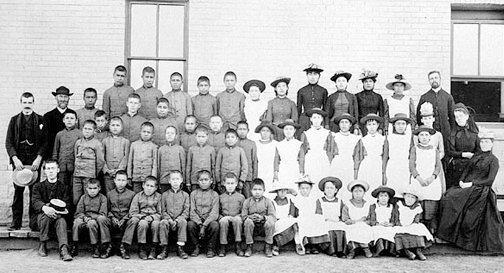
Photo: Rupert’s Land Indian Industrial School / later St. Paul’s Indian Residential School, 1901. Library and Archives Canada PA-182251.

WITH VERY few exceptions, the men and women who created and sustained Canada’s Indian Residential School System believed that the policy of “aggressive assimilation”* was benevolent and forward-looking. The absorption of the Indian into Canadian society, necessary to possess land and resources and to build a nation-state, was the desired outcome of policies and the final solution of the Indian Problem envisioned by Deputy Superintendent General of Indian Affairs, Duncan Campbell Scott. The policy of assimilation neither began nor ended with the Indian Residential School System. The program of assimilation continues to this day, for the simple reason that nation-building, from sea to shining sea, continues.

READ MORE

The Harper Government: Merchants of Death

LOOK OUT the window of my Elgin and Albert Streets office, one block south of Parliament Hill in Canada’s Capital, and you will see before you a building in part reduced to rubble. The reason is that this Government of Canada edifice contains asbestos, or as it is now more commonly known, chrysotile. Across the city and the nation, this poisonous stuff is being extirpated. And, at the same time, the current Prime Minister of Canada is actively abroad promoting its sale, in what are euphemistically termed developing countries. If that in itself is of insufficient force to turn your stomach, please do yourself the favour of reading on, for there’s more.

Continue reading The Harper Government: Merchants of Death