All posts by Wayne K. Spear

waynekspear.com

Heroes, Saviours, and Jordan Peterson

Peterson is at bottom a generic conservative—a believer in the moral and civilizational necessity of established authorities and traditions

✎  Wayne K. Spear | November 14, 2017 • Current Events

IT’S BEYOND REASONABLE DOUBT that we are living in a time of cultural warfare, and as a rule at such times heroes or saviour figures are lifted up to lead in battle. For the self-designated enemies of feminism, political correctness, and leftism, Jordan B. Peterson is such a figure.

Jordan Peterson

I first stumbled over this University of Toronto professor for the reason many others did—his vocal opposition to Canada’s Bill C-16, amending the Canadian Human Rights Act to add gender identity and gender expression to the list of prohibited grounds of discrimination. C-16 further amends the Criminal Code

to extend the protection against hate propaganda set out in that Act to any section of the public that is distinguished by gender identity or expression and to clearly set out that evidence that an offence was motivated by bias, prejudice or hate based on gender identity or expression constitutes an aggravating circumstance that a court must take into consideration when it imposes a sentence.

Peterson objects to many aspects of this bill. He’s deemed it compelled speech and has stated many times that he will not use non-gendered pronouns such as xe or xyr. His broader objection to non-binary (or perhaps it is extra-binary) gender identity and expression is that these are make-believe notions with no grounding either in biological or social reality. And so he has declared war against something he calls cultural neo-marxism, as well as against postmodernism, principally in the form of the propositions that all structures are oppressive and that Western civilization is white supremacist patriarchal rot, and little more, and thus must be overthrown and replaced by more progressive, inclusive, and egalitarian arrangements.

A simple Google search will yield many interviews, podcasts, news articles, and university lectures featuring Mr. Peterson. His notoriety is worldwide, and despite his fame originating in a claim that the university and the laws were out to silence and imprison and ultimately ruin him, Jordan Peterson’s views saturate the air and earn him many hundreds of thousands of dollars each year. Between his income as a tenured professor and his $50,000USD/month (and growing) Patreon subscriptions, to say nothing of his other income streams, Mr. Peterson is a millionaire, or will be one soon. He has a large following, mostly made up of the alt-right, white nationalist, libertarian, and MRM, or men’s rights movement, types of person. He is also admired by a good many atheists, who see him (wrongly, in my view) as a defender of science against faith.

What is it that Jordan Peterson proposes, and why have his statements and positions raised him to his current prominence? These are the questions I am setting out to answer, and along the way I will consider secondary matters, for example the prospect of his efforts to starve certain university professors and disciplines of students and therefore of income.

At the highest level of analysis (and here I am relying on his published lectures) Jordan Peterson appears to be concerned with the relationship of truth and value. Or, to put it as a question, what truth or set of truths will provide the values that allow us to live in this world in a manner that fulfils our individual and collective human potential? It is worth noting that questions of this sort, having to do with ultimate truths and the ideal human society, will as a rule land us in the territory of religion and politics, and so it is in the present case. Jordan Peterson studied political science and was a member of the New Democratic Party until he decided that the political solutions on offer were so much nonsense and turned instead to clinical psychology. But even his interest in psychology is largely an interest in the truth-value of ancient myths and archetypes, as they are rendered in religion and in particular in Judaism and Christianity. So he has in fact migrated from politics to religion, and it is through the door of religion that his thinking is best approached.

Much can be learned about a man from the company that he keeps, and Peterson appears to have ingested a good deal of Nietzsche and Jung and Piaget and Dostoevsky. This is a logical diet of someone who is in search of values by which to live, especially someone of an unconventional, non-conformist outlook who desires a heroic inner life. In college I knew a few Philosophy majors enamoured of Nietzsche, and to a man (they were all men: I have yet to meet a female devotee of Nietzsche) they were oddballs and misfits but I suspected with an imagination that made up for their outward limitations. With Dostoevsky it is much the same, except that Dostoevsky is perhaps even more a moralist than Nietzsche and with somewhat less of the Nietzschean self-aggrandizing bombast—especially of the later, Ecce Homo years, when tertiary syphilis was just around the corner. Piaget is of course an authority of psychological development, having focused on the socialization of children, and from him Peterson would have got the evolutionary-biological basis of the psyche as well as the notion that identity is the product of social negotiation. From his other major influence, Jung, Peterson derived an interest in mythic archetypes and probably in religion also. This brief review covers about 80% of Peterson’s evident influences, and most of the rest has to do with ethology (especially dominance hierarchies and mate selection) and the five-factor model of personality, with which I happen to be very familiar.

Peterson often has recourse to Darwinian natural selection, as well as to evolutionary psychology, and for this reason many atheists mistakenly see Peterson as a fellow-traveller. On his surface he is a rationalist and empiricist, and even to a degree below the surface as well. But if you listen to Jordan Peterson carefully for even one lecture, it becomes clear that he is not a philosophical materialist at bottom but rather some kind of believing Christian. It becomes clear also that his ethology and Darwinism—which is to say his science—are in service of subjective concerns related to masculinity and competitive success and whatnot. (It’s not hard to see why Men’s Rights activists have gravitated to Peterson.) He’s not a doctrinal Christian of an identifiable denomination, but he is a Christian nonetheless. And, being a Christian, he believes—this is I think the proper word for it—in the moral and civilizational necessity of tradition, including the moral Christian traditions that inform marriage and gender roles and so on. In other words his interest in myth and archetype is a prescriptive interest and not a theoretical or abstract one, in the way that an evangelical Christian’s interest in Koiné or ancient Hebrew is not merely intellectual but rather serves a practical goal, that is, attaining a closer relationship with Jesus. He means to apply his observations of things like the hero archetype and the dominance hierarchy and the five-factor model of personality to his life, and it seems to me he wants his students to do the same. Nor is this remarkable, most professors being self-consciously evangelical where their pet ideas are concerned. In short, his life has been a quest for the Guidebook, and now that he has it, he is not going to give up its counsel, or witness its denigration, without a fight.

If my admittedly superficial analysis is correct, what Jordan Peterson proposes is what all tradition-minded conservatives propose—that the answers to our most pressing questions will be found in the past and not in the innovations of radicals and revolutionaries, or even of liberals. Peterson’s exchanges with the podcaster and neuroscientist Sam Harris exhibit a clash of left-versus-right thinking, Harris taking the “left” position that myths from tribal bronze age societies, no matter how laden with practical wisdom, can not guide us successfully through the terrain of urban, high-tech societies. Peterson evidently not only believes that Christianity can guide us, he believes that if we abandon it we will find ourselves between the Scylla and Charybdis of nihilism and totalitarianism. When the news of Louis C.K.’s sexual assaults broke last week, Peterson tweeted that “we are going to soon remember why sex was traditionally enshrined in marriage….” The many casual observers of Jordan Peterson who had assigned him to the Darwinist-materialist camp were confused by this leap, but those of us who have discerned the conservative Christian moralist lurking within his views were not. Without believing in the literal truth of the Christian story, Peterson nonetheless is able to believe in its practical and prescriptive truth. His allegiance to Judeo-Christian values puts him in the company of many radical right figures who are fighting for Western civilization (their preferred tactic is always war) which is to say the institutions, laws, habits, and arrangements of Judeo-Christianity.

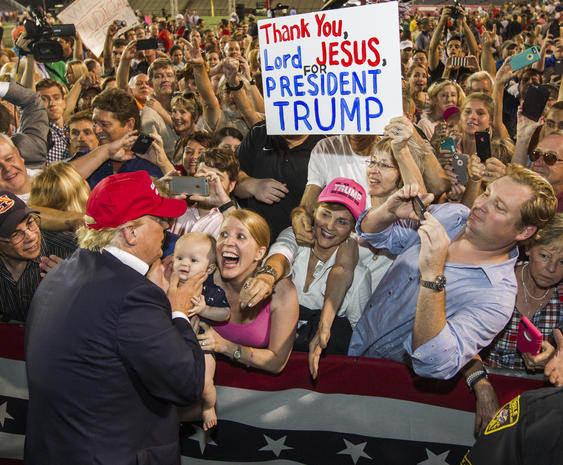
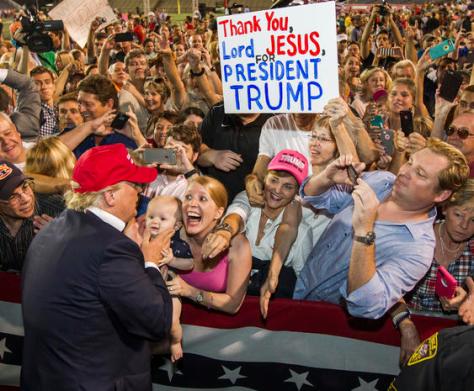
The answer to the second question is obvious once the first has been answered. Jordan B. Peterson’s statements and positions have raised him to his current prominence because the need of a strong leader and even of a fierce hero-saviour type is hardwired into the conservative-traditionalist worldview, an essentially hierarchical world that defers to authority. As Jerry Falwell Jr. correctly said of Donald Trump, “We’re not electing a pastor. We’re electing a president.” In Donald Trump, white conservative evangelicals found their outspoken, combative, strong-man leader. They were not looking for meek and mild Jesus and did not want him for the mission. And of course candidate Trump, like Professor Peterson, says what many are thinking, in a way that makes clear his indifference to political correctness and hurt feelings. The main difference between Trump and Peterson (whose constituencies largely overlap) is that Trump dissembles in plain language whereas Peterson is candid but in terms that are complex, hence easily misconstrued. The result is that both have within their followings people who are in the dark where the actual convictions and objectives of their hero are concerned.

As for the prospect of Peterson’s efforts, a few observations seem in order. The first is that Peterson is fighting over, and for, real-world things that go far beyond pronouns—things like traditional gender roles and marriage and sexual norms and the cultural authority of Christian teachings and values. In the future we will either be saying faerself or we will not, most of the battles being of the zero-sum variety. In a society where a minority of people read the Bible and where the general drift has been away from traditional authorities like the church and toward secularism and plurality, only an aggressive and sustained reaction to the developments of the modern world seems likely to reverse course. Such a reaction is not impossible to imagine, and in fact it is now underway both here and in Europe, but by definition the conservative cause is a doomed one. No one knows this more than conservatives, whose conception of historical development has at its core the notion of decline, or, in other words, the abandonment of a golden age and its values and institutions and the drifting away from natural law. If the tendency of the world were stasis, there would be no need of conservatives or of conservatism. The whole point of being a conservative is to fight for the impossible, which is to say the preservation of a world that is forever changing.

On the other side of this argument are the agents of change, who believe in the future perfection (or at least improvement) of the human being, as well as in the upward arc of human societies, driven by repudiation of the revealed wisdom and the norms embedded in and perpetuated by ancient institutions and authorities. Their disagreement with Peterson is deep and will probably occupy our species for the next century and more. In the meanwhile should Jordan Peterson be fired or silenced, as some of his opponents foolishly hope he will be, his followers will add martyr to the CV and promote him further up the dominance hierarchy, where greater helpings of prestige and American dollars and media celebrity await.

There is no use ignoring the points on which Jordan Peterson is doubtless correct. A society can not undergo rapid and enormous changes and not suffer, often in ways that are wholly unanticipated. Whatever its advances and improvements, the culture that jettisons its traditions and re-invents its values wholesale will invariably introduce an element of uncertainty and even of chaos. But no one born in the past one hundred years can believe that the world will not continue to change, likely at an increased pace and in ways it is impossible to imagine. We are, all of us, wondering what is going to happen and hoping it will not be catastrophic. Peterson’s defiance is doubtless grounded in a pessimism informed by this very point. Nor is he foolish to posit a future in which we have leapt the rails. Such a thing may well occur, and the agents of progress and social justice could well be responsible, and probably will be, since the most dangerous thing is to leap into the unknown. Whenever and wherever the refashioning of societies has been undertaken along tribal identitarian lines, the result has been bloodshed and barbarism, so much so that our survival will likely come down to our ability to transcend the evolutionary inheritance of our tribal ape ancestors. Here we are in a world of particle accelerators and nanorobotics, with our reptilian brains primed for a flight or a fight. One day we will have to learn how to live with this unfortunate paradox, if we are to live at all.


An honest telling of Canada’s story will make Canadians uncomfortable

Still, the truths of history are better than lies

✎  Wayne K. Spear | November 9, 2017 • Current Events

BEFORE BRONWYN EYRE was Saskatchewan’s Education Minister, she was an opinion columnist battling godlessness, political correctness, the myth of global warming, and other menaces. Her broadcasts were hosted at CKOM and CJME, and the Saskatoon StarPhoenix featured her columns, as did lesser-known publications like the Saskatchewan Pro-Life Association’s “Saskatchewan Choose Life News.”

bronwyn-eyre.png

Why do I mention this? To establish that Bronwyn Eyre is an experienced writer of opinion columns and, as such, a person able to put thoughts into words. And yet when she was asked recently to clarify comments she made in the Legislative Assembly of Saskatchewan, Bronwyn Eyre produced gobbledegook. Her initial comment however was plain enough and had the courage-of-conviction candour that you’ll find in her articles: “I would submit that there has come to be at once too much wholesale infusion into the curriculum, and at the same time, too many attempts to mandate material into it both from the inside and by outside groups.” Later on in her comments, made during the Throne Speech Debate of November 1, 2017, she says exactly what she means by wholesale infusion:

My grade 8 son brought a homework sheet home the other day — they’re always sheets — in which he was asked to outline nothing less than his vision of his collective past, his country, and his world. As background, however, he’d copied from the board the following facts which were presented as fact: that European and European settlers were colonialists, pillagers of the land who knew only buying and selling and didn’t respect mother earth. He asked me if it was okay if he could write that he associated with his pioneer great- and great-great-grandparents because no one was writing down their vision of the world. And I said yes, of course, and that after all, they had known poverty in Norway or Ukraine, or war in Germany, that they had come here and tilled the land that produced food for everybody and loved their families and tried to create whole, stable communities in this province, and had loved it here.

And here is the non-clarifying clarification Eyre offered a reporter:

What I was trying to highlight is that it’s maybe something that we all feel on some level that I think we can acknowledge that, you know, we’re perhaps free to love the story and our families and for him too to love the story without excluding loving anybody else. That’s really all I’m saying.

Anyone who has read Eyre’s works, as I have, will doubt “all she is saying” is that we should be free to love our stories and our families. She disapproves of the drift of current changes to the curriculum, just as she disapproves of the drift of politically correct modern society, and if she weren’t a politician she would have found the cahones to say so. But if her point were only about love, I would agree with her. It’s a good message: love your family and your ancestors and your country. We all need this love. And this love is what Indigenous people were denied for generations, by residential schools and the Sixties Scoop and the story of Canada.

I grew up in Canada in the 60s and 70s. I went to a public school and the history I was taught was definitely infused. Infused with lies. The textbooks had nothing to say of the inner life or aspirations of my Kanien’kehá:ka (Mohawk) ancestors, who suffered losses of every kind so that settlers could start a new life. It would have been nice to hear stories that made me love who and what I was, and where I was from, but there was no love, and no compassion, for Indians in the curriculum. My teachers told me stories about Indigenous people that justified the casual daily racism every Indigenous child experienced in the playground and in the town. The story of Canada wasn’t a story you could love as an Indigenous person, because it made you feel stupid and ashamed and worthless. Our schools didn’t give us a vision of the future, they told us we Indians belonged to the distant past. It’s no wonder so many gave up on life and took the leap into an early oblivion.

An honest telling of Canada’s story will make Canadians uncomfortable, but in the long-run Canada will be better for it. The truth is often unpleasant, but it’s morally and practically more defenisible to live a life informed by what’s true and real than it is to live under the sway of comforting half-truths and lies. In 2002 I wrote a speech for the launch of a residential school exhibit, at the National Archives of Canada, that began:

The National Archives of Canada is a solemn place, dedicated to the service of the nation’s identity. It gathers what has been as an endowment to what will be. Because no legacy is enriched by counterfeit, a nation is ill-served by history which is not genuine. And so, we are here today to consider a national institution committed, not to the preservation of a people, but to their forced assimilation.

“Because no legacy is enriched by counterfeit, a nation is ill-served by history which is not genuine”—I wrote these words 15 years ago and they guide me still. I care about truth, and I care about authenticity, and I consider it a tragedy to live without either. I’d like to think Canadians of honour feel the same. I used the metaphor of an inheritance of fake money because that is what I believe Canadians have received from their educators, for generations—a counterfeit. I know it’s what I received, and as a result I’ve been a skeptical person my entire adult life.

Ms Eyre, you can love your family and your ancestors and your accomplishments without sacrificing intellectual and moral honesty. In fact, you have to. Otherwise it’s not really love.

Is it Even Possible for the MMIWG National Inquiry To Do Better?

The problem may well be the inquiry process itself

✎  Wayne K. Spear | November 2, 2017 • Indigenous Affairs

THE NOVEMBER 1 interim report of the National Inquiry into Missing and Murdered Indigenous Women and Girls (MMIWG) is the first bit of positive news from an organization known for headlines like these:

– National inquiry into murdered and missing Indigenous women and girls postpones first family fall hearing
– Trudeau sidesteps calls to reboot MMIW inquiry amid calls for resignations
– Manitoba families push for Indigenous-led MMIW inquiry, want commissioners to resign
– Government policies making it difficult for MMIW inquiry to do its work on time: chief commissioner
– Family members say Missing and Murdered Indigenous Women inquiry a failure; call for ‘hard reset’

There are only a few plausible reasons that an agency will tumble into the category “problem plagued,” as the National Inquiry clearly has. One is suggested by a headline, above: government policies. The Truth and Reconciliation Commission of Canada was a mess in the beginning, because it was a micromanaged sub-department of the federal bureaucracy, subject to the government’s byzantine rules and lacking executive authority. Early on the TRC headlines had to do with things like the delays faced by the Commission while waiting for ministerial authorization to order furniture and paint offices. The work stalled and morale took a dive and everyone wondered if the TRC would be able to restore the lost trust and confidence, just as they wonder today about the wayward inquiry into murdered and missing women and girls.

mmiwg-national-inquiry.jpg

TRC Commissioners came and went—again, just as they have at the National Inquiry. I interviewed a number of people who told me the TRC departures were a result of political interference from the National Chief of the Assembly of First Nations. I was told that political agendas had contaminated the organization and made cooperation among the three commissioners impossible. Internal politics and political rivalry is a second plausible cause of dysfunction.

The third is personality conflict, and doubtless there’s some of this going on at the National Inquiry, as there was at the TRC and in every organization I’ve ever seen that was staffed by members of homo sapiens.

A moment ago I said that the interim report was the first bit of positive news from the National Inquiry, but that’s not entirely the case. The report has already been trashed by those who don’t see it as positive at all. Pam Palmater wrote on Twitter that “if u subtract references notes graphics definitions & recycled #MMIWG NI promo, then all that remains is a mini-literature review. #disgrace.” I wouldn’t say her assessment is wrong, but only that her expectations are high. Just as the expectations of the TRC were high. And not only high, but misguided.

At the onset of the TRC’s work, I had conversations with Indian residential school survivors who made no secret of their pleasure that justice was about to be served. I had read the Commission’s Terms of Reference and didn’t have the heart to tell them that there’d be no such thing. The lawyers who created the TRC are the lawyers fighting the Human Rights Tribunal ruling that orders Canada to bring on-reserve child and family services spending to parity with its non-native equivalent. They are the lawyers who have absorbed $110,000 in legal fees fighting a $6,000 dental procedure required by an Indigenous girl. The government’s lawyers are risk-averse and tenacious and not at all in the business of exposing their client to the messy inconveniences of justice.

The National Inquiry’s interim report is a literature review, as Pam Palmater says, because the Terms of Reference say so:

an interim report, to be submitted before November 1, 2017, setting out the Commissioners’ preliminary findings and recommendations, and their views on and assessment of any previous examination, investigation and report that they consider relevant to the Inquiry.

There’s even a helpful list of reports for review, such as the Report of the Royal Commission on Aboriginal Peoples, Invisible Women: A Call to Action, What Their Stories Tell Us: Research findings from the Sisters In Spirit initiative, and Missing and Murdered Indigenous Women in British Columbia. The TRC, like the National Inquiry, is mandated to “sit at the times and in the places, especially in Indigenous communities in Canada, that the Commissioners consider appropriate” for the “gathering of statements by qualified trauma-informed persons.” It is not mandated to go after the police or to point a finger at the corrupt or inept. The MMIWG National Inquiry is furthermore mandated to submit its findings, on or before November 1, 2018 (“without expressing any conclusion or recommendation regarding the civil or criminal liability of any person or organization”) and a list of non-binding recommendations.

So far the MMIWG National Inquiry has been a disappointment, but I wonder how much it is within the power of this organization to do better. To what extent is the National Inquiry hindered by Canada? Over the years the federal government has mastered the art of politically expedient, toothless commissions which provide ministerial speaking points and aspirational calls to action that may be ignored or co-opted. The independent or arms-length inquiry, with powers of subpoena, has given way to therapeutic talking circles micromanaged by the Privy Council Office. Recent experience suggests that the inquiry process is broken, and it’s at this dysfunctional process itself we should be directing our ire.

God’s Men In Washington

As weird as it may seem, “Theocracy” is the logical description of Trump’s Administration.

✎  Wayne K. Spear | October 31, 2017 ◈ Politics

THERE’S A GAME I sometimes play on Twitter, and it begins whenever I find a vicious troll in a Twitter feed. If you use Twitter, you know the type of person I’m talking about. He (or she) confuses your / there with you’re / their, uses the words snowflake and libtard, has a thing for all-caps, and loves Donald Trump. Now for the game. You must guess the precise wording on his (or her) Twitter profile. Follower of Jesus? Proud Christian? Lover of God? Five points if you correctly choose “Bible citation” as your answer, ten if you pick the chapter and verse.

gettyimages-484797712.jpg

It’s petty, I know. But it’s also revealing. Across social media the Jesus People are handing hourly beat-downs to their fellow-Americans, oblivious to the irony. Perhaps there is no irony. Evangelical Christianity is an angry and self-pitying creed, obsessed with persecution and impatient for a strong leader to initiate the final battle against the enemy. Soon enough the social media wars will be transposed to the streets, and when they are I won’t be surprised to see Christians trading their bullet-points for bullets, once again with no sense of irony.

Eighty-one percent of white evangelical Christians voted for Donald Trump, a man who enjoys the support of a pious rogue’s gallery including, but not limited to, Tony Perkins (Family Research Council), Jerry Falwell Jr (Liberty University), Franklin Graham, James Dobson, Ralph Reed (Christian Coalition), and Pat Robertson (700 Club). In the days after the Unite the Right rally, in Charlottesville, several of the President’s advisory boards disbanded, appalled by his non-denunciation of neo-nazis and white supremacists. But the Evangelical Executive Advisory Board remained intact, minus only one member, the African-American and megachurch pastor A.R. Bernard. Evangelical Christian support for Trump has been strong from the beginning, and it looks as if it’s going to stay that way until the red heifer comes home.

White evangelical Christian best describes the Tribe of Trump. Not everyone who supports this President is an evangelical, but an evangelical is highly likely to support this President. Tucker Carlson identifies himself as an Episcopalian, but his contempt for the Episcopal Church makes it clear that his religious views are fundamentalist. Sean Hannity is the executive producer of a recently-released conversion-porn movie called Let There Be Light, about a miserable and alcoholic atheist who finds god in a near-death experience. Hannity plays himself, although not very convincingly according to a review I found online.

There are enough evangelicals in Trump’s cabinet to cast a movie called Let There Be Theocracy, starring Mike Pence as the Vice-President, Jefferson Sessions (Attorney General), Rick Perry (Energy), Betsy DeVos (Education), Ben Carson (HUD), Sunny Perdue (Agriculture Secretary), Tom Price (HHS), and introducing Scott Pruitt, as the godly EPA Administrator who says that “true environmentalism, from my perspective, is using natural resources that God has blessed us with.” In Let There Be Theocracy, Sean Hannity also plays himself, again not convincingly, in the role of a Fox News host who believes that Hillary Clinton is the President and that she should be prosecuted for colluding with Russia.

thumb.jpg.png

Steve Bannon and Seb Gorka went to the Family Research Council’s Values Voters Summit recently to declare war on behalf of the Judeo-Christian West. Bannon put one of the Bible’s most poetic books, Ecclesiastes, to a cheap and nasty use: “There’s a time and a season for everything, and right now it’s a season of war against the GOP establishment,” he said. The many evangelicals and conservative Catholics around the President keep telling us that Donald Trump is fighting for Christian (or “Judeo-Christian”) values and doing a great job of it. Who am I to argue?

America’s evangelical Christians finally have God’s man in Washington, and God’s man is stuffing the government with Theocrats. We will soon learn a lot about their God from this administration, and it’s going to be a long, long time before we’ll forget what we discover.

Social Media, Conversation, and Connection

People can smell bad and have unpleasant loud voices but we can’t do without them

✎  Wayne K. Spear | October 26, 2017 ◈ Essays

THE ODDS ARE you’re not old enough to remember what it was like to be bored and lonely before the days of Facebook, so let me set the scene. In those days I watched Friends and reruns of The Rockford Files on cable television and I drank and I smoked cigarettes in my living room, or I walked the streets of my city for hours in search of diversions. One night, in my 20s, I drove to a singles party on the edge of town, circled the building twice, and went home, unable to summon the nerve to go inside. I was in a PhD program at the time and I spent my days in libraries or in front of a computer that was not connected to the world of distractions that we call the Internet. It was a good life when it was good, and when it wasn’t good it was an empty howling wilderness that I filled with words that no one else would ever read.

Many of us were already experts on isolation when Robert Putnam wrote his book Bowling Alone: The Collapse and Revival of American Community. A book like that wouldn’t have been written or read otherwise. In my 30s I had a family, well after my contemporaries had done the same, and I became fully absorbed in my work and responsibilities. But your world can shrink as a parent, especially if your extended family is far away. My partner and I didn’t go out for a movie or a restaurant meal for years, and even if we had tried to arrange a social outing it would have been an ordeal. To this day a drink in the neighbourhood with a friend can require weeks of negotiation. A get-together with someone from another city (and most of my friends live in another city) requires months, and often there are cancellations and deferments. The reality of post-college life for most of us is that we’ll rarely meet face-to-face with the few friends we have. The reality is that you’ll spend a good deal of time alone. Maybe that’s why Friends was such a big hit. We all want that life, and few of us have it.

I almost didn’t write this essay because I decided instead to spend my scheduled writing time at a Meetup for writers in my neighbourhood. Five minutes was all I could stomach. I sat at the table with a dozen strangers and one of them immediately took control of the group, setting down what she believed should be the terms and conditions of the meeting. I felt as if I was at an inaugural Bolshevik congress, when all I wanted was an intelligent conversation. We should have a closed Facebook group, the woman said. We should submit our writing for critique as an attachment and not in a post, she said. And on and on, we should do this and that and not these and those. I’m allergic to the word should, so I went outside, lit a cigar, walked home, and wrote this.

People have smells and loud irritating voices and ways of laughing that get under your skin like a nasty insect bite. But people can’t quite do entirely without people. When I was young I dreamed of writing for the magazines and newspapers. I fantasized about the smart dinner parties and the witty conversations that would be the collateral of my life of letters. My many writer friends would be creative and interesting and bold, and my nights would be filled with the feast of reason and the flow of soul. A bohemian life. The reality is another thing entirely, as everyone soon enough knows. The labour of writing is tedious and isolating, and for most of us it doesn’t lead to glamorous diners or even friendships. Instead, there are inboxes with messages like this:

Your a horrible writer, you dont even know what your talking about. Give your head a shake. This is the stupidest thing I have ever read. You should go back to working as a carnival barker.

Life is the same for people of all professions. Few of us bowl or join clubs or social organizations anymore, if we ever did. Less of us go to church or spend our weekends at the Legion than our parents’ generation did. We don’t drive to the singles’ dance, we look for love on Tindr. We have Meetups and Facebook and Twitter and Instagram. We go to the Internet for conversation and camaraderie and connection. There, we smell the virtual smells of other people, and it isn’t always pleasant or pretty. But it’s human, and we’re lying to ourselves if we think we can do without human connection.

The Reconciliation Scam

Ottawa isn’t going to change, ever, and Indigenous people should know it

✎  Wayne K. Spear | October 24, 2017 ◈ Current Affairs

FROM THE DAY I first set my eyes on Justin Trudeau, I thought he was an inconsequential narcissist, and I said so. I would say it to his face, to both of them in fact. Yes, Trudeau is charming. But that’s a problem, not a solution. Bill Clinton taught me long ago to mistrust charisma and charm, which is to say the political art of working out what a credulous audience wants to hear and then delivering it. If you’re a sucker for a schmoozer and a charmer, consider yourself warned: you really do get what you ask for.

Phoney TrudeauA phone for a phony

A lot of people fell for the Trudeau pitch, but the shrink wrap has been off a while now and buyers’ remorse has set in. Especially for Indigenous people. Just look at the ledger: discriminatory chronic underfunding of on-reserve child and family welfare, continuing lack of clean drinking water in communities, Ottawa’s refusal of non-insured health benefits, and a list of unfulfilled promises. It’s as if the principal interest of the federal government is in creating aspirational terms it has no intention to fulfill. Gathering Strength, The Aboriginal Action Plan, Self Governance, Nation-to-Nation, Reconciliation, A New Relationship. Nice, shiny charismatic words.

The charismatic Liberal is a compassionate feminist who rolls up his shirtsleeves to serve a beloved middle class, but the real Liberal has a trust fund and a bottomless budget for self-serving propaganda, like the $212,000 cover of the 2017 budget. The charming Liberal happens to jog past your wedding, where he poses for selfies, but the real Liberal planned the stunt in advance and used your nuptials as an occasion for personal PR advancement. The charming Liberal goes to the UN, where he cringingly displays his Liberal guilt, but the real goal of this contrition is self-serving—a Canada seat on the UN Security Council. The charismatic Liberal thought it would be cool and fun to box Senator Patrick Brazeau—for charity—but the real Liberal contrived to beat up an Indian, to show the voters how tough he was.

Reconciliation is just another Liberal scam from a government that is scam-ridden. A government that claims to stand for the middle class but that has spent $400 million to hire CRA employees who harass clerks and waitresses and other low-wage, service industry workers, all while the Finance Minister fattens himself on conflicts-of-interest. A government that promised to help small businesses but didn’t, until public outrage forced them to. A government that is more interested in cutting deals with a brutal communist regime in China than it is in human rights. A government of arrogant and entitled trust-fund millionaires.

The Liberals are not going to take Canada in some bold new direction, because they can’t. No government can. A loud segment of Canadians would never accept the disruption and inconvenience, no matter how small. As bad as it is for many Indigenous people, the status quo has worked well enough for the country, which is why it’s the status quo. The Crown hasn’t solved its Indian Problem, but it has managed it. Canada is sovereign from sea to sea to sea, and it has its fingers in all of the resources, and Indigenous communities are under thumb. This isn’t ideal (total assimilation and disappearance of a distinct Indigenous population, the original government plan, was the ideal) but it’s not bad. So the politicians concentrate on political damage control, trying to contain things like the news of youth suicides, or class action lawsuits for residential schools and the Sixties Scoop. There’s no reason Canada can’t go on like this for another 500 years, and as far as I can tell, there’s no compelling reason it won’t.

That’s why I think all the Ottawa talk of reconciliation is just part of an ongoing branding effort, by governments looking for shiny words to put into expensive budgets and aspirational press releases.

Reconciliation within our families is another matter entirely. It’s meaningful and real, beautiful and necessary. So, too, reconciliation of community members. I am encouraged by every survivor who learns to express the love of a parent, love that he was denied in a residential school, to his own children. I am encouraged by the communities that cast their eyes into the pit of collective historical trauma, determined to understand and to heal. I am encouraged by open and honest conversations between ordinary Canadian citizens and Indigenous people. I believe in the power of everyday people, and not in the empty words of career politicians. We don’t need Ottawa for real reconciliation, and that’s a good thing, because Ottawa is never going to give it to us.

Gord Downie, 1964–2017

His place in the firmament of Canadian music is well established

✎  Wayne K. Spear | October 19, 2017 ◈ Obituary

I’VE NEVER BEEN A Tragically Hip fanatic, and that’s a shame, because the two shows that I saw were the kind of show a fanatic would give an arm to have attended.

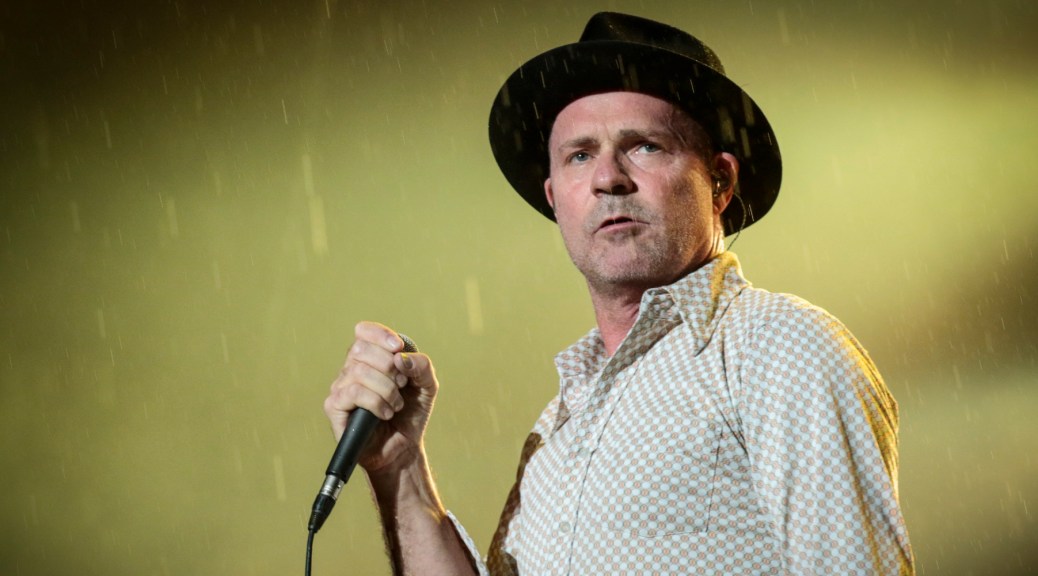
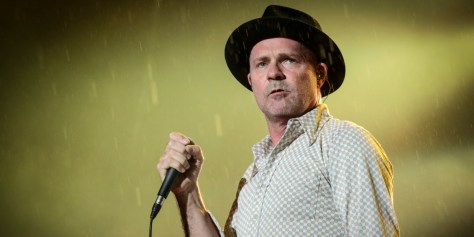
o-GORD-DOWNIE-facebook.jpgGord Downie established himself as a symbol of Canada


The first performance was in a St Catharines bar called The Hideaway, before The Hip were well-known, in the mid-1980s. We were so close to the stage that the sweat from Rob Baker’s hair was raining down on me and my friends, so we retreated into the crowd. The next and last time I saw The Hip was in 1994, in a small Kingston pub, where the band suddenly turned up for an unannounced free show. At the time I was hanging around with the curator of a local art gallery whose painter boyfriend was a close friend of the fellow who painted the cover of Day for Night. I got a call telling me to get to the pub, now, which I did, only minutes before it filled to beyond capacity.

The Tragically Hip made the most sense to me in bars, the seedier the better. I remember stepping into a Sudbury dive as the chorus to Little Bones played on the radio. I sat in the corner with my watery beer, and the song felt like the soundtrack of the place. In Sault Ste Marie, New Orleans Is Sinking. In Prince Albert, Courage. In Moncton, Ahead by a Century. Then there was Bobcaygeon, a song in a category of its own because some of my earliest memories are of the cottage my family had there, in the 1960s and 70s. We love musicians because they make music, and we love music because it captures and preserves our fondest memories like an amber that you can dance and sing along to.

Every obituary is about its author as well as its subject. We write of others to affirm our values and to praise what we hope to have within ourselves. A life lived is an object lesson, a set of actions and commitments to be appraised, celebrated, or (in some cases) denounced. And one day my friend you will arrive at the place, if you haven’t already, where the obituaries make you think, “my goodness, I’ll be that old very soon” or “she was younger than I” or (as I thought of Gord Downie) “he was the same age as me.” A selfish thought, but also human.

I am tempted to reach for the cliché that Gord Downie died before his time, but of course the time when one leaves this world is by definition his time. He died young, doubtless before he had said everything he wanted to say and before he had made everything he wanted to make. But he was also old enough to have left an indelible and enviable mark upon Canadian music and culture. The depth of his influence was revealed last May when news of a tumour went out to a stunned public. The tour that followed ranks among the most widely viewed and widely discussed in Canadian music history, as the outpouring of sentiment, then and now, attests. Gord Downie managed to do what only a handful of Canadian musicians have done—establish himself as a symbol of Canada. In this, he has joined the company of Gordon Lightfoot and Stomping Tom and Joni Mitchell and Leonard Cohen, all of whom, please note, are a full generation older.

Gord Downie committed himself late in life to causes including environmentalism and raising awareness of the Indian Residential School System. At the end, knowing his time was short, there came a final blast of creative fury. He took up the story of Chanie Wenjack, creating a book and album and film about the real-life boy who died trying to escape the Cecilia Jeffrey Indian Residential School. He set up the Gord Downie & Chanie Wenjack Fund. He became a prominent vocal proponent of Indigenous people, in a time when there were already numerous books, by Indigenous people, on numerous topics including residential schools.

An October 21, 2016 Walrus article asks, “Why is Gord Downie getting more attention for retelling Indigenous history than Indigenous artists?” The short answer is that Downie, because he was a rock star, could reach an audience few if any Indigenous authors could. That’s an unpleasant truth for those of us who are the Indigenous authors of books about the Indian residential schools, but it’s a truth nonetheless. I remember the day Secret Path arrived to fill the windows of a local bookstore where my book, Residential Schools, wasn’t even stocked. Again, the selfish but also human thoughts. I was glad the Wenjack story would get out, but I wished it didn’t take a pop-culture celebrity to do it. Are we going to have to assign a rock icon to each of the thousands of Chanie Wenjacks?

It’s too soon to say what Downie’s influence and legacy will be as these pertain to his twilight interest in Chanie Wenjack and Indigenous people generally. But his place in the firmament of Canadian music is well established. Gord Downie’s music will live on, and so will the Gord Downie & Chanie Wenjack Fund. May good come of it.

Too many Chiefs, not enough Indians

The Toronto District School Board is making a mockery of the Truth and Reconciliation Commission’s recommendations.

✎  Wayne K. Spear | October 17, 2017 ◈ Current Events

IT TAKES A LOT to render me speechless, but there I was nonplussed by the October 11 CBC headline, “Toronto District School Board to remove ‘chief’ from job titles out of respect for Indigenous communities.” Job titles with the word “chief” will now be replaced with “manager.”

TDSB

The Toronto District School Board says its decision to scrub “chief” from the lexicon was “in the spirit of recommendations made by the Truth and Reconciliation Commission of Canada, or TRC. It’s a shame they didn’t spend more time with those recommendations in the flesh. Or with Indigenous people, who would have helpfully informed the board that their proposal was a cure in search of a disease, and a ridiculous one at that.

It would be easy to mock the initiative for its frivolity, but this is no laughing matter. The cynic in me wondered if perhaps the bureaucracy was undergoing an internal job title review and simply tacked-on a high-minded purpose. Indeed, the TDSB has said the move is part of a larger renaming initiative, the most generous interpretation of which is that TDSB acted alone and only afterward took to the work of selling the public on the supposed merits of its decision.

And I’ve no doubt the bureaucrats believe this is for the good of Indigenous people, in the spirit of every boneheaded policy ever made in our absence and dropped on our heads from on-high.

I’m discerning a trend, and I don’t like it, and neither do many other Indigenous folks. The trend is to read (or pretend to have read) the TRC’s recommendations and to have been “inspired” to do something symbolic no Indigenous person has ever requested and that will have no discernible material benefit.

The word “chief” can be used as a slur, but it happens also to be an honorific title. It’s considered a breach of protocol, for example, not to address the Assembly of First Nations’ leader as National Chief.

The title “chief” is widely used in the communities, but there are, in some cases, preferred usages derived from Indigenous languages. I am a member of the Haudenosaunee, or Six Nations, whose traditional leaders are called rotiianer. When using English, we typically render the word roia:ner (singular of rotiianer) as “chief.” If you’re ever unsure what word to use, don’t worry. The rule of thumb concerning protocol is: when in doubt, ask.

An empty gesture would be bad enough, but it’s worse even than that. The TDSB’s proposal trivializes reconciliation and makes the cause appear pernicious by putting into the minds of the public a spectre of thick-headed literalists, nit-picking school-marms and language police, set loose to hunt down and banish words deemed offensive by the Politbureau. The TRC called for a lot of things, comrades, but not for this.

I know a bit about the Toronto District School Board. I’ve been the chair of a school council, and I’ve given TDSB presentations on Indian residential schools. I’m the co-author of a book (Residential Schools: with the Words and Images of Survivors) used in classrooms and libraries across the city. The teachers and librarians of the TDSB are good people. They are making an effort to involve Indigenous people — especially those who were in the residential schools — in the work of education and reconciliation.

Fulfilment of the TRC’s “Calls to Action” is not an easy task, and the educators I’ve spoken to feel the weight of their responsibilities. They have my respect. But whatever sub-committee made this decision needs to understand that they are undermining the work of educators.

Symbolism can be powerful in a good or a bad way, and this is a case of bad symbolism. Bad symbolism misrepresents reality and diverts our attention to non-existent problems like “offensive” job titles. When the bureaucracy of an institution with great power dabbles in bad symbolism, the confidence of the public in that institution is undermined.

The Truth and Reconciliation Commission has provided specific recommendations for educators and educational institutions, such as creating age-appropriate curriculum on residential schools and providing appropriate teacher training. There’s more than enough there to keep you busy. If the TDSB needs guidance or clarification, you can have it, from the many Indigenous people who are more than willing to work with you.

But if you go it alone and as a result alienate the public with bad symbolism of your own doing, you will find it much harder to do the work that actually needs to get done.

There’s Plenty More Where Harvey Weinstein Came From

Liberal Hollywood? Nothing is more conservative than an industry built by powerful old men to exploit women.

✎  Wayne K. Spear | October 12, 2017 ◈ Current Events

IT’S ENCOURAGING TO SEE the stars burn with indignation this week, but the spectacle would be better had Harvey Weinstein’s creepy predations not been an open Hollywood secret and a punchline before they finally became a scandal. Tinseltown’s men are making the correct noises now, but they aren’t the ones who put the former into Weinstein’s updated CV, former film studio executive. That honor belongs to female actresses and two female reporters at the New York Times, Megan Twohey and Jodi Kantor, who one week ago exposed a man who for years made a habit of exposing himself. Good riddance, Harvey Weinstein, you pig. You were forever cajoling women to watch you take a bath, and you forever looked like you needed one.

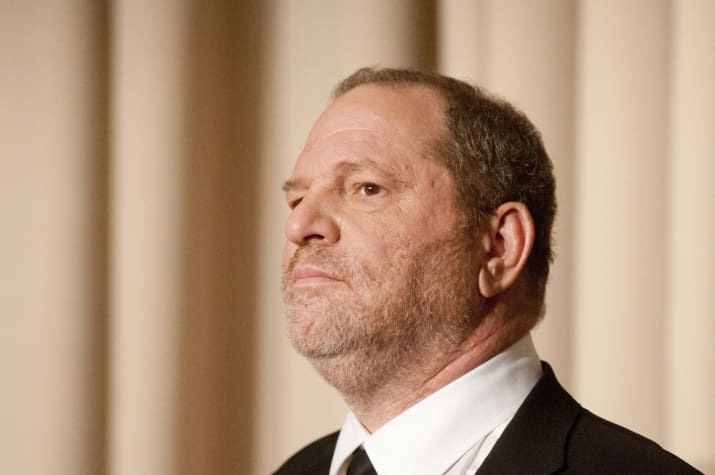
Harvey WeinsteinHarvey Weinstein is the elephant in the room.


Just as you’d expect, the Trumpians have taken to this news like the wolves that they are. Harvey Weinstein! A Democratic donor! Supporter of Hillary and Obama! And Weinstein was a donor to, and supporter of, Democratic politicians and causes. For this reason his crimes have become a symbol in the minds of many for all that is rotten within liberalism and the left. Hollywood, a pit of leftist godless sexual iniquity and deviance. A land of anarchic carnal indulgences and hedonistic arrogance. How on earth do they get away with this disregard for family values? You’ve heard the saying. When you’re a star, they let you do it.

Harvey Weinstein is gone, at least for now, but his species is far from extinct. We’re certain to revisit the sordid genre of sex, liar, and audiotape because men have made sure that the institutions which shelter and abet the Weinsteins of our world remain intact. Weinstein survived his 2015 audiotape exposure, as did a certain high-profile political candidate, in 2016. Our world still has locker rooms and casting couches. There’s still an elephant in the room, and the elephant is wearing a bathrobe, and if you don’t give the elephant a massage you will never work in this town.

So much for Hollywood liberalism. The industry clings to and conserves the outdated and pernicious garbage of our past. “I came of age in the 60s and 70s,” Weinstein said, “when all the rules about behavior and workplaces were different. That was the culture then.” His self-defence is ridiculous, but it’s also revealing. Hollywood is a throwback to an earlier era, an essentially conservative institution where female employees are expected to indulge the whims of older men as a condition of advancement. The film critic Manohla Dargis puts it like this, in her article “Harvey Weinstein Is Gone. But Hollywood Still Has a Problem.”

Outsiders tend to see the industry as liberal, and while insiders do promote progressive causes, the business hews to a fundamental conservatism. This conservatism shapes its story recycling, its exploitation of women (and men) and its preservation of a male-dominated, racially homogeneous system. Despite pressure, including from the likes of Ava DuVernay and Lena Dunham, the industry resists change. Those in power don’t see an upside in ceding it.

Miramax won over the outside world with artful stories, but on the inside it was a toxic environment over which presided a manipulative sexual predator and rapist. For decades Weinstein prevailed against allegations of harassment, all the while honing his grotesque sexual predator playbook. (From the Twohey and Kantor Times article: “Working for Mr. Weinstein could mean getting him out of bed in the morning and doing ‘turndown duty’ late at night ….”) Weinstein ought to be a type of man consigned to the past, but he isn’t. Hollywood ought to be setting a better example, but it isn’t. It’s still an industry run by powerful men to exploit women, and there’s nothing progressive or liberal about that. On the contrary it’s conserving the very worst instincts of men, in the interests of money and power, and in that sense it’s deeply conservative. And only men can change it.

The Made-for-TV President

Where would Donald Trump be without fake media like The Apprentice?

✎  Wayne K. Spear | October 10, 2017 ◈ Politics

A FEW YEARS AGO I spent a week at Sunset Bronson Studios, in Hollywood, home of Let’s Make A Deal and The Biggest Loser and the first-ever “talkie,” The Jazz Singer, starring Al Jolson. Opposite the third-floor offices of Judge Judy a fellow named Clint Arthur runs his business, Celebrity Launchpad. Arthur’s Sunset Bronson students learn pitching to small-market morning television producers and the art of hustling their way to New York and Los Angeles, where celebrities are born. His tagline is “Make a difference & a fortune sharing your message on local TV.” Celebrity after all translates nicely into influence and money, regardless of the means by which it’s attained.

celebrity apprenticeDonald Trump plays a successful human being on a TV game show
You can easily grasp why the President of the United States makes me think of Celebrity Launchpad. The Arthur method bares a truth of our era, that performance is everything. In the 1980s Donald Trump worked the New York tabloid and chat-show circuit as a Lothario figure, and in the 1990s his revised performance, as a builder and politician, went national. The celebrity breakthrough arrived in 2003 when Trump was offered the starring role in a reality television program. Here is what Kelly McEvers had to say of this, in an October 5 NPR interview titled “The Apprentice Creators Look Back.”

At the time of The Apprentice, Donald Trump’s companies had already been through four bankruptcies, and there were two more to come, including the Taj Mahal. Airbrushing all this out is what [producer] Bill Pruitt says he feels most guilty about now. He says he was a good con artist, and his con helped take Donald Trump all the way to the White House.

There you have it: the performance is everything. Mark Twain once remarked that a man with an established reputation for rising early could safely sleep until noon, and the same appears true of a man with an airbrushed reputation for business success. Over and over again The Donald failed—at marriage, at dealmaking, at ingratiating himself with the members of a social class whose acceptance he craved, and at business. When the new millennium arrived he was persona non grata among New York’s elite and a notorious credit risk no American bank would touch. No one who had followed his antics since the early 80s could take him seriously, whether as a businessman or a politician. But that was in real life, and television is something altogether different.

Donald Trump kept at it when there was nothing in the bank and nothing in the tank except hype. The columnist Christopher Hitchens was asked in January 2000 what he thought of the rumoured Trump candidacy and dismissed it with the comment, “he’s managed to cover ninety percent of his head with thirty percent of his hair.” Such was the state of affairs when Mark Burnett committed the considerable resources of his major-network prime-time game show to a rescue and rehab operation. We’ll never know what would have become of Mr. Trump in the absence of this deus ex machina, but we know what did happen. An entire generation who knew about Trump only what The Apprentice chose to tell them swallowed Burnett’s fiction whole. Trump used the show to perfect a business model he’s since carried into the White House, surrounding himself with toadies whose sole job is to flatter the boss, shilling Trump-licensed products, giving his children jobs as “advisors,” and spending NBC’s money at Trump properties.

Don’t ever forget that Donald Trump hadn’t built anything for years when The Apprentice made him the world’s most famous builder. In the 1990s he became a RINO (Real estate In Name Only) by licensing the word TRUMP to the developers who did the negotiating, land acquisition, financing, contracting, and project management. A large chunk of The Apprentice was fabricated, from the sets to the pretense that Trump was judging the contestants to decide who would be fired. (In fact the producers chose who would leave and who would stay, using criteria that had everything to do with show business and little to do with Trump’s in any case dubious business acumen.) But it wasn’t all fake. The show’s star was, as the theme song goes, a lover of money, and as we’ve seen since January 20 of this year he likes to fire the people around him. The Apprentice did well—very well—because the future President has a knack for drawing attention to himself, which is the alpha and omega of a celebrity job description.

The President has spent his life working three of the principal routes to fame: New York talk shows, Los Angeles film and TV, and DC politics. (He’s hinted at a fourth with his comment about shooting someone on Fifth Avenue.) Today he’s the most famous and most-talked-about human being on our planet. When he tweets the world moves. Every day the newspapers turn his cast-away and often incoherent utterances into news. The stock market rises and falls on speculation over the thoughts in his head. He may soon say something that starts a war. Hundreds of thousands of lives perch upon his volatile mercies. And this, all of this, because he understands that in America you prevail as long as you perform.

Jagmeet Singh’s Charm Offensive

His nice words don’t quite square with nasty realities

✎  Wayne K. Spear | October 5, 2017 ◈ Politics

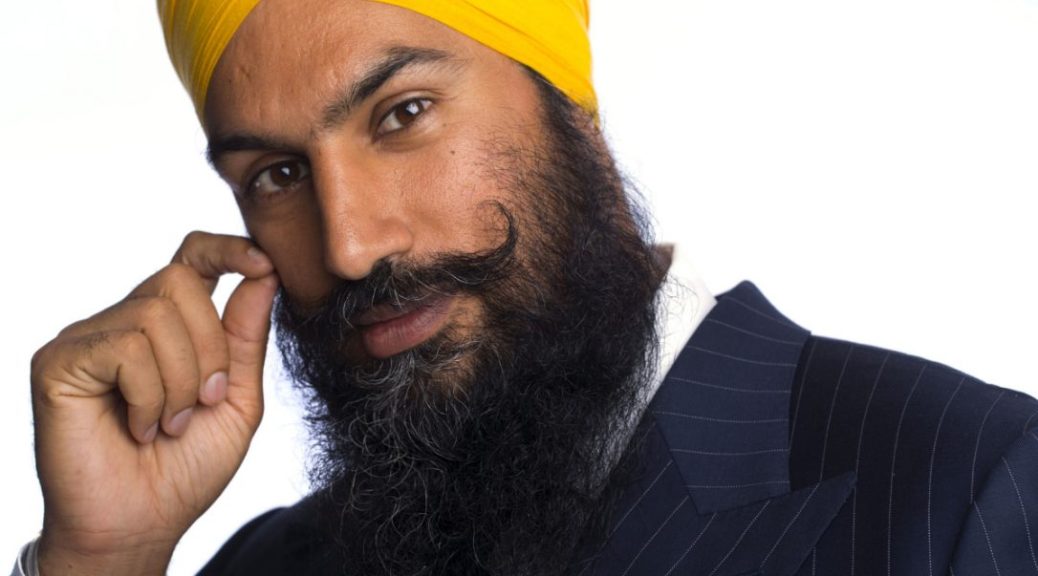
THE HEADLINES trumpeting Jagmeet Singh’s NDP leadership win each conformed to one of two themes. Either his victory as a “non-white” candidate was unprecedented, or it could be credited to the very-much-precedented appeal of charisma, GQ-worthy style, and handsomeness. The American papers in particular didn’t fail to notice that another Trudeau had arrived on the scene, ending the Prime Minister’s cornering of the charm market. Nor does the ringing of familiar bells end there. Kesh and kara aside, the new NDP leader is political boilerplate: a lawyer from Scarborough who speaks (cautiously) in both official languages and who celebrates Canada’s diversity and wholesomeness in, no doubt, focused-group-tested terms.

Jagmeet SinghCanada’s newest GQ leader

But, of course, he isn’t just another politician. He’s Sikh, and he is now leader of a federal political party, and as such he’s nullified a barrier to political office we should be glad to see nullified. The Charisma War can now begin, and how discouraging this prospect must be for the Conservative leader, Mr. Scheer, whose New York Times headline said: “Canada’s Conservatives Choose Andrew Scheer as Their New Leader.” In the meantime we all know how these battles are going to be fought, and that is with the ammunition of buttery words shot at the hardworking families of the middle class. Gone are the days when a political party might actually have something to fight for or about, such as proletariat revolution or tooth-and-claw capitalism. It’s three parties for the middle class, comrade. So who do you think has the nicest suit?

There are still things in this world for which and over which people fight and kill and die. The recent history of the Indian and Pakistan Punjab, birthplace of Jagmeet Singh’s parents, comes to mind. Since the British withdrawal from the region in the 1940s, the Punjab and Kashmir regions have been among the world’s most dangerous and volatile. The sectarian hatreds of two nuclear states and their diverse internal populations have engendered horrific violence, and while it may be true that none of this registers with the average Canadian, some of the old-world baggage has found its way to places like Brampton and Surrey and Vancouver. Canadians ought to care about that, more than they do.

There was a time when obscure causes like an independent Sikh state of Khalistan (obscure from a Canadian perspective) made headlines from Halifax to Vancouver. On June 23, 1985, Sikh terrorists associated with Babbar Khalsa put a bomb on Air India Flight 182 as well as on a plane bound for Japan—the latter detonated at the Japanese airport, killing the baggage handlers—one member of Babbar Khalsa having vowed that “we will not rest” until they had killed 50,000 Hindus. There are Sikh nationalists who to this day celebrate as a martyr the man behind this crime, the largest-ever mass murder of Canadian citizens, Talwinder Singh Babbar.

What has this to do with Jagmeet Singh? Nothing, really. But at the prospect of questions about Khalistan and Sikh extremism and the “martyrdom” of Talwinder Singh Babbar, the charming bespoke Jagmeet Singh fade into the curtains to be replaced by a cagey and defensive and lawyerly Jagmeet Singh? Why does he demand that all questions along these lines be submitted in advance and all transcriptions of his answers vetted prior to publication? Probably all the reasons one asks for these things: to prepare an answer, to avoid surprises, to make the best possible impression.

Screen Shot 2017-10-05 at 10.52.32 AMA headline from Sikh Siyasat News

To his credit, Jagmeet Singh appeared on the October 2nd episode of Power and Politics despite Terry Milewski’s refusal to grant Singh’s terms. There, Milewski asked, “Do you think that some Canadian Sikhs go too far when they honour Talwinder Singh Babbar as a martyr of the Sikh nation?” Singh argued, falsely in my view, that Sikhs and Hindus co-exist “in peace and harmony, and we need to celebrate that.” (I ask you: how on earth can you square this idea with the Flight 182 bombing?) Pressed further, he said:

So, it is so unacceptable that violence that was committed—the heinous massacre that was committed—is something that Sikhs, Muslim, Hindus all denounced, the violence as perpetrated against innocent Canadian lives, is something we all denounce. I regularly denounce it on the anniversary. It’s something that we all collectively are opposed to. There is no question about this, that innocent lives were killed and it is completely unacceptable and needs to be denounced as a terrorist act.

He never answered the question, “Do you think that some Canadian Sikhs go too far when they honour Talwinder Singh Babbar as a martyr of the Sikh nation?” But he did answer two questions that Terry Milewski didn’t ask. Again I am reminded of Trudeau.

Tom Petty, 1950–2017

Despite the vagaries of fortune and fashion, Tom Petty entertained and inspired, year after year and decade upon decade

✎  Wayne K. Spear | October 3, 2017 | waynekspear.com

When Tom Petty arrived forty years ago I was ready. I first got into music during that delicious interval when British rock was still king but when its chief rivals—punk, post-punk, and new wave—were charging the palace gate. It was the 1970s and Rock-n-Roll having crossed the Atlantic over a decade before was now crossing back. Early Tom Petty was punk around the edges but you could discern the influence of rock, blues, and country. He had Joe Strummer’s breadth of musical vocabulary and the on-stage confidence of an overnight sensation ten years in the making.

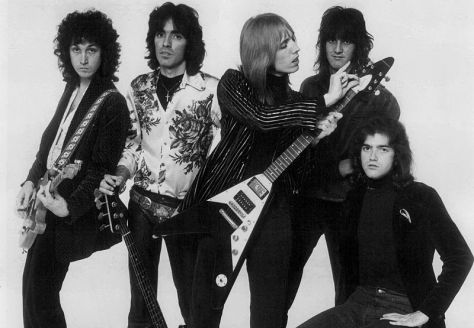
Tom Petty and the Heartbreakers in 1977. His “Flying V” guitar is featured in the band’s logo.

American Girl wasn’t a song, it was a drug, and no normal teenager could resist it. When you heard that opening D-major open chord you had to know Who is this? Simple and infectious, it showed Petty’s genius for pop hooks and story-telling. Breakdown and American Girl were followed by the 1978 hit I Need to Know, but it wasn’t until Damn the Torpedoes that Petty’s song-writing talents were fully materialized. The album is even more impressive when you consider its circumstances. Recorded while Petty was at war with his record label over publishing rights, the reel-to-reel tapes of Damn the Torpedoes were secretly shuttled by engineers into the recording sessions and then shuttled out at end-of-day to avoid seizure. The Tom Petty who recorded Refugee knew from personal experience that “everybody has to fight to be free.” He had bankrupted himself and risked everything to do so.

Tom Petty’s victory over MCA would be repeated with the next album, Hard Promises. MCA wanted it to retail for $9.98 but Petty was adamant that it should sell at the standard price, which at the time was $8.98. He refused to give the label Hard Promises just as he had refused to give it Damn the Torpedoes. When I rode my bicycle the 30 kilometres to Niagara Falls to buy the new record, I paid the Tom Petty price. Throughout the 1980s Petty released hit after hit, closing out the decade with another simple and infectious tune based on a jangly D-major open chord, Free Fallin. He played an early version of this song at Bob Dylan’s studio, where he had been spending time with Dylan, Roy Orbison, George Harrison, and Jeff Lynne. Eventually this association would lead to the short-lived project, Traveling Wilburys.

Tom Petty and the Heartbreakers traversed genres and generations. The Beatles convinced Petty that “I could do this, too” and Petty likewise inspired younger generations. My friends aged, their lives and circumstances evolved, and in many instances we drifted apart. Despite the vagaries of fortune and fashion, Tom Petty entertained and inspired, year after year and decade upon decade. For me the early years will always be the best, but Tom Petty was a reliable stage and studio artist from the late 1970s until the end. With so much else having drifted to the curb, my friends and I loved his music Back in the Day and we love it now. There isn’t a covers band that doesn’t play at least one Tom Petty song. (The band I saw this past weekend at Bloor and Jane played American Girl.) I don’t know a human being who professes dislike of Tom Petty’s music. If such a person exists, that person is taste challenged. As for the rest of us, we will always love the music of Tom Petty, and we will miss him.