Category Archives: Current Events

Essays on topical issues in the news, from around the world, by Wayne K. Spear

Martyrs and Millionaires

Why I defend free speech rights

✎  Wayne K. Spear | November 23, 2017 • Current Events

THE KERFUFFLE THIS PAST WEEK over Lindsay Shepherd looks like a debate about free speech, but it isn’t. In reality it’s yet another ingroup / outgroup event in the culture war.

We wouldn’t be discussing gender pronouns had transgendered and non-binary people not fought across past decades for recognition of their experiences and humanity. First-wave feminists fought to be at the table and second-wave feminists pointed out that it was a rotten table, accessible to white men and middle-class white women but not much else. Accessible spaces were not granted by the able-bodied, they were demanded by folks who faced everyday and omnipresent mobility barriers. Indigenous people in Canada were not given constitutional recognition and affirmation of their rights, they raised hell to take them. The history of social and economic progress is a history of struggle—of oppressed and silenced and exploited outgroups refusing to be kept forever to the sidelines of a society governed by privileged ingroups.

WLU

That’s the context for the gender pronoun battle, as well as for every other aspect of left-progressivism and anti-PC conservatism. Seen from one point-of-view, university safe spaces are a logical next-step from intellectual analysis and consciousness raising. First you identify and catalogue offensive speech, then you purge the speech and, with any luck, the oppressive systems and ideologies that go with it. From the opposing points-of-view, attacks on free speech are offences against liberalism itself: intellectual freedom, individual rights, the free-play of ideas, and progress through dialectic.

When I was a university student I had unpopular ideas. I got into arguments with professors over Duncan Campbell Scott and the prevailing notions of Canadian literature and history in general. The university may well have been incubating radical leftism: nonetheless I had no trouble finding conservative professors (and yes, they were usually white, cis-gendered and male) to tell me I was wrong. But I refused to be silenced. As a Haudenosaunee person, my ancestors’ lives and experiences had been undervalued and dismissed and erased, to make way for the views of colonizers, and every day the formal education system proved it to me. For a long long time in this country freedom of speech meant tolerance of diversity within the ethnic and cultural homogeneity of a dominant ingroup. “Should we turn these inferior savage Indians into labourers, or do they have the potential to be domestic servants? Discuss.” The aspirations of Indigenous people were beyond the boundaries of polite conversation.

The environment of the university is bad today, but it was bad in my day also. There’s no use pretending there were no unpopular nor unallowable ideas in the past, or that we’ve lost some golden age. But it was much easier to police and limit speech in the past than it is now. Unless you owned a newspaper or a television studio or a radio station, it was near impossible to get your perspective out into the world as little as 20 years ago. It’s ironic that we’re even discussing free speech at a time like this. Only hours after Lindsay Shepherd was disciplined, an electronic device that fits in a pocket allowed her to broadcast the event to the world. Similarly Jordan Peterson has made his silencing into a speaking point, and the speaking point has enriched him while broadening his fame.

I’m a free-speech advocate, and I’m dismayed to find that this position now puts me in the company of the alt-right, mens-rights, Jordan Peterson ingroup.

ABOVE: a typical alt-right Jordan Peterson shithead fanboyIf I were the only person on earth who felt the defence of unpopular views was a vital principle, it would be logically necessary for me to defend that position with greater eloquence and vigour, not less.  I’m certainly in the minority among the Indigenous people I’ve heard from. I have always defended the freedom-of-speech rights of people with whom I disagree, including my greatest enemies, because the rights of people who think differently are the only rights that need defending. Harmony can only be arrived at through negotiation and consensus building or by suppression and repression of offending ideas. In the latter case, who is going to be the judge and arbiter of admissible speech? There isn’t anyone I would trust to edit the world on my behalf. To enter into such a bargain is to invite the silencing of one’s own voice at some future point. And I will not abide that.

I don’t know where all of this is going, but I suspect that the Overton window is shifting, as it always has and always will. I don’t think pronouns are going to be a big deal for our grandchildren. Jordan Peterson will not be silenced (and I don’t think he should be) but we’re also not going to return to the days when girls were girls and men were men. The world is changing. In place of the old we will negotiate, and struggle for, the new. There will be disagreement and litigation and protest. People’s sentiments will be outraged on all sides. In an age of YouTube and Twitter it will be impossible to silence anyone, and the attempt to do so will only create martyrs and millionaires.

Gord Downie will not make things better

Canadians forgot about Chanie Wenjack before. They can forget about him again.

✎  Wayne K. Spear | November 16, 2017 • Current Events

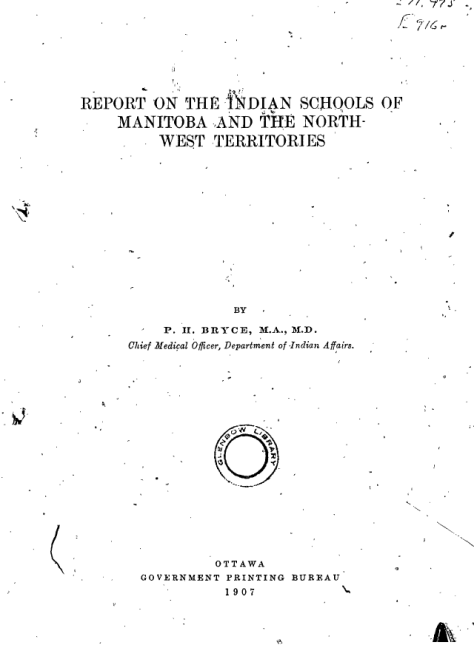
IN 1904 CANADA’S DEPARTMENT of Indian Affairs recruited the Chief Medical Officer of the Department of Immigration to study the health conditions throughout the western territories of the Indian residential school system. P.H. Bryce’s report, submitted on June 19, 1907 to Frank Pedley, Deputy Superintendent General of Indian Affairs, did not please his superiors. Not only were Bryce’s meticulous observations unpleasant, they were submitted on the false assumption that the federal government was in fact interested in improving the health and welfare of the children in its care. At the time Bryce was witnessing the substandard living conditions of the residential schools (where hunger, fires, overcrowding, and death rates of 20 percent and higher were common) the future head of Indian Affairs, Duncan Campbell Scott, was a treaty commisioner and the author of a 1905 collection of poetry, New World Lyrics and Ballads. Scott would eventually push the troublesome Bryce out of his job, admitting that

It is readily acknowledged that Indian children lose their natural resistance to illness by habituating so closely in the residential schools, and that they die at a much higher rate than in their villages. But this alone does not justify a change in the policy of this Department, which is geared towards a final solution of our Indian Problem.

Screen Shot 2017-11-15 at 7.27.06 PM

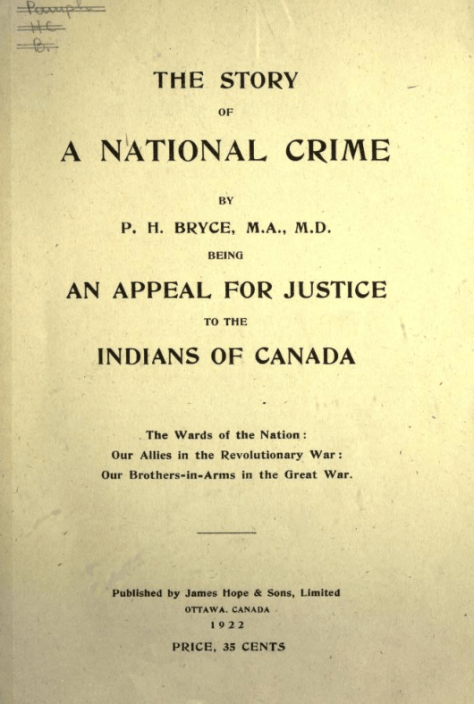
You’ve probably heard of P.H. Bryce, and you’ve also likely seen the Scott quotation. The effort of Duncan Campbell Scott to silence Bryce was a failed one, as such efforts often are. In 1922 Bryce’s medical report was turned into a book, under the fulsome title The Story of a National Crime: Being an Appeal for Justice to the Indians of Canada, the Wards of the Nation, Our Allies in the Revolutionary War, Our Brothers-in-Arms in the Great War.” Bryce’s book gave rise to newspaper headlines and to articles in well-circulated Canadian publications like Saturday Night Magazine and presumably also to momentary outrage and scandal. As early as the 1920s the general Canadian public could and did know that (for example) preventable deaths of children had occured in the residential schools at rates between 30 and 60 percent, and that “ a trail of disease and death has gone on almost unchecked by any serious efforts on the part of the Department of Indian Affairs.” Bryce not only had pointed figures, he had pointed fingers, specifcally assigning blame over the failure to improve matters to “the active opposition of Mr. D.C. Scott.”

Today Bryce is considered a rare example of a principled and outspoken critic of the Indian residential school system. He lost his career advocating on behalf of Indigenous children, and having found himself dismissed from the federal government, he took his crusade to the public. As far as I can tell, Bryce’s efforts changed nothing. The Indian residential schools would remain for another 47 years beyond the publication of The Story of a National Crime, and the conditions of the schools would slowly improve, because in the post-war years everything was improving. But the improvements didn’t prevent further, unnecessary deaths.

Chanie Wenjack was a public school student, boarded at the Cecilia Jeffrey Indian Residential School. You have almost certainly heard of him, and of his story, from Gord Downie. You know that he ran away from the residential school in October 1966 (just as many, many children ran way) and that he died of hunger and exposure longing to see the faces and to feel the embrace of his distant family. What you might not know is that Chanie’s story also had a P.H. Bryce figure, in the form of Ian Adams, a journalist whose February 1967 Maclean’s article, “The Lonely Death of Charlie Wenjack,” also received national attention. The article was turned into a chapter of Adams’ 1970 book, The Poverty Wall is Guilt of Greed, Racism, and the Misery of 6,000,000 Canadians. In the meanwhile, considerations raised by the death of Chanie Wenjack were the subject of additional media attention, including a front-page, June 21, 1969 Toronto Star report by Glen Allen. Over and over again, the “plight” of Indigenous people has been brought to the front pages, and to the attention of Canadians, to little if any effect.

In Thunder Bay there was an inquest recently into the deaths of seven Indigenous youth who had come south to attend high school. These young students, like Chanie Wenjack, were boarded many miles from home. In 1966 the jurors of a coroner’s inquest into the death of Chanie Wenjack questioned the wisdom of the education system. The jurors (none of whom was Indigenous) were able to see that the “Indian education system causes tremendous emotional & adjustment problems for these children.” They were baffled by the residential school system—specfically by the evident lack of the moral and practical wisdom of removing children from familes to have them educated far from home. The inquest recommendations directed that “a study be made of the present Indian Affairs’ education system and philosophy. Is it right?”—but none of the recommendations went anywhere. As Tanya Talaga has shown, in her book Seven Fallen Feathers, a straight line can be drawn from the residential schools to the death of Chanie Wenjack to the Thunder Bay deaths. Is the Indian Affairs education system and philosophy right? Do the deaths of Indigenous children justify a change in the policy of this Department? As the years go on, it seems more and more likely that Duncan Campbell Scott spoke for Canada and Canadians.

It isn’t true that nothing changes. But the deaths of Indigenous children, attending schools hundreds of miles from family and home, because there are no schools nearby, continue.

Bryce

And the rediscovery of this reality, over and over, through articles and books and songs, continues also. A generation ago the title of Bryce’s 1922 book appeared on John Milloy’s 1999 A National Crime: The Canadian Government and the Residential School System, 1879 to 1986. A country that had forgotten all about Indian residential schools in the 77 years since Bryce, and in the 32 years since Chanie Wenjack, was once again scandalised to discover its poorly-hidden history. The Royal Commission on Aboriginal Peoples released its final report in 1996 (John Milloy, author of A National Crime, wrote the RCAP chapter on Indian residential schools) and the Truth and Reconciliation Commission of Canada released its final report in December 2015. In the quarter century between 1990 and 2015, dozens and perhaps even hundreds of memoirs were written by the survivors of abuses in Canada’s Indian Residential School System. Yet somehow a good number of Canadians were shocked and surprised to learn about a piece of their history from a singer in a rock band.

Heroes, Saviours, and Jordan Peterson

Peterson is at bottom a generic conservative—a believer in the moral and civilizational necessity of established authorities and traditions

✎  Wayne K. Spear | November 14, 2017 • Current Events

IT’S BEYOND REASONABLE DOUBT that we are living in a time of cultural warfare, and as a rule at such times heroes or saviour figures are lifted up to lead in battle. For the self-designated enemies of feminism, political correctness, and leftism, Jordan B. Peterson is such a figure.

Jordan Peterson

I first stumbled over this University of Toronto professor for the reason many others did—his vocal opposition to Canada’s Bill C-16, amending the Canadian Human Rights Act to add gender identity and gender expression to the list of prohibited grounds of discrimination. C-16 further amends the Criminal Code

to extend the protection against hate propaganda set out in that Act to any section of the public that is distinguished by gender identity or expression and to clearly set out that evidence that an offence was motivated by bias, prejudice or hate based on gender identity or expression constitutes an aggravating circumstance that a court must take into consideration when it imposes a sentence.

Peterson objects to many aspects of this bill. He’s deemed it compelled speech and has stated many times that he will not use non-gendered pronouns such as xe or xyr. His broader objection to non-binary (or perhaps it is extra-binary) gender identity and expression is that these are make-believe notions with no grounding either in biological or social reality. And so he has declared war against something he calls cultural neo-marxism, as well as against postmodernism, principally in the form of the propositions that all structures are oppressive and that Western civilization is white supremacist patriarchal rot, and little more, and thus must be overthrown and replaced by more progressive, inclusive, and egalitarian arrangements.

A simple Google search will yield many interviews, podcasts, news articles, and university lectures featuring Mr. Peterson. His notoriety is worldwide, and despite his fame originating in a claim that the university and the laws were out to silence and imprison and ultimately ruin him, Jordan Peterson’s views saturate the air and earn him many hundreds of thousands of dollars each year. Between his income as a tenured professor and his $50,000USD/month (and growing) Patreon subscriptions, to say nothing of his other income streams, Mr. Peterson is a millionaire, or will be one soon. He has a large following, mostly made up of the alt-right, white nationalist, libertarian, and MRM, or men’s rights movement, types of person. He is also admired by a good many atheists, who see him (wrongly, in my view) as a defender of science against faith.

What is it that Jordan Peterson proposes, and why have his statements and positions raised him to his current prominence? These are the questions I am setting out to answer, and along the way I will consider secondary matters, for example the prospect of his efforts to starve certain university professors and disciplines of students and therefore of income.

At the highest level of analysis (and here I am relying on his published lectures) Jordan Peterson appears to be concerned with the relationship of truth and value. Or, to put it as a question, what truth or set of truths will provide the values that allow us to live in this world in a manner that fulfils our individual and collective human potential? It is worth noting that questions of this sort, having to do with ultimate truths and the ideal human society, will as a rule land us in the territory of religion and politics, and so it is in the present case. Jordan Peterson studied political science and was a member of the New Democratic Party until he decided that the political solutions on offer were so much nonsense and turned instead to clinical psychology. But even his interest in psychology is largely an interest in the truth-value of ancient myths and archetypes, as they are rendered in religion and in particular in Judaism and Christianity. So he has in fact migrated from politics to religion, and it is through the door of religion that his thinking is best approached.

Much can be learned about a man from the company that he keeps, and Peterson appears to have ingested a good deal of Nietzsche and Jung and Piaget and Dostoevsky. This is a logical diet of someone who is in search of values by which to live, especially someone of an unconventional, non-conformist outlook who desires a heroic inner life. In college I knew a few Philosophy majors enamoured of Nietzsche, and to a man (they were all men: I have yet to meet a female devotee of Nietzsche) they were oddballs and misfits but I suspected with an imagination that made up for their outward limitations. With Dostoevsky it is much the same, except that Dostoevsky is perhaps even more a moralist than Nietzsche and with somewhat less of the Nietzschean self-aggrandizing bombast—especially of the later, Ecce Homo years, when tertiary syphilis was just around the corner. Piaget is of course an authority of psychological development, having focused on the socialization of children, and from him Peterson would have got the evolutionary-biological basis of the psyche as well as the notion that identity is the product of social negotiation. From his other major influence, Jung, Peterson derived an interest in mythic archetypes and probably in religion also. This brief review covers about 80% of Peterson’s evident influences, and most of the rest has to do with ethology (especially dominance hierarchies and mate selection) and the five-factor model of personality, with which I happen to be very familiar.

Peterson often has recourse to Darwinian natural selection, as well as to evolutionary psychology, and for this reason many atheists mistakenly see Peterson as a fellow-traveller. On his surface he is a rationalist and empiricist, and even to a degree below the surface as well. But if you listen to Jordan Peterson carefully for even one lecture, it becomes clear that he is not a philosophical materialist at bottom but rather some kind of believing Christian. It becomes clear also that his ethology and Darwinism—which is to say his science—are in service of subjective concerns related to masculinity and competitive success and whatnot. (It’s not hard to see why Men’s Rights activists have gravitated to Peterson.) He’s not a doctrinal Christian of an identifiable denomination, but he is a Christian nonetheless. And, being a Christian, he believes—this is I think the proper word for it—in the moral and civilizational necessity of tradition, including the moral Christian traditions that inform marriage and gender roles and so on. In other words his interest in myth and archetype is a prescriptive interest and not a theoretical or abstract one, in the way that an evangelical Christian’s interest in Koiné or ancient Hebrew is not merely intellectual but rather serves a practical goal, that is, attaining a closer relationship with Jesus. He means to apply his observations of things like the hero archetype and the dominance hierarchy and the five-factor model of personality to his life, and it seems to me he wants his students to do the same. Nor is this remarkable, most professors being self-consciously evangelical where their pet ideas are concerned. In short, his life has been a quest for the Guidebook, and now that he has it, he is not going to give up its counsel, or witness its denigration, without a fight.

If my admittedly superficial analysis is correct, what Jordan Peterson proposes is what all tradition-minded conservatives propose—that the answers to our most pressing questions will be found in the past and not in the innovations of radicals and revolutionaries, or even of liberals. Peterson’s exchanges with the podcaster and neuroscientist Sam Harris exhibit a clash of left-versus-right thinking, Harris taking the “left” position that myths from tribal bronze age societies, no matter how laden with practical wisdom, can not guide us successfully through the terrain of urban, high-tech societies. Peterson evidently not only believes that Christianity can guide us, he believes that if we abandon it we will find ourselves between the Scylla and Charybdis of nihilism and totalitarianism. When the news of Louis C.K.’s sexual assaults broke last week, Peterson tweeted that “we are going to soon remember why sex was traditionally enshrined in marriage….” The many casual observers of Jordan Peterson who had assigned him to the Darwinist-materialist camp were confused by this leap, but those of us who have discerned the conservative Christian moralist lurking within his views were not. Without believing in the literal truth of the Christian story, Peterson nonetheless is able to believe in its practical and prescriptive truth. His allegiance to Judeo-Christian values puts him in the company of many radical right figures who are fighting for Western civilization (their preferred tactic is always war) which is to say the institutions, laws, habits, and arrangements of Judeo-Christianity.

The answer to the second question is obvious once the first has been answered. Jordan B. Peterson’s statements and positions have raised him to his current prominence because the need of a strong leader and even of a fierce hero-saviour type is hardwired into the conservative-traditionalist worldview, an essentially hierarchical world that defers to authority. As Jerry Falwell Jr. correctly said of Donald Trump, “We’re not electing a pastor. We’re electing a president.” In Donald Trump, white conservative evangelicals found their outspoken, combative, strong-man leader. They were not looking for meek and mild Jesus and did not want him for the mission. And of course candidate Trump, like Professor Peterson, says what many are thinking, in a way that makes clear his indifference to political correctness and hurt feelings. The main difference between Trump and Peterson (whose constituencies largely overlap) is that Trump dissembles in plain language whereas Peterson is candid but in terms that are complex, hence easily misconstrued. The result is that both have within their followings people who are in the dark where the actual convictions and objectives of their hero are concerned.

As for the prospect of Peterson’s efforts, a few observations seem in order. The first is that Peterson is fighting over, and for, real-world things that go far beyond pronouns—things like traditional gender roles and marriage and sexual norms and the cultural authority of Christian teachings and values. In the future we will either be saying faerself or we will not, most of the battles being of the zero-sum variety. In a society where a minority of people read the Bible and where the general drift has been away from traditional authorities like the church and toward secularism and plurality, only an aggressive and sustained reaction to the developments of the modern world seems likely to reverse course. Such a reaction is not impossible to imagine, and in fact it is now underway both here and in Europe, but by definition the conservative cause is a doomed one. No one knows this more than conservatives, whose conception of historical development has at its core the notion of decline, or, in other words, the abandonment of a golden age and its values and institutions and the drifting away from natural law. If the tendency of the world were stasis, there would be no need of conservatives or of conservatism. The whole point of being a conservative is to fight for the impossible, which is to say the preservation of a world that is forever changing.

On the other side of this argument are the agents of change, who believe in the future perfection (or at least improvement) of the human being, as well as in the upward arc of human societies, driven by repudiation of the revealed wisdom and the norms embedded in and perpetuated by ancient institutions and authorities. Their disagreement with Peterson is deep and will probably occupy our species for the next century and more. In the meanwhile should Jordan Peterson be fired or silenced, as some of his opponents foolishly hope he will be, his followers will add martyr to the CV and promote him further up the dominance hierarchy, where greater helpings of prestige and American dollars and media celebrity await.

There is no use ignoring the points on which Jordan Peterson is doubtless correct. A society can not undergo rapid and enormous changes and not suffer, often in ways that are wholly unanticipated. Whatever its advances and improvements, the culture that jettisons its traditions and re-invents its values wholesale will invariably introduce an element of uncertainty and even of chaos. But no one born in the past one hundred years can believe that the world will not continue to change, likely at an increased pace and in ways it is impossible to imagine. We are, all of us, wondering what is going to happen and hoping it will not be catastrophic. Peterson’s defiance is doubtless grounded in a pessimism informed by this very point. Nor is he foolish to posit a future in which we have leapt the rails. Such a thing may well occur, and the agents of progress and social justice could well be responsible, and probably will be, since the most dangerous thing is to leap into the unknown. Whenever and wherever the refashioning of societies has been undertaken along tribal identitarian lines, the result has been bloodshed and barbarism, so much so that our survival will likely come down to our ability to transcend the evolutionary inheritance of our tribal ape ancestors. Here we are in a world of particle accelerators and nanorobotics, with our reptilian brains primed for a flight or a fight. One day we will have to learn how to live with this unfortunate paradox, if we are to live at all.


An honest telling of Canada’s story will make Canadians uncomfortable

Still, the truths of history are better than lies

✎  Wayne K. Spear | November 9, 2017 • Current Events

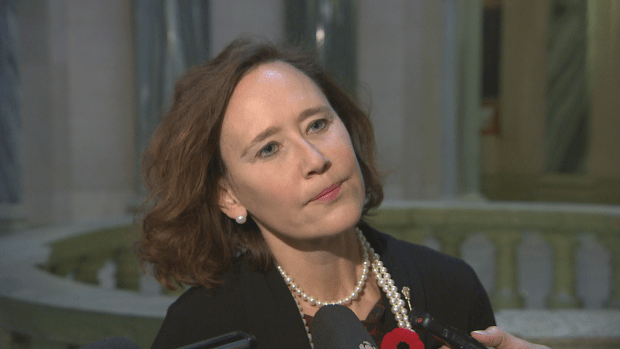
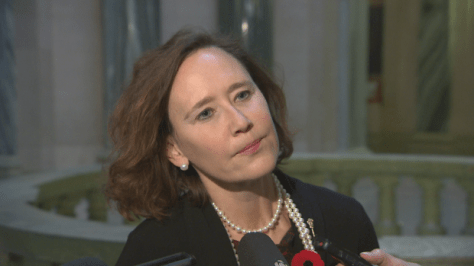
BEFORE BRONWYN EYRE was Saskatchewan’s Education Minister, she was an opinion columnist battling godlessness, political correctness, the myth of global warming, and other menaces. Her broadcasts were hosted at CKOM and CJME, and the Saskatoon StarPhoenix featured her columns, as did lesser-known publications like the Saskatchewan Pro-Life Association’s “Saskatchewan Choose Life News.”

bronwyn-eyre.png

Why do I mention this? To establish that Bronwyn Eyre is an experienced writer of opinion columns and, as such, a person able to put thoughts into words. And yet when she was asked recently to clarify comments she made in the Legislative Assembly of Saskatchewan, Bronwyn Eyre produced gobbledegook. Her initial comment however was plain enough and had the courage-of-conviction candour that you’ll find in her articles: “I would submit that there has come to be at once too much wholesale infusion into the curriculum, and at the same time, too many attempts to mandate material into it both from the inside and by outside groups.” Later on in her comments, made during the Throne Speech Debate of November 1, 2017, she says exactly what she means by wholesale infusion:

My grade 8 son brought a homework sheet home the other day — they’re always sheets — in which he was asked to outline nothing less than his vision of his collective past, his country, and his world. As background, however, he’d copied from the board the following facts which were presented as fact: that European and European settlers were colonialists, pillagers of the land who knew only buying and selling and didn’t respect mother earth. He asked me if it was okay if he could write that he associated with his pioneer great- and great-great-grandparents because no one was writing down their vision of the world. And I said yes, of course, and that after all, they had known poverty in Norway or Ukraine, or war in Germany, that they had come here and tilled the land that produced food for everybody and loved their families and tried to create whole, stable communities in this province, and had loved it here.

And here is the non-clarifying clarification Eyre offered a reporter:

What I was trying to highlight is that it’s maybe something that we all feel on some level that I think we can acknowledge that, you know, we’re perhaps free to love the story and our families and for him too to love the story without excluding loving anybody else. That’s really all I’m saying.

Anyone who has read Eyre’s works, as I have, will doubt “all she is saying” is that we should be free to love our stories and our families. She disapproves of the drift of current changes to the curriculum, just as she disapproves of the drift of politically correct modern society, and if she weren’t a politician she would have found the cahones to say so. But if her point were only about love, I would agree with her. It’s a good message: love your family and your ancestors and your country. We all need this love. And this love is what Indigenous people were denied for generations, by residential schools and the Sixties Scoop and the story of Canada.

I grew up in Canada in the 60s and 70s. I went to a public school and the history I was taught was definitely infused. Infused with lies. The textbooks had nothing to say of the inner life or aspirations of my Kanien’kehá:ka (Mohawk) ancestors, who suffered losses of every kind so that settlers could start a new life. It would have been nice to hear stories that made me love who and what I was, and where I was from, but there was no love, and no compassion, for Indians in the curriculum. My teachers told me stories about Indigenous people that justified the casual daily racism every Indigenous child experienced in the playground and in the town. The story of Canada wasn’t a story you could love as an Indigenous person, because it made you feel stupid and ashamed and worthless. Our schools didn’t give us a vision of the future, they told us we Indians belonged to the distant past. It’s no wonder so many gave up on life and took the leap into an early oblivion.

An honest telling of Canada’s story will make Canadians uncomfortable, but in the long-run Canada will be better for it. The truth is often unpleasant, but it’s morally and practically more defenisible to live a life informed by what’s true and real than it is to live under the sway of comforting half-truths and lies. In 2002 I wrote a speech for the launch of a residential school exhibit, at the National Archives of Canada, that began:

The National Archives of Canada is a solemn place, dedicated to the service of the nation’s identity. It gathers what has been as an endowment to what will be. Because no legacy is enriched by counterfeit, a nation is ill-served by history which is not genuine. And so, we are here today to consider a national institution committed, not to the preservation of a people, but to their forced assimilation.

“Because no legacy is enriched by counterfeit, a nation is ill-served by history which is not genuine”—I wrote these words 15 years ago and they guide me still. I care about truth, and I care about authenticity, and I consider it a tragedy to live without either. I’d like to think Canadians of honour feel the same. I used the metaphor of an inheritance of fake money because that is what I believe Canadians have received from their educators, for generations—a counterfeit. I know it’s what I received, and as a result I’ve been a skeptical person my entire adult life.

Ms Eyre, you can love your family and your ancestors and your accomplishments without sacrificing intellectual and moral honesty. In fact, you have to. Otherwise it’s not really love.

The Reconciliation Scam

Ottawa isn’t going to change, ever, and Indigenous people should know it

✎  Wayne K. Spear | October 24, 2017 ◈ Current Affairs

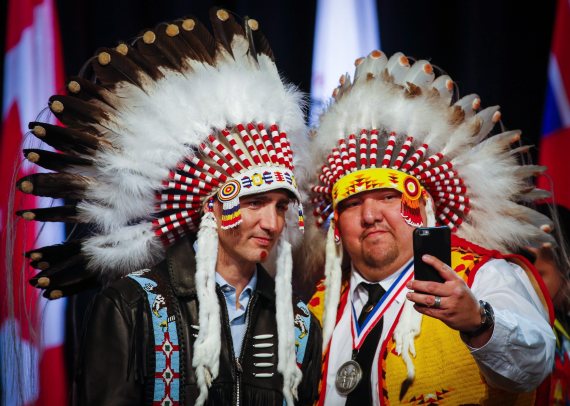
FROM THE DAY I first set my eyes on Justin Trudeau, I thought he was an inconsequential narcissist, and I said so. I would say it to his face, to both of them in fact. Yes, Trudeau is charming. But that’s a problem, not a solution. Bill Clinton taught me long ago to mistrust charisma and charm, which is to say the political art of working out what a credulous audience wants to hear and then delivering it. If you’re a sucker for a schmoozer and a charmer, consider yourself warned: you really do get what you ask for.

Phoney TrudeauA phone for a phony

A lot of people fell for the Trudeau pitch, but the shrink wrap has been off a while now and buyers’ remorse has set in. Especially for Indigenous people. Just look at the ledger: discriminatory chronic underfunding of on-reserve child and family welfare, continuing lack of clean drinking water in communities, Ottawa’s refusal of non-insured health benefits, and a list of unfulfilled promises. It’s as if the principal interest of the federal government is in creating aspirational terms it has no intention to fulfill. Gathering Strength, The Aboriginal Action Plan, Self Governance, Nation-to-Nation, Reconciliation, A New Relationship. Nice, shiny charismatic words.

The charismatic Liberal is a compassionate feminist who rolls up his shirtsleeves to serve a beloved middle class, but the real Liberal has a trust fund and a bottomless budget for self-serving propaganda, like the $212,000 cover of the 2017 budget. The charming Liberal happens to jog past your wedding, where he poses for selfies, but the real Liberal planned the stunt in advance and used your nuptials as an occasion for personal PR advancement. The charming Liberal goes to the UN, where he cringingly displays his Liberal guilt, but the real goal of this contrition is self-serving—a Canada seat on the UN Security Council. The charismatic Liberal thought it would be cool and fun to box Senator Patrick Brazeau—for charity—but the real Liberal contrived to beat up an Indian, to show the voters how tough he was.

Reconciliation is just another Liberal scam from a government that is scam-ridden. A government that claims to stand for the middle class but that has spent $400 million to hire CRA employees who harass clerks and waitresses and other low-wage, service industry workers, all while the Finance Minister fattens himself on conflicts-of-interest. A government that promised to help small businesses but didn’t, until public outrage forced them to. A government that is more interested in cutting deals with a brutal communist regime in China than it is in human rights. A government of arrogant and entitled trust-fund millionaires.

The Liberals are not going to take Canada in some bold new direction, because they can’t. No government can. A loud segment of Canadians would never accept the disruption and inconvenience, no matter how small. As bad as it is for many Indigenous people, the status quo has worked well enough for the country, which is why it’s the status quo. The Crown hasn’t solved its Indian Problem, but it has managed it. Canada is sovereign from sea to sea to sea, and it has its fingers in all of the resources, and Indigenous communities are under thumb. This isn’t ideal (total assimilation and disappearance of a distinct Indigenous population, the original government plan, was the ideal) but it’s not bad. So the politicians concentrate on political damage control, trying to contain things like the news of youth suicides, or class action lawsuits for residential schools and the Sixties Scoop. There’s no reason Canada can’t go on like this for another 500 years, and as far as I can tell, there’s no compelling reason it won’t.

That’s why I think all the Ottawa talk of reconciliation is just part of an ongoing branding effort, by governments looking for shiny words to put into expensive budgets and aspirational press releases.

Reconciliation within our families is another matter entirely. It’s meaningful and real, beautiful and necessary. So, too, reconciliation of community members. I am encouraged by every survivor who learns to express the love of a parent, love that he was denied in a residential school, to his own children. I am encouraged by the communities that cast their eyes into the pit of collective historical trauma, determined to understand and to heal. I am encouraged by open and honest conversations between ordinary Canadian citizens and Indigenous people. I believe in the power of everyday people, and not in the empty words of career politicians. We don’t need Ottawa for real reconciliation, and that’s a good thing, because Ottawa is never going to give it to us.

There’s Plenty More Where Harvey Weinstein Came From

Liberal Hollywood? Nothing is more conservative than an industry built by powerful old men to exploit women.

✎  Wayne K. Spear | October 12, 2017 ◈ Current Events

IT’S ENCOURAGING TO SEE the stars burn with indignation this week, but the spectacle would be better had Harvey Weinstein’s creepy predations not been an open Hollywood secret and a punchline before they finally became a scandal. Tinseltown’s men are making the correct noises now, but they aren’t the ones who put the former into Weinstein’s updated CV, former film studio executive. That honor belongs to female actresses and two female reporters at the New York Times, Megan Twohey and Jodi Kantor, who one week ago exposed a man who for years made a habit of exposing himself. Good riddance, Harvey Weinstein, you pig. You were forever cajoling women to watch you take a bath, and you forever looked like you needed one.

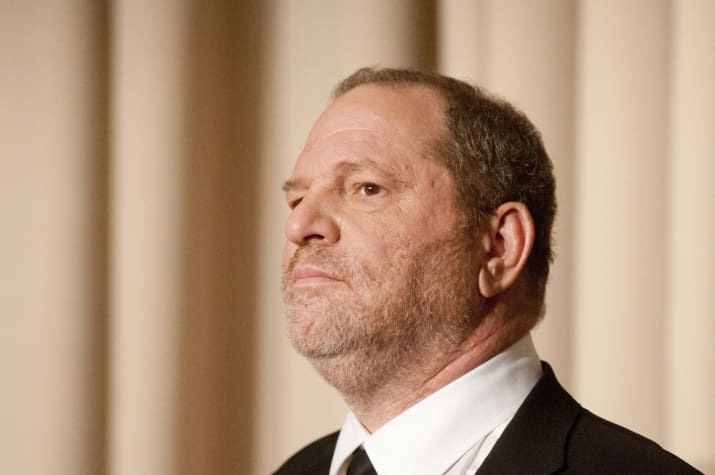
Harvey WeinsteinHarvey Weinstein is the elephant in the room.
Just as you’d expect, the Trumpians have taken to this news like the wolves that they are. Harvey Weinstein! A Democratic donor! Supporter of Hillary and Obama! And Weinstein was a donor to, and supporter of, Democratic politicians and causes. For this reason his crimes have become a symbol in the minds of many for all that is rotten within liberalism and the left. Hollywood, a pit of leftist godless sexual iniquity and deviance. A land of anarchic carnal indulgences and hedonistic arrogance. How on earth do they get away with this disregard for family values? You’ve heard the saying. When you’re a star, they let you do it.

Harvey Weinstein is gone, at least for now, but his species is far from extinct. We’re certain to revisit the sordid genre of sex, liar, and audiotape because men have made sure that the institutions which shelter and abet the Weinsteins of our world remain intact. Weinstein survived his 2015 audiotape exposure, as did a certain high-profile political candidate, in 2016. Our world still has locker rooms and casting couches. There’s still an elephant in the room, and the elephant is wearing a bathrobe, and if you don’t give the elephant a massage you will never work in this town.

So much for Hollywood liberalism. The industry clings to and conserves the outdated and pernicious garbage of our past. “I came of age in the 60s and 70s,” Weinstein said, “when all the rules about behavior and workplaces were different. That was the culture then.” His self-defence is ridiculous, but it’s also revealing. Hollywood is a throwback to an earlier era, an essentially conservative institution where female employees are expected to indulge the whims of older men as a condition of advancement. The film critic Manohla Dargis puts it like this, in her article “Harvey Weinstein Is Gone. But Hollywood Still Has a Problem.”

Outsiders tend to see the industry as liberal, and while insiders do promote progressive causes, the business hews to a fundamental conservatism. This conservatism shapes its story recycling, its exploitation of women (and men) and its preservation of a male-dominated, racially homogeneous system. Despite pressure, including from the likes of Ava DuVernay and Lena Dunham, the industry resists change. Those in power don’t see an upside in ceding it.

Miramax won over the outside world with artful stories, but on the inside it was a toxic environment over which presided a manipulative sexual predator and rapist. For decades Weinstein prevailed against allegations of harassment, all the while honing his grotesque sexual predator playbook. (From the Twohey and Kantor Times article: “Working for Mr. Weinstein could mean getting him out of bed in the morning and doing ‘turndown duty’ late at night ….”) Weinstein ought to be a type of man consigned to the past, but he isn’t. Hollywood ought to be setting a better example, but it isn’t. It’s still an industry run by powerful men to exploit women, and there’s nothing progressive or liberal about that. On the contrary it’s conserving the very worst instincts of men, in the interests of money and power, and in that sense it’s deeply conservative. And only men can change it.

Jagmeet Singh’s Charm Offensive

His nice words don’t quite square with nasty realities

✎  Wayne K. Spear | October 5, 2017 ◈ Politics

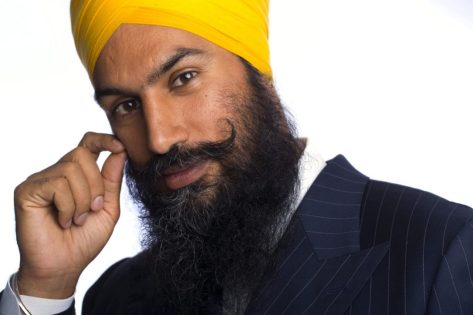
THE HEADLINES trumpeting Jagmeet Singh’s NDP leadership win each conformed to one of two themes. Either his victory as a “non-white” candidate was unprecedented, or it could be credited to the very-much-precedented appeal of charisma, GQ-worthy style, and handsomeness. The American papers in particular didn’t fail to notice that another Trudeau had arrived on the scene, ending the Prime Minister’s cornering of the charm market. Nor does the ringing of familiar bells end there. Kesh and kara aside, the new NDP leader is political boilerplate: a lawyer from Scarborough who speaks (cautiously) in both official languages and who celebrates Canada’s diversity and wholesomeness in, no doubt, focused-group-tested terms.

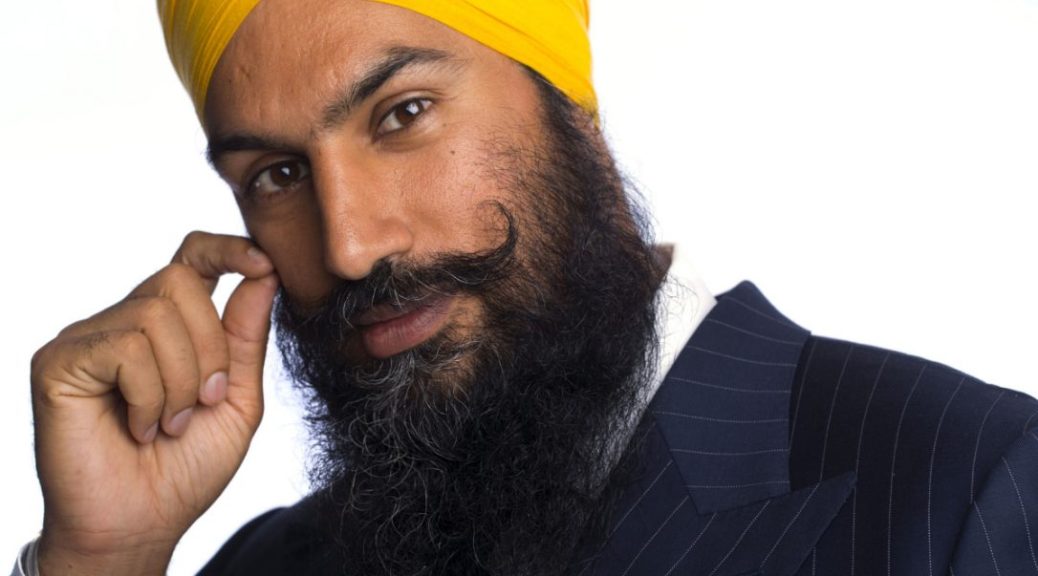
Jagmeet SinghCanada’s newest GQ leader

But, of course, he isn’t just another politician. He’s Sikh, and he is now leader of a federal political party, and as such he’s nullified a barrier to political office we should be glad to see nullified. The Charisma War can now begin, and how discouraging this prospect must be for the Conservative leader, Mr. Scheer, whose New York Times headline said: “Canada’s Conservatives Choose Andrew Scheer as Their New Leader.” In the meantime we all know how these battles are going to be fought, and that is with the ammunition of buttery words shot at the hardworking families of the middle class. Gone are the days when a political party might actually have something to fight for or about, such as proletariat revolution or tooth-and-claw capitalism. It’s three parties for the middle class, comrade. So who do you think has the nicest suit?

There are still things in this world for which and over which people fight and kill and die. The recent history of the Indian and Pakistan Punjab, birthplace of Jagmeet Singh’s parents, comes to mind. Since the British withdrawal from the region in the 1940s, the Punjab and Kashmir regions have been among the world’s most dangerous and volatile. The sectarian hatreds of two nuclear states and their diverse internal populations have engendered horrific violence, and while it may be true that none of this registers with the average Canadian, some of the old-world baggage has found its way to places like Brampton and Surrey and Vancouver. Canadians ought to care about that, more than they do.

There was a time when obscure causes like an independent Sikh state of Khalistan (obscure from a Canadian perspective) made headlines from Halifax to Vancouver. On June 23, 1985, Sikh terrorists associated with Babbar Khalsa put a bomb on Air India Flight 182 as well as on a plane bound for Japan—the latter detonated at the Japanese airport, killing the baggage handlers—one member of Babbar Khalsa having vowed that “we will not rest” until they had killed 50,000 Hindus. There are Sikh nationalists who to this day celebrate as a martyr the man behind this crime, the largest-ever mass murder of Canadian citizens, Talwinder Singh Babbar.

What has this to do with Jagmeet Singh? Nothing, really. But at the prospect of questions about Khalistan and Sikh extremism and the “martyrdom” of Talwinder Singh Babbar, the charming bespoke Jagmeet Singh fade into the curtains to be replaced by a cagey and defensive and lawyerly Jagmeet Singh? Why does he demand that all questions along these lines be submitted in advance and all transcriptions of his answers vetted prior to publication? Probably all the reasons one asks for these things: to prepare an answer, to avoid surprises, to make the best possible impression.

Screen Shot 2017-10-05 at 10.52.32 AMA headline from Sikh Siyasat News

To his credit, Jagmeet Singh appeared on the October 2nd episode of Power and Politics despite Terry Milewski’s refusal to grant Singh’s terms. There, Milewski asked, “Do you think that some Canadian Sikhs go too far when they honour Talwinder Singh Babbar as a martyr of the Sikh nation?” Singh argued, falsely in my view, that Sikhs and Hindus co-exist “in peace and harmony, and we need to celebrate that.” (I ask you: how on earth can you square this idea with the Flight 182 bombing?) Pressed further, he said:

So, it is so unacceptable that violence that was committed—the heinous massacre that was committed—is something that Sikhs, Muslim, Hindus all denounced, the violence as perpetrated against innocent Canadian lives, is something we all denounce. I regularly denounce it on the anniversary. It’s something that we all collectively are opposed to. There is no question about this, that innocent lives were killed and it is completely unacceptable and needs to be denounced as a terrorist act.

He never answered the question, “Do you think that some Canadian Sikhs go too far when they honour Talwinder Singh Babbar as a martyr of the Sikh nation?” But he did answer two questions that Terry Milewski didn’t ask. Again I am reminded of Trudeau.

One Nation Under Theocrats

In Trump’s America everything depends on the manner in which Republican factionalism is resolved. In Alabama we may have come closer to a resolution

✎  Wayne K. Spear | September 28, 2017 | waynekspear.com

HOURS AGO, as of the time I write these words, the President of the United States deleted his endorsements of Luther Strange from the Twitter account @realDonaldTrump. Now, in the untidy corner of social media he alone controls, let the record show that the President is and always has been a Roy Moore guy.

The likelihood has increased that Alabama will send a theocrat and conspiracy theorist to Washington in December. There he’ll join fellow-travellers Trump and Co. in the work of stirring a witch’s brew of fake populism, culture war, and white resentment. (I can’t resist observing that, if Trump had won the day, it would be a Strange Brew.) An irony of the Strange-Moore contest is that Trump backed the lesser-Trumpist candidate and the more-Trumpist contender won. Moore is just what the Republican party needs in 2017—another Bannon-and-Mercer-backed extremist who loathes the government and who comes to Washington not to build but to destroy.

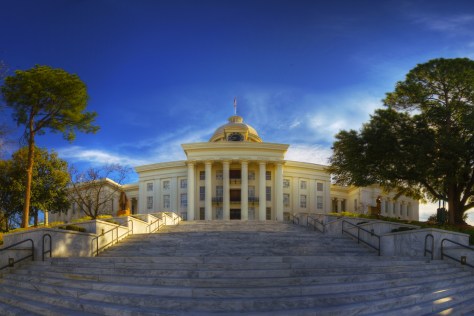
Alabama Capital Steps | Photo by sunsurfr (Creative Commons)
Across his career Roy Moore has agitated to “bring the knowledge of God back to the United States,” whatever that means. Eighty-six percent of Alabama voters self-identify as Christian, half of them as evangelical Protestants, and still Mr. Moore deemed his fellow citizens sufficiently god-stupid that he commisioned a 5,000-pound Ten Commandments granite memorial for the state’s Supreme Court building. Ordered to remove it by unanimous resolve of the Alabama Court of the Judiciary, Moore refused. This was the first occasion of two dismissals from public office—in 2003 and 2016—for (among other things) disregarding a federal injunction, abusing administrative authority, and demonstrating an unwillingness to follow the law. And so, to return to the theme of fellow-travelling, one can hope that if Moore goes to Washington, he might well go at the moment the President is facing dismissal on similar charges.

The only law Mr. Moore recognizes is the law of God. Under the law of God same-sex marriage is “the ultimate destruction of our country” and homosexuality is “an inherent evil” and the deaths of September 11, 2001 and Newtown, Connecticut are deserved punishments for America’s waywardness. Under the law of God Muslims are not fit for office and lesbians are not fit for parenthood and the laws of mere mortals may be ignored. It’s worth noticing that the victorious Alabama Republican primary candidate for the US Senate holds views that would be unremarkable in a Wahhabist-jihadist training camp. Also, why do these God people always have sex on the brain?

Beginning in the 1980s the Dixiecrat Alabama of George Wallace slowly morphed into the Republican Alabama of today. Here political diversity does not take the form of parties, but rather of Republican rivalry. It is easy for outsiders (and especially for northeastern urbanites) to sneer and condescend at Alabama, but what is happening in Alabama matters because it is happening everywhere. One need look no further than Washington, D.C. for confirmation. Conservatism has split into two principal factions, one grounded in political norms and institutions and the other in theocracy and resentment and the culture warfare of ethnic-nationalism. Everything depends on the manner in which this factionalism resolves, and in Alabama the nation just took another step closer toward resolution.

Fake News, Real Money

We have all heard the President say that the news is fake, and we have seen this assertion take root and spread like a kind of conceptual weed. The phrase “fake news” contains within it the connotation of counterfeit and thus the insinuation of an act of wilful deception. Or, to use a more plain word, lying. If I were to spread around the claim that the Prime Minister of Canada is addicted to Xintopan, the way that Hunter S. Thompson did of Ed Muskie and Ibogaine, it could be correctly said that I was spreading fake news. The presumption that something like this is widely taking place in the dominant commercial media, each and every day, could only be maintained by the most credulous and lazy. A news outfit that deliberately fabricated would soon find itself discredited and driven out of business. And yet there is no denying that news is a manufactured good, like bicycle tires or washing machines or laxatives. The news does not drop from heaven, it is made. What is it then that the media are doing, as makers of a mass-consumer product called news?

When I was a boy the news was something trotted out by three news stations each weeknight between 6 and 7. This was before the cable networks invented the 24-hour news cycle. Where once it had been accepted that a one-hour dose of news per day was sufficient, the cable universe substituted the proposition that news is something requiring round-the-clock attention and comment. Whatever else this substitution may entail, it is beyond doubt a scaling-up of manufacture. To go from one hour of news a day to twenty-four is more than a quantitative change: it is an admission that something arbitrary is at work, untethered from any underlying principle or logic. News is only another product that can be made in batches small or large. Here I do not mean to equate the manufacture of a product with fabrication in the sense of lying. I mean only that the news is made up in the way that a book or song or photograph is made up. It is a matter of perspective and of discrimination. An outbreak of war or the assassination of a public figure will be obvious instances of news to most people, but many daily events will necessarily occupy a grey area which only subjective considerations will resolve. It is someone’s job every day to scan the landscape and to package up a selection of found objects for this thing we call the news.

I have been claiming that the news is a product, but in a sense this is misleading. While news is packaged, the media do not deal in the business of selling news. The actual product of the news media are the eyeballs of their audience, which the industry sells to advertisers. And just as every audience constitutes a market, with exhaustively studied desires and beliefs and tastes, so too the media audience is a market. Everything produced by a news corporation will defer to the interests of advertisers by taking pains to court the market they are selling, because that market is the fruit of their efforts, hence their chief product. The specific character of a news outlet is a reflection of this ongoing and often imperfect effort to attract and to hold viewers. It is possible to parse the various news outlets into the grammar of their respective markets, taking into account matters such as aesthetics and social class and political assumptions. Here are some rough examples off the top of my mind, of the respective markets targeted by media outlets, to demonstrate how this might look:

PBS Newshour: “I believe there are two sides to every story and so it is important that we seek out balancing points-of-view in a rational and civilized manner. I’m a pretty informed and intelligent person and I think of myself as open-minded and highly educated. I think the great malaise of our time is partisanship. The parties must work together to find compromises that serve the broader public interest.”
New York Times: “To me America is an imperfect country whose history is marred by hubris and miscalculation, yet it remains a beacon to the world. I care about the arts and humanities and I don’t apologize for wanting sophistication, and I like my news to be informed and thoughtful. Our system is unique in history and to protect it politicians must be held to account, in particular by media.”
FOX News: “I’m sick of the establishment. It’s corrupt and must be brought down. The GOP is Republican In Name Only. Liberalism is ruining America. I am angry as hell and it’s time to fight back to reclaim the real America our forefathers fought to protect. I love this country and I love God and I am not ashamed to call myself a Patriot.”
National Post: “There’s nothing worse than Social Justice Warriors and the Culture of Entitlement. Taxes are too high and free enterprise plus individual responsibility will solve most of our problems, if anything can. Most politicians are clowns, and we would be better off without them, but Canada remains the greatest country in the world and our system is fundamentally sound and just.”
The Rebel: “I love this country and I care about what happens to it. We’re at war with Cultural Marxism and Islamic terrorism, whether you want to admit it or not. Political correctness be damned. Radical feminism and the fascist left are huge dangers today, and the mainstream media is either too weak or too biased to see it. If we don’t act now, our civilization will be lost.”

These sketches are of course caricatures, but even a caricature projects the recognizable outline of a face. What the media share among them is an unspoken but firm assumption that “our way of life” is fundamentally sound. This is why no allowance is made for outside-the-system cranks and revolutionaries, even on a more extreme network such as Fox. The media target and trade in, above all else, aesthetic differences, from the calm establishment tit-and-tat of PBS to the fringe-establishment agitation of Fox. The New York Times marketing department knows exactly what ads to put in front of the people who read it, and in the main they are ads for “luxury” watches and automobiles and not for obesity medication or adult diapers. Even the PBS fiction of a publicly-funded broadcaster has a marketing/aesthetics impetus, aimed as it is at upper-middles whose tastes lead them to abjure anything they regard as vulgar capitalism. Because the PBS NewsHour ads come at the end of the program, disguised as public-service announcements, the viewer may enjoy the wholesome illusion of an organic, free-range, untainted media.

To appreciate how thoroughly the news is market tested and market formulated, one only has to spend some time watching a program that makes no accommodation for one’s tastes and outlook. To begin with, the aesthetics and the social-class markers will be all wrong. You will either find the program too loud and uncouth, or you will find it boring and pinheaded and elitist. The villains will be wrong, as will the heroes. A Marxist-Leninist will be unable to consume any of the widely-available news except critically and oppositionally, as imperialist-capitalist propaganda, because in capitalist societies Marxism per se does not exist as a market. The same is doubtless true for white-power fascists, who until the arrival of Mr Trump saw little in the media tailored to their obsessive hatred of the elites, and especially of establishment race traitors. In recent years however outlets such as Breitbart and The Rebel have courted what might be termed under-served markets. As the media markets further segment and diverge, we approach the point at which the news can refer to a widening range of subjects, for example Tucker Carlson dedicating weeks of programming to a Hillary Clinton scandal from the past. Presumably there is a sizeable chunk of America that wakes every day enraged at and obsessed with a woman who is not a politician and who is no longer pursuing public office. It follows that such a person will be deeply unsatisfied by news that doesn’t take up as its operating premise the notion that Ms Clinton remains America’s foremost menace.

It is easy to conclude that the news is so much fabricated, or fake, nonsense if one’s assumptions and tastes and prejudices go unserved. The final ineluctable truth of every human life is that it is brief and pointless and of no enduring consequence, but only a person of mental instability would seek out a messenger and a message emphasizing this point day upon day. For reasons having to do with our animal survival, most of us prefer to believe reassuring if also distorted propositions about our own intelligence, beauty, rightness, and significance. In the same way the news is forever serving up a workable and reassuring version of the world, even when it is delivering word of the latest political scandal or humanitarian disaster. Mr Trump objects to the “fake news” for the simple reason that much of the press is neither workable nor reassuring from his perspective, both practically and psychologically. He is a pedlar of emotions and not of arguments, and if the facts do not serve his emotional needs then they are in a sense inauthentic. It goes without comment that Mr Trump runs what amounts to a media platform, via Twitter, that has all of the New York Times‘ reach but none of the fact checkers or editors. Much of what he claims in public would not pass the hastiest edit, because the standards of even a small-town paper exceed those of the Commander-In-Chief. But facts are not what the Trumpists have in mind when they complain of fake news. What they have in mind is a different test: “Do I like what I am hearing?”

Beyond this is another consideration, the fact that the President is so far outside the norms of American politics that it is impossible to say whether political norms will move him, or vice versa. What is clear is that the liberal-centrist-consensus media markets, which have long been the dominant markets, are under an organized attack that shows no sign of relenting. As a celebrity media personality, from roughy 1980 to 2015, Trump got what he needed and wanted from the media by providing them outrageous and therefore attention-getting tidbits to distribute, which they faithfully did and continue to do. Only, Mr Trump is no longer in the celebrity business, or perhaps is in it but in another business also—a business where his provocations and broadcasts can lead to international scandal, impeachment, violence, and war. Under the former dispensation, both sides got what they wanted, that is to say celebrity-and-profit-promoting click-bait. Now the President wants something more. He wants media that are supplicants of his reign. And there is no reason to assume he won’t get it if, in exchange, the media get eyeballs and clicks and dollars.

Twelve things Millennials have amazingly never experienced

Millennials-Team-Building

Seeing a movie once, and only once, forever

Before the mass adoption of video home systems (VHS) in the early 1980s, the only place you’d see a movie was in the theatre, and the only time you’d see it was at the time of its release. Sure, you could go back to the theatre during the two weeks it was playing, and see it again and again. If the movie was unusually popular, it might be held over for as long as a month. Eventually the screening would end, and the movie would disappear into a black hole with no plan or expectation of a re-release. There was no option of renting or streaming. And since sequels (and prequels) have become commonplace only in the last couple of decades, chances are there would be no revisiting of the story, ever. You’d move on to the next movie, and your recollections would be the only thing you’d have.

Read More

Terrorism vs. Mental Illness: I Say Bring on the Debates

eight_col_canada_parliament

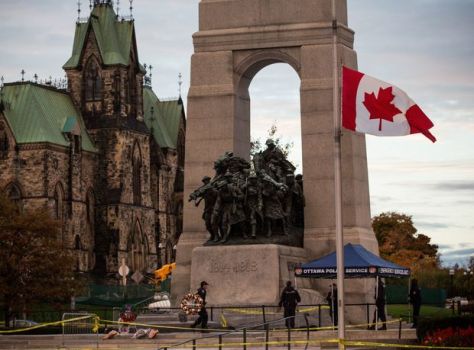
IN AN OCTOBER 30, Ottawa Citizen column (“Terrorism vs. Mental Illness: a Totally Bogus Debate”), Terry Glavin sketches out the respective positions and concludes that, whatever one’s view—that recent murders of Canadian soldiers were an act of terrorism, or that they were the work of mental illness—the current Parliament lacks a capacity to confront either.

Continue …

Life After the Fords

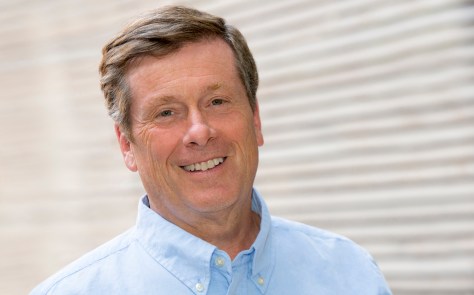
John Tory

YES, IT’S TRUE that Rob Ford was elected to the Toronto municipal council in his Etobicoke ward—and, yes, it was a landslide: but the Ford era of this city is now in remission. When the counting of votes was complete, Doug had received 34% of the popular vote to John Tory’s 40%. When Olivia Chow’s take of 23% is added, it appears that two-thirds of the voters were finished with the circus, or the gutter, or whatever the personal metaphor happened to be.

Continue …

The First Nations Financial Transparency Act and Business as Usual in Ottawa

first-nations-education-bernard-valcourt-20140224

THE RON GIESBRECHT story is an everyone-saw-it-coming affair, and that’s among the reasons why the First Nations Financial Transparency Act has engendered both its champions and detractors. “This is the greatest piece of legislation passed by our parliament, I believe, in a long time,” Derek Fildebrandt (of the Canadian Taxpayers Federation) has been reported as saying. You can imagine him salivating these recent and delicious months, in anticipation of the handful of uncloseted Chiefs à la Giesbrecht, just as you can imagine the few rueful and disgraced Chiefs lamenting a lapsed age of innocence.

Continue …

Why Would Anyone Want to Be the National Chief of the AFN?

Why Would Anyone Want to Be the National Chief of the AFN?

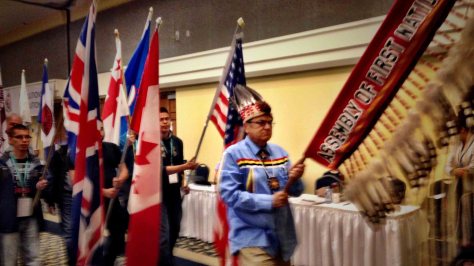
THE ASSEMBLY of First Nations 35th Annual General Assembly, held last week in Halifax, was remarkable more for what wasn’t said than what was. The name of the former national chief was seldom spoken, and the consensus appeared to be for a reconstitution of the leadership as quickly as possible, better to put behind the recent—and unprecedented—disruption.

Continue …