Tag Archives: Canada

94ways: how we will ensure the TRC report is not the RCAP report

 RCAP

A COUPLE WEEKS AGO, Zoe Todd posted a YouTube video inviting people to read from the Truth and Reconciliation Commission of Canada’s 388-page executive summary. The video was conceived by Erica Violet Lee and co-organized by Zoe Todd and Joseph Murdoch-Flowers, and its inspiration came from Chelsea Vowel’s blog post “Reaction to the TRC: Not all opinions are equal or valid.” Ever good one, that.

You can read a CBC article about this project here.

As a result of these amazing folks, people are now posting their readings of the TRC summary on YouTube.

Chelsea’s post, which I recommend, was itself a response to Conrad Black’s National Post article “Canada’s treatment of aboriginals was shameful, but it was not genocide.”

Black took up a Utilitarian argument, heavily inflected by 19th-century tropes and by the White Man’s Burden—arguing that European civilization was such a gift to the natives that there’s no way you could call what Canada attempted genocide, even if you preface it with the qualifier cultural.

His point-of-view, that aboriginal people should be thankful for the gifts of human civilization, has a vocal following. Maybe not a majority following, but likely a sizeable minority. And since it’s a common enough position, it should be aired and not just dwell in the dirty cracks of CBC’s comment section.

I love a heated debate, and I’d be happy to undertake one in my (limited) spare time. But, OK, I’m coming down now from the soapbox. Lord Black is not the point of this post!

That National Post article has indirectly inspired a YouTube campaign, in which ordinary people—i.e. people who are not referred to in public as “Lord Such & Such”—are reading the very report that Black dismisses—without having read it! Seems to me like a decent turn.

But I had another idea, too. That’s the real reason I have written this post—to tell you about my idea.

It’s called 94ways. I’m not 100% settled on this name, but it’s the best I’ve come up with so far, in my opinion.

The idea is to create a website and the related social media where people can post simple, practical, actionable ideas related to each of the 94 recommendations of the TRC’s document Calls to Action. It could be an idea they are planning to do, or one they’ve already done. We could all brainstorm. We could trade experiences and stories. We could bring the report to life.

Nowadays you can even do things like organize a Meetup or host a Webinar. All of this could be part of the 94ways.com or 94campaign.com or 94toRestore.com or whatever it ends up being called.

All of this and more. The only limits are imagination, human will, and courage.

One final thought

Years ago I had a conversation with Georges Erasmus about RCAP—the Royal Commission on Aboriginal Peoples. (Actually, we had a lot of conversations over the years about RCAP!)

Georges was reflecting on the 1996 final report. It had just come out, and he was looking forward to a holiday, after his intense traveling and media work around that extraordinary and unprecedented five-volume, 4,000-page work.

You see, he went straight from being National Chief of the AFN to being co-chair of the Royal Commission. Every time the man tried to take a holiday, someone would arm-twist him into another job. In fact, that’s what happened after RCAP. Phil Fontaine called and said, “Georges, you’ve got to come help create this Aboriginal Healing Foundation. If we don’t do it by April 1st, we’ll lose the $350 million.”

Georges said, “I’m not looking for a job, Phil!” But it was futile.

He spent the next 14 years at the AHF, and even today he is hard-at-work, building up a nation run by the Dene, for the Dene.

Anyway, what Georges told me was that, just as the report was to be distributed, the feds pulled the funding. As a result, RCAP lacked the resources it needed to properly and effectively get the report into the hands of Canadians.

Remember, this is before YouTube and Twitter and Facebook. It would be years before the technology existed to put RCAP on the Internet, and even more years before anyone did. (You can now find it here.) So back then, if you didn’t have an actual printed copy, you were pretty much out of luck.

And most of us did not have printed copies.

RCAP’s final report became a cliché: you know, the report that collects dust sitting on a shelf. Only I doubt it even did sit on a shelf in more than a couple Parliamentary offices. There were some great efforts to get the word out, for example by reading the entire report, page-by-page, on the radio.

A few lucky people (like me) managed to get the report on CD, but back then the technology was so primitive that they may as well not have bothered. It was designed for installation on a server running Windows NT, because back then a five-volume report was basically an unimaginably huge amount of data—certainly not something you’d pop into your lousy desktop.

I never did get that darn RCAP CD-ROM to work!

I’m sure the feds were happy to have a report no one could access. Because that meant no one could challenge the government to do something.

Well, it’s now 2015, and the people can do all sort of things. It will be 100% impossible for Mr. Harper and his kind to bury the TRC report, the way RCAP was buried, although they will try as best they can.

And they will fail.

Contact me if you think 94ways is a good idea.


Update (06/25): I have registered the domain 94ways.com and am gradually building the site. You can now visit and have a look around. The next step is to create the social media accounts. I hope to have this done in the coming days. Please share your comments, ideas, suggestions or other content here, or at 94ways.com. Thanks!


Education is the key to reconciliation

100 Years of Loss

BRITISH COLUMBIA’S Education Minister, Peter Fassbender, announced late last week that the province will introduce a new education curriculum on Aboriginal cultures and history this autumn.

Education was a focus of the Truth and Reconciliation Commission of Canada’s 94 recommendations. (Download the TRC’s “Calls to Action” document here.)

Here’s an excerpt from the TRC’s education-specific recommendations:

Education for reconciliation

62. We call upon the federal, provincial, and territorial governments, in consultation and collaboration with Survivors, Aboriginal peoples, and educators, to:

i. Make age-appropriate curriculum on residential schools, Treaties, and Aboriginal peoples’ historical and contemporary contributions to Canada a mandatory education requirement for Kindergarten to Grade Twelve students.

ii. Provide the necessary funding to post-secondary institutions to educate teachers on how to integrate Indigenous knowledge and teaching methods into classrooms.

iii. Provide the necessary funding to Aboriginal schools to utilize Indigenous knowledge and teaching methods in classrooms.

iv. Establish senior-level positions in government at the assistant deputy minister level or higher dedicated to Aboriginal content in education.

63. We call upon the Council of Ministers of Education, Canada to maintain an annual commitment to Aboriginal education issues, including:

i. Developing and implementing Kindergarten to Grade Twelve curriculum and learning resources on Aboriginal peoples in Canadian history, and the history and legacy of residential schools.

ii. Sharing information and best practices on teaching curriculum related to residential schools and Aboriginal history.

iii. Building student capacity for intercultural understanding, empathy, and mutual respect.

iv. Identifying teacher-training needs relating to the above.

There are many more education recommendations in Calls to Action. Murray Sinclair, Chair of the TRC, has said that “Education is the key to reconciliation.”

It makes sense for him to say this. The residential school system was an education system of a sort. It didn’t provide much at all by way of skills or learning. Mostly, it was a child labor system.

Always poorly-funded, the residential schools depended upon the output of child workers. Relatively little teaching and learning took place, especially until the 1950s, when reforms gradually were introduced.

The point is that the present-day education system can help to redress what was done by an education system of the past.

For this reason, I’ve been working for years on residential school curriculum. One of the projects with which I’ve been involved—”100 Year of Loss”—is already in use in two Canadian school systems, Nunavut and Northwest Territories.

Next month, I’ll start work on an exciting new curriculum project which I will say more about when the time arrives.

In the meantime, I commend British Columbia. And I look forward to more school systems responding to the TRC’s recommendation to “make age-appropriate curriculum on residential schools, Treaties, and Aboriginal peoples’ historical and contemporary contributions to Canada a mandatory education requirement for Kindergarten to Grade Twelve students,” in “consultation and collaboration with Survivors, Aboriginal peoples, and educators.”

Looking back on this week’s Truth and Reconciliation final event

The Delta Hotel

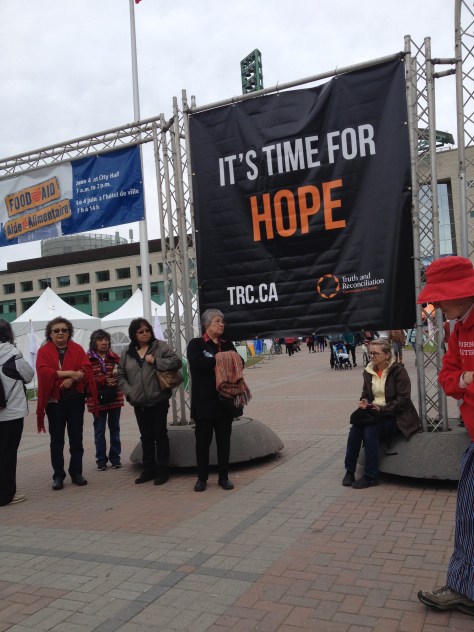
It’s a sunny Tuesday in Ottawa, and I’m having shawarma with my son on Bank Street. We are the only customers this late in the afternoon. On the TV there’s a live broadcast from the nearby Delta Hotel, where I too had been only minutes ago. Earlier in the day, the Truth and Reconciliation Commission of Canada released its report “What We Have Learned: Principles of Truth and Reconciliation.” As I eat my shawarma I try to imagine all the restaurants, all the bars and lobbies and lounges across Canada, and elsewhere, that this broadcast is reaching.

It’s difficult to summarize how I feel.

It’s earlier in the week and I am tucked into a corner of the second-floor balcony, looking into the Delta foyer. There are people everywhere. It smells of burning sage and the grilled chicken from the restaurant below. Voices combine to an indecipherable roar that resembles crashing water. The noise is punctuated by the sounds of forks surrendered to exhausted plates, of drumming, of abrupt laughter. A drum group whose members include Wab Kinew plays a song, and right above the drummers, on the same second-floor balcony to which I’ve escaped, the Primate of the Anglican Church of Canada taps his foot.

My senses are numbed. It’s relieving, and also a bit strange, to realize that I can walk two blocks in any direction and find myself in the sleepy day-to-day of downtown Ottawa.

I see many familiar faces. I’ve been at this long enough now that I catch myself reminiscing about the old days. The people I talk to agree: it was different then.

Twenty years ago the pain of Indian residential schools was raw. It tore through the rooms where we gathered. Anger and hurt so fresh, so intense, it was frightening to behold. I’ve lost count of the gatherings of residential school survivors I’ve attended—some well over a decade before there was a TRC—but the emotions are something you can never forget. I knew more than a few senior bureaucrats who didn’t mind admitting they were terrified, half-convinced they wouldn’t get out unscathed.

All these years later, there are survivors of terrible abuse who are telling their story for the first time. The familiar anger, and the hurt, remain. But the mood at this week’s final event is not what is used to be at gatherings of this sort. We aboriginal people are stronger than we were. We are no longer so filled with shame and self-loathing that we are unable to talk about what happened in those institutions. Survivors know that it wasn’t their fault, and one by one they are letting go of the destructive emotions which have held them back. We are looking to the future, and we’re in no mood to settle for anything less than what we consider good and just.

Healing and reconciliation, as Justice Murray Sinclair notes, are personal matters. It’s up to individual survivors to assess progress. Everyone wants to believe, but when it comes to the relationship between aboriginal people and the Canadian government we are all agnostic. For a century now native people have complained of politicians who deal only in fine-sounding words. Although the mood of the week is positive, I note the standing ovations given to people who, like Ellen Gabriel, have had their goodwill and patience depleted—not only by inaction but by government actions which are seen to contradict the spirit of reconciliation.

Here, at the Truth and Reconciliation Commission’s final event, we are reliving the June 2008 apology. On that day the painful experiences of aboriginal people were recognized and validated by every political party, including the Prime Minister of Canada, Stephen Harper. No longer could anyone credibly argue (as I remember people did) that there was nothing to apologize for, beyond perhaps the unfortunate zeal or wickedness of “a few bad apples.” Now, as in 2008, we were receiving official acknowledgement of the pain and injustices inflicted on us.

It took decades to get here. Years of survivors telling their stories, year after year pushing for recognition, apology and restitution. It’s been over 20 years since Phil Fontaine saw his story of residential school abuse on the front page of the Globe and Mail. (He later told me he didn’t expect this airport conversation to end up in print.) In the years following this revelation, many hundreds of survivors organized themselves.

A remarkable coalition formed around the cause of truth-telling, healing and reconciliation. Survivors, churches, activists, artists, politicians, elders, front-line workers, citizens, and other joined for a common cause. Survivors and their supporters published books and commissioned reports. They created support groups and lobbied for an apology. They launched what would become Canada’s largest-ever class action lawsuit, the Indian Residential School Settlement Agreement.

Out of this exhausting and relentless effort came the Truth and Reconciliation Commission. To understand the feelings in that room, as the TRC summarized its findings, you have to understand the amount of time and work that went into making that day a reality. In terms of sheer human will and commitment, the determination to have the history of Indian residential schools properly recognized rivals anything else this country can put up—including the building of a transcontinental railroad, or the establishment of a nation from sea to sea.

It’s done now. There’s no turning back.

My Truth, My Reconciliation

TRC

Will Canadians learn anything of useful value from the Truth and Reconciliation Commission of Canada? Will they even be interested in doing so?

These and other questions are on my mind as I prepare for the final closing events of the TRC, from May 31 to June 3. I don’t expect to find the answers to my questions in Ottawa. It will take years to assess the efficacy of this commission. And ordinary Canadians, not the Establishment, will be the ones who decide. Or perhaps not.

I’ve been asking questions about the Indian residential schools, and looking for answers, for a quarter century now.

In the early years of the last century, my grandfather Gowandehsonh was in the Anglican-run Mohawk Institute (the longest-running Indian residential School, better known today as the Mush Hole). He rarely spoke of it, mentioning as we drove by the building that he used to dig in the moonlight for raw potatoes to eat. This information—delivered casually and in passing—came without context or further explanation, and young as I was I could do nothing but sit in confused silence.

In the 1990s I began studying the residential schools for my doctoral thesis. Around the time former AFN National Chief Phil Fontaine went public with his story of residential school abuses, and others soon came forward. In 1992 I had my first candid conversation with a former student, or “inmate” as Indian Affairs had once termed them, about what really happened.

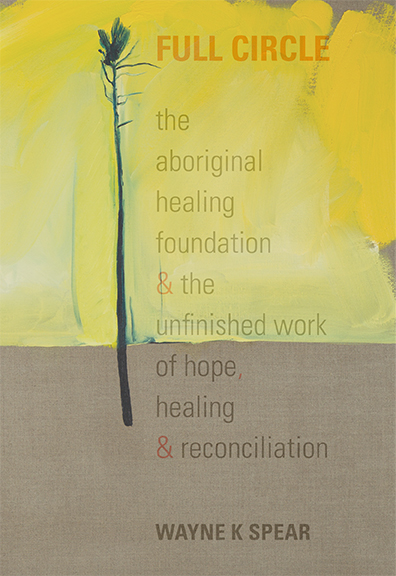
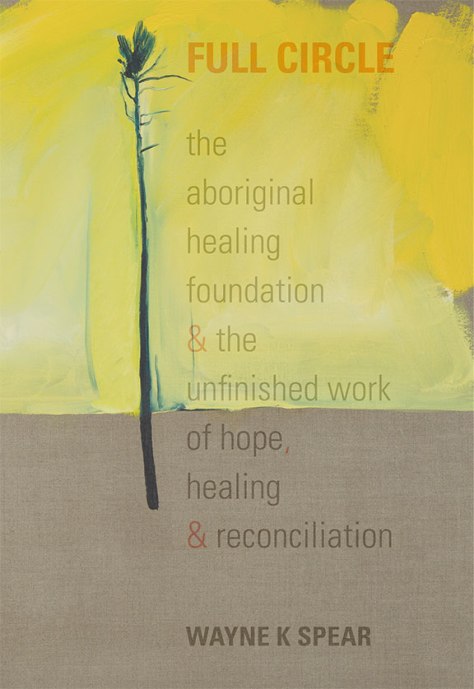
Since then I’ve interviewed hundreds of people and written several books, including Full Circle: the Aboriginal Healing Foundation & the unfinished work of hope, healing & reconciliation (get your free ebook version here) and Residential Schools: with the words and images of survivors.

Bob Watts, who played an instrumental role in setting up the Truth and Reconciliation Commission, said something to me I’ll never forget. It’s quoted in my book Full Circle:

I don’t think of reconciliation as the Prime Minister of Canada and the National Chief of the Assembly of First Nations having some sort of hug-fest on Parliament Hill, and then everything will be okay. I think about my friend Ken, who was in his sixties when he told his daughter for the first time that he loved her. He didn’t know that was part of the deal being a parent, because he never got that himself as a kid. To me that’s reconciliation. I think there’s going to be hundreds and thousands and maybe tens of thousands of little wee tiny reconciliations. But all those have a force.

I’ve interviewed former students, church leaders, therapists, lawyers, journalists and government officials from the front-lines right up to the Prime Minister. I’ve found that everyone has their own ideas about what reconciliation is and how we get there. My book ended up being a collection of personal truths, jostling against and conflicting with one another. I expect the TRC’s final report to be the same, offering to Canadians myriad reflections on the truth of experience rather than the objective Truth of a judicial inquiry. I also think my friend Bob is closest to being right about the nature of reconciliation.

I was in the House of Commons when the Prime Minister of Canada apologized for the government’s role in residential schools. It was a powerful speech, and I was frightened at how unprepared I’d been for my nearly-overwhelming emotional reaction. But even then I knew that, on their own speeches and slogans and photo-ops are not going to get us very far. This isn’t about the National Chief nor the Prime Minister, although they doubtless have a role to play. The thousands of unseen, unreported, uncelebrated gestures of ordinary folks are what will make the difference—if there’s going to be a difference at all.

I’m going to Ottawa in search of this.

You can join me this weekend, wherever you are, by participating in the Legacy of Hope Foundation’s #hopeis social media campaign.

Maslow’s hierarchy of needs, updated for the 21st century

2218320_9e329c0e68_b
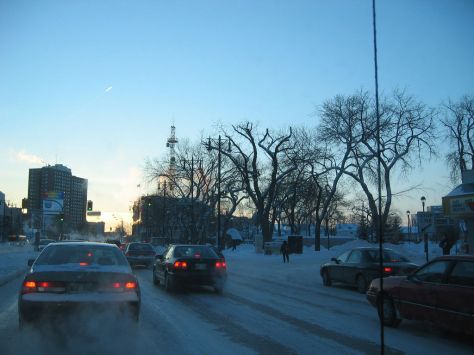
Photo by Jezz, “Winter Traffic” on Flickr.


I WAS IN WINNIPEG, Manitoba last week, where the temperature reached a breath-taking -729.5°C when the FLTW is factored in.

And FLTW is, of course, the Feels Like To Wayne scale. Which is how all temperatures should be measured but for some absurd reason aren’t.

Anyways, the weather was so breath-taking that my breath got back on the airplane and went home to the warm Toronto temperatures, which hovered somewhere around -702.6°C. That left me, my legs, and a thin wool suit to deal unaided with the arctic winds of Portage Avenue.

The reason I was walking down Portage Avenue, in nothing but a suit, was that my brother-in-law’s cat was sick. You see, he went off to Africa (temp. 22C/72F) and left his cat with some lovely folks who weren’t quite prepared for a sick cat.

So there I was, leaving a business meeting to look for a bank so I could transfer money to pay for the vet.

And that got me philosophating.

First of all, how did the pioneers survive without electricity and medicine, back in the day, walking around in their moose-and-beaver-fur business suits? I truly can not comprehend it.

This makes me think that before about 1920, people in Canada just stayed indoors nine months of the year. They ate whatever walked past their house, or hut, or whatever it was, and drank melted snow. And then they dressed in the animal they had just eaten.

Life was simple.

Well I found the bank and needed a coffee to warm up, so I went to another thing they didn’t have in the olden days, Starbucks.

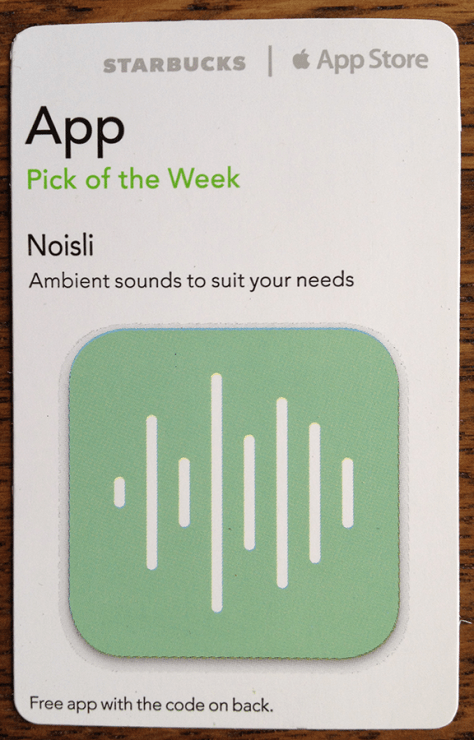
I don’t know if you ever go to Starbucks, but they have these free iTunes “App of the Week” that they give away. Here it is.

Noisli

I haven’t downloaded the app, and I’m not sure exactly what it is and does—but I can see from the card that it suits all my ambient needs.

And I didn’t even know I had ambient needs.

This is why living in the 21st Century is so freaky amazing: here is a company working around the clock on my needs, and I didn’t even know that I have these needs.

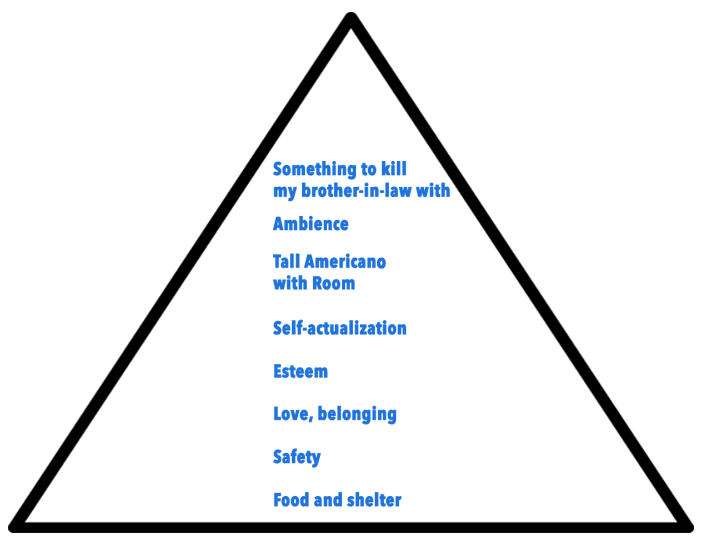
So I realized right away quick that it was time to update Maslow’s hierarchy of needs. You know, that triangle thingy that talks about food and clothing and shelter.

When you are in Winnipeg in February, looking for a bank on Portage Avenue, you don’t have to be told by Mr. Maslow that you need clothing and shelter. Your legs tell you this.

But you do need Starbucks to remind you that you need belonging, love, “a Tall Americano with room,” and ambience.

So I went straight to work, updating Maslow’s hierarchy of needs for the 21st Century.

maslow

I realize there’s still some work to do on this.

For example: there is obviously more than one type of ambient need, with one Brian Eno record for each.

And I’m not sure yet whether to Chinese water-torture my brother-in-law, or just make him walk around Saskatoon during a blizzard, in his underwear, looking for my dry cleaning.

So many options, all so attractive.

But if we’ve learned one thing today, it’s that every cloud has a silver lining. That would be the next blizzard taking shape.

Or, the silver lining could also be the inspiration for an update of Maslow’s hierarchy of needs.

You’re welcome.


Some tips for keeping warm in interstellar space. I mean, Canada.

IF YOU LIVE in Canada, or northern USA, you know how nasty Winter can be. Also, if you live on the moon or in interstellar space, where I hear it gets almost as cold as Winnipeg.

Like me, every Winter you ask yourself What on earth am I doing here? Okay, I also ask myself that in the Spring, Fall and Summer. In the Winter, I just add “…in this cold country.” Why do I stay in such an inhospitable climate, year after year, when there are places in the world where you can live on the beach, basking in the life-giving rays of paradise, until a beaver-sized scorpion bites you and you go blind, and then slowly die as thick yellow foam erupts from your mouth.

And that’s how I remember why I stay in Canada.

Read More

Life After the Fords

John Tory

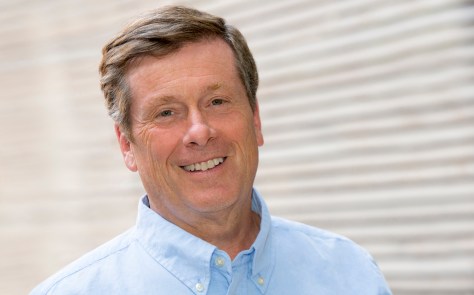
YES, IT’S TRUE that Rob Ford was elected to the Toronto municipal council in his Etobicoke ward—and, yes, it was a landslide: but the Ford era of this city is now in remission. When the counting of votes was complete, Doug had received 34% of the popular vote to John Tory’s 40%. When Olivia Chow’s take of 23% is added, it appears that two-thirds of the voters were finished with the circus, or the gutter, or whatever the personal metaphor happened to be.

Continue …

The Roundtable Podcast 72: Crimes Against Headlines

Week of 28.09.2014

TanyaTagaq

Walking In LA | One Month to the Toronto Mayoral Election | Game: Crimes Against Headlines | Music: Tanya Tagaq | The World Conference on Indigenous Peoples | Paul Calandra | Is Canada Going to War? (Yes) | Fighting ISIS: The Coalition is Growing


Download entire podcast (320 kbps mp3) | Visit The Roundtable on Facebook.

Follow me on Twitter

Full Circle: the Aboriginal Healing Foundation & the Unfinished Work of Hope, Healing & Reconciliation

An excerpt from my book Full Circle: the Aboriginal Healing Foundation & the Unfinished Work of Hope, Healing & Reconciliation, Chapter 3, “Long-Term Visions & Short-Term Politics.”

Full-Circle(PDF)-1

THE MANDATE of the Aboriginal Healing Foundation was conceived as two related components: healing and reconciliation. As a funding agency, the AHF supported these with money and community support workers and other clerical services. Another large part of the Foundation’s work and legacy subsisted in its research agenda, which by 2010 had produced 20 studies all focused upon the Indian Residential School System and its current-day manifestations. The research was meant to advance one objective above all others: healing. The topics explored were enormously complex and included fetal alcohol syndrome, incarceration, domestic violence, sexual offenses and addiction. Behind the complex subjects however were practical questions: what relationship does the Indian Residential School System have to the realities of current-day life? Is there an underlying and perhaps even unifying agent which may account for the many apparent diverse forms of physical and emotional turmoil we can discern in indigenous communities? When communities undertake to solve their problems for themselves, what works, and why? Such were the sort of concrete prospects to which the research agenda was directed.

Continue …

The First Nations Financial Transparency Act and Business as Usual in Ottawa

first-nations-education-bernard-valcourt-20140224

THE RON GIESBRECHT story is an everyone-saw-it-coming affair, and that’s among the reasons why the First Nations Financial Transparency Act has engendered both its champions and detractors. “This is the greatest piece of legislation passed by our parliament, I believe, in a long time,” Derek Fildebrandt (of the Canadian Taxpayers Federation) has been reported as saying. You can imagine him salivating these recent and delicious months, in anticipation of the handful of uncloseted Chiefs à la Giesbrecht, just as you can imagine the few rueful and disgraced Chiefs lamenting a lapsed age of innocence.

Continue …

The Roundtable Podcast 69

Week of 20.07.2014

table

Rob Ford’s nephew, Mikey Ford, running for councillor in Doug Ford’s Etobicoke riding | Remove a letter, ruin a band | Mike Duffy | Israeli troops battle Hamas in 2nd day of ground offensive, as Palestinian death toll tops 330 | Music: Future, “Shit” | Ukraine says Russia helping separatists destroy evidence at Malaysia Airlines crash site | Finish the Headline | Protests and crowd-funding can’t prevent N.B. Morgentaler clinic from performing final abortions | Peter MacKay’s Privacy Deficit Turned These Lives Upside Down

Download entire podcast (320 kbps mp3) | Visit The Roundtable on Facebook.

Follow me on Twitter

Why Would Anyone Want to Be the National Chief of the AFN?

Why Would Anyone Want to Be the National Chief of the AFN?

THE ASSEMBLY of First Nations 35th Annual General Assembly, held last week in Halifax, was remarkable more for what wasn’t said than what was. The name of the former national chief was seldom spoken, and the consensus appeared to be for a reconstitution of the leadership as quickly as possible, better to put behind the recent—and unprecedented—disruption.

Continue …