A story teller must be tenacious

Pitch, pitch, pitching at Heaven’s door. ✎ By Wayne K. Spear

What’s the story?

An account and a message and a performance and a bond. The most powerful stories communicate values, identity, and purpose.

Pitches, vision statements, business plans, novels, movies, and cultures are made of story.

Stories matter, and so we care for and communicate them.

There are many theories about communication that say a message has to be heard multiple times before it sinks in.

Some say three—others, more.

Thomas Smith’s 1885 book Successful Advertising says 20.

Rarely is it once.

Book browsers are much more likely to buy when they’ve heard of the author, even when they can’t recall what they’ve heard.

When I was in college I had two room mates. One of them (I didn’t know which) had bottles of near-empty shampoo cluttering up the shower.

I decided to send a message.

Each week I bought a bottle of shampoo and put it in the shower. In two months, I had eight bottles of shampoo cluttering the shower.

That’s when my room mates started to get the message.

Here is what the television and film producer Lisa Meeches said to me about her grandfather:

He told me that not everything I thought of would be successful, but to continue trying, and to persevere. He used to use the word tenacious. To be tenacious and to have tenacity as a story teller.

Lisa Meeches
Photo: Lisa Meeches, by Fred Cattroll

Tenacity means to hold on, to retain, to have firmness of purpose.

Know your story, and never compromise its integrity. Be respectful, and don’t beat your audience over the head.

But also be open to finding new ways to tell your story when your message doesn’t get through. Persevere and adapt, without losing site of your values, identity, and purpose.

A story teller must be tenacious.

Don’t go it alone

It takes a village to rock. ✎ By Wayne K. Spear

This is a story about Mick and Keith.

Steve Jobs wasn’t interested in computer circuitry, and Steve Wozniak didn’t believe there was a market for the machines he was making in his computer club.

Elton John can write a decent melody. Bernie Taupin has written some of pop music’s best-known lyrics. The two met in 1967 through an audition that both failed. When they joined forces, they succeeded.

In the 1980s, Mick Jagger tried (unsuccessfully) to become a solo superstar. Keith Richards once said that, together, he and Ron Wood were the best guitarists. He added that he and Ron were average individually.

A rock band is a division of labor, a team, a small corporation, and an alchemy.

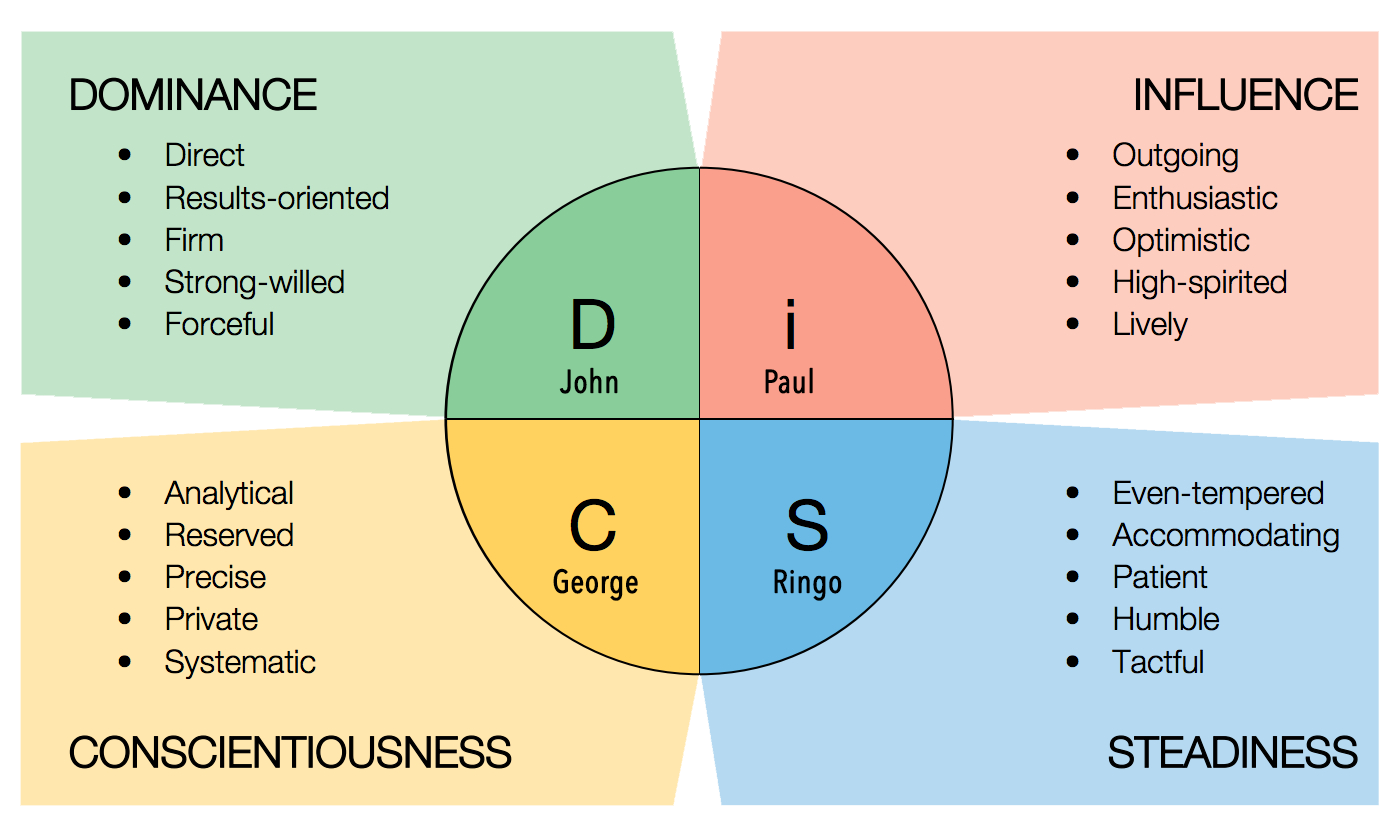
Many of the most successful rock bands have had four members. Many personality assessments are four-factor. You can plot many rock bands on a DiSC graph.

DiSC Graph

I’ve created several rock bands, and I’ve worked with many corporations. Whatever you’re doing, think of it as a team effort, because it is. The alchemy of personality and talent is not arbitrary or mysterious. It can be assessed and measured. I know this.

Even if you are a novelist, you need a good team behind you.

Who is supporting your success? Do you have mentors, collaborators, colleagues, partners, and role models?

The lesson of Mick, Steve, Elton, and Paul is that you can’t do it on your own.

Don’t go it alone.

Pie versus Sunshine

Be open, bold, & generous. ✎ By Wayne K. Spear

Imagine a company that sells sunshine.

You can’t, because there is no plausible reason to buy it.

If I have a pie, a certain number of people are going to get pie. I can cut it two or twenty ways. No matter how I slice it, every portion eaten is a share someone else is not going to get, ever.

Absorbing the rays doesn’t mean someone else will now be unable to enjoy sunlight. It is impossible to take in the sun the way we eat a pie. No matter how many people step into the sun, there is surplus sunlight.

The difference between pie and sunshine is not only a matter of supply. Both can be scarce. In the northern hemisphere, there is less sunshine during winter, so people pay for tanning salons.

You can slice a pie but not sunlight. One is divisible, the other indivisible.

If I love one person today and ten tomorrow, I do not diminish the supply of love. If I am kind to ten people, it doesn’t follow that I must be less kind to the eleventh person I meet because kindness has been consumed.

Love and kindness, like sunlight, are indivisible.

I went to a store in my city and ordered something I’ve been looking forward to having for some time, but they didn’t have any of it in stock.

The moment I walked into the store, the staff smiled and welcomed me. It felt good to be there. It was obvious to me when I left that the store managers had paid careful attention to every moment and detail of my experience.

Even though I didn’t get the slice of a pie that I wanted, I am going to go back because I got sunlight.

In your life and in your business, some things are divisible and some are indivisible.

Take stock of the abundance and indivisibility within your personal inventory: creativity, imagination, and will. Be open, be bold, and be generous. Give, without regard to getting in return. Count your pies and cast your sunlight to the waters, because you can and because it is a good idea.

Cultivate abundance, and you will have abundance.

You can afford to do this, and you can’t afford not to.

Simple, not simplistic

We need more simple people. ✎ By Wayne K. Spear

The best ideas are simple, never simplistic.

E=mc2 is simple. Einstein had other, earlier formulations, but none had the elegance of energy equals mass times the speed of light, squared.

Even a child can recite his simple formula. Few can comprehend its profundity. Einstein provided insight into the nature and relationships of matter, energy, light, and gravity.

If you eat more calories than you burn, you gain weight. It’s simple. And yet there have been countless fad diets, promoting simplistic ideas like “don’t eat x.”

Simplistic ideas often resemble simple ones. Simple ideas summarize complex insights, while simplistic ideas remove them.

The only way to tell a simple idea from a simplistic one is to conduct a forensic audit, listening to the account an idea gives of itself.

The simple idea can not be superseded. It can explain even the simplistic competitor. The reverse is not the case.

Example: any fad diet that works involves eating less calories than you burn.

No one comes up with a simple idea until they have perceived, studied, and comprehended complexity.

Take something complex that you understand, and find a simple way to represent it: a mathematical formula, a picture, a phrase, a neologism.

Use your representation as a means to provide a fuller account.

Be simple, not simplistic, and serve the world.

How do you make people feel?

Beauty is good business. ✎ By Wayne K. Spear

Yesterday I had a business meeting with Apple. On my way to the meeting, I rode the subway next to a woman who was reading the Bible on her iPad.

There are bibles on iPads, but no iPads in the Bible.

If Jesus had known about iPads, he would have used them as metaphors, because they are integral to our lives. There would be at least one good apple story that didn’t involve a serpent.

An iPad is the size of a sheet of paper, a magazine, and a human face. It’s light and sleek and beautiful. It’s aesthetically pleasing, to the eye and to the touch.

Apple didn’t invent the tablet. Years earlier, when it was first introduced, people mocked and ridiculed the idea of a keyboard-less computer.

The tablet was not a laptop, or a Palm Pilot, or a Pocket PC, or a BlackBerry. So the experts scoffed.

When Apple introduced its tablet, they scoffed again.

And then they tried it, and the scoffing stopped.

Whatever your product, your service, your labor, or your mission, aesthetics matter. Bernadette Jiwa says that “marketing is, and always has been, a transfer of emotion. It’s about changing how people feel and, in turn, helping them to fall in love with something.”

How do you make someone fall in love with something?

By seducing them with beauty, poetry, thoughtful design, attention to detail, excellence.

What does your customer feel in the presence of your product? How thoroughly have you thought through the experience of your client, from the moment before they have even opened the door?

Remember: we judge books by covers. That’s why I hire pros to design them.

Apple has created an aesthetic and applied it to every detail of every interaction. The simple and sleek brushed-chrome-and-white surfaces of their boardroom look like an iPad.

Seduce your audience with beauty. Make them fall in love with something. Until you have, your work is unfinished.

Follow Your Passion, revisited

Create, test, refine, repeat. ✎ By Wayne K. Spear

We have all heard the phrase, many times now:

Follow your passion.

It usually means Quit Your Job. Stop doing what you hate. Do only what you love.

Love vs hate. Happiness vs misery.

I hate my job, what do I do? Follow your passion.

Accounting, engineering, finance, and dentistry are passions. Maybe they’re not your passion, but they’re someone’s. In these cases, follow your passion means Get Your Job.

Some passions have clear pathways. If your passion is helping sick people, you can study medicine and be a doctor.

Business consultant Jim Collins invented the Hedgehog Concept, which says: Find a passion that is economically viable and that you can do better than your competition.

Questions:

– How do I find my passion?
– Do I have, or even need, a passion?
– Could I have many different passions, at different stages of my life?
– If I can love my job, does it follow I am passionate?

Doing what you are passionate about = being passionate about what you do.

A lot of us do something all day we are not passionate about. But the problem is that the passion<—>doing connection can be murky.

If you are passionate about medieval poetry, then what?

The reading and writing of poetry requires skills like intelligence and creativity and the ability to perceive and to make sense of complex patterns. A poet is an entrepreneur of language. She builds something out of nothing, using will and mind.

This is creativity. Creatives ought to be the richest people on earth, given their ability to make something from nothing.

Making something from nothing is a passion.

– Make a list of ten skills that you have
– Create a list of businesses or products that use the skills on your list
– Identify the products or services that you can do best and that are the most economically viable
– Set targets of one, three, six, and twelve months to develop and sell your services
– Are you less, or more, happy?
– Test, Refine, Repeat

What if everything you know is wrong?

Be loyal, and oppose. ✎ By Wayne K. Spear

What if it turned out that the world was flat? Can you even show beyond doubt that it isn’t?

We don’t know what we don’t know, and we think we know what we think we know.

A person who goes around questioning everything is called crazy.

And yet, the opposite of crazy is conventional wisdom, or common sense.

Common sense says that it’s good to go to college, vote, drink milk, buy a house, and work your way up the corporate ladder.

I’ve done all of these things, and I don’t recommend any of them. I think some of the things recommended by conventional wisdom are crazy things.

In the Parliamentary system, there is an official, loyal opposition. The duty of the loyal opposition is to show that the people in power are wrong.

The opposition is called loyal because challenging power is valuable, even necessary.

I think it should be someone’s job in society to challenge powerful ideas.

Each week this person should write an article on topics like:

– your school grades don’t matter
– the experts are wrong
– democracy is a bad idea
– economic growth is dangerous
– dinosaurs and humans walked the earth together

I don’t think dinosaurs and people ever walked the earth together, but apparently some people do, and it may be worth understanding why. Or maybe not.

I don’t know what I don’t know, but by definition the person who does know will think differently than I do.

They might also be crazy.

Sometimes however the loyal opposition is going to be right.

After all, college may in fact be a waste of time, and voting may not make a difference.

– Find something that, your whole life, everybody has accepted uncritically as good
– Come up with all the reasons it isn’t
– Turn those reasons into opportunities
– Invent a product or service or new conventional wisdom that everyone fixated on the old conventional wisdom can’t see, because they think they know what they think they know and don’t know what they don’t know.

This is how all human progress works.

Is there a better way?

Seek not, and ye shalln’t find. ✎ By Wayne K. Spear

I have a Post-It Note fixed to my desk, next to my keyboard. On it are written the words “IS THERE A BETTER WAY?”

I realize how this must look—like I’m at my rope’s end.

But I’m not saying “there’s got to be a better way.” There doesn’t. Everything in my world might be as good as it could ever be, and if that’s so I’m fine with it.

My life is good, after all.

Asking “is there a better way?” is not about hating how things are, or wishing they were better. It’s about cultivating an inquisitive, active mind.

A mind that is alert to the better way to open doors, to take notes, to eat food, to keep up with friends, to learn, to do laundry, to write a book, to build relationships, to find joy, to make a home, to be idle.

I’ve become an enthusiast of simplicity. Often, the better way is a more simple way. If I can do something in three steps and five minutes that yesterday took me five steps and fifteen, I’d say that’s a better way.

What I’m describing is the cultivation of an active mental discipline. Everything in our world works against it: gravity, habit, human laziness, fear, vested political interests, tradition, experts.

We probably will never find something we haven’t decided to look for. Seek, and ye shall find; don’t seek, and ye shalln’t.

Is donating the bulk of your material possessions to charity a better way? Or dropping out of school? Maybe it’s making less money and having more joy, or stopping everything you’re doing right now, to instead relax and take stock of your blessings.

I don’t know, and maybe neither do you. And the reason is probably because we’ve never decided we want to know.

What we do know are the things we never even asked to know—the conventional ways of thinking and doing:

– Follow the rules
– Go to school
– Get a job
– Work
– Retire
– Die

Is there a better way? The question doesn’t seem quite so weird when you consider the alternatives.

80% stop what you’re doing right now

Today’s lesson is diminishing marginal futility ✎ By Wayne K. Spear

I’m going to stop 80% of what I’m doing, right now.

We’ve all heard of the 80/20 rule, known as the law of unequal distribution.

– Eighty percent of your business is driven by twenty percent of your customers.

– Eighty percent of your profits come from twenty percent of your products.

– Eighty percent of the problems are caused by twenty percent of the people.

The idea is that roughly 80% of effects come from 20% of causes. Known as the Pareto Principle, the concept is named after the economist Vilfredo Pareto.

Pareto noticed that 80% of the peas in his garden came from 20% of the pea pods. He started looking around for other examples of the 80/20 rule.

He found them everywhere.

I think it’s more like the 90/10 rule, but 80/20 is not meant to be absolute. In any individual example, it could be 70/30 or 60/40 or even 99/1.

It will never be 100/100. That’s like buying only winning lottery tickets, and writing only #1 hit songs or #1 New York Times best-sellers.

I have almost 600 posts on this website, and over 80% of my traffic is generated by a half-dozen of them. That’s 80+ percent of traffic from 1% of posts, each and every day!

So I’m focusing on the 10–20 percent of my ideas and actions that get the results. And then I’m focusing on the 80/20 subset of that 80/20.

For example, I’m only going to write the 10% of the words that you’ll read, and leave out the other 90.

If we all did this, we could waste a lot less time.

But first you have to find the 20% of your pods where all your joy, fulfillment, happiness, money, and success come from.

How the media failed at marketing and made us sick

The Internet did not kill Old Media ✎ By Wayne K. Spear

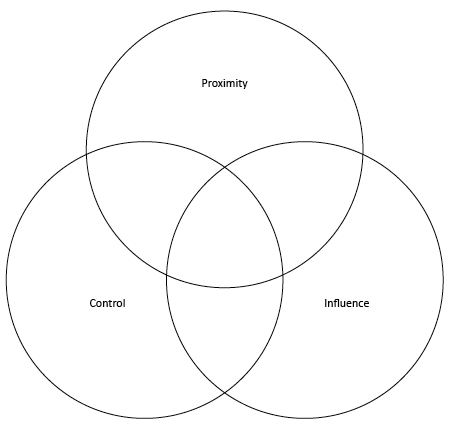
First, a Venn Diagram.

Venn-Diagram

Proximity is physical distance, Influence is the degree to which something directly affects you, and Control is your ability to do something about it.

At the centre, where the spheres intersect, are far-away events that have little effect on your life and that you have no power to control.

This intersection is the news.

News appears to break the rules of sticky marketing. Since the job of media is to sell eyeballs to advertisers, breaking these rules is a bad idea.

What exactly is it that the media sell?

Before we explore this question, here’s a quotation from Hoover Adams, of the Dunn Daily Record, reproduced in Chip and Dan Heath’s Made to Stick:

I’ll bet that if the Daily Record reprinted the entire Dunn telephone directory tonight, half the people would sit down and check it to be sure their name was included.

I don’t need to explain why the New York Times doesn’t print the Manhattan phone directory, or why the Wall Street Journal doesn’t run stories on happenings around my dining room table.

But if the Wall Street Journal did do this, I’d read with keen and active interest.

Local is a hook. Hooks are sticky—our eyeballs get snagged and we can’t turn away.

The most powerful hook is your name. You can’t not read something that has your name in it.

If tomorrow’s New York Times had the headline “Spear Considers Bold Business Move,” I would buy ten copies.

Come to think of it, reprinting the phone directory is likely a good strategy, in an era when news media struggle merely to survive.

Spending your time focused on things far away, well outside the sphere of your life, that you have no power to control, is the path to mental illness.

At the very least, it’s a recipe for gloom, negativity, cynicism, and resignation.

A healthy person’s Venn diagram intersects at nearness, influence, and control—focused on the people and events that they can influence for the better.

In fact, sticky marketing can be condensed into a kindred formula: you must demonstrate how your product, service, or message solves a painful problem of your audience.

No wonder we loathe a media that is forever bringing us bad news from across the world of things we have no power to change.

Worse yet, the bad news from across the world is emotionally charged.

Emotion is a powerful hook.

In fact, it’s one of the six “hooks” of Made to Stick:

1 – Simple
2 – Unexpected
3 – Concrete
4 – Credible
5 – Emotional
6 – Story

This is the answer to our question What exactly do the media sell?

Powerful, emotional hooks. Outrage, scandal, indignation, horror, pathos, fear.

Lacking the prospect of proximity, nearness, and control, these hooks produce mental fatigue and malaise.

Our logical mind recoils. We ask “why exactly are we reading the news?” We come to the realization that the news, in fact, is best ignored.

Perhaps, then, the Internet did not kill Old Media, or at least not in the way we had thought. Perhaps it was all a marketing failure.

What is a brand?

When a brand is owning the thoughts in someone’s head ✎ By Wayne K. Spear

It’s a big question, but the simplest (and, I hope, not simplistic) answer is that a brand is the experience of a customer in the presence of a product.

Have you noticed those smiling, laughing people in Coca-Cola ads? There’s nothing remarkable about water, CO2, and high-fructose corn syrup. Combined, they produce an unexceptional, sugary drink.

But love, belonging, and joy are remarkable. We crave them. So every Coke ad sells them to us. And it’s the same with everything. Every successful brand in history has sold basic human desires—the stuff we’re hard-wired to need and want.

Affection, approval, acceptance, love, security, hope, sex, beauty.

Then, in the 2000s, we began removing the products.

I’m sure you’ve seen that viral post which started at TechCrunch:

Uber, the world’s largest taxi company, owns no vehicles. Facebook, the world’s most popular media owner, creates no content. Alibaba, the most valuable retailer, has no inventory. And Airbnb, the world’s largest accommodation provider, owns no real estate. Something interesting is happening.

Maybe what’s happening is that brand is now entirely separable from product.

There has always been a degree of separation. The product was never the brand. The experience of the customer in the presence of the product was the brand.

Increasingly, however, the product is someone else’s business.

Here’s an interesting way of looking at it, in a Seth Godin post “Templates for organic and viral growth”:

Invent a connection venue or format, but give up some control

Show it can be done, but don’t insist that it be done precisely the same way you did it

Establish a cultural norm

Get out of the way …

Many of Seth’s examples are not businesses, but his description is nonetheless relevant to the TechCrunch post.

The idea is that every time someone wonders “What happened to that girl in high school?” they’ll think Facebook.

Every time someone thinks “I need a cab,” they’ll think Uber.

Every time someone thinks “I’m going to Australia and I need a place to stay,” they’ll think Airbnb.

None of these companies delivers the product or service. They have, as Seth puts it, got out of the way.

Their brand is ownership of a cultural norm—even of a thought itself, as the examples above suggest.

Imagine if every time someone thought about x [“I wonder what happened to my high-school girlfriend”], it evoked your brand [Facebook]. And then a stranger far away produced and delivered the product [your high-school girlfriend, in this example] under the umbrella of your brand.

Instant connection, all unbeknownst to you. And you get paid.

Invent a way for people to connect, show them it can be done, establish it as a cultural norm, and get out of the way.

Branding, 21st-Century style.

Long live the gatekeepers

Gatekeeping is a Unique Value Proposition ✎ By Wayne K. Spear

Content marketers have a big problem.

Over 95% of website visitors aren’t paying attention. They don’t “engage,” they don’t “convert.”

They land on a web page, and they move on.

Ask any marketing pro. You have, at best, five seconds.

1 … 2 … 3 … 4 …

… and they’re gone.

Forever.

It was a case of cosmic improbability that they were ever on your website in the first place. There are hundreds of millions of websites in the world. Every day there are many thousands more.

Every Google keyword search is the spinning of a giant roulette wheel. And keyword searches are what’s driving most traffic to most websites.

This is why we have Internet content marketing.

And it’s getting tougher every day for the marketers, as more online content generates more market fragmentation.

But not really. The Internet is, in fact, tiny.

Tiny?

Yes, tiny—because most of the Internet doesn’t matter. The marketing people have confirmed this, over and again.

We skim and then skip over 99% of it. How much of the Internet do you really use?

Maybe one one-hundredth of one percent?

In reality there are a few major “channels” on the Web, just as there were a few major players in the days of Old Media.

We’re not yet finished sorting out who the big players are going to be, but there will be big players.

And so, our topic today is: the common wisdom is all wrong.

There are still gatekeepers. There are going to be gatekeepers. And gatekeepers matter—maybe, in fact, more than ever. Because the gatekeepers simplify, and make sense out of, the tangled information jungle.

This is the textbook definition of marketing—having a unique value proposition.

Gatekeeping is a Unique Value Proposition.

Google is a gatekeeper. It’s not the only one, but it’s one of them. And we love it because it is a gatekeeper.

How do you cut through the noise? How do you identify and connect with an audience? How do establish your brand in a crowded marketplace?

These are marketing questions, and the answer is: become a gatekeeper.

Plus ça change, plus c’est la même.

Hollywood is for introverts

I used to think my introversion was a cosmic practical joke ✎ By Wayne K. Spear

“Stand against the wall. Now shout your pitch—as loud and fast as you can. Louder. Faster. LOUDER. FASTER.”

I’ll never forget it. I was in North Hollywood, learning how to “do” television from Clint Arthur.

There were about ten of us in the class. A dentist to the stars, bloggers, fitness and beauty experts, a woman who describes herself as America’s favorite lesbian grandmother.

The first day we worked on our pitch, and the second and third we pitched—over and over and over—to daytime television producers across the US, ten hours a day, on Skype.

It was exhausting. But no way was I going to show weakness. I did what I was told, how I was told to do it.

It was a valuable experience, but still it felt ridiculous. And I knew exactly why.

“I’m an introvert,” I said.

“So am I,” Clint replied.

Show business is filled with introverts. Comedians, musicians, motivational speakers—it’s amazing how many of them prefer silence and solitude. Introverts have conquered the world, time and again.

And afterward, they’ve gone home for some welcome peace and quiet.

I used to think my introversion was a cosmic practical joke. I’ve known for a long time that I want to leave my mark on the world—that I want to do something useful and meaningful that makes a difference. I’m driven. It’s what the Greeks called a “daimon”—an inner spirit that compels you to live your life a certain way.

But really I just want to stay at home and read a book. When I say I am an introvert, I mean I am extremely introverted.

I’ve also been on radio and television and on many stages, giving speeches or leading workshops or performing music and plays.

The truth is I couldn’t have done any of these things without reading and introspection and thinking and silence and solitude.

Introversion is another word for “we’re busy getting ready to take over the world.”

Becoming a Question Machine

Questions matter more than answers. If you have the right answers to the wrong questions, you have wrong answers. We’ve all had this kind of wrong answer.

I know I have.

According to James Altucher, action is a subset of an idea. Ideas matter. Maybe that’s why Altucher recommends we become Idea Machines.

I recommend that we become Question Machines, by asking ourselves:

What are my right questions?

My right questions are not your right questions. We are all at the unique intersection of a time and a place.

There are, however, universal questions. A universal question is a question you can ask anyone—a question that is relevant everywhere and at all times:

– What are your regrets?
– What gets you out of bed in the morning?
– What do you think about death?
– You have a time machine. Where are you going?

Today I am giving you my right questions. They also happen to be Bernadette Jiwa’s questions.  I used them to build my business, and it transformed how I thought about my work, and my life.

I was so impressed with the power of these questions that I now use them with my clients, to help them achieve focus in their business.

The results are always powerful.

Bernadette calls this the Difference Map. If you like this, please show her some love.

What I’ve learned by looking at trees

Tree

HAVE YOU EVER WONDERED, as I did recently, what determines the seemingly random pattern of tree branches?

A case of “every which way,” it appears. One branch projects confidently toward the sky—another launches tentatively in one direction, suddenly adopting a new trajectory.

A life is the same.

I know this, because I can see my own life in these branches. That little ragged outgrowth that goes nowhere? That’s a girl I dated in high school. The long, straight branch which stops suddenly? An office job I once had. The fat branch with many small off-shoots? My writing career. The trunk? That represents my upbringing: the formative experiences which established my values, outlook, and dreams.

To this day, my trunk is nourishing the new branches which sprout in my life.

I noticed that there are a lot of dead-ends on a tree: but look at those branches, and you’ll see many outgrowths. Again, I think of the times I’ve come to the end of a path. Maybe it was a goal I didn’t reach, or a job I didn’t get.

When you’re standing at the end of a path you thought and hoped would go farther, you only see  losses and failures—the job you didn’t get, the money you won’t make, and the things you won’t be able to do and have because you won’t get that paycheque.

Looking back, you can see that those endings are in fact launching points, like new shoots from a branch. My first business, which I created in high school, was the result of having the doors to gainful employment shut in my face. Within a month, I had more business than I could manage. I made more money and was far happier than I would have been in a job, but I felt depressed and defeated all the same when my plan to be hired by someone else didn’t work out.

What I learned by looking at trees is that you can reverse engineer the process, applying it to your future. You can look forward as well as back. Today I see “dead-ends” and “failures” as intrinsic to the organic process of creating a path of your own.

A tree is the sum total of its experiments in reaching the light, and rarely (if ever) is this effort a straight line from vision to reality. We humans, however, seem to be addicted to the idea that life works (or at least should work) as follows:

Aspirations ———> A Well-Laid Plan ———> Goal Achieved!

I know this kind of thinking has often been applied by me. Many times, I’ve been disappointed and discouraged because I haven’t been able to draw, and then pursue, a straight line from Point A to Point B. Even when I’ve “known” life is more complicated than that, I’ve acted as if it weren’t.

The prime directive of a tree is to reach the life-giving light. All that apparently crazy, here-there-and-everywhere is in service of the tree’s need for sun. And that’s why I’ve changed my thinking, as well as my way of creating a path.

You see, the tree is on to something—and I think I know what it is.

I’m not talking about creating 10 new businesses or launching 50 new projects. I’m not suggesting you should run, willy-nilly, in every direction. That’s certainly not what I do. Instead, I focus on activating as many potential trajectories in my life as I can, by nourishing relationships in my life and business. Just as the prime directive of a tree is to reach the life-giving light, my prime directive is to nurture my community, every day.

The second thing I do is to introduce as much variety into my life as I can. I take long showers. I go for walks in the woods. I meet with, and talk to, as many interesting people as I can. When I really need to be productive, I get away from my desk.

Because here is the worst way I’ve found to be productive:

Sit at Computer ———> Work Eight Hours ———> Get Results

And yet that’s still how we see work, as a linear process.

The fact is that we are addicted to straight lines and old ways of doing things. I know how hard it is to let go. I’ve made painful adjustments. I used to believe in things like:

Go to School ———> Get An Education ———> Work Hard ———> Succeed

or

Get an Agent ———> Find a Publisher ———> Write Books ———> Make Money

or

Get Hired by a Newspaper ———> File Stories ———> Get Paid ———> Retire

None of these things have worked out as advertised. I’ve only been miserable and unfulfilled pursuing them. It took a painful adjustment, and months of study and effort, to let go of the old ways of thinking. And that was after years of emotional work, gradually getting to the place where I could admit that what I was doing wasn’t working—and would never work.

Going in a new direction is hard. You may have a decade invested in that branch of yours. It may be the favourite branch on your tree. Maybe it’s the only branch. You probably imagined it soaring one day above the canopy, into the full and glorious life-affirming sun of a new day. But what if it doesn’t?

If you build your life on the principle of abundance, each day nurturing a wide network of relationships, being open to many possibilities—sending out many branches—you’ll never have this problem. You’ll soon realize that your life is, like a tree, the sum total of its trajectories, explorations, and so-called “dead-ends.”

A tree, like a life, is nothing less than the sum of its experiments.